The Capstone · Across the eight volumes
Mind map · C-M02
Rome's Enemies as Teachers
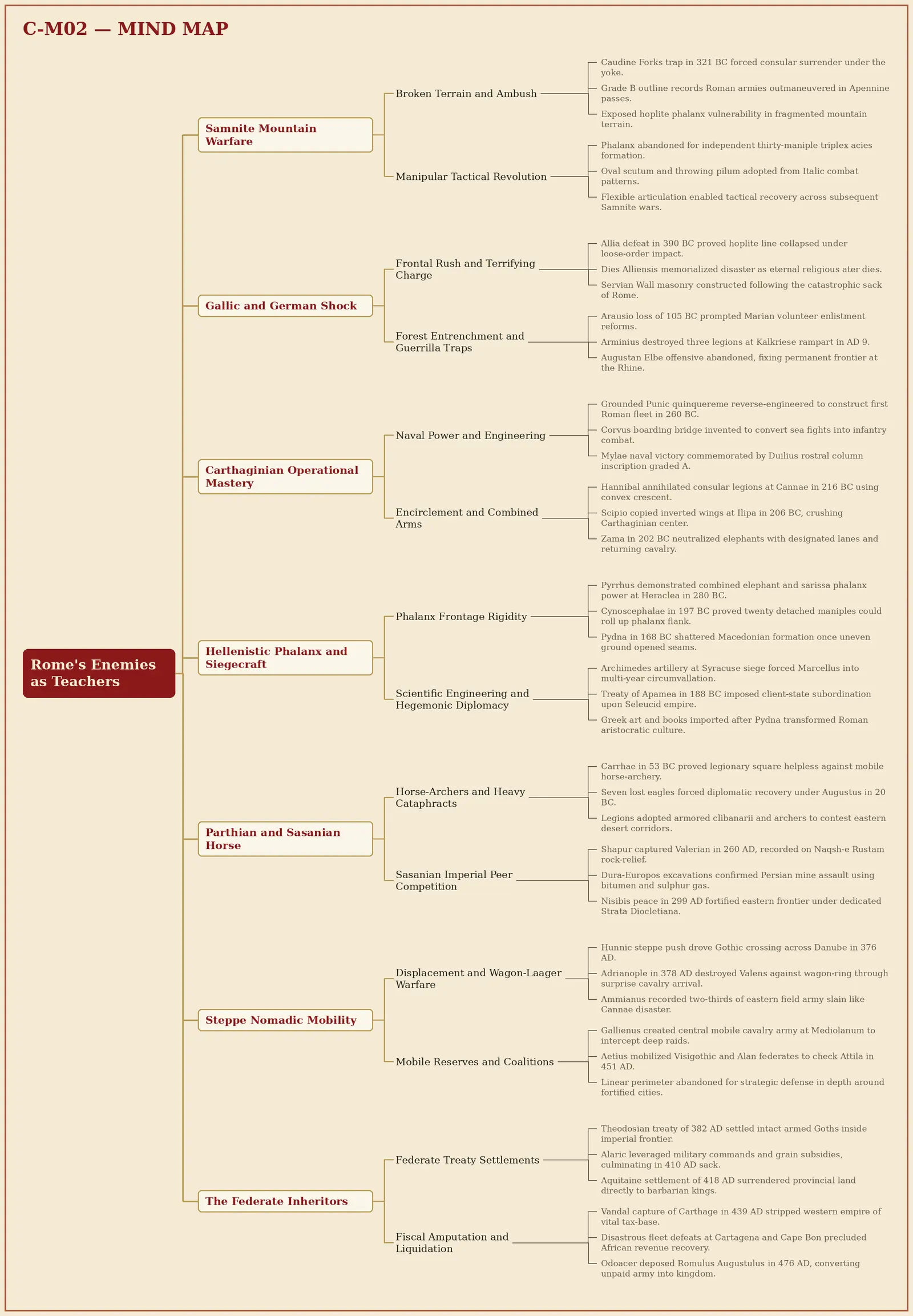
- Samnite Mountain Warfare
- Broken Terrain and Ambush
- Caudine Forks trap in 321 BC forced consular surrender under the yoke.
- BGrade B outline records Roman armies outmaneuvered in Apennine passes.
- Exposed hoplite phalanx vulnerability in fragmented mountain terrain.
- Manipular Tactical Revolution
- Phalanx abandoned for independent thirty-maniple triplex acies formation.
- Oval scutum and throwing pilum adopted from Italic combat patterns.
- Flexible articulation enabled tactical recovery across subsequent Samnite wars.
- Broken Terrain and Ambush
- Gallic and German Shock
- Frontal Rush and Terrifying Charge
- Allia defeat in 390 BC proved hoplite line collapsed under loose-order impact.
- Dies Alliensis memorialized disaster as eternal religious ater dies.
- Servian Wall masonry constructed following the catastrophic sack of Rome.
- Forest Entrenchment and Guerrilla Traps
- Arausio loss of 105 BC prompted Marian volunteer enlistment reforms.
- Arminius destroyed three legions at Kalkriese rampart in AD 9.
- Augustan Elbe offensive abandoned, fixing permanent frontier at the Rhine.
- Frontal Rush and Terrifying Charge
- Carthaginian Operational Mastery
- Naval Power and Engineering
- Grounded Punic quinquereme reverse-engineered to construct first Roman fleet in 260 BC.
- Corvus boarding bridge invented to convert sea fights into infantry combat.
- Mylae naval victory commemorated by Duilius rostral column inscription graded A.
- Encirclement and Combined Arms
- Hannibal annihilated consular legions at Cannae in 216 BC using convex crescent.
- Scipio copied inverted wings at Ilipa in 206 BC, crushing Carthaginian center.
- Zama in 202 BC neutralized elephants with designated lanes and returning cavalry.
- Naval Power and Engineering
- Hellenistic Phalanx and Siegecraft
- Phalanx Frontage Rigidity
- Pyrrhus demonstrated combined elephant and sarissa phalanx power at Heraclea in 280 BC.
- Cynoscephalae in 197 BC proved twenty detached maniples could roll up phalanx flank.
- Pydna in 168 BC shattered Macedonian formation once uneven ground opened seams.
- Scientific Engineering and Hegemonic Diplomacy
- Archimedes artillery at Syracuse siege forced Marcellus into multi-year circumvallation.
- Treaty of Apamea in 188 BC imposed client-state subordination upon Seleucid empire.
- Greek art and books imported after Pydna transformed Roman aristocratic culture.
- Phalanx Frontage Rigidity
- Parthian and Sasanian Horse
- Horse-Archers and Heavy Cataphracts
- Carrhae in 53 BC proved legionary square helpless against mobile horse-archery.
- Seven lost eagles forced diplomatic recovery under Augustus in 20 BC.
- Legions adopted armored clibanarii and archers to contest eastern desert corridors.
- Sasanian Imperial Peer Competition
- Shapur captured Valerian in 260 AD, recorded on Naqsh-e Rustam rock-relief.
- Dura-Europos excavations confirmed Persian mine assault using bitumen and sulphur gas.
- Nisibis peace in 299 AD fortified eastern frontier under dedicated Strata Diocletiana.
- Horse-Archers and Heavy Cataphracts
- Steppe Nomadic Mobility
- Displacement and Wagon-Laager Warfare
- Hunnic steppe push drove Gothic crossing across Danube in 376 AD.
- Adrianople in 378 AD destroyed Valens against wagon-ring through surprise cavalry arrival.
- Ammianus recorded two-thirds of eastern field army slain like Cannae disaster.
- Mobile Reserves and Coalitions
- Gallienus created central mobile cavalry army at Mediolanum to intercept deep raids.
- Aetius mobilized Visigothic and Alan federates to check Attila in 451 AD.
- Linear perimeter abandoned for strategic defense in depth around fortified cities.
- Displacement and Wagon-Laager Warfare
- The Federate Inheritors
- Federate Treaty Settlements
- Theodosian treaty of 382 AD settled intact armed Goths inside imperial frontier.
- Alaric leveraged military commands and grain subsidies, culminating in 410 AD sack.
- Aquitaine settlement of 418 AD surrendered provincial land directly to barbarian kings.
- Fiscal Amputation and Liquidation
- Vandal capture of Carthage in 439 AD stripped western empire of vital tax-base.
- Disastrous fleet defeats at Cartagena and Cape Bon precluded African revenue recovery.
- Odoacer deposed Romulus Augustulus in 476 AD, converting unpaid army into kingdom.
- Federate Treaty Settlements
C-M02 · generated by the Imperium factory studio (gemini-3.8-flash) from all eight volumes under the House Preamble.