Book I · The Republic in Italy
Infographic · I-G03
THE ALLIANCE ENGINE: The Graduated Peninsular Manpower Reservoir (338–264 BC)
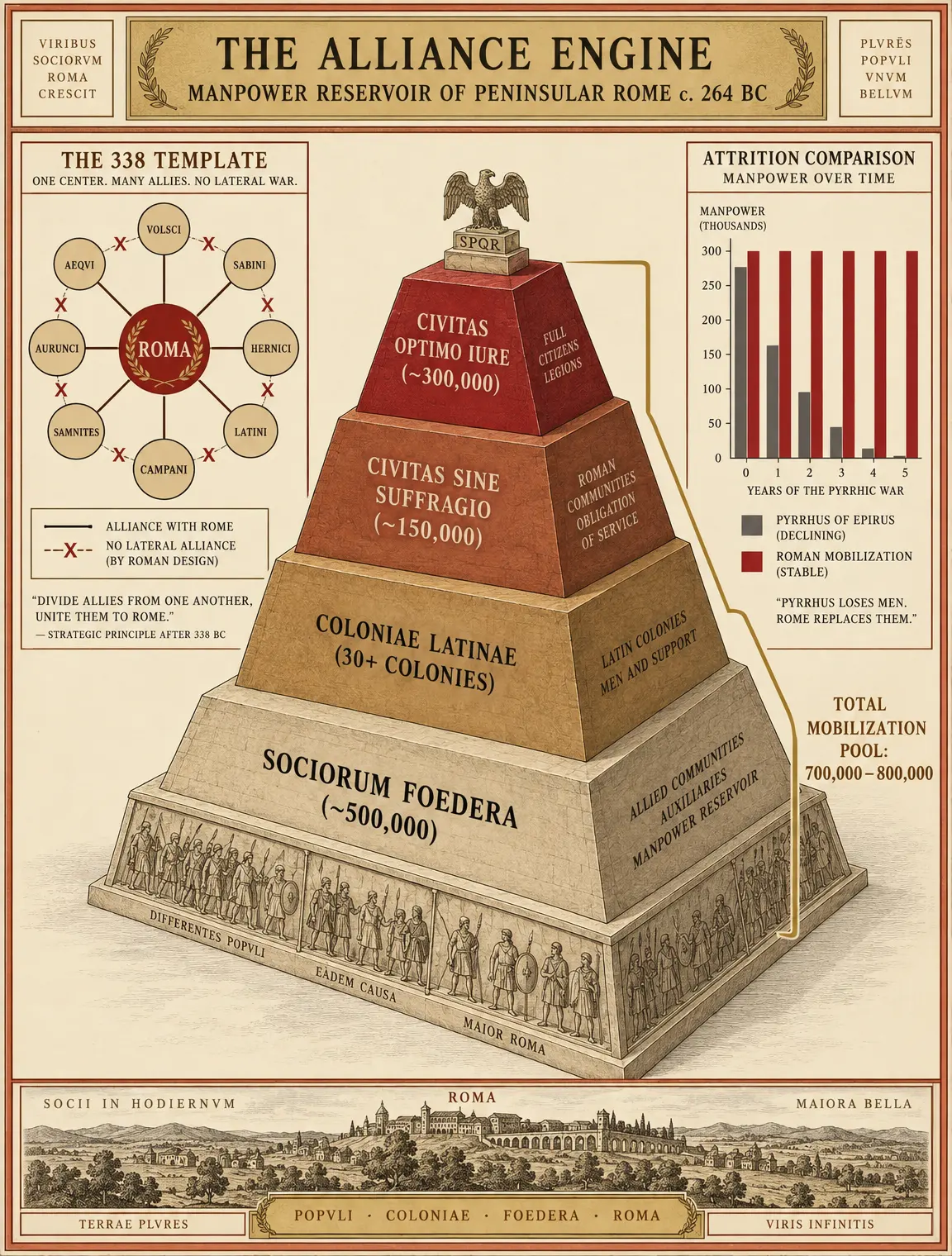
The weapon Pyrrhus discovered — a state that refills.
DESIGN BRIEF: INFOGRAPHIC I-G03
THE ALLIANCE ENGINE: The Graduated Peninsular Manpower Reservoir (338–264 BC)
1. Purpose and Editorial Thesis
This asset diagrams the structural mechanism that transformed Rome from a regional Latin power into an un-exhaustible military hegemony: the graduated alliance and citizenship system initiated in the Latin Settlement of 338 BC and completed by 264 BC. By categorizing peninsular manpower into concentric, legalistic reservoir bands—each bound bilaterally to Rome without lateral links—the Republic built an institutional engine that converted every military conquest into an expanded recruitment base. The diagram visually demonstrates the operational reality discovered by Pyrrhus of Epirus between 280 and 275 BC: Rome was an adversary whose tactical defeats (Heraclea, Asculum) produced zero strategic depletion, because its demographic reservoir refilled annually while Hellenistic mercenary armies decayed.
2. Layout and Architecture (Vertical Format 3:4)
The graphic is structured into five integrated zones within an archival border:
-
Header Cartouche (Top 8%):
- Series header:
IMPERIUM ROMANUM · BOOK I · THE REPUBLIC IN ITALY - Plate title:
THE ALLIANCE ENGINE · MANPOWER RESERVOIR OF PENINSULAR ROME c. 264 BC - Subtitle:
The Architecture of Graduated Hegemony from the Latin Settlement to the Eve of the Punic Wars
- Series header:
-
The Central Reservoir Pyramid (Center 55%): A stepped, four-tier ascending reservoir vessel with graduated liquid-fill hatching, displaying the demographic stratification of peninsular fighting manpower:
- Apex Tier (Crimson #8B1A1A):
CIVITAS OPTIMO IURE(Full Roman Citizens)- Quant:
~300,000 ADULT MALES[BGrade B: The tradition's census arithmetic] - Role: Core consular legions, political franchise, centuriate assembly service.
- Quant:
- Upper-Mid Tier (Deep Terracotta #A85638):
CIVITAS SINE SUFFRAGIO(Citizenship Without Franchise)- Quant:
~150,000 ADULT MALES[BGrade B] - Territory: Campanians (Capua), Sabines (pre-268), Volscians.
- Role: Legionary service, legal protection under Roman law, zero voting rights.
- Quant:
- Lower-Mid Tier (Punic Ochre #B5824A):
COLONIAE LATINAE & NOMEN LATINUM(Latin Colonies & Latin Rights)- Quant: Strategic forward garrisons (
30+ FOUNDATIONS) [AGrade A: Epigraphic & Fasti] - Sites: Cales (334), Luceria (314), Beneventum (268), Ariminum (268), Paestum (273).
- Role: Demographic locks, strategic hubs, equal military contingents.
- Quant: Strategic forward garrisons (
- Base Tier (Pale Sepia / Sand #D9C5A0):
SOCIORUM FOEDERA(Italian Allied Cantons & Federated Greeks)- Quant:
~500,000 ADULT MALES[CGrade C: Retrospective Polybian estimate] - Groups: Samnite cantons (Pentri, Hirpini, Caudini), Lucanians, Bruttians, Greek naval cities (civitates foederatae).
- Role: Auxiliary alae, cavalry contingents, naval vessels (navales socii).
- Quant:
- Total Mobilization Bracket: Surrounding the entire pyramid, a bold bracket annotates:
TOTAL MOBILIZATION POOL: 700,000–800,000 FIGHTING MEN[BGrade B: Annalistic consensus via Polybius].
- Apex Tier (Crimson #8B1A1A):
-
Left Column: Institutional Mechanics (Width 22%, Mid-Left):
- Subhead:
THE 338 TEMPLATE: BILATERAL ISOLATION - Schematic glyph: Rome at center hub with radial arrows to isolated allied nodes; lateral lines crossed out with red negation hashes.
- Explanatory note:
"Every city bound to the center, none to each other. Graduated obligations; zero horizontal solidarity." [BGrade B] - Land area breakdown:
Direct Roman Ager: ~25,000 km²[BGrade B]Allied & Federated: ~110,000 km²[BGrade B]Total Peninsular Sphere: ~135,000 km²[BGrade B]
- Subhead:
-
Right Column: The Pyrrhic Paradox (Width 22%, Mid-Right):
- Subhead:
THE WEAPON PYRRHUS ENCOUNTERED (280–275 BC) - Comparative attrition meter:
PYRRHUS (HELLENISTIC EXPEDITION): Iron-grey bar dropping from 25,500 effectives (280 BC) to ~8,500 survivors (275 BC). Zero domestic refill."One more such victory will ruin us." [BGrade B]ROME & THE ITALIAN ENGINE: Crimson bar remaining level across 280–275 BC. Absorbed 7,000 dead at Heraclea and 6,000 at Asculum; fielded two fresh consular armies each spring without depleting the base pool.
- Subhead:
-
Footer & Epigraphic Apparatus (Bottom 15%):
- Epigraphic baseline:
PRIMARY ATTESTATION & SOURCES: Livy 8–10 (T2/BGrade B); Polybius 1.6, 2.24 (T2/BGrade B); Fasti Triumphales (T1/AGrade A); CIL VI inscriptions (T1/AGrade A). - Methodological note:
"All demographic figures represent the tradition's arithmetic as recorded in late annalistic and Polybian summaries; exact modern census counts remain contested. The institutional framework (optimo iure, sine suffragio, socii) is epigraphically secure (AGrade A)."
- Epigraphic baseline:
3. Palette and Typography
- Canvas Ground: Aged cream parchment
#F4EBD5 - Framing & Accents: Terracotta
#A85638with double ruled lines - Titling & Cartouches: Dull burnished gold
#B89954 - Apex Layer (Citizens): Tyrian / Roman crimson
#8B1A1A - Intermediate Layers (Sub-citizens/Colonies): Punic ochre
#B5824Aand warm terracotta#A85638 - Base Layer (Allies): Pale antique sand
#D9C5A0with sepia hatchings - Adversary Data (Pyrrhus comparison): Dark slate iron-grey
#4A4E51 - Lettering: Clean, high-legibility classical epigraphic serif (Trajan/Baskerville type). Every text block spelled out exactly as specified.
Image prompt (3:4)
A detailed technical infographic diagram in the historical staff-college and antiquarian atlas style, titled 'THE ALLIANCE ENGINE: MANPOWER RESERVOIR OF PENINSULAR ROME c. 264 BC'. Background in cream (#F4EBD5) bordered with a precise terracotta (#A85638) architectural rule and a gold (#B89954) header cartouche. In the center, a stepped four-tiered manpower reservoir pyramid drawn in clear isometric projection: apex in Roman crimson (#8B1A1A) labeled 'CIVITAS OPTIMO IURE (~300,000)', upper-middle tier in terracotta (#A85638) labeled 'CIVITAS SINE SUFFRAGIO (~150,000)', lower-middle tier in ochre (#B5824A) labeled 'COLONIAE LATINAE (30+ COLONIES)', and wide base tier in pale sepia (#D9C5A0) labeled 'SOCIORUM FOEDERA (~500,000)'. A gold callout bracket encloses the pyramid with 'TOTAL MOBILIZATION POOL: 700,000–800,000'. On the left side, a clean hub-and-spoke schematic labeled 'THE 338 TEMPLATE' showing radial spokes connecting Rome to isolated allied circles with crossed-out lateral lines. On the right side, an attrition bar chart comparing 'PYRRHUS OF EPIRUS' in iron-grey declining sharply against 'ROMAN MOBILIZATION' in crimson remaining flat. Clean serif lettering, all labels in sharp legible uppercase print with quotation marks where specified, elegant historical map engraver aesthetic, no modern graphical clutter.
I-G03 · generated by the Imperium factory studio (gemini-3.8-flash) from Book I under the House Preamble.