Book I · The Republic in Italy
Mind map · I-M01
The Roman Recovery System (390–264 BC)
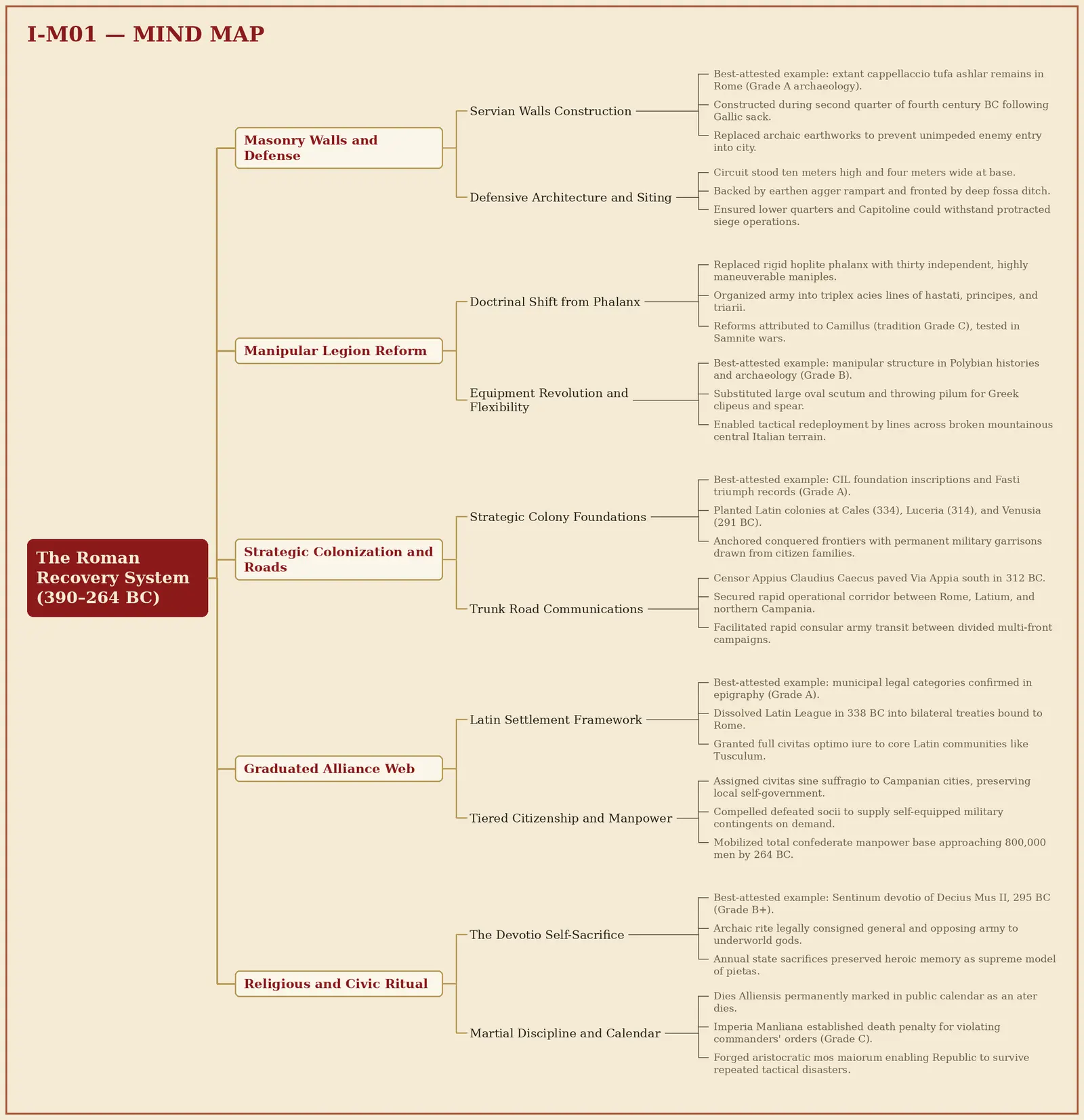
- Masonry Walls and Defense
- Servian Walls Construction
- Best-attested example: extant cappellaccio tufa ashlar remains in Rome (AGrade A archaeology).
- Constructed during second quarter of fourth century BC following Gallic sack.
- Replaced archaic earthworks to prevent unimpeded enemy entry into city.
- Defensive Architecture and Siting
- Circuit stood ten meters high and four meters wide at base.
- Backed by earthen agger rampart and fronted by deep fossa ditch.
- Ensured lower quarters and Capitoline could withstand protracted siege operations.
- Servian Walls Construction
- Manipular Legion Reform
- Doctrinal Shift from Phalanx
- Replaced rigid hoplite phalanx with thirty independent, highly maneuverable maniples.
- Organized army into triplex acies lines of hastati, principes, and triarii.
- Reforms attributed to Camillus (tradition CGrade C), tested in Samnite wars.
- Equipment Revolution and Flexibility
- Best-attested example: manipular structure in Polybian histories and archaeology (BGrade B).
- Substituted large oval scutum and throwing pilum for Greek clipeus and spear.
- Enabled tactical redeployment by lines across broken mountainous central Italian terrain.
- Doctrinal Shift from Phalanx
- Strategic Colonization and Roads
- Strategic Colony Foundations
- Best-attested example: CIL foundation inscriptions and Fasti triumph records (AGrade A).
- Planted Latin colonies at Cales (334), Luceria (314), and Venusia (291 BC).
- Anchored conquered frontiers with permanent military garrisons drawn from citizen families.
- Trunk Road Communications
- Censor Appius Claudius Caecus paved Via Appia south in 312 BC.
- Secured rapid operational corridor between Rome, Latium, and northern Campania.
- Facilitated rapid consular army transit between divided multi-front campaigns.
- Strategic Colony Foundations
- Graduated Alliance Web
- Latin Settlement Framework
- Best-attested example: municipal legal categories confirmed in epigraphy (AGrade A).
- Dissolved Latin League in 338 BC into bilateral treaties bound to Rome.
- Granted full civitas optimo iure to core Latin communities like Tusculum.
- Tiered Citizenship and Manpower
- Assigned civitas sine suffragio to Campanian cities, preserving local self-government.
- Compelled defeated socii to supply self-equipped military contingents on demand.
- Mobilized total confederate manpower base approaching 800,000 men by 264 BC.
- Latin Settlement Framework
- Religious and Civic Ritual
- The Devotio Self-Sacrifice
- Best-attested example: Sentinum devotio of Decius Mus II, 295 BC (B+Grade B+).
- Archaic rite legally consigned general and opposing army to underworld gods.
- Annual state sacrifices preserved heroic memory as supreme model of pietas.
- Martial Discipline and Calendar
- Dies Alliensis permanently marked in public calendar as an ater dies.
- Imperia Manliana established death penalty for violating commanders' orders (CGrade C).
- Forged aristocratic mos maiorum enabling Republic to survive repeated tactical disasters.
- The Devotio Self-Sacrifice
I-M01 · generated by the Imperium factory studio (gemini-3.8-flash) from Book I under the House Preamble.