Book I · The Republic in Italy
Mind map · I-M03
How We Know Book I
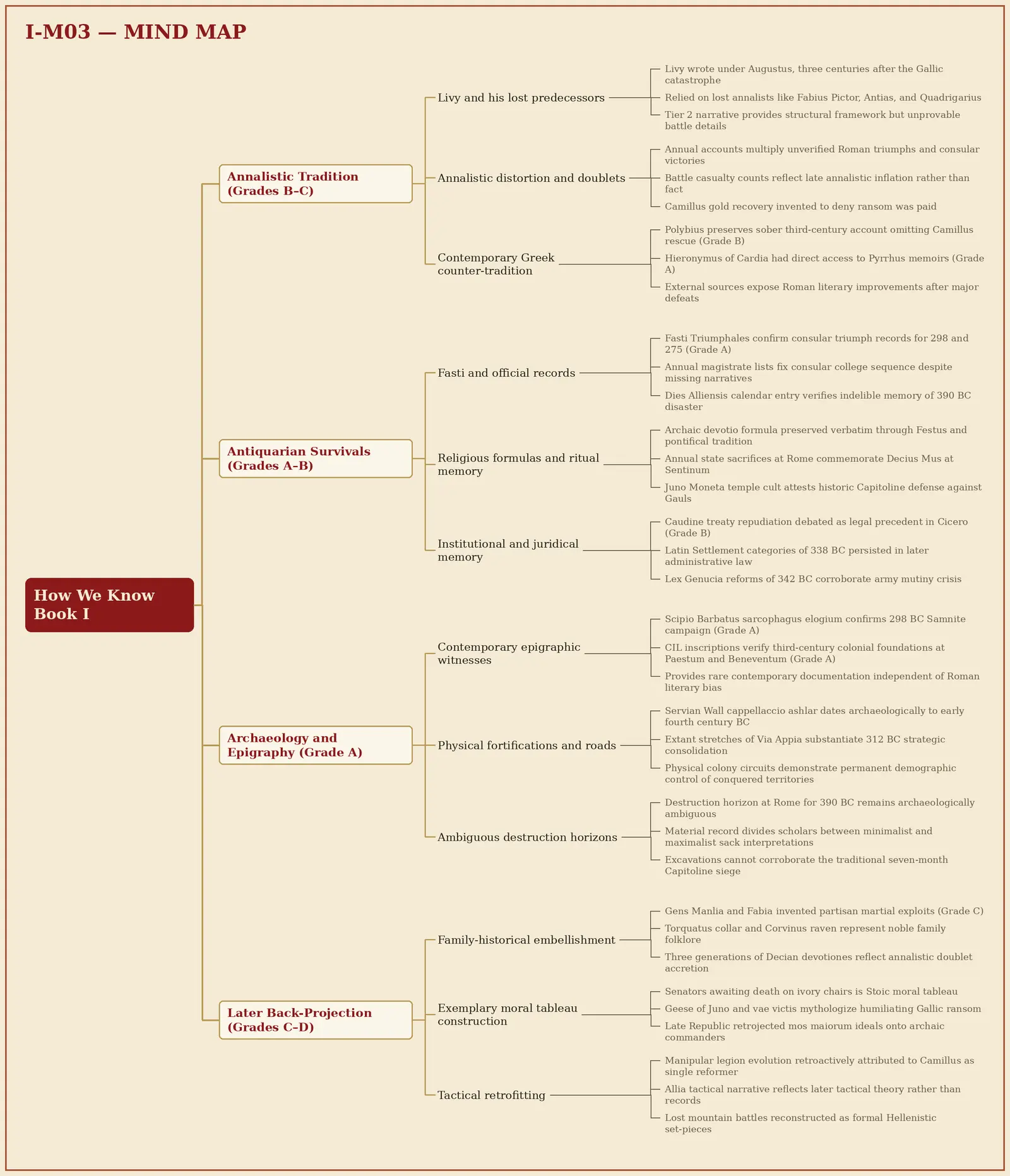
- Annalistic Tradition (Grades B–C)
- Livy and his lost predecessors
- Livy wrote under Augustus, three centuries after the Gallic catastrophe
- Relied on lost annalists like Fabius Pictor, Antias, and Quadrigarius
- Tier 2 narrative provides structural framework but unprovable battle details
- Annalistic distortion and doublets
- Annual accounts multiply unverified Roman triumphs and consular victories
- Battle casualty counts reflect late annalistic inflation rather than fact
- Camillus gold recovery invented to deny ransom was paid
- Contemporary Greek counter-tradition
- Polybius preserves sober third-century account omitting Camillus rescue (BGrade B)
- Hieronymus of Cardia had direct access to Pyrrhus memoirs (AGrade A)
- External sources expose Roman literary improvements after major defeats
- Livy and his lost predecessors
- Antiquarian Survivals (Grades A–B)
- Fasti and official records
- Fasti Triumphales confirm consular triumph records for 298 and 275 (AGrade A)
- Annual magistrate lists fix consular college sequence despite missing narratives
- Dies Alliensis calendar entry verifies indelible memory of 390 BC disaster
- Religious formulas and ritual memory
- Archaic devotio formula preserved verbatim through Festus and pontifical tradition
- Annual state sacrifices at Rome commemorate Decius Mus at Sentinum
- Juno Moneta temple cult attests historic Capitoline defense against Gauls
- Institutional and juridical memory
- Caudine treaty repudiation debated as legal precedent in Cicero (BGrade B)
- Latin Settlement categories of 338 BC persisted in later administrative law
- Lex Genucia reforms of 342 BC corroborate army mutiny crisis
- Fasti and official records
- Archaeology and Epigraphy (AGrade A)
- Contemporary epigraphic witnesses
- Scipio Barbatus sarcophagus elogium confirms 298 BC Samnite campaign (AGrade A)
- CIL inscriptions verify third-century colonial foundations at Paestum and Beneventum (AGrade A)
- Provides rare contemporary documentation independent of Roman literary bias
- Physical fortifications and roads
- Servian Wall cappellaccio ashlar dates archaeologically to early fourth century BC
- Extant stretches of Via Appia substantiate 312 BC strategic consolidation
- Physical colony circuits demonstrate permanent demographic control of conquered territories
- Ambiguous destruction horizons
- Destruction horizon at Rome for 390 BC remains archaeologically ambiguous
- Material record divides scholars between minimalist and maximalist sack interpretations
- Excavations cannot corroborate the traditional seven-month Capitoline siege
- Contemporary epigraphic witnesses
- Later Back-Projection (Grades C–D)
- Family-historical embellishment
- Gens Manlia and Fabia invented partisan martial exploits (CGrade C)
- Torquatus collar and Corvinus raven represent noble family folklore
- Three generations of Decian devotiones reflect annalistic doublet accretion
- Exemplary moral tableau construction
- Senators awaiting death on ivory chairs is Stoic moral tableau
- Geese of Juno and vae victis mythologize humiliating Gallic ransom
- Late Republic retrojected mos maiorum ideals onto archaic commanders
- Tactical retrofitting
- Manipular legion evolution retroactively attributed to Camillus as single reformer
- Allia tactical narrative reflects later tactical theory rather than records
- Lost mountain battles reconstructed as formal Hellenistic set-pieces
- Family-historical embellishment
I-M03 · generated by the Imperium factory studio (gemini-3.8-flash) from Book I under the House Preamble.