Infographic · III-G02
The Scipio Gambit: Spain as the Decisive Flank (209–202 BC)
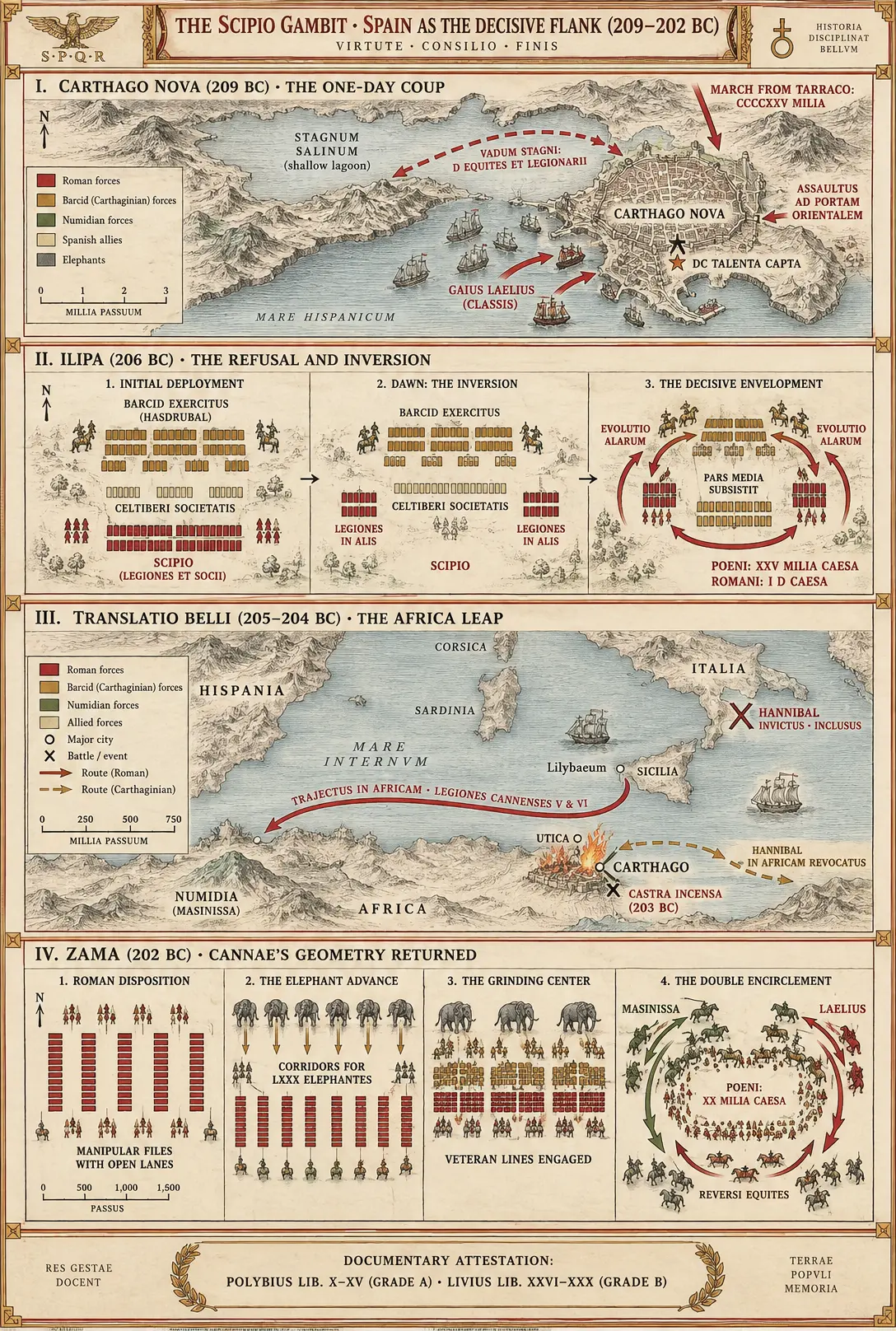
The Scipio Gambit (209–202 BC): how the Spanish command, the tactical inversion of Cannae at Ilipa, and the indirect African offensive dismantled Carthaginian hegemony.
INFOGRAPHIC DESIGN BRIEF: THE SCIPIO GAMBIT (III-G02)
Series: IMPERIUM ROMANUM — Book III: The Long War (216–202 BC)
Asset Code: III-G02
Topic: Publius Cornelius Scipio's operational architecture from the assault on Carthago Nova to the tactical inversion of Cannae at Ilipa, the strategic leap to Africa, and the final encirclement at Zama.
Format: Four-panel vertical operational progression with staff-history metadata plate.
1. Strategic Concept & Thesis
Between Cannae (216 BC) and Zama (202 BC), Rome broke the strategic stalemate in Italy not by confronting Hannibal in set-piece battle, but by institutional mobilization across secondary theaters. Publius Cornelius Scipio transformed the war through an operational sequence: cutting the Carthaginian fiscal-recruitment base in Iberia, bypassing senatorial containment doctrine via the African expedition, and inverting Hannibalic tactical geometry to destroy the Carthaginian army on home soil.
2. Palette Architecture
- Background (Base): Aged Cream Parchment (
#F4EBD5) - Roman Formations & Maneuver Arcs: Consular Crimson (
#8B1A1A) - Punic Forces & Fortifications: Barcid Ochre (
#B5824A) - Numidian Cavalry (Roman-allied): Bronze-Green (
#5A6B3A) - Spanish Levies (Contested/Allied): Pale-Buff (
#E2D2B5) - Elephants & Physical Infrastructure: Iron-Grey (
#4A4A4A) - Borders & Dividers: Terracotta (
#A85638) - Titling & Cartouches: Muted Imperial Gold (
#B89954)
3. Panel-by-Panel Architecture
+-------------------------------------------------------------------+
|  BANNER: THE SCIPIO GAMBIT · SPAIN AS THE DECISIVE FLANK          |
+-------------------------------------------------------------------+
|  PANEL I: CARTHAGO NOVA (209 BC) — THE ONE-DAY COUP               |
|  - 425-mile coastal march from Tarraco (7 days)                  |
|  - East gate assault (feint) & low-tide northern lagoon escalade |
|  - Strategic seizure: 600 talents, 18 warships, Iberian hostages  |
+-------------------------------------------------------------------+
|  PANEL II: ILIPA (206 BC) — THE REFUSAL AND INVERSION             |
|  - Daily deployment habituation vs. Dawn inversion               |
|  - Refused Spanish center (pale-buff) holding Punic veterans     |
|  - Wing double-envelopment: column-extension-wheel               |
+-------------------------------------------------------------------+
|  PANEL III: TRANSLATIO BELLI (205–204 BC) — THE AFRICA ARROW      |
|  - Senate debate: Fabian containment vs. Scipionic diversion     |
|  - Force: 5th & 6th 'Cannae' Legions + 7,000 Italian volunteers   |
|  - Camps burned (203 BC) & Hannibal's strategic recall           |
+-------------------------------------------------------------------+
|  PANEL IV: ZAMA (202 BC) — CANNAE'S GEOMETRY RETURNED             |
|  - Corridors through hastati/principes/triarii for 80 elephants   |
|  - Wing cavalry superiority: Masinissa & Laelius sweep field     |
|  - Veteran clash in center; cavalry returns to close the rear     |
+-------------------------------------------------------------------+
|  METADATA PLATE: Source attestation, casualty tables, grades      |
+-------------------------------------------------------------------+
4. Text & Tactical Content by Panel (Verbatim Labels)
Header
- Primary Title:
THE SCIPIO GAMBIT - Subtitle:
Operational Architecture of the Peripheral Offensive (209–202 BC) - Series Reference:
IMPERIUM ROMANUM · VOLUME III: THE LONG WAR
Panel I: CARTHAGO NOVA (Spring 209 BC) — "The One-Day Coup"
- Operational Scheme: Schematic map of the Carthago Nova peninsula, natural harbor, eastern land bridge, and northern shallow lagoon (stagnum).
- Tactical Indicators:
MARCH FROM TARRACO: CCCCXXV MILIA PASSUUM IN VII DIEBUS(Consular Crimson route arrow along coast).FRONTAL ASSAULT: GAIUS LAELIUS (CLASSIS) & LEGIONES(Crimson arrow attacking eastern land gate and harbor seawall).VADUM STAGNI: D PICKED LEGIONARIES WADING AT LOW EBB(Dashed Crimson infiltration arrow cutting north lagoon to ungarrisoned rampart).PUNISHER & TREASURY: DC TALENTA · XVIII NAVES LONGAE · X MILIA CAPTIVORUM(Barcid Ochre capture star).OBSIDUM LIBERATIO: Spanish tribal hostages freed without ransom, collapsing Barcid diplomatic control.
- Data & Historiographical Hedge:
- "Tactical narrative AGrade A (Polybius 10.6–15 via Laelius memoirs)."
- "The 'Continence of Scipio' (Allucius betrothal) graded C: Hellenistic moral topos / unverified tradition."
Panel II: ILIPA (Spring 206 BC) — "The Refusal and Inversion"
- Operational Scheme: 3-step deployment and evolution diagram on the Baetis plain.
- Step 1 (Habituation): Days of identical skirmishing. Punic array: Hasdrubal Gisgo & Mago (African/Iberian veterans center in ochre, Spanish levies wings). Roman array: Legions center, Spanish allies wings.
- Step 2 (The Inversion at Dawn): Roman legions fed in darkness, deployed on wings; Spanish allies (
CELTIBERI SOCIETATIS, pale-buff) deployed in center. Punic host deployed unbreakfasted into fixed mirror. - Step 3 (The Refusal & Pincer):
- Center Refusal:
PARS MEDIA SUBSISTIT(Roman-allied center holds fast at slow march, pinning veteran Africans without contact). - Wing Decimation:
EVOLUTIO ALARUM(Legions execute wheel maneuver into raw Punic wings). CIRCUMLATIO: Victorious Roman wings fold inwards around isolated Carthaginian center.
- Center Refusal:
- Losses Plate (AGrade A, Polybius 11.20–24):
POENI: XXV MILIA CAESA · XXV MILIA CAPTA(50,000 lost from 54,500 total).ROMANI: I D CAESA(~1,500 Roman casualties).RESULT: GADES CAPTA · HISPANIA AMISSA(Total Punic collapse in Spain).
Panel III: TRANSLATIO BELLI (205–204 BC) — "The Strategic Lever"
- Operational Scheme: Strategic theater map of Western Mediterranean showing the shift from Italy to North Africa.
- Strategic Axis:
BRUTTIUM CONTAINMENT: Hannibal isolated (INVICTUS · INCLUSUS).THE SENATORIAL CLASH: Fabius Maximus (attrition/containment) vs. Scipio (indirect strike at Africa). Senate refuses general levy.EXERCITUS CANNENSIS: Legiones V & VI (disgraced Cannae survivors, 9 years Sicilian exile) + 7,000 Italian volunteers form expeditionary core.TRAJECTUS IN AFRICAM: 25,000 infantry, 2,500 cavalry sail from Lilybaeum to Cape Farina (204 BC).THE SPARK AT UTICA (203 BC): Night assault and burning of reed camps (CASTRA INCENSA). Punic-Numidian losses: ~40,000 dead (Polybius; modern critical consensus hedges at 25,000–30,000).EVOCATIO HANNIBALIS: Carthaginian Senate recalls Hannibal; seventeen-year Italian campaign abandoned without set-piece defeat.
Panel IV: ZAMA (October 202 BC) — "Cannae's Geometry Returned"
- Operational Scheme: Four-stage tactical breakdown of the battle at Naraggara/Zama.
- Phase 1 (The Open Lanes): Maniples aligned in direct file columns rather than quincunx.
LANES OPENED FOR LXXX ELEPHANTES. Velites draw charges down empty lanes; horn blasts panic beasts into Punic flanks. - Phase 2 (The Cavalry Decoupling):
- Right Wing:
MASINISSA · IV MILIA EQUITUM NUMIDORUMdrives Tychaeus off-field. - Left Wing:
GAIUS LAELIUS · II MILIA EQUITUM ROMANORUMbreaks Carthaginian heavy horse.
- Right Wing:
- Phase 3 (The Veteran Collision):
- Mercenary 1st line breaks into panicking Carthaginian citizen 2nd line.
- Hannibal's 3rd line (12,000 Italian veterans held 200 paces back) extends line against reorganized single-front Roman line (hastati center, principes/triarii wings).
- Phase 4 (The Rear Strike):
REVERSI EQUITES: Masinissa and Laelius return simultaneously into the rear of the Punic 3rd line.- Encirclement complete: Cannae's closing pocket delivered upon its creator.
- Losses Plate (AGrade A, Polybius 15.14):
POENI: XX MILIA CAESA · XX MILIA CAPTA.ROMANI: I D CAESA · IV MILIA VULNERATA.
Footer & Metadata Cartouche
TEXTUAL BASIS: Polybius Books 10, 11, 14, 15 (AGrade A); Livy Books 26, 28, 30 (BGrade B); Appian Punica (CGrade C).THESIS SUMMARY: Rome won the Hannibalic War not by matching Barcid tactical genius in Italy, but by generating an operational system that detached the enemy's resources, transposed the theater of war, and turned the tactics of Cannae against Carthage herself.
Image prompt (2:3)
A complete, finished military-historical infographic plate titled 'THE SCIPIO GAMBIT · SPAIN AS THE DECISIVE FLANK (209–202 BC)', designed in the authoritative style of a 19th-century general staff tactical atlas. The composition is set on an aged cream parchment background (#F4EBD5) bordered by a slim terracotta geometric frame (#A85638) with muted gold corner clasps (#B89954). The layout is organized vertically into four distinct tactical panels separated by thin terracotta rule lines, topped by a formal gilded banner and anchored at the bottom by an attestation metadata plate. Palette strictly limited: Roman Crimson (#8B1A1A) for Roman forces, Barcid Ochre (#B5824A) for Carthaginian forces, Bronze-Green (#5A6B3A) for Masinissa's Numidians, Pale-Buff (#E2D2B5) for Spanish allies, Iron-Grey (#4A4A4A) for terrain and elephant units, with crisp black-ink typography and serif labeling throughout. Panel I, 'CARTHAGO NOVA (209 BC) · THE ONE-DAY COUP', shows a clean topographic plan of the Cartagena peninsula and lagoon: a crimson arrow labeled 'MARCH FROM TARRACO: CCCCXXV MILIA' leads to the city, with a naval attack marked 'GAIUS LAELIUS' at the harbor, a frontal assault at the east gate, and a dashed crimson arrow marked 'VADUM STAGNI: D EQUITES ET LEGIONARII' traversing the northern shallow lagoon to breach the wall; an ochre star marks 'DC TALENTA CAPTA'. Panel II, 'ILIPA (206 BC) · THE REFUSAL AND INVERSION', illustrates three progressive line-deployment diagrams: the initial deployment, the dawn inversion with crimson legions on the wings and pale-buff 'CELTIBERI SOCIETATIS' in the center, and the decisive envelopment where the center is marked 'PARS MEDIA SUBSISTIT' while the crimson wings execute 'EVOLUTIO ALARUM' to crush the Punic flanks, with casualty figures 'POENI: XXV MILIA CAESA' in ochre and 'ROMANI: I D CAESA' in crimson. Panel III, 'TRANSLATIO BELLI (205–204 BC) · THE AFRICA LEAP', displays a strategic map of the central Mediterranean with Hannibal marked 'INVICTUS · INCLUSUS' in Bruttium, crossed out by a long sweeping crimson arrow labeled 'TRAJECTUS IN AFRICAM · LEGIONES CANNENSES V & VI' vaulting from Lilybaeum to Utica; near Carthage, flame glyphs signify 'CASTRA INCENSA (203 BC)' with an ochre retreat arrow showing Hannibal's recall. Panel IV, 'ZAMA (202 BC) · CANNAE'S GEOMETRY RETURNED', presents a four-tier battle diagram showing Roman manipular files aligned in vertical columns to create open lanes labeled 'CORRIDORS FOR LXXX ELEPHANTES', cavalry sweeps on the flanks by 'MASINISSA' and 'LAELIUS', the grinding center clash of veteran lines, and the decisive double cavalry charge striking the Punic rear marked 'REVERSI EQUITES', enclosing the Punic center in an annihilation pocket labeled 'POENI: XX MILIA CAESA'. At the bottom, a crisp metadata plate in gold and black text reads 'DOCUMENTARY ATTESTATION: POLYBIUS LIB. X–XV (GRADE A) · LIVIUS LIB. XXVI–XXX (GRADE B)'. Highly legible serif lettering, precise geometric troop blocks, no modern photographic elements, purely authentic hand-engraved cartographic register.
III-G02 · generated by the Imperium factory studio (gemini-3.8-flash) from Book III under the House Preamble.