Book IV · The Wars of Mediterranean Hegemony
Infographic · IV-G01
EIGHTEEN INCHES — Gladius vs. Sarissa and the Mechanics of Infiltration
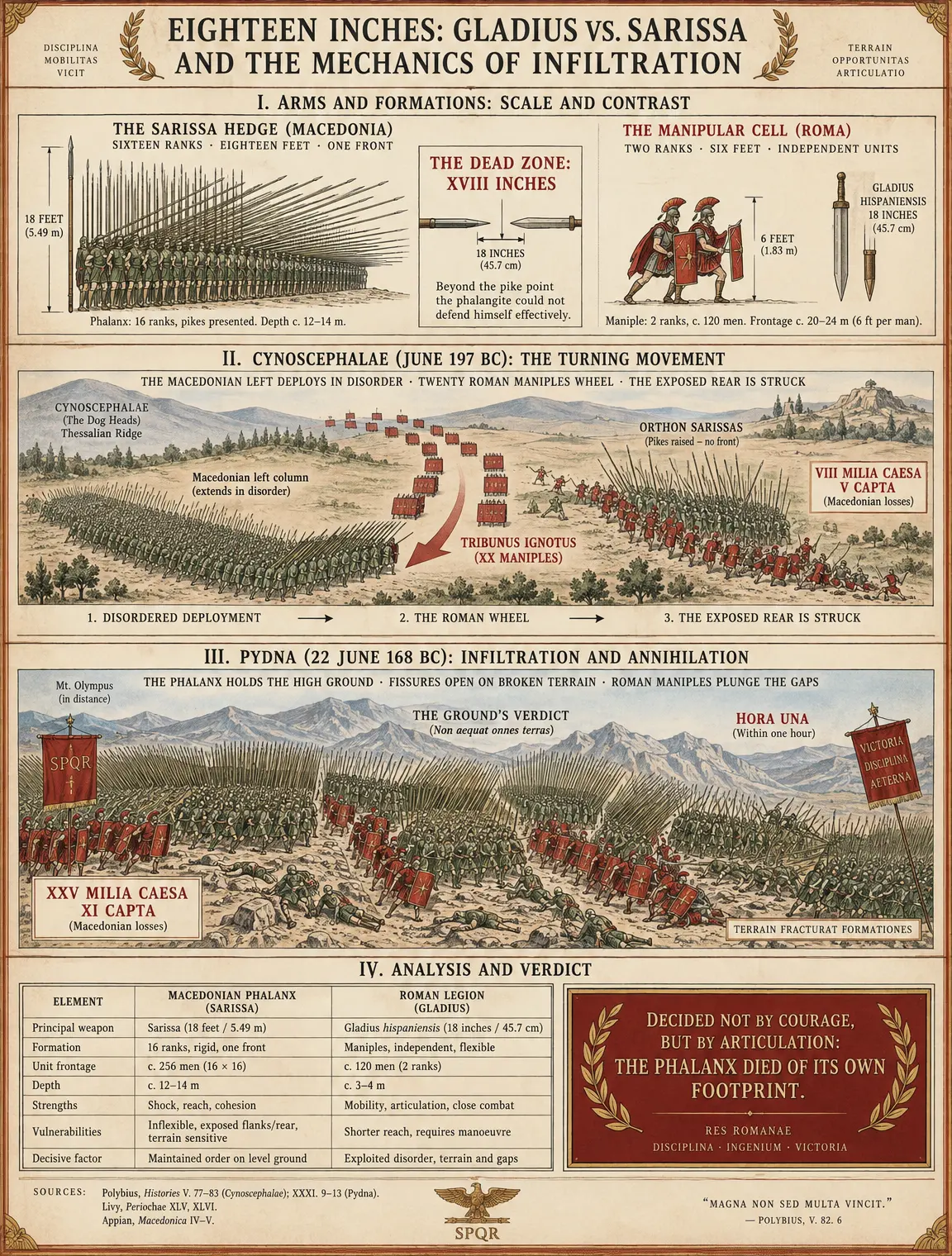
The phalanx died of its own footprint: how the eighteen-inch gladius penetrated the eighteen-foot sarissa at Cynoscephalae and Pydna.
INFOGRAPHIC IV-G01: EIGHTEEN INCHES
(Gladius vs. Sarissa Mechanics: Cynoscephalae 197 BC and Pydna 168 BC)
PURPOSE
To provide an attestation-graded, staff-history mechanical analysis demonstrating why the Hellenistic Macedonian phalanx was structurally dismantled by the Roman manipular legion. The plate visually contrasts the spatial physics of weapon systems (the eighteen-foot sarissa versus the eighteen-inch gladius hispaniensis) and demonstrates the mechanics of tactical infiltration at Cynoscephalae (197 BC) and Pydna (168 BC), establishing the volume thesis: the phalanx died of its own footprint, decided not by courage but by articulation.
PALETTE SPECIFICATION
- Ground: Pale archival cream (#F4EBD5)
- Roman Elements: Imperial crimson (#8B1A1A)
- Hellenistic / Macedonian Elements: Bronze-green (#5A6B3A) and Iron-grey (#4A4E51)
- Punic / Auxiliary Accents: Warm ochre (#B5824A)
- Borders and Rules: Terracotta (#A85638)
- Titling and Cartouches: Gold leaf (#B89954)
PANEL-BY-PANEL ARCHITECTURE
1. Header & Title Cartouche
- Verbatim Text: "IMPERIUM ROMANUM · BOOK IV · INFOGRAPHIC IV-G01"
- Main Title: "EIGHTEEN INCHES: THE GEOMETRY OF INFILTRATION"
- Subtitle: "The Mechanics of Sarissa vs. Gladius at Cynoscephalae (197 BC) and Pydna (168 BC)"
- Framing: Terracotta border with gold corner florets on cream ground.
2. Panel I: The Spatial Geometry of Combat (The Weapons Compared)
- Visual Elements: Precise elevation blueprints and dimensional footprints of individual combatants.
- Left Blueprint: "THE SARISSA HEDGE (MACEDONIA)" — Length: XVIII PEDES (~18 feet / 5.5 m). Two-handed grip with counterweight butt-spike (sauroter). Defensive frontage: points of the first five ranks project beyond the front line; 16 ranks deep. Lateral space per phalangite: III PEDES (~3 feet). Frontal profile: impenetrable wall of points. Flank profile: zero defensive agility; secondary weapon (short sword) inadequate in close-quarters.
- Right Blueprint: "THE MANIPULAR CELL (ROMA)" — Weapon: Gladius Hispaniensis (~18–22 inch cut-and-thrust blade) shielded behind the semi-cylindrical scutum (IV pedes). Tactical footprint: VI PEDES (~6 feet) per legionary, providing independent 360-degree pivot and lateral movement.
- Central Comparison Graphic: "THE DEAD ZONE (XVIII INCHES)" — Diagram illustrating the fatal transition zone: outside 18 feet, the phalanx dominates frontally; inside 18 inches, the sarissa is useless wood, leaving the packed phalangites unshielded against the Roman blade.
3. Panel II: Cynoscephalae, June 197 BC (The Meeting in the Mist)
- Tactical Map / Diagram: The Dog's Heads ridge in Thessaly.
- Sub-diagram A ("ONE ARMY, TWO CLOCKS"): Macedonian right phalanx deployed on crest, sarissa-hatch pressing Roman left downslope in yielding-arrows. Macedonian left phalanx still caught in winding marching column on reverse slope, attacked mid-deployment by Flamininus's crimson right and elephants before cohesion can form.
- Sub-diagram B ("THE TWENTY MANIPLES"): From the victorious Roman right, an unnamed tribune (labeled "TRIBUNUS IGNOTUS [PROB. M. AEMILIUS LEPIDUS]") detaches XX maniples on his own initiative, wheeling across the rear to strike the rigid, unturnable rear of Philip V's victorious right phalanx. Surrender glyph: "ORTHON SARISSAS" (upright pikes signal unread by legionaries, followed by close-quarter slaughter).
- Outcome Data: Macedonian losses: "VIII MILIA CAESA · V CAPTA"; Roman losses: "c. DCC" (Source: Polybius 18.27; AGrade A event, figures tradition's arithmetic).
4. Panel III: Pydna, 22 June 168 BC (The Ground's Verdict)
- Tactical Sequence: Three sequential phases across the plain south of Pydna.
- Phase 1 ("THE ADVANCE TERRIBLE"): Perseus's compact phalanx (c. XLIV milia) advancing over level ground near stream Leucus. Roman line buckling before the pike wall (Paullus later confessing it was the most terrifying sight of his career).
- Phase 2 ("THE FRACTURE"): As the phalanx advances onto the undulating stipple of the Olympus foothills, irregular terrain forces uneven speeds. Gaps and fissures appear along the pike-hedge.
- Phase 3 ("THE ARTICULATED ENTRY"): Aemilius Paullus orders maniples to break into independent wedges and enter the seams at right angles. Maniples operate inside the phalanx's reach; close-quarters gladius butchery disassembles the monolith from within in one hour ("HORA UNA"). Macedonian cavalry flees unengaged ("REX PRIOR FUGIT").
- Outcome Data: Macedonian losses: "XXV MILIA CAESA · XI CAPTA"; Roman losses: "c. C" (Source: Plutarch Aemilius 21, Polybius 29; AGrade A event, casualty totals tradition's arithmetic).
5. Panel IV: The Analytical Ledger & Epilogue
- Comparison Matrix:
* Turning Radius: Phalanx = 0° while engaged; Maniple = 360° articulated.
* Optimal Terrain: Phalanx = completely flat, obstacle-free plain; Maniple = any broken or irregular ground.
* System Failure Mode: Phalanx = catastrophic cascade once flanked or fissured; Maniple = elastic absorption in three lines (triplex acies).
- Summary Ledger Box: "DECIDED NOT BY COURAGE, BUT BY ARTICULATION."
- Source Citation Cartouche: "SOURCES: Polybius Books 18 & 29 (AGrade A); Livy Books 33 & 44 (BGrade B); Plutarch Aemilius (AGrade A/B). All casualty counts reflect ancient annalistic arithmetic."
Image prompt (3:4)
A meticulous, highly detailed military-historical infographic plate titled 'EIGHTEEN INCHES: GLADIUS VS. SARISSA AND THE MECHANICS OF INFILTRATION', designed in the antique staff-history technical register. Composition arranged in four clean horizontal tiers on an aged cream background (#F4EBD5) bordered by an authentic terracotta rim (#A85638) with refined gold-leaf corner brackets (#B89954). Tier 1 features elevation schematics and scale blueprints comparing the Macedonian eighteen-foot sarissa pike against the Roman eighteen-inch gladius hispaniensis, showing the dense sixteen-rank wall of pikes labeled 'THE SARISSA HEDGE (MACEDONIA)' in bronze-green (#5A6B3A) contrasted with the open six-foot cell of the legionary labeled 'THE MANIPULAR CELL (ROMA)' in crimson (#8B1A1A), highlighting the central danger zone labeled 'THE DEAD ZONE: XVIII INCHES'. Tier 2 depicts the Cynoscephalae battle sequence (June 197 BC) across the Thessalian ridge, showing the disordered Macedonian left column struck mid-deployment and twenty crimson maniple blocks detached by an arrow labeled 'TRIBUNUS IGNOTUS' wheeling around to hit the exposed rear of the rigid phalanx, annotated with raised pikes 'ORTHON SARISSAS' and casualty metrics 'VIII MILIA CAESA · V CAPTA'. Tier 3 illustrates the Battle of Pydna (22 June 168 BC), detailing the compact pike front undulating over broken foothill terrain, showing visible fissures opening in the bronze-green formation and independent crimson Roman maniples plunging into the cracks at right angles to slaughter the immobilized phalangites at close range, annotated 'THE GROUND'S VERDICT', 'HORA UNA', and 'XXV MILIA CAESA · XI CAPTA'. Tier 4 presents a crisp analytical comparison table and summary cartouche with precise serif Roman lettering stating 'DECIDED NOT BY COURAGE, BUT BY ARTICULATION: THE PHALANX DIED OF ITS OWN FOOTPRINT', with historical citations in the lower margin. Clean architectural lines, strict technical vector aesthetic, zero photorealistic human faces, high legibility, historical cartographic precision.
IV-G01 · generated by the Imperium factory studio (gemini-3.8-flash) from Book IV under the House Preamble.