Book IV · The Wars of Mediterranean Hegemony
Infographic · IV-G02
THE YEAR 146: ANNUS CXLVI — The Two Erasures
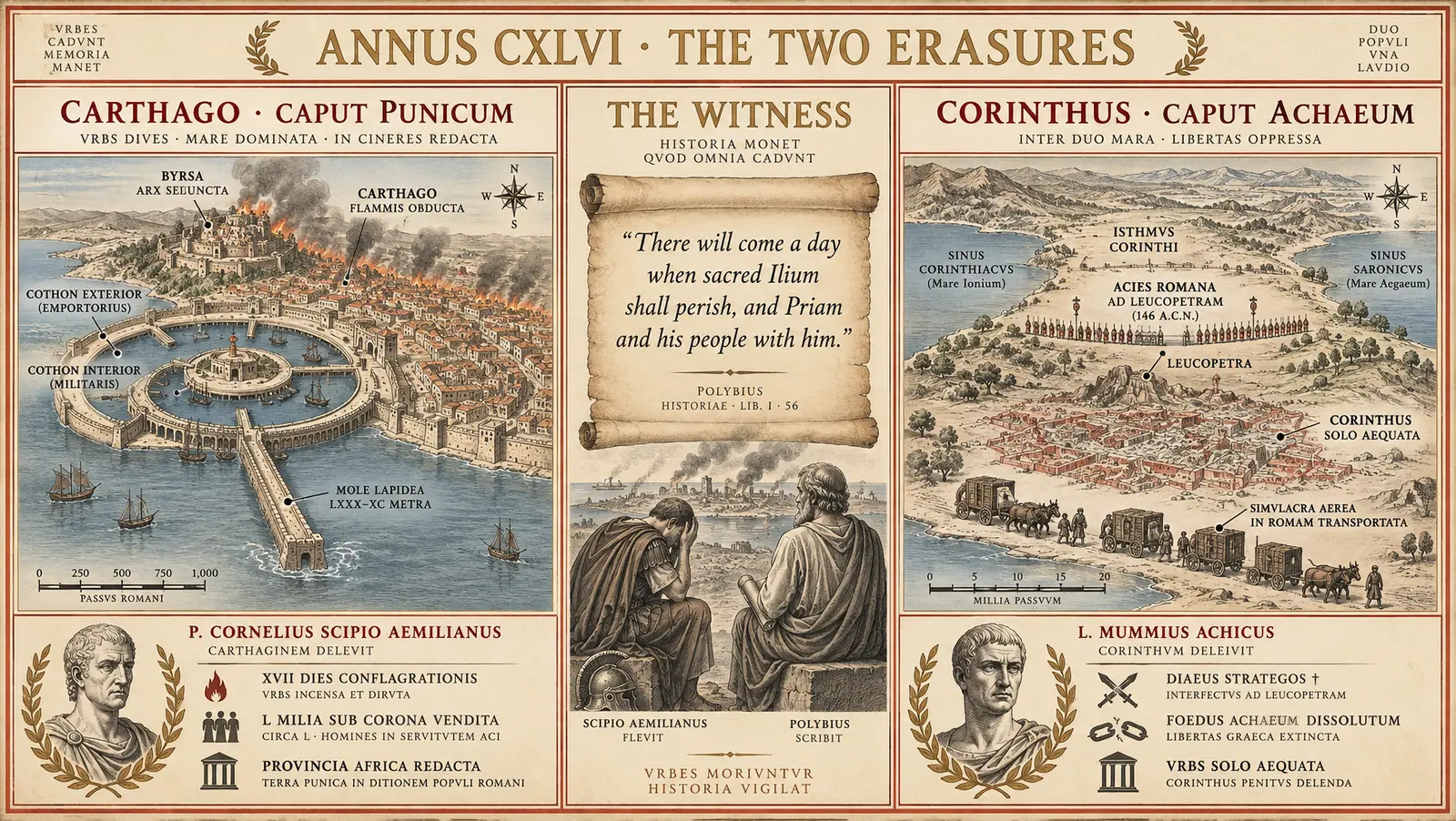
In the single campaigning season of 146 BC, the Roman Republic razed Carthage and Corinth, demonstrating to the Mediterranean basin that supervisory hegemony had been permanently replaced by categorical erasure.
INFOGRAPHIC DESIGN BRIEF: IV-G02 — THE YEAR 146
Compendium Volume: Book IV — The Wars of Mediterranean Hegemony (200–146 BC)
Asset Identifier: IV-G02
Format / Canvas: 16:9 Panoramic Plate
Target Register: Military-cartographic staff-history display; high-density editorial museum presentation. Clean, precise, devoid of romantic mysticism.
1. Purpose & Thesis
This plate illustrates the defining geopolitical watershed of the mid-second century BC: the simultaneous destruction of Carthage (African coast) and Corinth (central Greece) within a single campaigning season in 146 BC. By physically annihilating the two commercial and political alternatives to Roman dominance, the Republic replaced fifty years of supervisory client-management with categorical, programmatic erasure. The center vertical pillar anchors the plate in historical consciousness through the eyewitness account of Polybius of Megalopolis and the philosophical weeping of Scipio Aemilianus over the burning ruins.
2. Series Color Palette & Style Conventions
- Field / Background: Warm parchment cream (
#F4EBD5) - Roman Operational Color: Deep Roman crimson (
#8B1A1A) - Punic Sovereign Color: Burnished Punic ochre (
#B5824A) - Opponents / Defeated Leagues: Iron-grey (
#4A4D50) & dark charcoal (#2D3134) - Titling & Cartouches: Antique burnished gold (
#B89954) - Borders & Structural Rules: Terracotta red (
#A85638) - Typography: High-legibility classical Roman epigraphic serif headers, clean tabular numerals, modern monospaced explanatory notes.
3. Structural Layout & Panel Architecture
The diagram is structured as a triptych memorial display framed within an outer terracotta double rule:
+---------------------------------------------------------------------------------+
|                      ANNUS CXLVI · THE TWO ERASURES (146 BC)                    |
+-----------------------+-------------------------------+-------------------------+
|      LEFT PANEL       |         CENTER PILLAR         |       RIGHT PANEL       |
|       CARTHAGO        |          THE WITNESS          |        CORINTHUS        |
|  (Spring 146 BC)      |   (Polybius & Aemilianus)     |    (Autumn 146 BC)      |
|                       |                               |                         |
| - Punic Metropolis    | - The Iliad Recitation        | - Hellenic Jewel        |
| - Siege & Assault     | - Universal Turn of Fortune   | - Leucopetra & Isthmus  |
| - 17 Days Burning     | - Hostage turned Chronicler   | - Systematic Sack       |
| - Province of Africa  | - Institutional Ledger        | - Provincial Subjection |
+-----------------------+-------------------------------+-------------------------+
|   BOTTOM BANNER: THE MEDITERRANEAN LEARNED THE NEW RULES IN A SINGLE SEASON    |
+---------------------------------------------------------------------------------+
4. Verbatim Content by Panel
A. Top Master Cartouche
- Main Title:
ANNUS CXLVI · THE TWO ERASURES - Subtitle:
The Synchronized Annihilation of Carthage and Corinth · Summer & Autumn, 146 BC - Thesis Tagline:
Fifty-four years of supervisory hegemony consolidated in one season of programmatic erasure.
B. Left Panel: CARTHAGO (The African Seat)
- Header:
CARTHAGO · CAPUT PUNICUM - Date & Operational Theater:
Spring 146 BC · Africa Proconsularis - Roman Command:
P. Cornelius Scipio Aemilianus Africanus [Age 38; Extraordinary Consul] - Punic Defense:
Hasdrubal the Boetharch [c. 25,000 garrison remnants, civilian levy] - Operational Mechanics:
Investment: Triple-line circumvallation across the isthmus (147 BC)Blockade: 90-meter stone mole sealing the commercial cothonThe Sortie: Secret eastern harbor channel cut; fleet engagement defeatedThe Assault: Six days of continuous residential street fighting up the ByrsaThe Last Redoubt: Temple of Eshmun fired; surrender of Hasdrubal; leap of his wife into the pyre [BGrade B]
- The Ledger of Annihilation:
Fire Duration: XVII Dies Continuous Burning [AGrade A]Pre-War Urban Density: c. 200,000–500,000 [Tradition's arithmetic, unverified]Captives Sold into Bondage: L Milia (50,000) [BGrade B]Site Status: Solo Aequata · Ritual ploughing and salt curse [Ceremonial tradition, B-Grade B-]Political Transformation: Creation of Provincia Africa under praetorian administration
- Attestation Box:
Primary Sources: Appian Libyca 117–135 (drawing on lost Polybius 38–39); Diodorus 32. Attestation Grade: A/B.
C. Center Pillar: THE WITNESS (The Troy Verse)
- Header:
THE PHILOSOPHICAL EYE · POLYBIUS OF MEGALOPOLIS - Subhead:
The Achaean Hostage and the Scipionic Household - Graphic Device: An antique papyrus scroll vignette displaying Homeric Greek in translation, set between two contemplative silhouettes (Roman imperator in paludamentum and Greek statesman-historian in himation).
- Verbatim Text on Scroll:
"There will come a day when sacred Ilium shall perish,
and Priam and his people with him."
— Homer, Iliad 6.448–449, recited by Scipio Aemilianus watching the fires of Carthage [AGrade A: Polybius 38.21–22 via Appian] - Commentary Text:
The Reflexive Realization: The victor acknowledges that Rome's own hour of ruin is fixed in the same wheel of historical necessity.The Chronicler: Polybius (detained 167 BC, freed 150 BC) accompanies Scipio at the walls of Carthage, then sails east to mediate the post-catastrophe ruins of Greece.The Fifty-Four Years: The duration calculated by Polybius (220–167 BC, extended here to 146 BC) during which Rome constructed a singular, unexampled world-monarchy.
- Attestation Box:
Witness Grade: A (Direct participant observation).
D. Right Panel: CORINTHUS (The Hellenic Jewel)
- Header:
CORINTHUS · CAPUT ACHAEUM - Date & Operational Theater:
Autumn 146 BC · The Peloponnesian Isthmus - Roman Command:
Lucius Mummius [Consul 146 BC, later styled Achaicus] - Achaean Defense:
Diaeus of Megalopolis [Achaean League Strategos; c. 14,000 men] - Operational Mechanics:
Preliminary: Metellus breaks Critolaus at Scarpheia (Critolaus drowned/vanished) [BGrade B]The Climax: Total collapse of federal lines at Leucopetra on the Isthmus [BGrade B]The Leader's End: Diaeus flees to Megalopolis; slays family, fires house, commits suicide [BGrade B]The Entry: Roman army enters ungarrisoned Corinth through open gates
- The Ledger of Annihilation:
Adult Male Population: Put to the sword [BGrade B]Women & Children: Enslaved en masse [BGrade B]City Status: Burned to the earth; habitation interdicted; walls levelled [BGrade B]The Territory: Partitioned; coastal tracts transferred to Sicyon; balance made Ager PublicusThe Plunder: Stripping of high-classical bronze and painted panels; Mummius's contract requiring contractors to replace damaged antique masterpieces [Anecdote / Tradition, CGrade C: Velleius 1.13]Political Transformation: Achaean League dissolved; Peloponnese placed under Macedonian governor's surveillance
- Attestation Box:
Primary Sources: Pausanias 7.14–16; Polybius 38–39; Livy Periochae 52. Attestation Grade: B/C.
E. Bottom Institutional Ledger
- Full-Width Caption Banner:
"In the same campaigning season, the Roman state annihilated the ancient commercial seat of North Africa and the intellectual-artistic capital of the Isthmus. Supervisory hegemony was buried under the ashes of 146 BC; the Mediterranean world learned the new rules in one year." - Institutional Key:
Left: Punic sphere terminated · Right: Greek liberty superseded · Center: The Republic's fatal apex.
Image prompt (16:9)
A wide 16:9 historical infographic plate designed as an ancient military staff-room memorial display titled 'ANNUS CXLVI · THE TWO ERASURES', printed on aged vellum cream paper (#F4EBD5) with crisp double-lined borders in terracotta red (#A85638) and titling in antique gold (#B89954). The layout is an exact symmetrical triptych divided by crisp terracotta rules. The LEFT PANEL is titled 'CARTHAGO · CAPUT PUNICUM' in dark Roman crimson (#8B1A1A), featuring a schematic architectural cutaway map of ancient Carthage showing the double circular cothon harbor, the 90-meter stone mole in deep ochre (#B5824A), the isolated Byrsa citadel, and stylized flame-hatching; precise data callouts in black serif typography list 'P. CORNELIUS SCIPIO AEMILIANUS', 'XVII DIES CONFLAGRATIONIS', 'L MILIA SUB CORONA VENDITA' (50,000 enslaved), and 'PROVINCIA AFRICA REDACTA'. The RIGHT PANEL is titled 'CORINTHUS · CAPUT ACHAEUM' in deep Roman crimson, featuring a clean topographical line drawing of the Isthmus of Corinth, the battle line of Leucopetra, the razed city footprint labeled 'SOLO AEQUATA', and wagon icons indicating crated bronze sculptures shipped to Rome; data callouts list 'L. MUMMIUS ACHICUS', 'DIAEUS STRATEGOS †', and 'FOEDUS ACHAEUM DISSOLUTUM'. The CENTER PILLAR, labeled 'THE WITNESS', displays an illustrated papyrus scroll containing the quote: 'There will come a day when sacred Ilium shall perish, and Priam and his people with him.' Below the quote are stylized line silhouettes in iron-grey (#4A4D50) of Scipio Aemilianus weeping beside the Greek historian Polybius against a smoking horizon. Classical serif typography throughout, zero modern gloss, museum-grade cartographic elegance, every label sharp and completely legible.
IV-G02 · generated by the Imperium factory studio (gemini-3.8-flash) from Book IV under the House Preamble.