Book IV · The Wars of Mediterranean Hegemony
Infographic · IV-G03
PYDNA'S TWENTY MINUTES: The Fastest Verdict on a Two-Century Argument
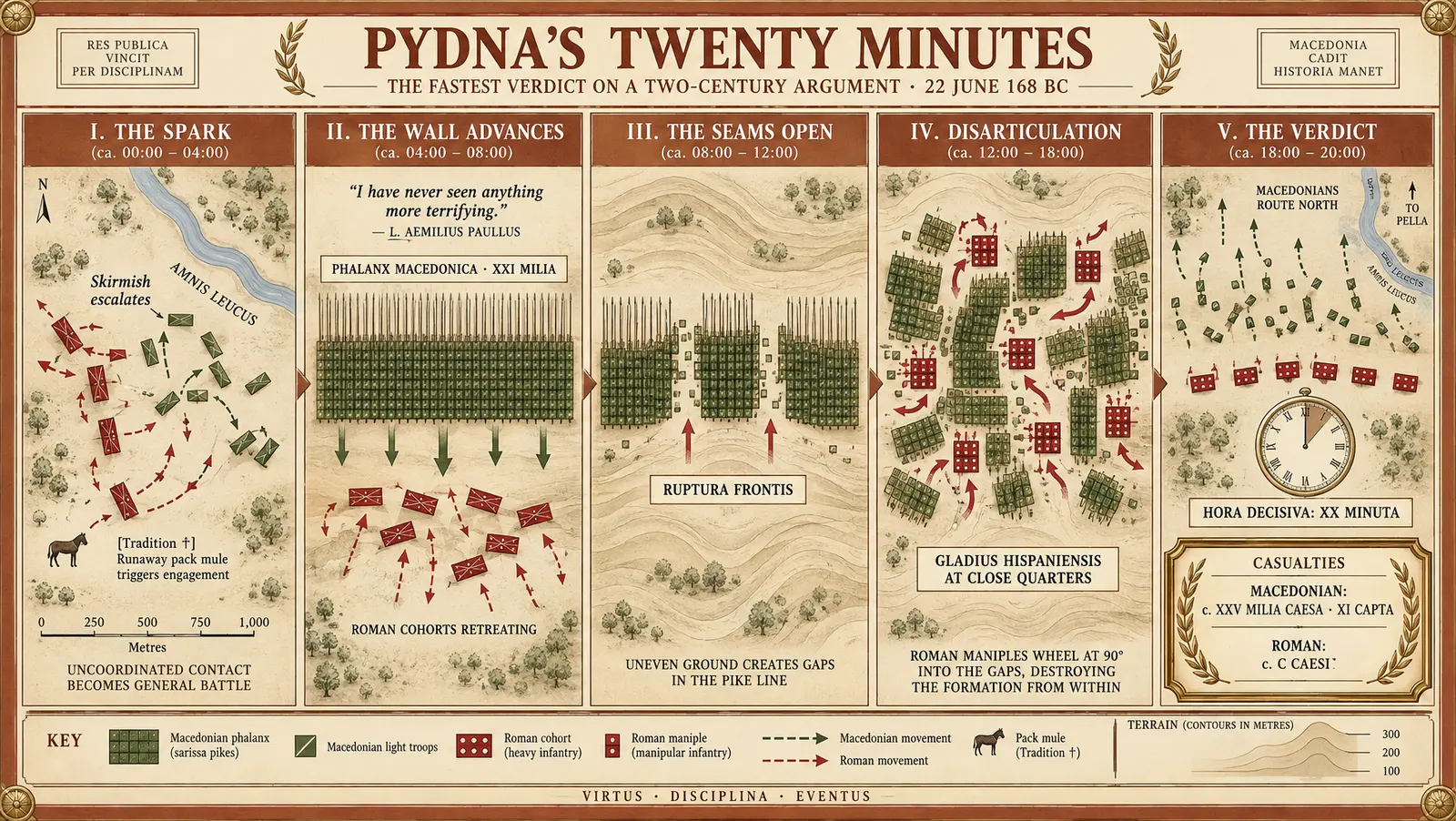
The fastest verdict on a two-century argument.
INFOGRAPHIC SPECIFICATION: IV-G03
PYDNA'S TWENTY MINUTES: The Fastest Verdict on a Two-Century Argument
1. Purpose & Analytical Thesis
This tactical phase-strip diagrams the climactic engagement of the Third Macedonian War (22 June 168 BC). The analytical thesis of Book IV holds that the encounter between the manipular legion and the Hellenistic phalanx was decided neither by individual courage nor generalship, but by architectural articulation. Over level ground, the compact sarissa wall was frontally impenetrable; but the moment the phalanx moved across uneven terrain, minor irregularities forced fissures into the unbroken pike-front. The Roman legion—subdivided into independent, responsive maniples—entered these gaps and dismantled the monolith from the inside. The entire tactical decision was enacted in approximately twenty minutes within a battle that lasted barely an hour.
2. Architecture & Layout (16:9 Horizontal Phase-Strip)
The infographic is structured as a five-column horizontal progression across a continuous timeline running left to right, unified by an overhead tactical rail and an underlying chronological baseline:
- Phase I (15:00) — The Accidental Spark: The Leucus stream between the camps. Skirmish over a loose pack animal escalating outside the command of either general.
- Phase II (15:20) — The Advance Terrible: Perseus’s 21,000 phalangites advance across the level flat. Compact sarissas at full projection; Roman front lines recoiling; Paullus’s recorded terror.
- Phase III (15:40) — The Ground’s Verdict: The phalanx reaches the undulating slopes and dry watercourses. The continuous pike-front stumbles, stretches, and develops structural seams.
- Phase IV (15:50) — Maniple Infiltration: Paullus orders the maniples to operate independently, turning into the gaps at right angles. Short sword (gladius) versus unwieldy 18-foot pikes in close quarters.
- Phase V (16:00) — The Collapse-Clock: Complete disintegration of the phalanx; flight of the royal cavalry; the ledger of one-sided destruction.
3. Verbatim Text & Label Roster
Header & Cartouche
- Title:
PYDNA'S TWENTY MINUTES - Subtitle:
The Fastest Verdict on a Two-Century Argument · 22 June 168 BC - Frame Inscription:
IMPERIUM ROMANUM · LIBER IV · CONFLICTUS SYSTEMATUM
Panel I: THE ACCIDENTAL SPARK (15:00)
- Top Header:
I. THE SPARK - Ground Label:
AMNIS LEUCUS - Event Callout:
UNPLANNED ESCALATION - Skirmish Label:
Foragers clash at the watering line - Annalistic Marker:
Runaway baggage mule [Tradition ✝] - Tactical Glyph:
ESCALATION SPIRAL: COHORTS & SPECIES ADVANCING SINE IMPERIO
Panel II: THE ADVANCE TERRIBLE (15:20)
- Top Header:
II. THE WALL ADVANCES - Unit Label:
PHALANX MACEDONICA · XXI MILIA SARISSOPHORORUM - Pike Front Indicator:
18-FOOT SARISSA FRONTAGE · V RANKS PROJECTING - Roman Reaction:
COHORS PAELIGNA BROKEN ON THE POINTS - Historical Quote:
"I have never seen anything more terrifying." — L. Aemilius Paullus [BGrade B] - Vector:
Monolithic frontal compression · Unyielding crimson retreat
Panel III: THE GROUND'S VERDICT (15:40)
- Top Header:
III. THE SEAMS OPEN - Terrain Feature:
FOOTHILL UNDULATIONS & DRIED GULLIES - Mechanical Flaw:
DIFFERENTIAL MARCH-RATES BREAK SARISSA CONTINUITY - Key Tactical Callout:
RUPTURA FRONTIS (THE SYSTEMIC RUPTURE) - Annotation:
The rigid pike-wall cannot bend without fissuring
Panel IV: MANIPLE INFILTRATION (15:50)
- Top Header:
IV. DISARTICULATION - Order Callout:
PAULLUS ORDERS MANIPULAR PENETRATION - Combat Dynamic:
GLADIUS HISPANIENSIS AT CLOSE QUARTERS - Vector Mechanics:
Crimson maniple wedges turning 90° into interior gaps - Target State:
SARISSAS TRAPPED USELESS UPRIGHT OR DROPPED - Combat Note:
The monolith disassembled from within
Panel V: THE COLLAPSE-CLOCK (16:00)
- Top Header:
V. THE VERDICT - Duration Dial:
HORA DECISIVA: XX MINUTA - Flight Label:
PERSEUS & REGAL CAVALRY FLEE UNENGAGED (REX PRIOR FUGIT) - Ledger Box:
MACEDONIAN CASUALTIES: c. XXV MILIA CAESA · XI MILIA CAPTA [Tradition's Arithmetic]ROMAN CASUALTIES: c. C CAESI [Tradition's Arithmetic]
- Terminal Note:
The Antigonid monarchy extinguished in a single afternoon
4. Data Values & Attestation Ledger
- Battle Date (22 June 168 BC): [AGrade A]. Fixed firmly by the lunar eclipse of the preceding night, recorded by Polybius, Livy, and verified by modern astronomical retrocalculation.
- Phalanx Rupture & Manipular Exploitation: [AGrade A]. Documented by Polybius (present with Aemilius Paullus shortly after) and preserved via Plutarch (Aem. Paull. 19–21) and Livy (44.40–42).
- Paullus’s Confession of Fear: [BGrade B]. Preserved in Plutarch via Polybian report.
- The Water-Creek Mule Spark: [CGrade C ✝]. Standard annalistic trope of the runaway animal starting the general engagement.
- Casualties (25,000 Macedonian dead, 100 Roman): [BGrade B/C]. Ancient tradition’s arithmetic (Plutarch/Livy). Extreme disparity is authentic to the slaughter of disrupted phalangites, but exact integers reflect annalistic conventions.
5. Palette & Graphic System
- Base Support: Aged vellum / Antique Cream (
#F4EBD5) - Frame & Structural Borders: Terracotta red-brown (
#A85638) - Roman Tactical Glyphs & Vectors: Roman Crimson (
#8B1A1A) - Macedonian Formations: Bronze-Green (
#5A6B3A) and Heavy Iron-Grey (#4A4A4A) - Titling, Medallions & Accents: Imperial Ochre-Gold (
#B89954) - Hydrology & Terrain Shading: Desaturated Aegean Blue-Grey (
#A4C2D9) and Sepia Hachures (#5C4033) - Typography: Clean, incised Roman serif style (capitalis monumentalis style headers; restrained humanist serif for analytical callouts).
Image prompt (16:9)
A museum-grade technical battle infographic titled "PYDNA'S TWENTY MINUTES" with subtitle "The Fastest Verdict on a Two-Century Argument · 22 June 168 BC", presented in a 16:9 horizontal staff-history register on an antique cream background (#F4EBD5) bordered by an architectural terracotta frame (#A85638) with gold corner clasps (#B89954). The composition is divided into five sequential chronological panels running left to right. Panel 1, labeled "I. THE SPARK", shows a schematic blue-grey creek labeled "AMNIS LEUCUS" with skirmish markers and a small symbol for a runaway pack mule labeled "[Tradition ✝]", showing uncoordinated unit escalations. Panel 2, labeled "II. THE WALL ADVANCES", shows a dense, impenetrable bronze-green block (#5A6B3A) representing "PHALANX MACEDONICA · XXI MILIA" bristling with forward-pointing sarissas, driving back retreating crimson Roman cohorts (#8B1A1A), accompanied by the quote '"I have never seen anything more terrifying." — L. Aemilius Paullus'. Panel 3, labeled "III. THE SEAMS OPEN", diagrams the phalanx moving across undulating sepia ground contours where vertical gaps and ruptures appear in the pike line, labeled "RUPTURA FRONTIS". Panel 4, labeled "IV. DISARTICULATION", shows isolated crimson Roman maniple blocks wheeling at 90-degree right angles into the open gaps of the green phalanx, destroying the rigid formation from within, labeled "GLADIUS HISPANIENSIS AT CLOSE QUARTERS". Panel 5, labeled "V. THE VERDICT", displays a collapse clock marking "HORA DECISIVA: XX MINUTA", routed Macedonian symbols fleeing toward the top, and a formal gold-trimmed cartouche listing the casualties: "MACEDONIAN: c. XXV MILIA CAESA · XI CAPTA" versus "ROMAN: c. C CAESI". Precise military symbology, no human faces or pictorial figures, clean scholarly typography with every label spelled out legibly in crisp serifs.
IV-G03 · generated by the Imperium factory studio (gemini-3.8-flash) from Book IV under the House Preamble.