Book IV · The Wars of Mediterranean Hegemony
Mind map · IV-M01
THE HELLENISTIC SYSTEM AND ITS SOLVENTS
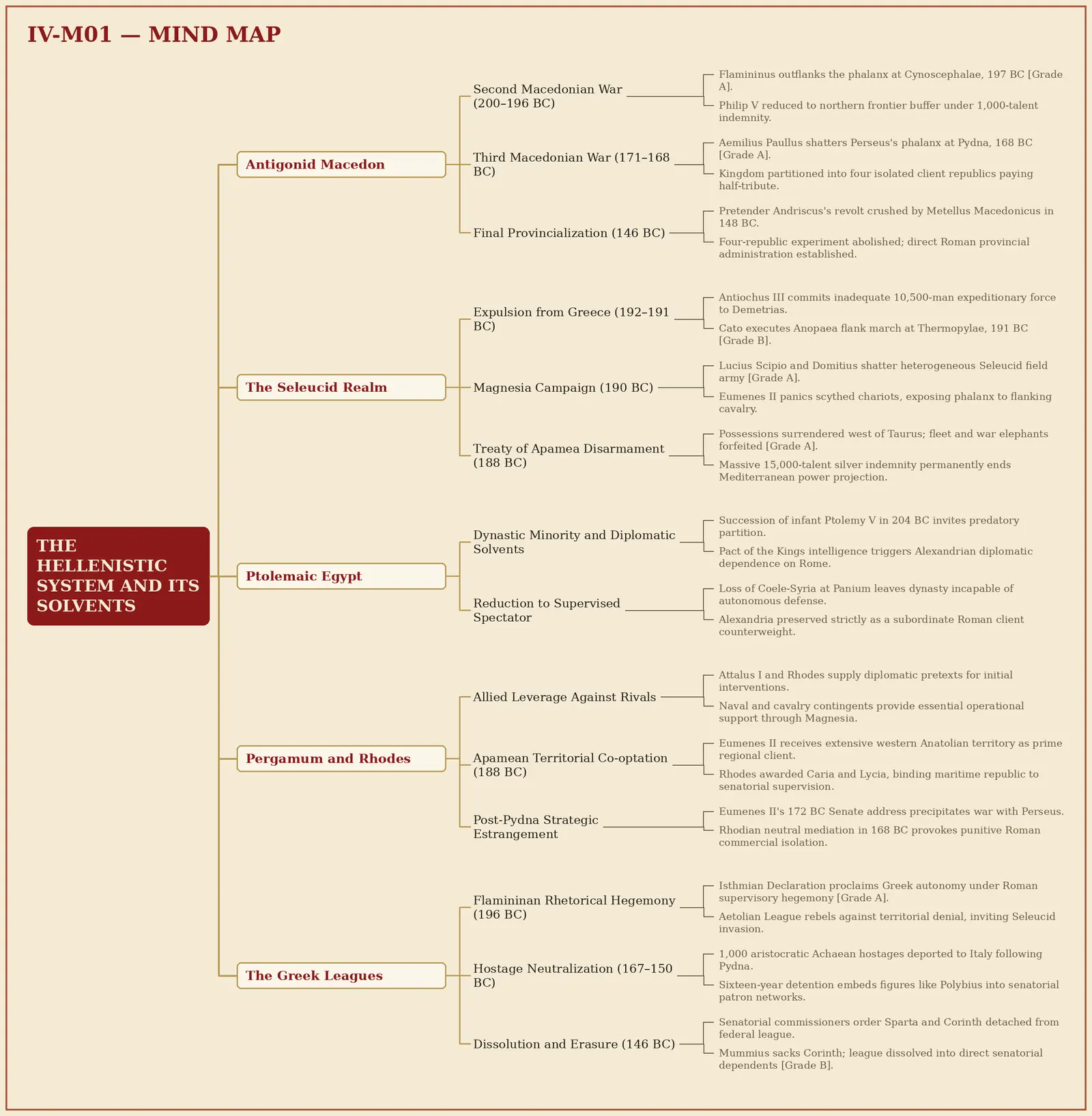
- Antigonid Macedon
- Second Macedonian War (200–196 BC)
- Flamininus outflanks the phalanx at Cynoscephalae, 197 BC [AGrade A].
- Philip V reduced to northern frontier buffer under 1,000-talent indemnity.
- Third Macedonian War (171–168 BC)
- Aemilius Paullus shatters Perseus's phalanx at Pydna, 168 BC [AGrade A].
- Kingdom partitioned into four isolated client republics paying half-tribute.
- Final Provincialization (146 BC)
- Pretender Andriscus's revolt crushed by Metellus Macedonicus in 148 BC.
- Four-republic experiment abolished; direct Roman provincial administration established.
- Second Macedonian War (200–196 BC)
- The Seleucid Realm
- Expulsion from Greece (192–191 BC)
- Antiochus III commits inadequate 10,500-man expeditionary force to Demetrias.
- Cato executes Anopaea flank march at Thermopylae, 191 BC [BGrade B].
- Magnesia Campaign (190 BC)
- Lucius Scipio and Domitius shatter heterogeneous Seleucid field army [AGrade A].
- Eumenes II panics scythed chariots, exposing phalanx to flanking cavalry.
- Treaty of Apamea Disarmament (188 BC)
- Possessions surrendered west of Taurus; fleet and war elephants forfeited [AGrade A].
- Massive 15,000-talent silver indemnity permanently ends Mediterranean power projection.
- Expulsion from Greece (192–191 BC)
- Ptolemaic Egypt
- Dynastic Minority and Diplomatic Solvents
- Succession of infant Ptolemy V in 204 BC invites predatory partition.
- Pact of the Kings intelligence triggers Alexandrian diplomatic dependence on Rome.
- Reduction to Supervised Spectator
- Loss of Coele-Syria at Panium leaves dynasty incapable of autonomous defense.
- Alexandria preserved strictly as a subordinate Roman client counterweight.
- Dynastic Minority and Diplomatic Solvents
- Pergamum and Rhodes
- Allied Leverage Against Rivals
- Attalus I and Rhodes supply diplomatic pretexts for initial interventions.
- Naval and cavalry contingents provide essential operational support through Magnesia.
- Apamean Territorial Co-optation (188 BC)
- Eumenes II receives extensive western Anatolian territory as prime regional client.
- Rhodes awarded Caria and Lycia, binding maritime republic to senatorial supervision.
- Post-Pydna Strategic Estrangement
- Eumenes II's 172 BC Senate address precipitates war with Perseus.
- Rhodian neutral mediation in 168 BC provokes punitive Roman commercial isolation.
- Allied Leverage Against Rivals
- The Greek Leagues
- Flamininan Rhetorical Hegemony (196 BC)
- Isthmian Declaration proclaims Greek autonomy under Roman supervisory hegemony [AGrade A].
- Aetolian League rebels against territorial denial, inviting Seleucid invasion.
- Hostage Neutralization (167–150 BC)
- 1,000 aristocratic Achaean hostages deported to Italy following Pydna.
- Sixteen-year detention embeds figures like Polybius into senatorial patron networks.
- Dissolution and Erasure (146 BC)
- Senatorial commissioners order Sparta and Corinth detached from federal league.
- Mummius sacks Corinth; league dissolved into direct senatorial dependents [BGrade B].
- Flamininan Rhetorical Hegemony (196 BC)
IV-M01 · generated by the Imperium factory studio (gemini-3.8-flash) from Book IV under the House Preamble.