Book IV · The Wars of Mediterranean Hegemony
Mind map · IV-M02
Systems-Clash: Legion Versus Phalanx
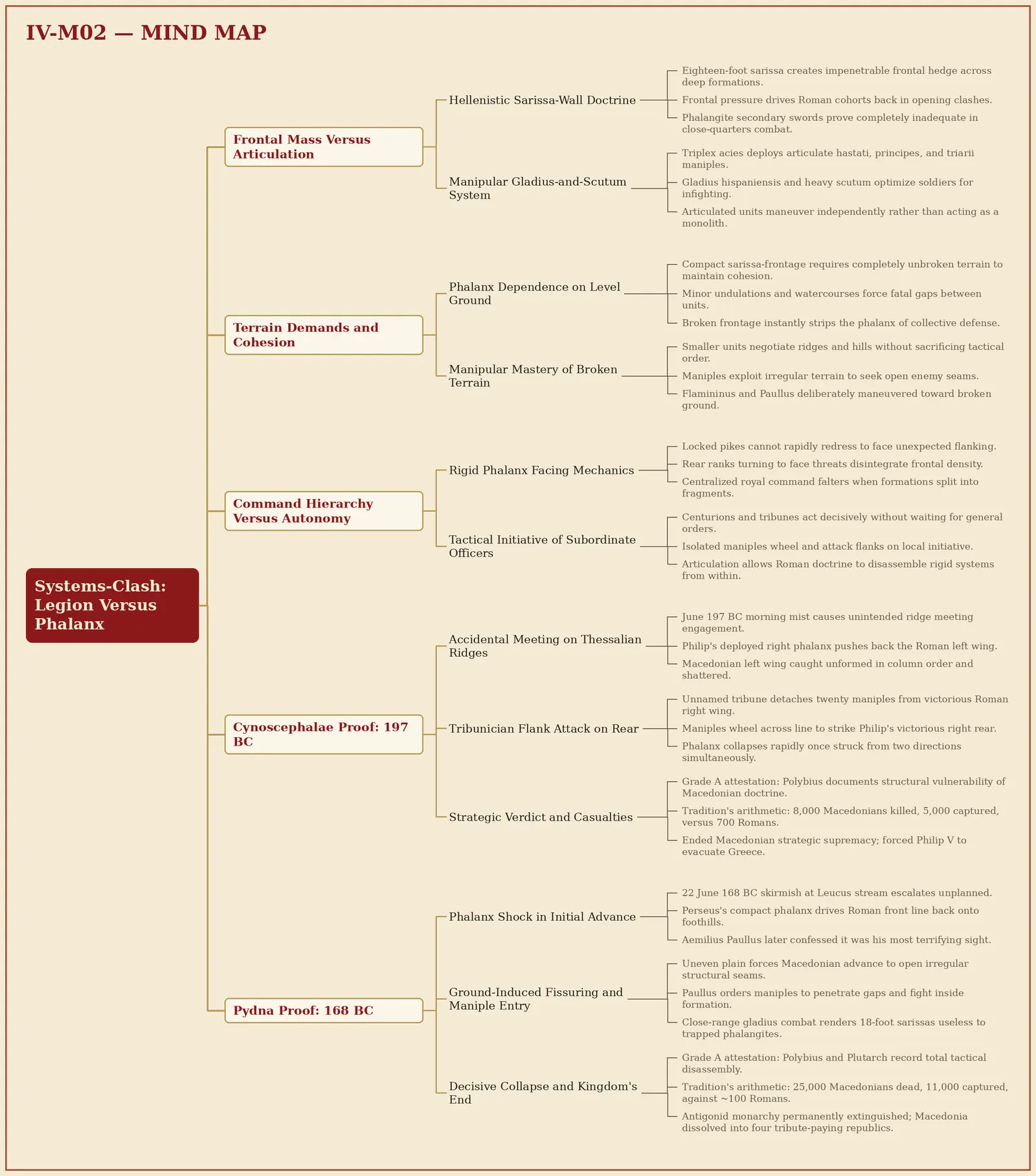
- Frontal Mass Versus Articulation
- Hellenistic Sarissa-Wall Doctrine
- Eighteen-foot sarissa creates impenetrable frontal hedge across deep formations.
- Frontal pressure drives Roman cohorts back in opening clashes.
- Phalangite secondary swords prove completely inadequate in close-quarters combat.
- Manipular Gladius-and-Scutum System
- Triplex acies deploys articulate hastati, principes, and triarii maniples.
- Gladius hispaniensis and heavy scutum optimize soldiers for infighting.
- Articulated units maneuver independently rather than acting as a monolith.
- Hellenistic Sarissa-Wall Doctrine
- Terrain Demands and Cohesion
- Phalanx Dependence on Level Ground
- Compact sarissa-frontage requires completely unbroken terrain to maintain cohesion.
- Minor undulations and watercourses force fatal gaps between units.
- Broken frontage instantly strips the phalanx of collective defense.
- Manipular Mastery of Broken Terrain
- Smaller units negotiate ridges and hills without sacrificing tactical order.
- Maniples exploit irregular terrain to seek open enemy seams.
- Flamininus and Paullus deliberately maneuvered toward broken ground.
- Phalanx Dependence on Level Ground
- Command Hierarchy Versus Autonomy
- Rigid Phalanx Facing Mechanics
- Locked pikes cannot rapidly redress to face unexpected flanking.
- Rear ranks turning to face threats disintegrate frontal density.
- Centralized royal command falters when formations split into fragments.
- Tactical Initiative of Subordinate Officers
- Centurions and tribunes act decisively without waiting for general orders.
- Isolated maniples wheel and attack flanks on local initiative.
- Articulation allows Roman doctrine to disassemble rigid systems from within.
- Rigid Phalanx Facing Mechanics
- Cynoscephalae Proof: 197 BC
- Accidental Meeting on Thessalian Ridges
- June 197 BC morning mist causes unintended ridge meeting engagement.
- Philip's deployed right phalanx pushes back the Roman left wing.
- Macedonian left wing caught unformed in column order and shattered.
- Tribunician Flank Attack on Rear
- Unnamed tribune detaches twenty maniples from victorious Roman right wing.
- Maniples wheel across line to strike Philip's victorious right rear.
- Phalanx collapses rapidly once struck from two directions simultaneously.
- Strategic Verdict and Casualties
- AGrade A attestation: Polybius documents structural vulnerability of Macedonian doctrine.
- Tradition's arithmetic: 8,000 Macedonians killed, 5,000 captured, versus 700 Romans.
- Ended Macedonian strategic supremacy; forced Philip V to evacuate Greece.
- Accidental Meeting on Thessalian Ridges
- Pydna Proof: 168 BC
- Phalanx Shock in Initial Advance
- 22 June 168 BC skirmish at Leucus stream escalates unplanned.
- Perseus's compact phalanx drives Roman front line back onto foothills.
- Aemilius Paullus later confessed it was his most terrifying sight.
- Ground-Induced Fissuring and Maniple Entry
- Uneven plain forces Macedonian advance to open irregular structural seams.
- Paullus orders maniples to penetrate gaps and fight inside formation.
- Close-range gladius combat renders 18-foot sarissas useless to trapped phalangites.
- Decisive Collapse and Kingdom's End
- AGrade A attestation: Polybius and Plutarch record total tactical disassembly.
- Tradition's arithmetic: 25,000 Macedonians dead, 11,000 captured, against ~100 Romans.
- Antigonid monarchy permanently extinguished; Macedonia dissolved into four tribute-paying republics.
- Phalanx Shock in Initial Advance
IV-M02 · generated by the Imperium factory studio (gemini-3.8-flash) from Book IV under the House Preamble.