Book IV · The Wars of Mediterranean Hegemony
Mind map · IV-M03
Roads to 146: Escalation Logics
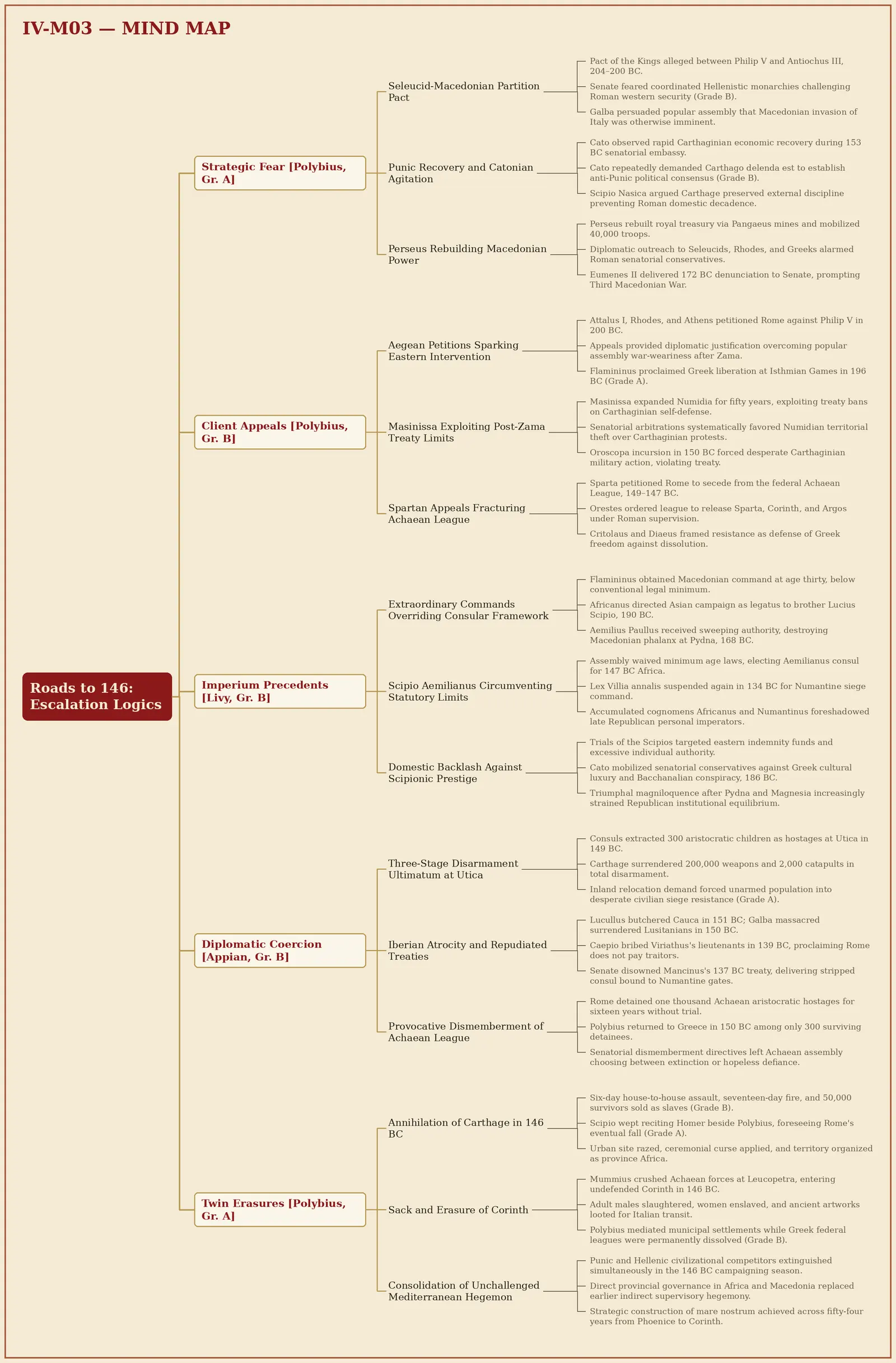
- Strategic Fear [Polybius, Gr. A]
- Seleucid-Macedonian Partition Pact
- Pact of the Kings alleged between Philip V and Antiochus III, 204–200 BC.
- Senate feared coordinated Hellenistic monarchies challenging Roman western security (BGrade B).
- Galba persuaded popular assembly that Macedonian invasion of Italy was otherwise imminent.
- Punic Recovery and Catonian Agitation
- Cato observed rapid Carthaginian economic recovery during 153 BC senatorial embassy.
- Cato repeatedly demanded Carthago delenda est to establish anti-Punic political consensus (BGrade B).
- Scipio Nasica argued Carthage preserved external discipline preventing Roman domestic decadence.
- Perseus Rebuilding Macedonian Power
- Perseus rebuilt royal treasury via Pangaeus mines and mobilized 40,000 troops.
- Diplomatic outreach to Seleucids, Rhodes, and Greeks alarmed Roman senatorial conservatives.
- Eumenes II delivered 172 BC denunciation to Senate, prompting Third Macedonian War.
- Seleucid-Macedonian Partition Pact
- Client Appeals [Polybius, Gr. B]
- Aegean Petitions Sparking Eastern Intervention
- Attalus I, Rhodes, and Athens petitioned Rome against Philip V in 200 BC.
- Appeals provided diplomatic justification overcoming popular assembly war-weariness after Zama.
- Flamininus proclaimed Greek liberation at Isthmian Games in 196 BC (AGrade A).
- Masinissa Exploiting Post-Zama Treaty Limits
- Masinissa expanded Numidia for fifty years, exploiting treaty bans on Carthaginian self-defense.
- Senatorial arbitrations systematically favored Numidian territorial theft over Carthaginian protests.
- Oroscopa incursion in 150 BC forced desperate Carthaginian military action, violating treaty.
- Spartan Appeals Fracturing Achaean League
- Sparta petitioned Rome to secede from the federal Achaean League, 149–147 BC.
- Orestes ordered league to release Sparta, Corinth, and Argos under Roman supervision.
- Critolaus and Diaeus framed resistance as defense of Greek freedom against dissolution.
- Aegean Petitions Sparking Eastern Intervention
- Imperium Precedents [Livy, Gr. B]
- Extraordinary Commands Overriding Consular Framework
- Flamininus obtained Macedonian command at age thirty, below conventional legal minimum.
- Africanus directed Asian campaign as legatus to brother Lucius Scipio, 190 BC.
- Aemilius Paullus received sweeping authority, destroying Macedonian phalanx at Pydna, 168 BC.
- Scipio Aemilianus Circumventing Statutory Limits
- Assembly waived minimum age laws, electing Aemilianus consul for 147 BC Africa.
- Lex Villia annalis suspended again in 134 BC for Numantine siege command.
- Accumulated cognomens Africanus and Numantinus foreshadowed late Republican personal imperators.
- Domestic Backlash Against Scipionic Prestige
- Trials of the Scipios targeted eastern indemnity funds and excessive individual authority.
- Cato mobilized senatorial conservatives against Greek cultural luxury and Bacchanalian conspiracy, 186 BC.
- Triumphal magniloquence after Pydna and Magnesia increasingly strained Republican institutional equilibrium.
- Extraordinary Commands Overriding Consular Framework
- Diplomatic Coercion [Appian, Gr. B]
- Three-Stage Disarmament Ultimatum at Utica
- Consuls extracted 300 aristocratic children as hostages at Utica in 149 BC.
- Carthage surrendered 200,000 weapons and 2,000 catapults in total disarmament.
- Inland relocation demand forced unarmed population into desperate civilian siege resistance (AGrade A).
- Iberian Atrocity and Repudiated Treaties
- Lucullus butchered Cauca in 151 BC; Galba massacred surrendered Lusitanians in 150 BC.
- Caepio bribed Viriathus's lieutenants in 139 BC, proclaiming Rome does not pay traitors.
- Senate disowned Mancinus's 137 BC treaty, delivering stripped consul bound to Numantine gates.
- Provocative Dismemberment of Achaean League
- Rome detained one thousand Achaean aristocratic hostages for sixteen years without trial.
- Polybius returned to Greece in 150 BC among only 300 surviving detainees.
- Senatorial dismemberment directives left Achaean assembly choosing between extinction or hopeless defiance.
- Three-Stage Disarmament Ultimatum at Utica
- Twin Erasures [Polybius, Gr. A]
- Annihilation of Carthage in 146 BC
- Six-day house-to-house assault, seventeen-day fire, and 50,000 survivors sold as slaves (BGrade B).
- Scipio wept reciting Homer beside Polybius, foreseeing Rome's eventual fall (AGrade A).
- Urban site razed, ceremonial curse applied, and territory organized as province Africa.
- Sack and Erasure of Corinth
- Mummius crushed Achaean forces at Leucopetra, entering undefended Corinth in 146 BC.
- Adult males slaughtered, women enslaved, and ancient artworks looted for Italian transit.
- Polybius mediated municipal settlements while Greek federal leagues were permanently dissolved (BGrade B).
- Consolidation of Unchallenged Mediterranean Hegemon
- Punic and Hellenic civilizational competitors extinguished simultaneously in the 146 BC campaigning season.
- Direct provincial governance in Africa and Macedonia replaced earlier indirect supervisory hegemony.
- Strategic construction of mare nostrum achieved across fifty-four years from Phoenice to Corinth.
- Annihilation of Carthage in 146 BC
IV-M03 · generated by the Imperium factory studio (gemini-3.8-flash) from Book IV under the House Preamble.