Book V · The Crisis of the Republic
Infographic · V-G01
THE MARIAN BARGAIN: The Institutional Transformation of the Roman Legion (107–31 BC)
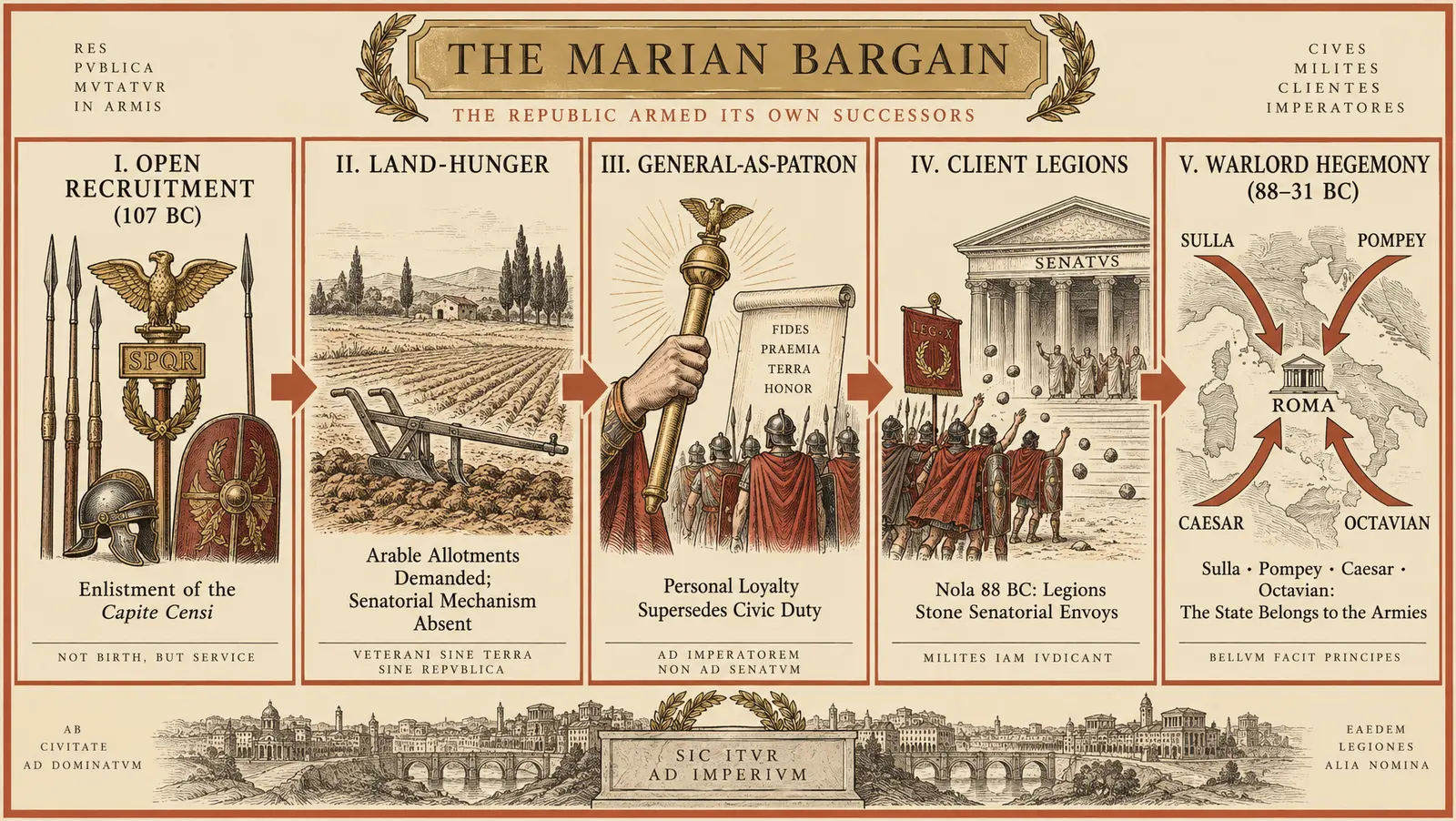
The Republic armed its own successors.
INFOGRAPHIC DESIGN BRIEF: THE MARIAN BARGAIN (V-G01)
1. Core Thesis & Strategic Purpose
To map the five-stage institutional degeneration of the Roman military system following Gaius Marius's enrollment of the capite censi in 107 BC. The infographic illustrates the causal chain that converted the citizen-militia into privatized client legions, demonstrating how military recruitment directly dictated the constitutional collapse of the late Republic.
2. Palette & Architecture
- Canvas Ground: Muted antique cream (
#F4EBD5) - Primary Vectors & Roman Units: Roman Crimson (
#8B1A1A) - Agrarian & Settlement Accents: Punic Ochre (
#B5824A) - Destabilization & Warlord Vectors: Dark Iron-Grey (
#3D3D3D) - Titling, Cartouches & Standard Glyphs: Warm Gold (
#B89954) - Borders, Frames & Phase Dividers: Terracotta (
#A85638) - Typography: Classical epigraphic serif capitals for headers (Trajan register); clean, high-legibility book serifs for descriptive text.
3. Structural Layout (Horizontal 5-Phase Flow)
Enclosed within a thin terracotta border, five equal panels (I through V) progress from left to right across the 16:9 canvas, linked by sequential crimson-to-iron-grey chevron arrows.
Panel I: OPEN RECRUITMENT (107 BC)
- Header:
I. OPEN RECRUITMENT (107 BC) - Attestation Grade:
BGrade B [Sallust BJ 86; Plutarch Mar. 9] - Visual Schematic: A recruit index icon. Propertied census bars crossed out; an eagle standard (aquila) rising over massed spears.
- Verbatim Text:
- Mechanism: Enrollment of the capite censi (citizens below census minimum) into the legions as volunteers.
- Tactical Shift: Maniple replaced by the 600-man cohort; standardized state equipment; kit carried on soldiers' backs (muli Mariani).
- Constitutional Breach: Service shifts from temporary civic duty of the propertied class to permanent livelihood of the propertyless.
Panel II: LAND-HUNGER
- Header:
II. LAND-HUNGER & DESTITUTION - Attestation Grade:
BGrade B [Appian BC 1.29; Epigraphic cippi] - Visual Schematic: An ochre plough resting on barren, unallotted ground; crossed boundary lines indicating senatorial deadlock.
- Verbatim Text:
- Economic Reality: Veterans possess no ancestral farms or smallholdings to resume after discharge.
- Structural Void: The senatorial Republic provides no institutional pension, discharge bounty, or legal machinery for regular veteran settlement.
- Demand: Demobilization contingent upon massive grants of arable public land (ager publicus).
Panel III: GENERAL-AS-PATRON
- Header:
III. THE GENERAL-AS-PATRON - Attestation Grade:
BGrade B [Appian BC 1.28–33; Plutarch Mar. 28–30] - Visual Schematic: A gold commander's baton (imperium) linked to a tribunician scroll, bypassing a muted curia temple silhouette.
- Verbatim Text:
- Patronage Pivot: Soldier loyalty transfers from the civic abstraction of the res publica to the person of the general.
- Tribunician Alliance: Commanders ally with radical tribunes (Saturninus, 103/100 BC) to force agrarian allocations via plebiscite.
- Extortion: The Senate is coerced into ratifying veteran settlements under threat of civic violence and assembly vetoes.
Panel IV: CLIENT ARMIES
- Header:
IV. THE CLIENT LEGIONS - Attestation Grade:
AGrade A/B [Appian BC 1.57; Plutarch Sulla 8–9] - Visual Schematic: Crimson cohort blocks with eagle standards wheeling toward a boundary marker; stones falling on senatorial envoys.
- Verbatim Text:
- Privatization: The legion becomes a client mass armed against rival factions to defend its donatives and veteran rights.
- Nola Precedent (88 BC): Sulla’s six legions stone tribunician envoys to protect their Asian plunder command, then execute the first march on Rome.
- Obedience: The rank-and-file obeys the commander who guarantees pay, boot, and soil, ignoring consular and senatorial decrees.
Panel V: WARLORD POLITICS (88–31 BC)
- Header:
V. WARLORD HEGEMONY (88–31 BC) - Attestation Grade:
AGrade A [Cicero Epp.; Caesar BC; Res Gestae] - Visual Schematic: Converging iron-grey arrows bearing dates striking the Roman Forum; proscription lists; the Rubicon crossing.
- Verbatim Text:
- Armed Dynasts: Private levying of legions by twenty-year-olds (Pompey in 83 BC, Octavian in 44 BC).
- Civil War Sequence: Sullan proscriptions (82 BC), Caesarian Rubicon crossing (49 BC), Triumviral proscriptions and Philippi (43–42 BC).
- Terminal Outcome: The state is whoever commands the legions; competitive warlordism ends at Actium in the autocracy of a sole patron.
4. Title Cartouche & Footer Metadata
- Top Title Cartouche (Gold & Terracotta):
THE MARIAN BARGAIN · FROM CITIZEN-MILITIA TO CLIENT ARMY (107–31 BC) - Subtitle Banner:
ANALYTICAL FLOW-PANEL: RECRUITMENT REFORM AS THE CATALYST OF CONSTITUTIONAL COLLAPSE - Bottom Summary Band:
Summary: Propertyless recruitment created an army dependent on its commander for survival; commanders acquired client legions; client legions dismantled the senatorial state.
Image prompt (16:9)
A mid-twentieth-century luxury scholarly constitutional diagram and strategic staff-history flowchart depicting 'THE MARIAN BARGAIN · FROM CITIZEN-MILITIA TO CLIENT ARMY (107–31 BC)' on an antique cream background (#F4EBD5). The layout is enclosed within a crisp terracotta border (#A85638) and structured as five horizontal rectangular panels arranged in a strict left-to-right progression across a wide 16:9 canvas. At the top center, a classical gold cartouche (#B89954) displays the title 'THE MARIAN BARGAIN' in crisp Trajan serif capitals, with the subtitle 'THE REPUBLIC ARMED ITS OWN SUCCESSORS' below in terracotta lettering. Each of the five panels features an engraved classical heading, clean serif labels, and technical vector schematics. Panel I is labeled 'I. OPEN RECRUITMENT (107 BC)' with a schematic icon of Roman spears, an aquila eagle standard, and text noting 'Enlistment of the Capite Censi'. Panel II is labeled 'II. LAND-HUNGER' rendered in Punic ochre (#B5824A) and iron-grey lines showing an unworked field and plow with text reading 'Arable Allotments Demanded; Senatorial Mechanism Absent'. Panel III is labeled 'III. GENERAL-AS-PATRON' featuring a golden imperator's baton linking to an assembly scroll, with text reading 'Personal Loyalty Supersedes Civic Duty'. Panel IV is labeled 'IV. CLIENT LEGIONS' showing crimson (#8B1A1A) legionary cohort blocks wheeling away from a senatorial curia symbol, labeled 'Nola 88 BC: Legions Stone Senatorial Envoys'. Panel V is labeled 'V. WARLORD HEGEMONY (88–31 BC)' rendered in iron-grey and crimson fracture arrows pointing toward Rome, labeled 'Sulla · Pompey · Caesar · Octavian: The State Belongs to the Armies'. Thick connective arrows link the panels in sequence. Rich academic cartography style, exquisite typography, sharp line engraving, perfectly flat cream ground, no photographic elements, no extra illegible markings.
V-G01 · generated by the Imperium factory studio (gemini-3.8-flash) from Book V under the House Preamble.