Book V · The Crisis of the Republic
Mind map · V-M01
Who Killed the Roman Republic?
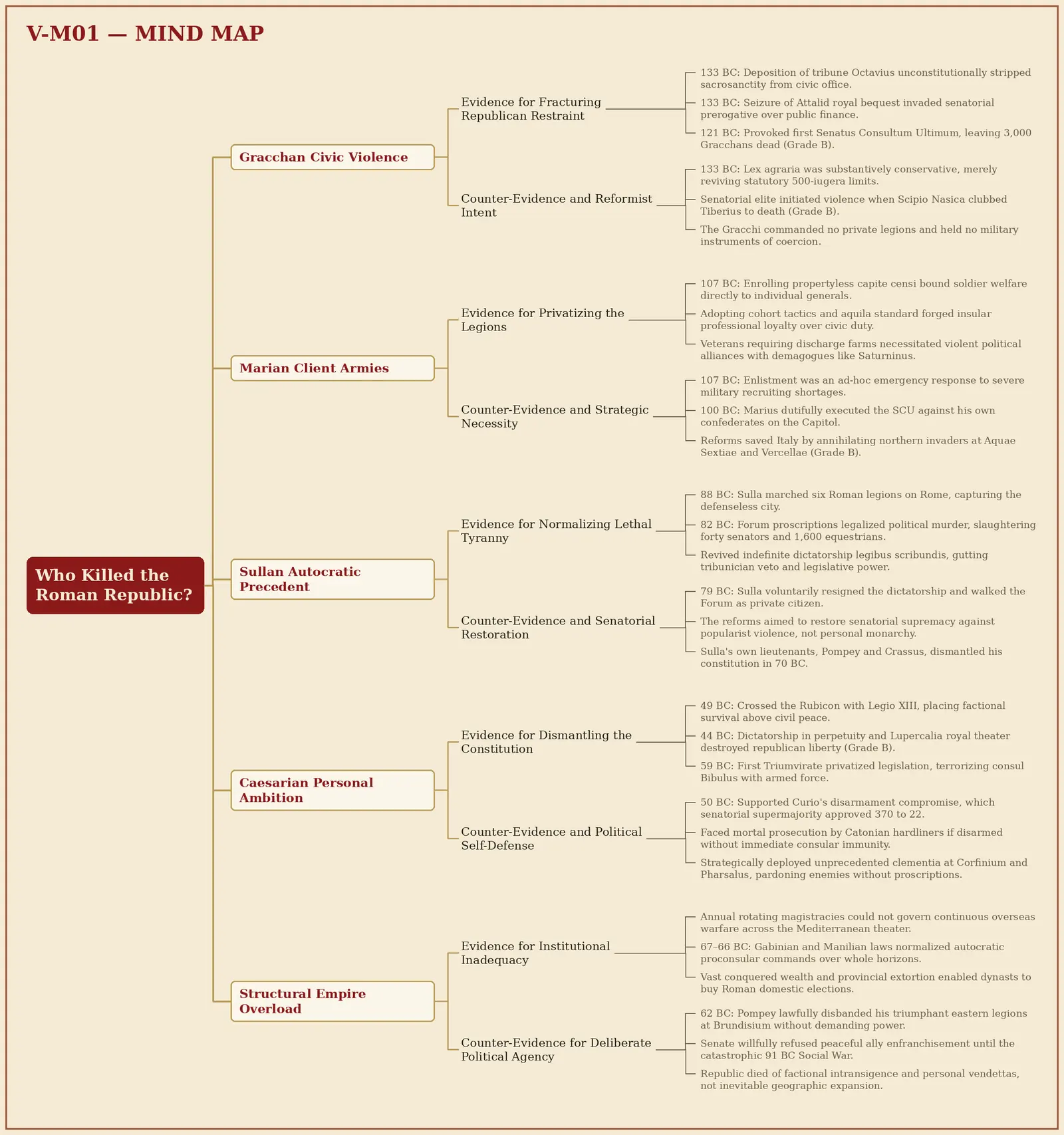
- Gracchan Civic Violence
- Evidence for Fracturing Republican Restraint
- 133 BC: Deposition of tribune Octavius unconstitutionally stripped sacrosanctity from civic office.
- 133 BC: Seizure of Attalid royal bequest invaded senatorial prerogative over public finance.
- 121 BC: Provoked first Senatus Consultum Ultimum, leaving 3,000 Gracchans dead (BGrade B).
- Counter-Evidence and Reformist Intent
- 133 BC: Lex agraria was substantively conservative, merely reviving statutory 500-iugera limits.
- Senatorial elite initiated violence when Scipio Nasica clubbed Tiberius to death (BGrade B).
- The Gracchi commanded no private legions and held no military instruments of coercion.
- Evidence for Fracturing Republican Restraint
- Marian Client Armies
- Evidence for Privatizing the Legions
- 107 BC: Enrolling propertyless capite censi bound soldier welfare directly to individual generals.
- Adopting cohort tactics and aquila standard forged insular professional loyalty over civic duty.
- Veterans requiring discharge farms necessitated violent political alliances with demagogues like Saturninus.
- Counter-Evidence and Strategic Necessity
- 107 BC: Enlistment was an ad-hoc emergency response to severe military recruiting shortages.
- 100 BC: Marius dutifully executed the SCU against his own confederates on the Capitol.
- Reforms saved Italy by annihilating northern invaders at Aquae Sextiae and Vercellae (BGrade B).
- Evidence for Privatizing the Legions
- Sullan Autocratic Precedent
- Evidence for Normalizing Lethal Tyranny
- 88 BC: Sulla marched six Roman legions on Rome, capturing the defenseless city.
- 82 BC: Forum proscriptions legalized political murder, slaughtering forty senators and 1,600 equestrians.
- Revived indefinite dictatorship legibus scribundis, gutting tribunician veto and legislative power.
- Counter-Evidence and Senatorial Restoration
- 79 BC: Sulla voluntarily resigned the dictatorship and walked the Forum as private citizen.
- The reforms aimed to restore senatorial supremacy against popularist violence, not personal monarchy.
- Sulla's own lieutenants, Pompey and Crassus, dismantled his constitution in 70 BC.
- Evidence for Normalizing Lethal Tyranny
- Caesarian Personal Ambition
- Evidence for Dismantling the Constitution
- 49 BC: Crossed the Rubicon with Legio XIII, placing factional survival above civil peace.
- 44 BC: Dictatorship in perpetuity and Lupercalia royal theater destroyed republican liberty (BGrade B).
- 59 BC: First Triumvirate privatized legislation, terrorizing consul Bibulus with armed force.
- Counter-Evidence and Political Self-Defense
- 50 BC: Supported Curio's disarmament compromise, which senatorial supermajority approved 370 to 22.
- Faced mortal prosecution by Catonian hardliners if disarmed without immediate consular immunity.
- Strategically deployed unprecedented clementia at Corfinium and Pharsalus, pardoning enemies without proscriptions.
- Evidence for Dismantling the Constitution
- Structural Empire Overload
- Evidence for Institutional Inadequacy
- Annual rotating magistracies could not govern continuous overseas warfare across the Mediterranean theater.
- 67–66 BC: Gabinian and Manilian laws normalized autocratic proconsular commands over whole horizons.
- Vast conquered wealth and provincial extortion enabled dynasts to buy Roman domestic elections.
- Counter-Evidence for Deliberate Political Agency
- 62 BC: Pompey lawfully disbanded his triumphant eastern legions at Brundisium without demanding power.
- Senate willfully refused peaceful ally enfranchisement until the catastrophic 91 BC Social War.
- Republic died of factional intransigence and personal vendettas, not inevitable geographic expansion.
- Evidence for Institutional Inadequacy
V-M01 · generated by the Imperium factory studio (gemini-3.8-flash) from Book V under the House Preamble.