Book V · The Crisis of the Republic
Mind map · V-M03
The Warlords' Web (60–31 BC)
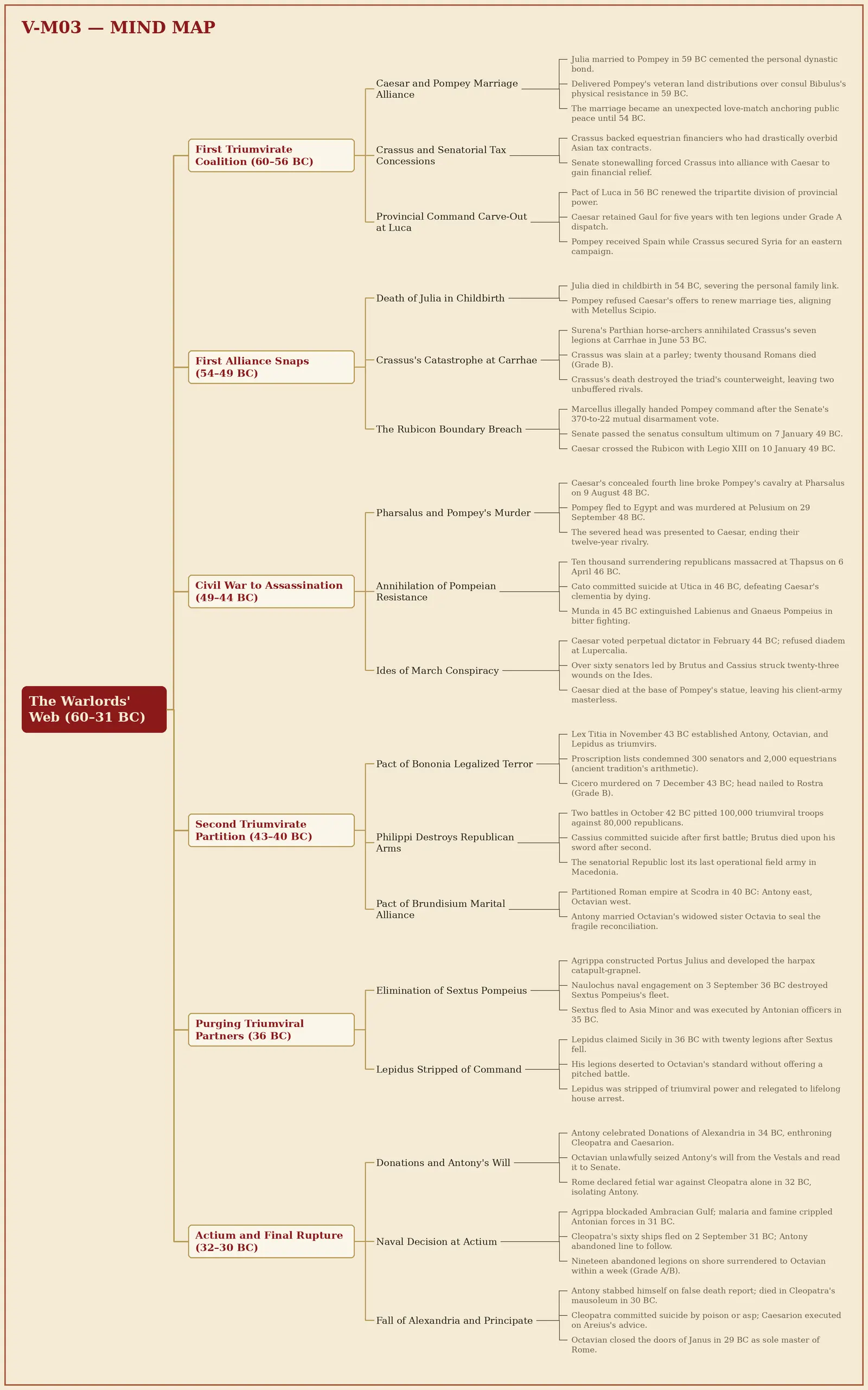
- First Triumvirate Coalition (60–56 BC)
- Caesar and Pompey Marriage Alliance
- Julia married to Pompey in 59 BC cemented the personal dynastic bond.
- Delivered Pompey's veteran land distributions over consul Bibulus's physical resistance in 59 BC.
- The marriage became an unexpected love-match anchoring public peace until 54 BC.
- Crassus and Senatorial Tax Concessions
- Crassus backed equestrian financiers who had drastically overbid Asian tax contracts.
- Senate stonewalling forced Crassus into alliance with Caesar to gain financial relief.
- Provincial Command Carve-Out at Luca
- Pact of Luca in 56 BC renewed the tripartite division of provincial power.
- Caesar retained Gaul for five years with ten legions under AGrade A dispatch.
- Pompey received Spain while Crassus secured Syria for an eastern campaign.
- Caesar and Pompey Marriage Alliance
- First Alliance Snaps (54–49 BC)
- Death of Julia in Childbirth
- Julia died in childbirth in 54 BC, severing the personal family link.
- Pompey refused Caesar's offers to renew marriage ties, aligning with Metellus Scipio.
- Crassus's Catastrophe at Carrhae
- Surena's Parthian horse-archers annihilated Crassus's seven legions at Carrhae in June 53 BC.
- Crassus was slain at a parley; twenty thousand Romans died (BGrade B).
- Crassus's death destroyed the triad's counterweight, leaving two unbuffered rivals.
- The Rubicon Boundary Breach
- Marcellus illegally handed Pompey command after the Senate's 370-to-22 mutual disarmament vote.
- Senate passed the senatus consultum ultimum on 7 January 49 BC.
- Caesar crossed the Rubicon with Legio XIII on 10 January 49 BC.
- Death of Julia in Childbirth
- Civil War to Assassination (49–44 BC)
- Pharsalus and Pompey's Murder
- Caesar's concealed fourth line broke Pompey's cavalry at Pharsalus on 9 August 48 BC.
- Pompey fled to Egypt and was murdered at Pelusium on 29 September 48 BC.
- The severed head was presented to Caesar, ending their twelve-year rivalry.
- Annihilation of Pompeian Resistance
- Ten thousand surrendering republicans massacred at Thapsus on 6 April 46 BC.
- Cato committed suicide at Utica in 46 BC, defeating Caesar's clementia by dying.
- Munda in 45 BC extinguished Labienus and Gnaeus Pompeius in bitter fighting.
- Ides of March Conspiracy
- Caesar voted perpetual dictator in February 44 BC; refused diadem at Lupercalia.
- Over sixty senators led by Brutus and Cassius struck twenty-three wounds on the Ides.
- Caesar died at the base of Pompey's statue, leaving his client-army masterless.
- Pharsalus and Pompey's Murder
- Second Triumvirate Partition (43–40 BC)
- Pact of Bononia Legalized Terror
- Lex Titia in November 43 BC established Antony, Octavian, and Lepidus as triumvirs.
- Proscription lists condemned 300 senators and 2,000 equestrians (ancient tradition's arithmetic).
- Cicero murdered on 7 December 43 BC; head nailed to Rostra (BGrade B).
- Philippi Destroys Republican Arms
- Two battles in October 42 BC pitted 100,000 triumviral troops against 80,000 republicans.
- Cassius committed suicide after first battle; Brutus died upon his sword after second.
- The senatorial Republic lost its last operational field army in Macedonia.
- Pact of Brundisium Marital Alliance
- Partitioned Roman empire at Scodra in 40 BC: Antony east, Octavian west.
- Antony married Octavian's widowed sister Octavia to seal the fragile reconciliation.
- Pact of Bononia Legalized Terror
- Purging Triumviral Partners (36 BC)
- Elimination of Sextus Pompeius
- Agrippa constructed Portus Julius and developed the harpax catapult-grapnel.
- Naulochus naval engagement on 3 September 36 BC destroyed Sextus Pompeius's fleet.
- Sextus fled to Asia Minor and was executed by Antonian officers in 35 BC.
- Lepidus Stripped of Command
- Lepidus claimed Sicily in 36 BC with twenty legions after Sextus fell.
- His legions deserted to Octavian's standard without offering a pitched battle.
- Lepidus was stripped of triumviral power and relegated to lifelong house arrest.
- Elimination of Sextus Pompeius
- Actium and Final Rupture (32–30 BC)
- Donations and Antony's Will
- Antony celebrated Donations of Alexandria in 34 BC, enthroning Cleopatra and Caesarion.
- Octavian unlawfully seized Antony's will from the Vestals and read it to Senate.
- Rome declared fetial war against Cleopatra alone in 32 BC, isolating Antony.
- Naval Decision at Actium
- Agrippa blockaded Ambracian Gulf; malaria and famine crippled Antonian forces in 31 BC.
- Cleopatra's sixty ships fled on 2 September 31 BC; Antony abandoned line to follow.
- Nineteen abandoned legions on shore surrendered to Octavian within a week (AGrade A/B).
- Fall of Alexandria and Principate
- Antony stabbed himself on false death report; died in Cleopatra's mausoleum in 30 BC.
- Cleopatra committed suicide by poison or asp; Caesarion executed on Areius's advice.
- Octavian closed the doors of Janus in 29 BC as sole master of Rome.
- Donations and Antony's Will
V-M03 · generated by the Imperium factory studio (gemini-3.8-flash) from Book V under the House Preamble.