Book VI · The Wars of the Early Principate
Infographic · VI-G04
THE OATH ARCHITECTURE
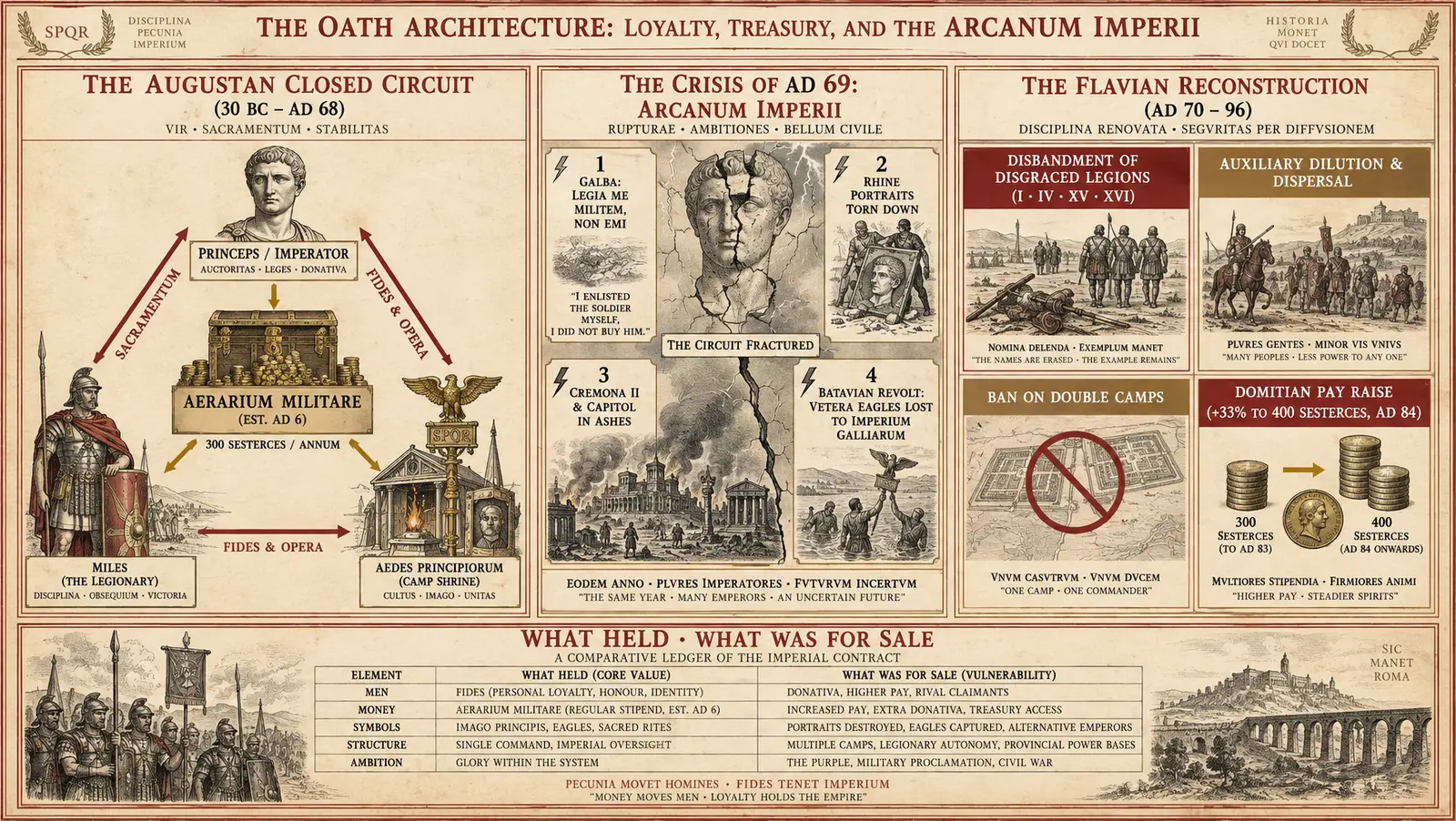
The oath architecture: what held was the office of princeps and the iron loyalty of dying cohorts; what was for sale was the person wearing it, priced in donatives and broken across eighteen months of civil war.
Design Brief: VI-G04 — THE OATH ARCHITECTURE
Strategic Purpose
To diagram the institutional mechanism of military loyalty under the Early Principate (30 BC–AD 96): how Augustus nationalized the patronage of the late Republican warlords into a closed administrative circuit; how the circuit fractured across four break-points in the crisis of AD 68–69 (arcanum imperii); and how the Flavian reconstruction restructured, diluted, and repriced the army’s allegiance to insulate the throne against further auctions.
Layout & Architecture
Format: Horizontal infographic (16:9 aspect ratio), enclosed in a double-ruled terracotta frame (#A85638) on aged cream parchment (#F4EBD5).
The diagram is organized into three parallel, chronological structural panels with a continuous lower audit ledger:
- Panel I (Left): The Augustan Closed Circuit (30 BC–AD 68) — The triangular feedback loop connecting the individual soldier, the camp shrine standards, and the sacred person of the Princeps.
- Panel II (Center): The Crisis of AD 69 (The Circuit Fractured) — The four catastrophic failures of the oath mechanism during the Year of the Four Emperors and the Batavian Revolt.
- Panel III (Right): The Flavian Reconstruction (AD 70–96) — The structural safeguards, auxiliary dilution, legionary dispersal, and Domitian’s AD 84 wage repricing.
- Bottom Banner: The Attestation & Structural Ledger: What Held, What Was for Sale, and When.
Palette System
- Base Parchment Ground:
#F4EBD5 - Imperial State / Legionary Flow: Tyrian Crimson (
#8B1A1A) - Fiscal & Treasury Arrows (Pay, Donatives, Pensions): Punic Ochre / Gold (
#B5824A/#B89954) - Break-Points, Usurpations & Traitors: Iron-Grey / Muted Charcoal (
#4A4A4A) - Cartouche Outlines & Structural Enclosures: Terracotta (
#A85638)
Detailed Panel Specifications & Verbatim Text Elements
Master Header Cartouche (Top Center)
- Main Title: "THE OATH ARCHITECTURE: LOYALTY, TREASURY, AND THE ARCANUM IMPERII"
- Subtitle: "The Nationalization of Military Patronage (30 BC) · The Collapse of 69 · The Flavian Settlement (AD 96)"
Panel I: The Augustan Design (30 BC–AD 68) — The Closed Circuit
Visual Structure: A closed triangular vector flow linking three primary nodes.
- Top Apex Node:
PRINCEPS / IMPERATOR[Crimson Box#8B1A1Awith gold border]- Text: "Sole Patron & Commander-in-Chief in Perpetuity. Holds frontier provinces and legions through subordinate legates. Sole proprietor of triumph; generals receive ornamenta triumphalia."
- Central Vector 1 (Right Downward):
SACRAMENTUM[Crimson Arrow]- Text: "Sacred military oath sworn personally to the emperor by name; renewed annually on 1 January."
- Bottom-Right Node:
AEDES PRINCIPIORUM (CAMP SHRINE)[Terracotta Box#A85638]- Text: "The Sacred Medium: Eagle (Aquila) and legionary standards flanked by the imperial image (imago). Treason against the image is treason against the legion."
- Bottom-Left Node:
MILES / THE PROFESSIONAL SOLDIER[Crimson Box#8B1A1A]- Text: "Long-service regular (16, then 20 years + recall). 25–28 Legions (c. 150,000 citizens) + matched Auxilia (non-citizens awarded citizenship via bronze diploma)."
- Central Vector 2 (Left Upward):
FIDES & OPERA[Crimson Arrow]- Text: "Absolute obedience; labor on fortifications, roads, and canals; surrender of independent political agency."
- Central Financial Loop (Gold
#B89954):AERARIUM MILITARE (EST. AD 6)- Text: "Dedicated military treasury funded by 5% inheritance and 1% auction taxes. Pays fixed annual wage (300 sesterces) and cash discharge bounty (12,000 sesterces). The state, not the general, provides the veteran's farm."
- Lateral Guard Node (Top Left):
COHORTES PRAETORIAE[Crimson/Violet Box]- Text: "9 cohorts guarding—and owning—the person of the princeps. The sole regular military force stationed in Italy."
Panel II: The Crisis of AD 69 — The Circuit Fractured
Visual Structure: The triangular circuit shattered by four iron-grey rupture glyphs (⚡) annotated with break-points.
- Header: "AD 69: ARCANUM IMPERII DETECTO"
- The Governing Thesis: "'The secret of empire was out: that an emperor could be made elsewhere than at Rome.' (Tacitus, Hist. 1.4)"
- Break-Point 1: The Donative Refusal (Rome, Jan 69) [Iron-Grey Glyph ⚡1]
- Event: Galba refuses to pay the Praetorians their promised bounty.
- Verbatim Maxim: "'Legi a me militem, non emi' — I levy my soldiers, I do not buy them." [BGrade B]
- Result: Otho bribes 23 speculatores of the Guard; Galba butchered at the Lacus Curtius.
- Break-Point 2: The Rhine Rejection (Mainz/Cologne, Jan 69) [Iron-Grey Glyph ⚡2]
- Event: Upper Germany tears down Galba's imagines; Lower Germany proclaims Vitellius.
- Mechanism: Frontier army groups assert candidate monopoly; march on Italy over winter Alpine passes.
- Break-Point 3: The Danube Coup & Pillage (Oct–Dec 69) [Iron-Grey Glyph ⚡3]
- Event: Antonius Primus marches Danubian legions; Second Battle of Cremona.
- Rupture: Cremona sacked for four days by Roman soldiers; Capitol burned (19 Dec); Vitellius slain at Gemonian stairs.
- Break-Point 4: The Auxilia Treason (Lower Rhine, 69–70) [Iron-Grey Glyph ⚡4]
- Event: Batavian revolt under Julius Civilis; Vetera garrison starved.
- Rupture: Legions swear allegiance to a foreign power (Imperium Galliarum); two eagles captive. Ultimate collapse of the auxiliary-diploma compact.
Panel III: The Flavian Reconstruction (AD 70–96) — Structural Repair
Visual Structure: A fortified, re-engineered schematic showing new institutional locks and fiscal flows.
- Header: "THE FLAVIAN FORTIFICATION OF ALLEGIANCE"
- Measure 1: Legionary Damnatio & Reconstitution (AD 70) [AGrade A]
- Action: Disbandment of 4 oath-broken legions (I Germanica, IV Macedonica, XV Primigenia, XVI Gallica); numbers permanently erased from the army lists.
- Measure 2: Auxiliary Dilution & Dispersal [AGrade A]
- Action: Abolition of tribal commands under native princes. Batavian cohorts dispersed to Britain and Danube. Regiments recruited locally, commanded by equestrian Roman officers; ethnic names reduced to administrative labels.
- Measure 3: De-concentration of Force (Post-Saturninus, AD 89) [BGrade B]
- Regulation: Absolute prohibition against two legions occupying a single winter camp (double-camps broken up). Camp savings-deposits capped below usurpation-financing scale.
- Measure 4: Domitian's Repricing of Loyalty (AD 84) [AGrade A]
- Action: Legionary pay raised by one-third (from 300 to 400 sesterces per annum), the first wage increase since Julius Caesar. Paid in three annual installments.
- Measure 5: Solvency & Donative Mastery [AGrade A/B]
- Policy: Rigorous taxation ("pecunia non olet") ensures state treasury can always outbid usurpers. Cappadocia annexed; Rhine-Danube salient (Agri Decumates) secured.
- Measure 6: The Succession Hinge (AD 96) [AGrade A]
- Resolution: Nerva adopts Trajan (legate of Upper Germany); the army's veto conceded in advance, securing senatorial-military synthesis for a century.
Lower Audit Ledger: What Held · What Was for Sale
A three-part horizontal comparative ledger bar spanning the base of the frame.
- WHAT HELD (Institutional Constants):
- The Praetorians of Vitellius died at their camp gates to a man (unbought loyalty to an unworthy princeps).
- The Principate itself: no faction or mutinous army group ever fought to restore the Republic; every sword was drawn to install an Imperator.
- Imperial borders: no frontier collapsed to foreign powers during the 18 months of civil war; Parthian cavalry offers were declined.
- WHAT WAS FOR SALE (The Transactional Weakness):
- The individual occupant of the purple: priced in Praetorian donatives (Otho’s coup bought for pennies to 23 speculatores) and frontier candidate pride.
- The sacredness of civilian space: Cremona sacked by its own legions; the Capitoline temple burned by Roman hands.
- THE HISTORICAL VERDICT (Epilogue Synthesis):
- "The Marian client army made universal and hereditary, with the state itself as the sole remaining patron. The system held the world with one soldier for every two hundred subjects—an astonishingly thin garrison held by consent, habit, and the certainty of retribution."
Evidence & Attestation Grades
- AGrade A: Aerarium militare establishment (AD 6; Res Gestae, Dio); Erased legionary rolls (I, IV, XV, XVI; inscriptions); Flavian auxiliary discharge diplomas; Domitian's AD 84 pay raise (papyri, Suetonius); Lex de imperio Vespasiani (CIL VI 930).
- BGrade B: Galba's donative maxim (Hist. 1.18); Otho's transaction with the 23 speculatores (Hist. 1.27); Saturninus's camp banking limits (Suet. Dom. 7); Antonius Primus at Cremona.
- CGrade C/D: Speeches of Civilis, Percennius, and Cerialis (literary compositions demonstrating contemporary political logic).
Image prompt (16:9)
A clean, highly detailed historical-atlas infographic diagram titled 'THE OATH ARCHITECTURE: LOYALTY, TREASURY, AND THE ARCANUM IMPERII', presented in an authentic 19th-century staff-college military history folio style. Rendered on an aged cream parchment ground (#F4EBD5) within a crisp, double-ruled terracotta border (#A85638). The composition is divided into three distinct vertical instructional panels and a bottom horizontal summary ledger. Left Panel labeled 'THE AUGUSTAN CLOSED CIRCUIT (30 BC–AD 68)' shows a triangular vector flow in rich Tyrian crimson (#8B1A1A) linking three main nodes: 'PRINCEPS / IMPERATOR' at the top, 'AEDES PRINCIPIORUM (CAMP SHRINE)' with an eagle standard and imperial imago icon on the right, and 'MILES (THE LEGIONARY)' on the left, connected by crimson arrows labeled 'SACRAMENTUM' and 'FIDES & OPERA', with a gold central financial hub (#B89954) labeled 'AERARIUM MILITARE (EST. AD 6)' distributing pay arrows labeled '300 SESTERCES / ANNUM'. Center Panel labeled 'THE CRISIS OF AD 69: ARCANUM IMPERII' displays the circuit fractured by four dark iron-grey rupture glyphs (#4A4A4A): ⚡1 'GALBA: LEGI A ME MILITEM, NON EMI', ⚡2 'RHINE PORTRAITS TORN DOWN', ⚡3 'CREMONA II & CAPITOL IN ASHES', and ⚡4 'BATAVIAN REVOLT: VETERA EAGLES LOST TO IMPERIUM GALLIARUM'. Right Panel labeled 'THE FLAVIAN RECONSTRUCTION (AD 70–96)' shows re-engineered organizational blocks in deep crimson and ochre (#B5824A): 'DISBANDMENT OF DISGRACED LEGIONS (I · IV · XV · XVI)', 'AUXILIARY DILUTION & DISPERSAL', 'BAN ON DOUBLE CAMPS', and 'DOMITIAN PAY RAISE (+33% TO 400 SESTERCES, AD 84)'. Across the bottom runs a full-width comparative ledger labeled 'WHAT HELD · WHAT WAS FOR SALE' with structured analytical text blocks. All lettering is sharp, elegant academic serif typography, every label fully spelled out in legible Latin and English, with absolute historical cartographic precision, crisp linework, and no extraneous modern graphic elements. Aspect ratio 16:9 horizontal.
VI-G04 · generated by the Imperium factory studio (gemini-3.8-flash) from Book VI under the House Preamble.