Book VII · The High Empire and the Long Crisis
Infographic · VII-G01
THE SILVER SEISMOGRAPH
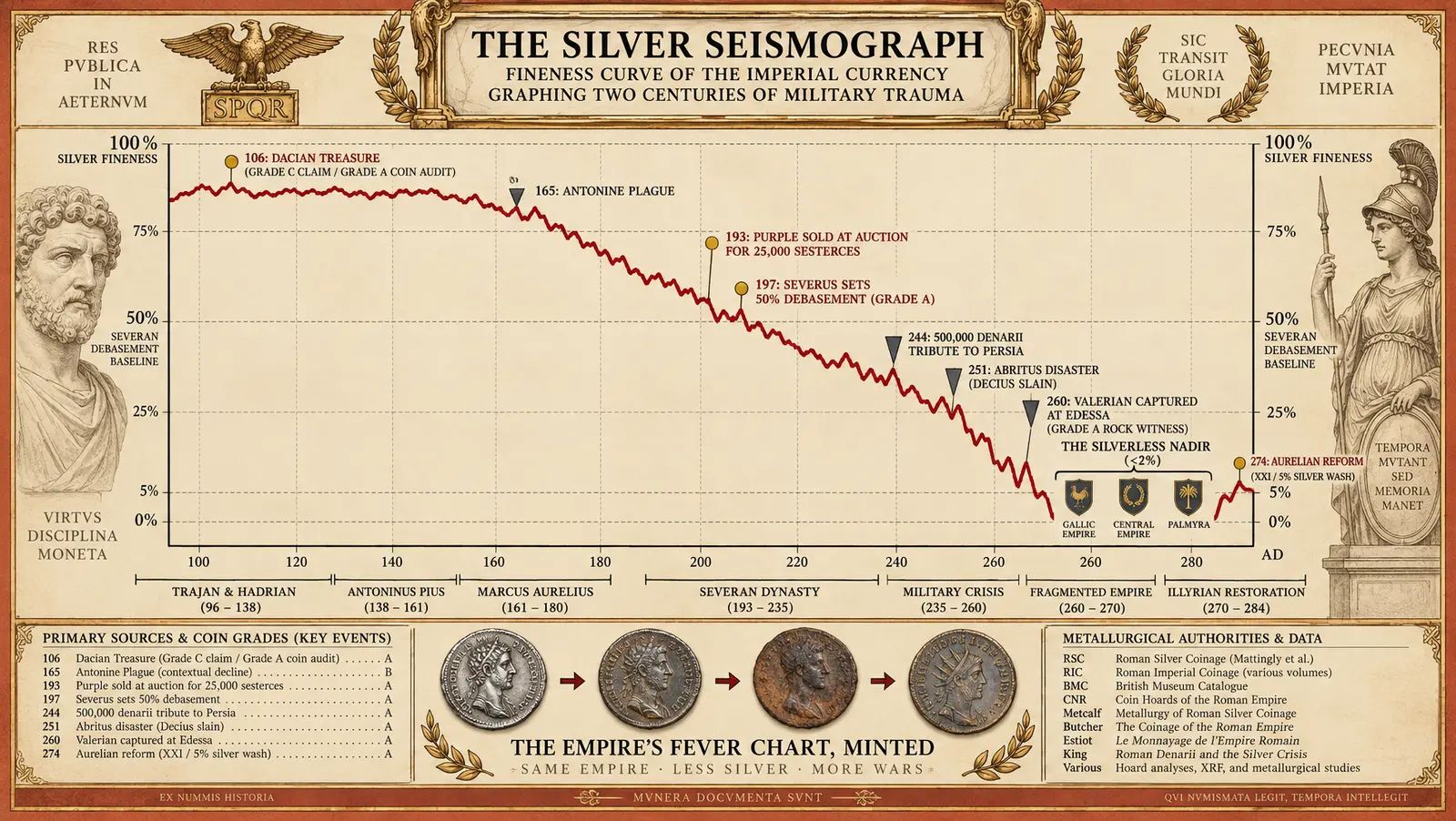
The empire's fever chart, minted.
DESIGN BRIEF: VII-G01 — THE SILVER SEISMOGRAPH
1. PURPOSE & EDITORIAL THESIS
This plate functions as the core quantitative exhibit of Book VII: The High Empire and the Long Crisis (96–284). It visualizes the metallurgical collapse of the imperial currency (the silver denarius and its double-denomination successor, the antoninianus/aurelianianus) as an attestation-graded fever chart.
As established in the volume's Proem and Epilogue, when narrative historians fall silent (Dio ending in 229, Herodian in 238, and the Historia Augusta descending into DGrade D fabrication), the coins provide an unbribable, continuous material witness (AGrade A / Tier 1). Every major plunge in silver purity correlates with operational shocks: civil wars, barbarian penetrations, devastating pandemics, and the structural necessity to bribe the frontier legions upon whose swords imperial survival depended.
2. STRUCTURAL ARCHITECTURE & SPECS
- Aspect Ratio: 16:9 widescreen panoramic data display.
- Framing: Heavy outer architectural frame in Terracotta (
#A85638) with inner fillet in Imperial Gold (#B89954). - Background Field: Aged vellum / warm cream ground (
#F4EBD5) with faint sepia grid lines for percentage and chronology. - Axes Grid:
- Vertical Axis (Y-Axis, Left & Right): Denarius/Antoninianus Silver Fineness Percentage from 0% to 100%, marked at 10% intervals with major milestone baselines at 100%, 75%, 50% (The Severan Baseline), 20%, and 5% (The Aurelian Reform Floor).
- Horizontal Axis (X-Axis, Bottom): Chronological year-rail running from 96 to 284 AD, divided into the volume's seven primary dynastic/operational eras.
3. COLOR CODING & VISUAL TAXONOMY
- The Silver Curve (Primary Seismic Line): Deep Roman Crimson (
#8B1A1A) tracking metallurgical fineness across time. Line width thickens at major plunges; area beneath the line receives a faint, graduated crimson-to-ash wash. - Monetary & State Interventions: Warm Imperial Gold (
#B89954) and Terracotta (#A85638) callout pins, denoting stipendium increases, debasements, and currency reforms. - Severan & Palmyrene Sub-tracks: Punic Ochre (
#B5824A) text accents and provincial secession markers. - External Shocks & Enemy Impacts: Cold Iron-Grey (
#4A4A4A) chevron markers pointing downward directly into the curve's valleys, indicating frontier breaches, plagues, and catastrophic battlefield losses.
4. CHRONOLOGICAL PHASES, DATA NODES & PINNED ANNOTATIONS
PHASE I: THE ANTONINE PEAK & SECURE HIGH-WATER MARK (96–161 AD)
- Baseline Fineness: ~90–80% Fine Silver.
- 96–117 (Trajan): High, stable curve.
- Marker 1 (101–106): "DACIAN BOOTY AUDIT" — Annotation: "165 TONS GOLD · 331 TONS SILVER (TRADITION CLAIM: GRADE C; AUDITED BY COIN MASS: GRADE A)".
- Marker 2 (113–117): "PARTHIAN WAR & DIASPORA REVOLT" — Annotation: "EXPANSION CEILING REACHED · TROOPS CONCENTRATED AT PERSIAN GULF".
- 117–138 (Hadrian):
- Marker 3 (117): "RENUNCIATION & PERIMETER" — Coin legend flag: "DISCIPLINA AUGUSTI · CONQUEST HALTED TO PRESERVE SOLVENCY".
- Marker 4 (132–136): "BAR KOKHBA REVOLT" — Heavy military expenditure marker; "XXII DEIOTARIANA EXPUNGED".
- 138–161 (Antoninus Pius):
- Marker 5 (c. 150): "AEQUANIMITAS: THE EMPTIED CRISIS REGISTER" — Annotation: "TWENTY-THREE YEARS WITHOUT A CAMPAIGN · FULL TREASURY · ZERO DEBASEMENT".
PHASE II: THE DOUBLE EMERGENCY & THE PLAGUE SLIDE (161–192 AD)
- Descent: Curve dips from ~80% down toward ~70%.
- 161–180 (Marcus Aurelius):
- Shock 1 (165–189): Iron-grey skull glyph — "PESTILENTIA ANTONINIANA" — Annotation: "SMALLPOX SWEEPS EMPIRE · 1/3 TAXABLE RECRUITS LOST (GRADE A) · MINTS THINNED".
- Shock 2 (166/7–175): Iron-grey chevron — "MARCOMANNIC INVASIONS" — Annotation: "BARBARIANS IN ITALY · IMPERIAL PALACE FURNISHINGS AUCTIONED IN FORUM TO FUND DEFENSE".
- 180–192 (Commodus):
- Marker 6 (180): "PEACE PURCHASED ON DANUBE" — Subsidies substituted for field annexation.
PHASE III: THE SEVERAN FISCAL RECONSTRUCTION (193–235 AD)
- The Structural Halving: Sharp, vertical plunge to ~50% Fine Silver.
- 193 (The Succession Crisis):
- Shock 3 (28 March 193): Terracotta auction flag — "THE EMPIRE AT AUCTION" — Annotation: "PRAETORIANS SELL PURPLE AT 25,000 SESTERCES PER MAN (GRADE A)".
- Marker 7 (194–197): "CIVIL WARS: ISSUS & LUGDUNUM" — Massive Roman casualty horizon.
- 197 (Septimius Severus Reform):
- Marker 8 (197): Gold Cartouche Pin — "DITATE MILITES: THE 50% LINE" — Annotation: "DENARIUS DEBASED DELIBERATELY TO ~50% FINE SILVER (GRADE A) · SOLDIER PAY RAISED · IUS CONUBII ENACTED".
- 211–217 (Caracalla) & 222–235 (Severus Alexander):
- Marker 9 (212): "CONSTITUTIO ANTONINIANA" — Universal citizenship enacted for inheritance/tax extraction.
- Shock 4 (224–226): Iron-grey Sasanian crest glyph — "SASANIAN REVOLUTION" — Annotation: "ARDASHIR I OVERTHROWS ARSACIDS · CENTRALIZED PEER COMPETITOR EMERGES".
- Shock 5 (March 235): Blood droplet marker — "MUTINY AT MOGONTIACUM" — Annotation: "SEVERUS ALEXANDER SLAIN · MAXIMINUS THRAX ELEVATED · RANKER-EMPEROR ERA BEGINS".
PHASE IV: THE COLLAPSE & THE CATASTROPHIC DECADE (235–260 AD)
- Freefall: The curve cascades precipitously from ~50% to under ~10%.
- 238 (Year of Six Emperors): Multi-pronged dagger glyph — civil breakdown.
- 244 (Gordian III Dead at Misiche):
- Marker 10: Terracotta defeat pin — "500,000 DENARII TRIBUTE TO SHAPUR I" — Annotation: "OFFICIAL PERSIAN RES GESTAE DIVI SAPORIS (GRADE A) VS PAX FUNDATA CUM PERSIS COIN FICTION".
- 248 (Secular Games): "THE SICK MILLENNIUM: ROME 1000 YEARS OLD WITH COLLAPSING COINAGE".
- 251 (Abritus & Plague):
- Shock 6 (June 251): Iron-grey double-skull glyph — "DISASTER AT ABRITUS & PLAGUE OF CYPRIAN" — Annotation: "DECIUS AND HEIR KILLED IN DOBRUJA BOGS (FIRST EMPEROR SLAIN BY EXTERNAL FOE) · POPULATION THINNED".
- Mid-250s (Dura-Europos Siege):
- Shock 7: Sulfur flame glyph — "CHEMICAL WAR AT TOWER 19 · GARRISON EXTERMINATED (GRADE A)".
- 260 (The Nadir of Rome — Edessa):
- Shock 8 (260): Massive Iron-grey capture-star — "VALERIAN TAKEN ALIVE BY SHAPUR I" — Annotation: "ONLY EMPEROR EVER CAPTURED BY FOREIGN ENEMY · 70,000 TROOPS INTO CAPTIVITY (GRADE A)".
PHASE V: THE SILVERLESS VALLEY & SECESSION (260–268 AD)
- Floor: Silver fineness bottoms out between 0.5% and 2.5% (virtually bronze washed in tin/trace silver).
- 260–268 (Gallienus & The Fragmented Empire):
- Marker 11: Secession split-bracket — "TRIPARTITE SECESSION" — Annotation: "IMPERIUM GALLIARUM (POSTUMUS) & PALMYRENE EAST (ODAENATHUS / ZENOBIA) DEFEND SECTORS AS CENTRAL MINT COLLAPSES".
- Marker 12 (c. 265): Mobile Cavalry glyph — "THE MEDIOLANUM INNOVATION" — Annotation: "GALLIENUS ASSEMBLES MOBILE RESERVE (EQUITES) · EQUESTRIAN REVOLUTION REPLACES SENATORS".
PHASE VI: THE ILTON-RESTITUTOR STABILIZATION (268–284 AD)
- Recovery: Sharp stepped plateau upward to ~5% with guaranteed silver surface.
- 269 (Claudius II): "VICTORY AT NAISSUS · BALKANS CLEARED OF GOTHS".
- 270–275 (Aurelian — Restitutor Orbis):
- Marker 13 (271): Brick wall glyph — "THE WALL OF AURELIAN BEGUN" — Annotation: "19 KM BRICK CIRCUIT AROUND ROME · THE CAPITAL PUTS ON ARMOR".
- Marker 14 (271): Evacuation chevron — "DACIA RELICTA" — Annotation: "TRAJANIC PROVINCE ABANDONED TO SHORTER DANUBE DEFENSE".
- Marker 15 (274): Gold double-clasp — "IMPERIUM RESTITUTUM" — Annotation: "ZENOBIA IN CHAINS · GALLIC REALM REABSORBED AT CHÂLONS".
- Marker 16 (274): Coin stamp glyph — "AURELIANIANUS CURRENCY REFORM" — Annotation: "SILVER-WASHED RADIATE COIN INTRODUCED (XXI MARK = 5% SILVER) · SENATORIAL MINT REVOLT CRUSHED".
- 276–282 (Probus): "FRONTIER REPAIRS & BARBARIAN LAETI SETTLEMENTS".
- 284 (Diocletian):
- Marker 17 (20 November 284): Gold imperial diadem glyph — "ACCLAMATION AT NICOMEDIA" — Annotation: "DALMATIAN CAVALRY GENERAL PROCLAIMED · THE REORGANIZED STATE (DOMINATE) COMMENCES".
5. FOOTER & METHODOLOGY DATA BOX
- Left Box (Methodological Rule): "WITNESSES THAT CANNOT LIE IN PROSE: Coin metallurgy, hoard burial dates, and epigraphy provide AGrade A material control where senatorial histories fail (Dio ends 229, Herodian ends 238; Historia Augusta rejected as DGrade D fabrication)."
- Right Box (Attestation Tiers): "Tier 1 (A): Physical Coin Analyses (Butcher–Ponting, Harl), Res Gestae Divi Saporis, Dura Papyri, Aurelian Wall. Tier 2 (B): Cassius Dio (autoptic sections), Dexippus fragments. Tier 3–4 (C/D): KG Epitomators (C), Historia Augusta fiction (D, excluded)."
- Center Bottom Cartouche: "THE EMPIRE'S FEVER CHART, MINTED · IMPERIUM ROMANUM VII".
Image prompt (16:9)
A rigorous, masterfully drafted historical infographic titled "THE SILVER SEISMOGRAPH: Denarius and Antoninianus Silver Content, AD 96–284" in an authentic classical-academic cartographic style. Wide 16:9 aspect ratio. Warm aged cream vellum paper background (#F4EBD5) framed by a crisp terracotta border (#A85638) with an inner fine gold line (#B89954). At the center, a jagged, prominent seismic-style fever line in deep Roman crimson (#8B1A1A) tracks the catastrophic collapse of Roman silver coinage purity across nearly two centuries, plunging from an Antonine plateau of over 85% down through the 50% Severan baseline to a near-zero bronze trough in the 260s, followed by a slight stepped recovery at the 5% mark. The Y-axis on both left and right is calibrated neatly from "0%" to "100% SILVER FINENESS" with clean dashed grid lines at 100%, 75%, "50% SEVERAN DEBASEMENT BASELINE", 25%, and 5%. The X-axis spans horizontally with distinct reign brackets: "TRAJAN & HADRIAN (96–138)", "ANTONINUS PIUS (138–161)", "MARCUS AURELIUS (161–180)", "SEVERAN DYNASTY (193–235)", "MILITARY CRISIS (235–260)", "FRAGMENTED EMPIRE (260–270)", and "ILLYRIAN RESTORATION (270–284)". Pinned along the crimson plunge-line are exquisite serif text callouts, historical marker flags, and tiny iconographic symbols: gold pins at "106: DACIAN TREASURE (GRADE C CLAIM / GRADE A COIN AUDIT)", "193: PURPLE SOLD AT AUCTION FOR 25,000 SESTERCES", "197: SEVERUS SETS 50% DEBASEMENT (GRADE A)", and "274: AURELIAN REFORM (XXI / 5% SILVER WASH)"; iron-grey downward shock chevrons labeled "165: ANTONINE PLAGUE", "244: 500,000 DENARII TRIBUTE TO PERSIA", "251: ABRITUS DISASTER (DECIUS SLAIN)", and "260: VALERIAN CAPTURED AT EDESSA (GRADE A ROCK WITNESS)". In the lower valley between 260 and 268, an iron-grey bracket marks "THE SILVERLESS NADIR (<2%)" beside three small realm shields: "GALLIC EMPIRE", "CENTRAL EMPIRE", and "PALMYRA". In the upper center, an ornate gold titling cartouche reads: "THE SILVER SEISMOGRAPH" with the subtitle "FINENESS CURVE OF THE IMPERIAL CURRENCY GRAPHING TWO CENTURIES OF MILITARY TRAUMA". At the bottom base, a detailed two-column data box lists source grades and metallurgical authorities, anchored by the central caption in clean Roman capitals: "THE EMPIRE'S FEVER CHART, MINTED". Flawless museum-catalogue engraving aesthetic, perfectly crisp legible typography, no modern digital artifacts, authentic historical infographic rendering.
VII-G01 · generated by the Imperium factory studio (gemini-3.8-flash) from Book VII under the House Preamble.