Book VII · The High Empire and the Long Crisis
Mind map · VII-M03
The Third-Century Crisis Debate
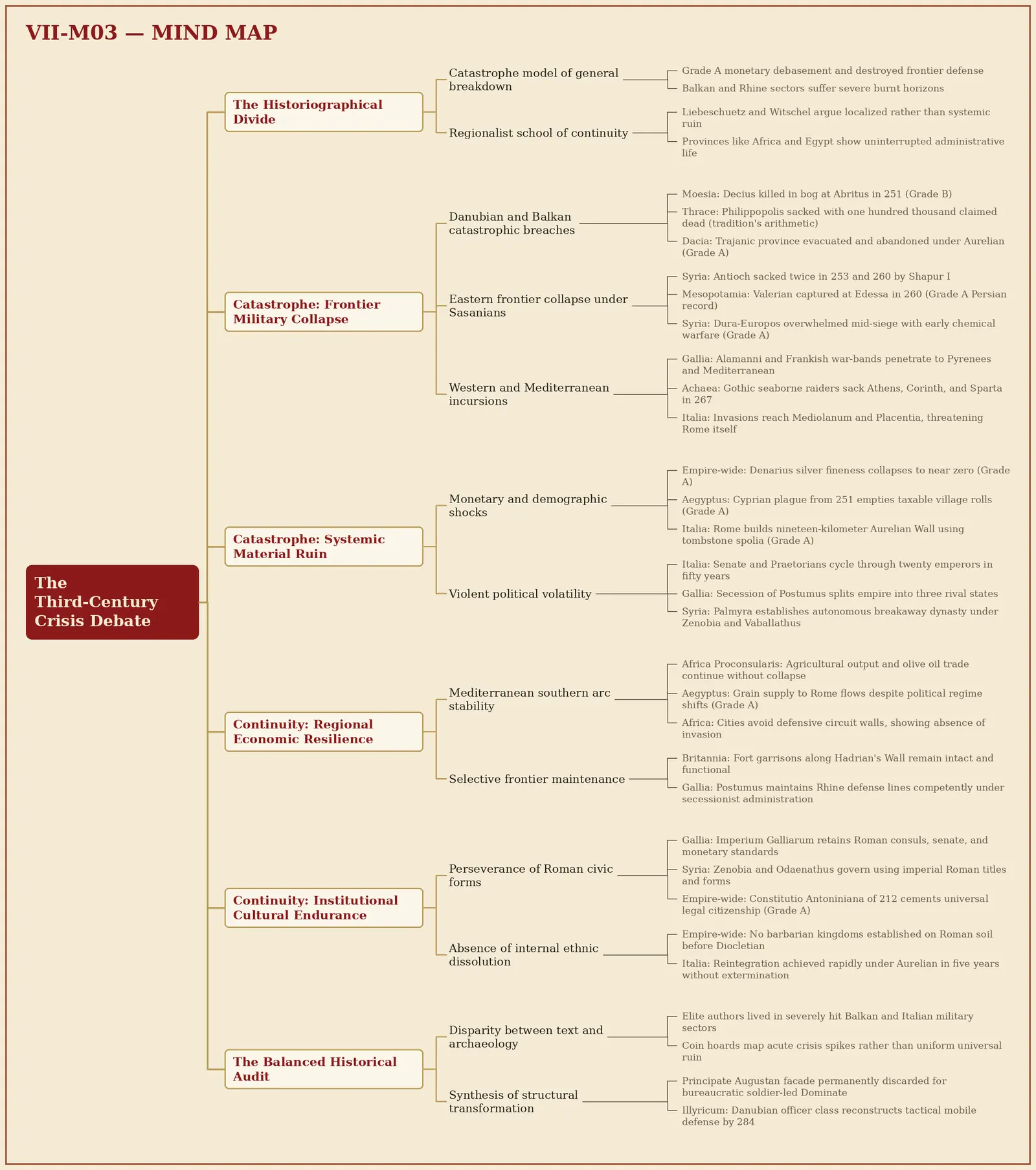
- The Historiographical Divide
- Catastrophe model of general breakdown
- AGrade A monetary debasement and destroyed frontier defense
- Balkan and Rhine sectors suffer severe burnt horizons
- Regionalist school of continuity
- Liebeschuetz and Witschel argue localized rather than systemic ruin
- Provinces like Africa and Egypt show uninterrupted administrative life
- Catastrophe model of general breakdown
- Catastrophe: Frontier Military Collapse
- Danubian and Balkan catastrophic breaches
- Moesia: Decius killed in bog at Abritus in 251 (BGrade B)
- Thrace: Philippopolis sacked with one hundred thousand claimed dead (tradition's arithmetic)
- Dacia: Trajanic province evacuated and abandoned under Aurelian (AGrade A)
- Eastern frontier collapse under Sasanians
- Syria: Antioch sacked twice in 253 and 260 by Shapur I
- Mesopotamia: Valerian captured at Edessa in 260 (AGrade A Persian record)
- Syria: Dura-Europos overwhelmed mid-siege with early chemical warfare (AGrade A)
- Western and Mediterranean incursions
- Gallia: Alamanni and Frankish war-bands penetrate to Pyrenees and Mediterranean
- Achaea: Gothic seaborne raiders sack Athens, Corinth, and Sparta in 267
- Italia: Invasions reach Mediolanum and Placentia, threatening Rome itself
- Danubian and Balkan catastrophic breaches
- Catastrophe: Systemic Material Ruin
- Monetary and demographic shocks
- Empire-wide: Denarius silver fineness collapses to near zero (AGrade A)
- Aegyptus: Cyprian plague from 251 empties taxable village rolls (AGrade A)
- Italia: Rome builds nineteen-kilometer Aurelian Wall using tombstone spolia (AGrade A)
- Violent political volatility
- Italia: Senate and Praetorians cycle through twenty emperors in fifty years
- Gallia: Secession of Postumus splits empire into three rival states
- Syria: Palmyra establishes autonomous breakaway dynasty under Zenobia and Vaballathus
- Monetary and demographic shocks
- Continuity: Regional Economic Resilience
- Mediterranean southern arc stability
- Africa Proconsularis: Agricultural output and olive oil trade continue without collapse
- Aegyptus: Grain supply to Rome flows despite political regime shifts (AGrade A)
- Africa: Cities avoid defensive circuit walls, showing absence of invasion
- Selective frontier maintenance
- Britannia: Fort garrisons along Hadrian's Wall remain intact and functional
- Gallia: Postumus maintains Rhine defense lines competently under secessionist administration
- Mediterranean southern arc stability
- Continuity: Institutional Cultural Endurance
- Perseverance of Roman civic forms
- Gallia: Imperium Galliarum retains Roman consuls, senate, and monetary standards
- Syria: Zenobia and Odaenathus govern using imperial Roman titles and forms
- Empire-wide: Constitutio Antoniniana of 212 cements universal legal citizenship (AGrade A)
- Absence of internal ethnic dissolution
- Empire-wide: No barbarian kingdoms established on Roman soil before Diocletian
- Italia: Reintegration achieved rapidly under Aurelian in five years without extermination
- Perseverance of Roman civic forms
- The Balanced Historical Audit
- Disparity between text and archaeology
- Elite authors lived in severely hit Balkan and Italian military sectors
- Coin hoards map acute crisis spikes rather than uniform universal ruin
- Synthesis of structural transformation
- Principate Augustan facade permanently discarded for bureaucratic soldier-led Dominate
- Illyricum: Danubian officer class reconstructs tactical mobile defense by 284
- Disparity between text and archaeology
VII-M03 · generated by the Imperium factory studio (gemini-3.8-flash) from Book VII under the House Preamble.