Book VIII · The Last Age of the West
Infographic · VIII-G03
THE RECEPTIO (376–382)
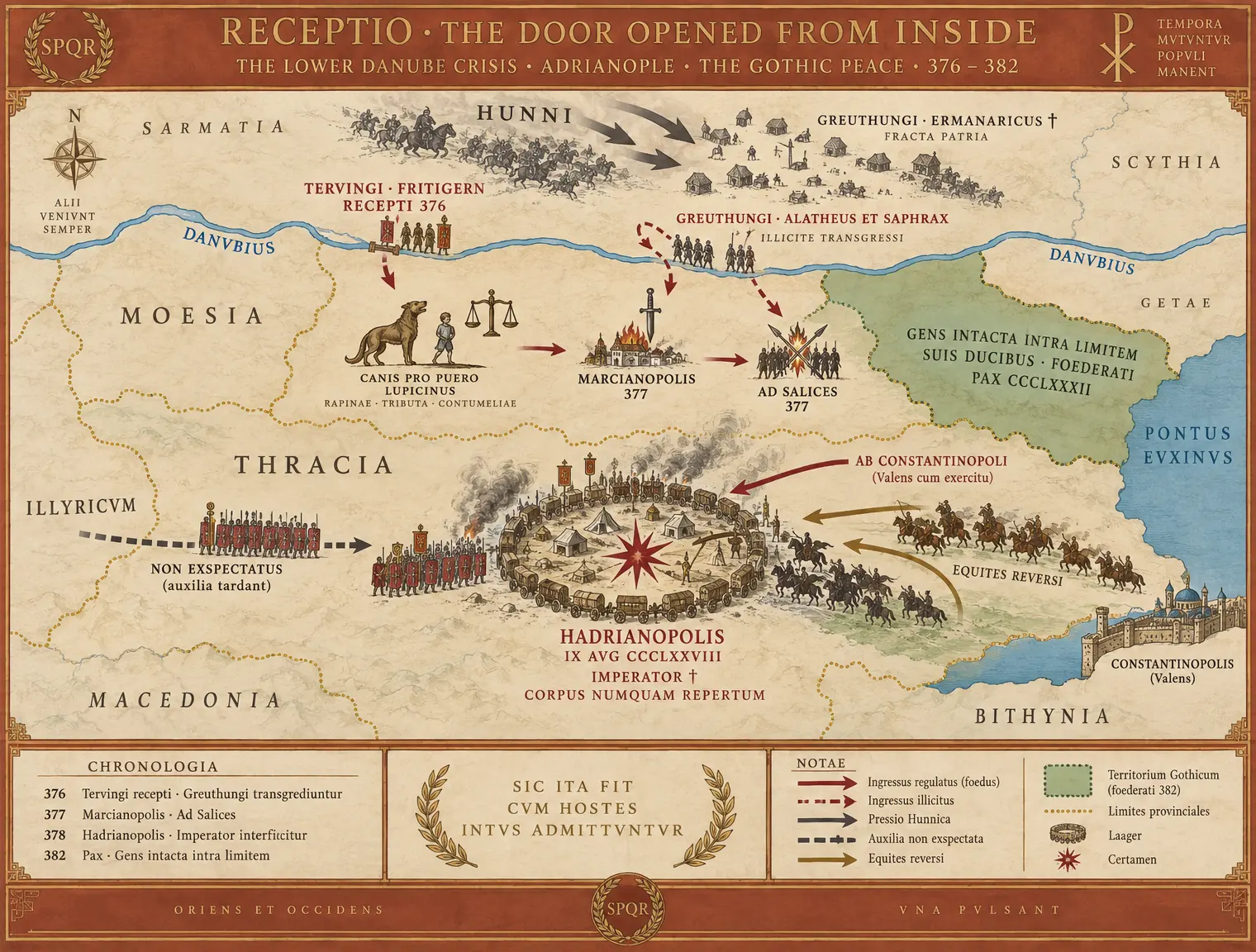
The door opened from inside: how a corrupt humanitarian crossing on the Danube became the catastrophe of Adrianople and the empire's first permanent federate partition.
Strategic Diagram Brief: THE RECEPTIO — The Door Opened from Inside (376–382)
1. Purpose and Thesis
This diagram tracks the structural pivot of the late empire: the collapse of the Roman Danube frontier not through sudden foreign breakthrough, but through a licensed entry (receptio) systematically corrupted by administrative extortion, resulting in military disaster at Adrianople and the institutional cession of imperial territory to an autonomous armed nation. It charts the four-phase chain of causation between the autumn of 376 and the treaty of 3 October 382.
2. Palette Architecture & Graphic Values
- Background (Base Paper): Cream (#F4EBD5).
- Imperial Sovereignty / Command: Roman Crimson (#8B1A1A).
- Provincial Interior / Roman Infrastructure: Punic Ochre (#B5824A).
- Steppe Forces / Threat Vectors: Iron-Grey (#2A2A2A).
- Successor Color (Autonomous Federate Settlement): Bronze-Green (#4B5B42) — the first non-crimson sovereign territory admitted inside the imperial frontier.
- Cartouche, Borders, & Accents: Gold (#B89954) headers and titling; Terracotta (#A85638) outer structural rule and framing.
3. Panel-by-Panel Layout & Visual Schema (Historical Atlas Register, 4:3 Horizontal)
Cartouche & Header (Top Margin)
- Top Frame: Terracotta (#A85638) double border.
- Gold Cartouche (#B89954): Centered title:
"RECEPTIO · THE DOOR OPENED FROM INSIDE" - Subtitle:
"The Danubian Catastrophe and the Gothic Settlement, 376–382"
Sector 1: The Frontier Breach (North / Upper Map Register)
- Steppe Shock: North of the Danube, an Iron-Grey (#2A2A2A) pressure-arrow labeled
"HUNNI"strikes the Gothic homelands, marked by a shattered tribal glyph:"GREUTHUNGI · ERMANARICUS †"and displacement vectors pushing toward the river. - The Danube Line: The river rendered as a broad Punic Ochre (#B5824A) and blue-tinted defensive ribbon.
- The Regulated Crossing (Crimson Ferry Glyph): Roman-monitored checkpoint labeled
"TERVINGI · FRITIGERN · RECEPTI 376"(Attestation AGrade A for crossing; CGrade C for numbers). - The Unmonitored Breach (Dashed Vector): East of the crossing point, an uncontrolled passage marked:
"GREUTHUNGI · ALATHEUS ET SAPHRAX"crossing without Roman sanction.
Sector 2: The Provocation & Outbreak (Thracian Interior, 376–377)
- Extortion Symbol: A pair of scales balancing a carcass against a child, captioned:
"CANIS PRO PUERO — LUPICINUS"(Attestation AGrade A prosecution outline, Ammianus 31.4: dog-flesh sold at the price of a child per dog). - The Banquet Ambush: At Marcianople, a dagger glyph marked
"MARCIANOPOLIS 377 · CONVIVIUM ERRORE FRACTUM"(AGrade A event). - The Rising: Radiating tactical arcs showing Gothic columns guided inland:
"SERVI ET METALLARII DUCES"(AGrade A). - Holding Action: Battle-star on the lower Danube:
"AD SALICES 377"(BGrade B drawn battle).
Sector 3: The Annihilation (Adrianople, 9 August 378)
- The Roman Advance: A solid Crimson (#8B1A1A) column advancing from Constantinople under Valens. From the west, an aborted relief arrow from the Rhine under Gratian, broken off and annotated:
"NON EXSPECTATUS"(AGrade A). - The Tactical Trap: A circular wagon-laager glyph labeled
"CARRAGO". The Roman infantry block depicted compressed against the laager perimeter. - The Flank Stroke: A jagged lightning vector descending from the northern heights onto the exposed Roman left:
"EQUITES REVERSI · ALATHEUS ET SAPHRAX"(BGrade B tactical sequence). - Disaster Marker: Black-and-crimson battle star labeled
"HADRIANOPOLIS · IX AUG CCCLXXVIII"with casualty data-block:"EXERCITUS ORIENTALIS DUAE PARTES DELETAE · VALENS IMPERATOR † · CORPUS NUMQUAM REPERTUM"(AGrade A scale-class / disappearance).
Sector 4: The Structural Settlement (Balkans / Thrace, 3 October 382)
- The Sovereign Inset / Wash: A contiguous inland region of Thrace washed in Bronze-Green (#4B5B42) across the interior.
- Treaty Formula (Gold Box):
"PAX CCCLXXXII · GENS INTACTA INTRA LIMITEM · SUIS DUCIBUS · FOEDERATI"(Terms: CGrade C inference; Treaty occurrence: AGrade A). - Legend Note:
"The First Non-Imperial Color Inside the Frontier in Eight Volumes."
4. Ledger & Attestation Footnote (Bottom Margin)
- Small-caps audit strip along bottom frame:
"SOURCES: AMMIANUS MARCELLINUS 31 (GRADE A) · THEMISTIUS OR. 16/34 (GRADE A AS IDEOLOGY) · ZOSIMUS 4 (GRADE C) · CODEX THEODOSIANUS (GRADE A). TERMS OF 382 RECONSTRUCTED FROM HISTORICAL BEHAVIOR."
Image prompt (4:3)
A stylized historical-atlas crisis configuration map titled 'RECEPTIO · THE DOOR OPENED FROM INSIDE', tracking the lower Danube crisis, Adrianople, and the Gothic peace from 376 to 382. Rendered in a clean late-Roman cartographic register on cream ground (#F4EBD5) with terracotta framing (#A85638) and gold display titling (#B89954). In the upper sector, an iron-grey pressure vector labeled 'HUNNI' shatters the gothic homeland marked 'GREUTHUNGI · ERMANARICUS †'. At the blue Danube river line, two crossings are marked: a regulated crimson crossing glyph labeled 'TERVINGI · FRITIGERN · RECEPTI 376' and a dashed illicit vector labeled 'GREUTHUNGI · ALATHEUS ET SAPHRAX'. In Thrace below the river, an extortion symbol of a dog and scales is inscribed 'CANIS PRO PUERO — LUPICINUS', leading to a dagger glyph at 'MARCIANOPOLIS 377' and an engagement star at 'AD SALICES 377'. To the south, the convergence of 378 is drawn with a crimson arrow from Constantinople and an interrupted relief vector from the west annotated 'NON EXSPECTATUS'. Outside Adrianople, a massive circular wagon-laager is assaulted by the Roman line, struck in the flank by a lightning cavalry arrow labeled 'EQUITES REVERSI', centered on a catastrophic battle-star marked 'HADRIANOPOLIS · IX AUG CCCLXXVIII' and 'IMPERATOR † CORPUS NUMQUAM REPERTUM'. Across northern Thrace, a distinct bronze-green territory is washed into the interior, bordered with the treaty legend: 'GENS INTACTA INTRA LIMITEM · SUIS DUCIBUS · FOEDERATI · PAX CCCLXXXII'. Precise, immaculate late-antique epigraphic serif lettering, no modern decorative fluff, historical atlas quality, 4:3 aspect ratio.
VIII-G03 · generated by the Imperium factory studio (gemini-3.8-flash) from Book VIII under the House Preamble.