Book VIII · The Last Age of the West
Infographic · VIII-G04
ADRIANOPLE: THE RETURNING CAVALRY
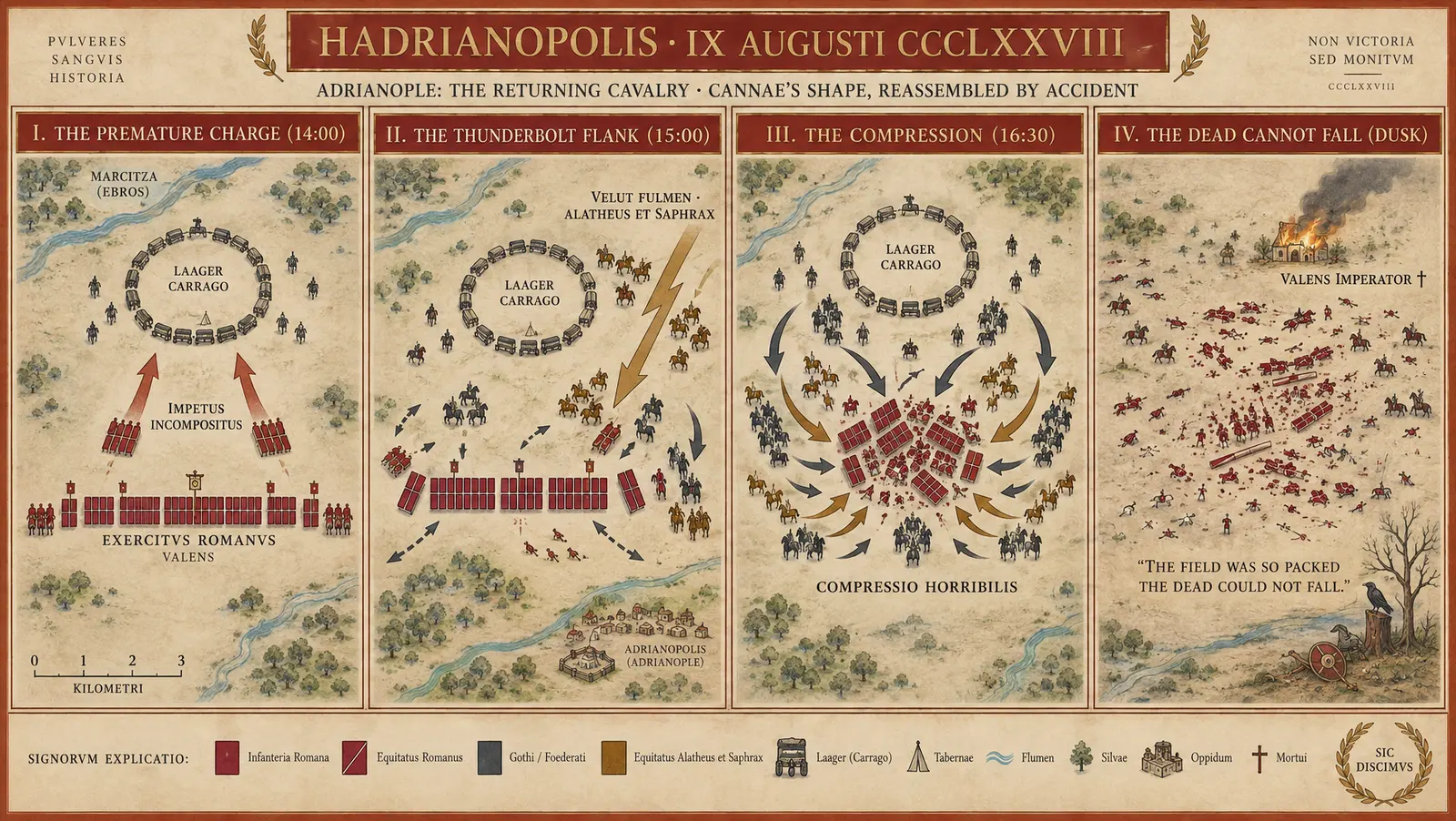
Cannae's shape, reassembled by accident.
Infographic Design Brief: Adrianople — The Returning Cavalry (9 August 378)
1. Purpose and Historical Thesis
An operational phase-strip analyzing the collapse of the Roman eastern field army before the Gothic wagon-laager at Adrianople. The plate illustrates Ammianus Marcellinus’s tactical reconstruction (Book 31): how an uncoordinated initial assault, compounded by the sudden arrival of Gothic-Alan foraging cavalry on the Roman left flank, compressed the Roman infantry into a dense mass incapable of maneuver or defense—reproducing the geometry of Cannae entirely by contingency rather than strategic trap.
2. Layout Architecture
- Orientation & Aspect Ratio: 16:9 horizontal strip, divided into four sequential chronological panels framed within an external terracotta border (
#A85638) on a warm cream ground (#F4EBD5). - Header Banner: Full-width gold cartouche (
#B89954) across the top featuring the primary title and subtitle. - Four Sequential Panels (Left-to-Right Progression):
- Panel I: The Premature Charge (14:00) — The uncoordinated opening and disordered deployment.
- Panel II: The Thunderbolt Flank (15:00) — The arrival of Alatheus and Saphrax.
- Panel III: The Compression (16:30) — The collapse of the cavalry wings and infolding of the legions.
- Panel IV: The Field Too Packed to Fall (18:00–Dusk) — The slaughter, encirclement, and dissolution.
- Footer Ledger: Statistical ledger comparing Adrianople to Cannae, noting source attestation grades and transmission limits.
3. Panel-by-Panel Specifications
Header
- Title (Gold Cartouche): "HADRIANOPOLIS · IX AUGUSTI CCCLXXVIII"
- Subtitle: "ADRIANOPLE: THE RETURNING CAVALRY · CANNAE'S SHAPE, REASSEMBLED BY ACCIDENT"
Panel I: The Premature Charge (14:00)
- Context: After an 8-mile march in scorching August heat over broken ground, Valens deploys facing the Gothic wagon-laager (carrago). Negotiations between Valens and Fritigern are underway.
- Tactical Diagram:
- North: Gothic wagon-ring (circular dark iron-grey barrier
#3A3D40, labeled"LAAGER / CARRAGO (FRITIGERN)"). - South: Deploying Roman lines (Roman crimson
#8B1A1A). The left cavalry is still straggling into line; the infantry center forms an extended front. - Vector: Two vanguard units on the Roman right wing (Ibiel archers and Scutarii) break discipline and surge forward in an unsupported assault without imperial orders (dashed crimson arrow labeled
"IMPETUS INCOMPOSITUS · CHARGE WITHOUT ORDERS").
- North: Gothic wagon-ring (circular dark iron-grey barrier
- Panel Annotations:
"ROMAN FORCES: 20,000–30,000 [GRADE C: MODERN CONSENSUS]""TERVINGI: TEN THOUSAND ESTIMATED [GRADE C: FAULTY INTELLIGENCE]""NEGOTIATIONS INTERRUPTED"
Panel II: The Thunderbolt Flank (15:00)
- Context: The premature attack is repulsed with loss. Roman left-wing cavalry advances aggressively to the edge of the laager but remains unsupported by infantry reserves.
- Tactical Diagram:
- East: Heavy Greuthungian and Alan cavalry under Alatheus and Saphrax, returning unexpectedly from foraging in the Tundzha valley, slam directly into the exposed flank of the Roman left cavalry.
- Vector: Dynamic ochre lightning bolt/arrow (
#B5824A) striking from off-map east into the Roman left flank, labeled"VELUT FULMEN · ALATHEUS ET SAPHRAX (GREUTHUNGI & ALANI)". - Collision: The advanced Roman cavalry is shattered and driven rearward across its own lines.
- Panel Annotations:
"GOTHIC CAVALRY SURPRISE [GRADE A: AMMIANUS]""ROMAN LEFT CAVALRY COMMITTED PIECEMEAL & ROUTED"
Panel III: The Compression (16:30)
- Context: The flight of the cavalry leaves the Roman infantry flanks entirely uncovered. Gothic warriors pour from the laager as the Alan/Greuthungian horse envelopes both wings.
- Tactical Diagram:
- Centripetal compression: Gothic masses (ochre and dark iron-grey vectors) press inward from three sides, shoving the Roman center backward into its own advancing rearguard.
- The Roman crimson block deforms from a wide line into an agonizingly dense, crushed polygon.
- Dense concentration marks show soldiers unable to lift their shields or draw swords: inward-pointing black pressure wedges labeled
"COMPRESSIO HORRIBILIS".
- Panel Annotations:
"FLANKS STRIPPED · INFANTRY BOXED AGAINST LAAGER""DUST & AUGUST HEAT: MISSILES BLINDLY EFFECTIVE""LINES MERGED SO CLOSE WEAPONS CANNOT BE DRAWN [GRADE B]"
Panel IV: The Field Too Packed to Fall (18:00–Dusk)
- Context: Total structural failure. The Roman line fractures into isolated slaughter-pockets. Valens falls; dusk covers the rout.
- Tactical Diagram:
- The crimson Roman formation disintegrates into broken, cross-hatched casualty zones.
- Outer encircling ring of Gothic horse and foot pressing inward.
- Scattered escape arrows trickling southwest into darkness.
- Burning farmhouse glyph on the southern edge:
"VILLA INCENSA · VALENS IMPERATOR † (CORPUS NUMQUAM REPERTUM)".
- Panel Annotations:
"THE FIELD WAS SO PACKED THE DEAD COULD NOT FALL [GRADE A: AMMIANUS]""TWO-THIRDS OF FIELD ARMY DESTROYED [GRADE C: TRADITION'S ARITHMETIC]""XXXV TRIBUNES & MAGISTRI TRAIANUS ET SEBASTIANUS SLAIN"
4. Footnote & Evidence Ledger
- Comparison Box:
"CANNAE (216 BC): ENCIRCLEMENT BY CALCULATION · REPLACED BY DEPTH""ADRIANOPLE (AD 378): ENCIRCLEMENT BY ACCIDENT · IRREPLACEABLE LOSS"
- Methodological Audit:
"Attestation Grade: A for operational sequence, scale-class, and Valens's death (Ammianus 31). BGrade B for minute tactical timings. CGrade C for all unit counts and casualty totals. DGrade D for providential/theological interpretations."
5. Color Palette & Typography Specifications
- Background: Cream Parchment (
#F4EBD5) - Borders & Frame: Terracotta (
#A85638) - Titles & Embellishments: Gilt Gold (
#B89954) - Roman Formations & Vectors: Imperial Crimson (
#8B1A1A) - Gothic/Alan Cavalry & Mobile Vectors: Danubian Ochre (
#B5824A) - Gothic Laager & Wagon Defense: Weathered Iron-Grey (
#3A3D40) - Typography: Crisp, elegant classical serif display capitals for titles; legible semi-bold serif for tactical unit labels; neat italics for historical Latin quotes.
Image prompt (16:9)
A clean, museum-grade historical military infographic with aspect ratio 16:9, titled 'HADRIANOPOLIS · IX AUGUSTI CCCLXXVIII' in an ornamental gold (#B89954) cartouche at top, subtitled 'ADRIANOPLE: THE RETURNING CAVALRY · CANNAE'S SHAPE, REASSEMBLED BY ACCIDENT'. Framed with a clean terracotta border (#A85638) on an aged cream parchment ground (#F4EBD5). The layout consists of four distinct horizontal progression panels side-by-side, each featuring stylized bird's-eye tactical maps drawn with crisp late-Roman military symbology. Panel 1 is labeled 'I. THE PREMATURE CHARGE (14:00)', showing a Roman crimson (#8B1A1A) rectangular battle-line facing an iron-grey (#3A3D40) circular wagon-laager labeled 'LAAGER / CARRAGO', with two crimson units surging forward under the label 'IMPETUS INCOMPOSITUS'. Panel 2 is labeled 'II. THE THUNDERBOLT FLANK (15:00)', showing a dynamic ochre (#B5824A) lightning-bolt tactical arrow striking the exposed Roman cavalry flank labeled 'VELUT FULMEN · ALATHEUS ET SAPHRAX'. Panel 3 is labeled 'III. THE COMPRESSION (16:30)', illustrating the crimson Roman infantry crushed from both wings into an irregular, dense red block surrounded by dark grey and ochre vectors, labeled 'COMPRESSIO HORRIBILIS'. Panel 4 is labeled 'IV. THE DEAD CANNOT FALL (DUSK)', showing broken crimson remnants shattered across the plain, a burning farmhouse labeled 'VALENS IMPERATOR †', and the quotation 'THE FIELD WAS SO PACKED THE DEAD COULD NOT FALL'. Clear, sharp Roman serif lettering throughout, no modern sans-serif fonts, no blur, strictly following the specified historical-atlas aesthetic.
VIII-G04 · generated by the Imperium factory studio (gemini-3.8-flash) from Book VIII under the House Preamble.