Book VIII · The Last Age of the West
Mind map · VIII-M03
A State Died; Name What Didn't
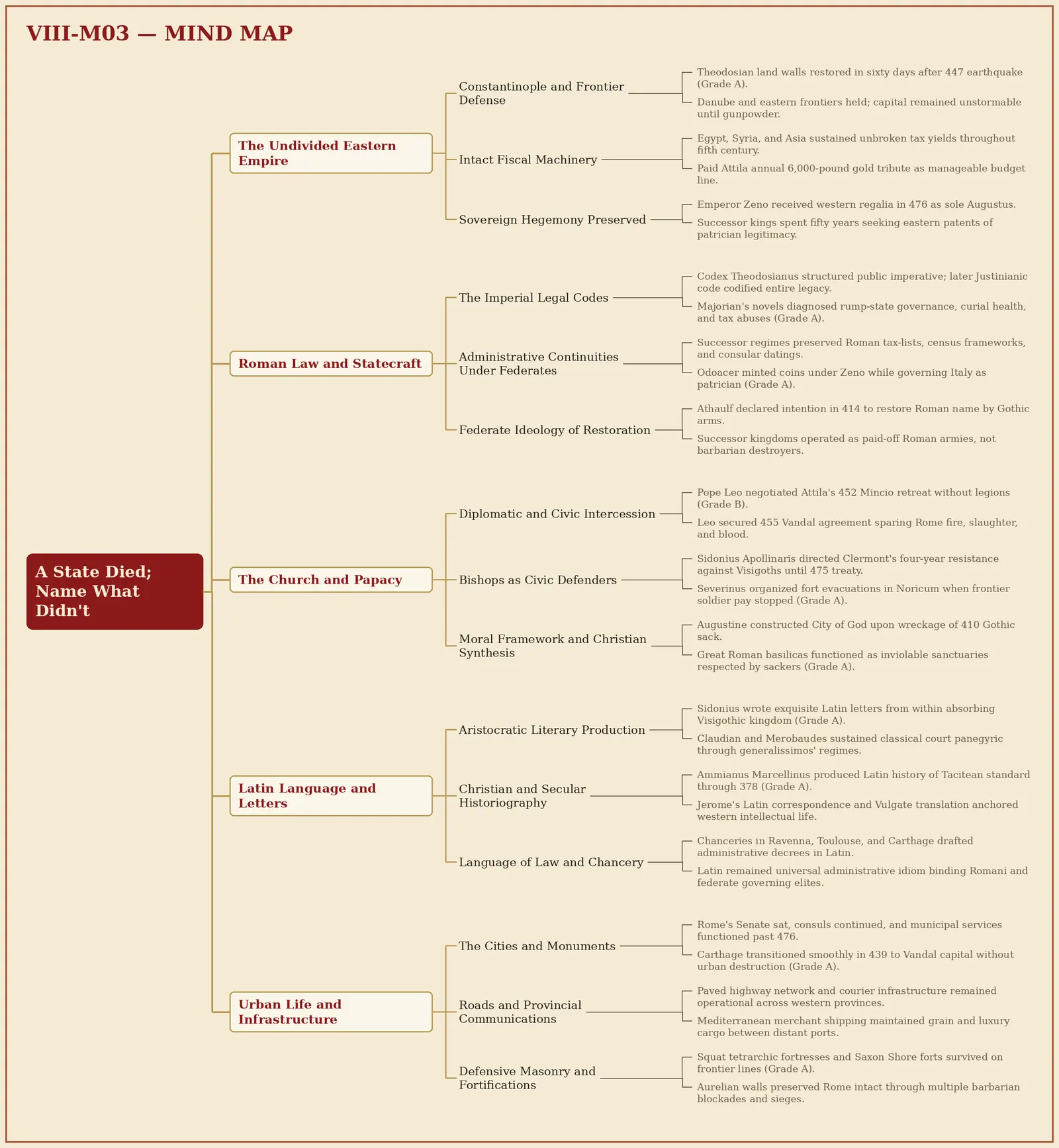
- The Undivided Eastern Empire
- Constantinople and Frontier Defense
- Theodosian land walls restored in sixty days after 447 earthquake (AGrade A).
- Danube and eastern frontiers held; capital remained unstormable until gunpowder.
- Intact Fiscal Machinery
- Egypt, Syria, and Asia sustained unbroken tax yields throughout fifth century.
- Paid Attila annual 6,000-pound gold tribute as manageable budget line.
- Sovereign Hegemony Preserved
- Emperor Zeno received western regalia in 476 as sole Augustus.
- Successor kings spent fifty years seeking eastern patents of patrician legitimacy.
- Constantinople and Frontier Defense
- Roman Law and Statecraft
- The Imperial Legal Codes
- Codex Theodosianus structured public imperative; later Justinianic code codified entire legacy.
- Majorian's novels diagnosed rump-state governance, curial health, and tax abuses (AGrade A).
- Administrative Continuities Under Federates
- Successor regimes preserved Roman tax-lists, census frameworks, and consular datings.
- Odoacer minted coins under Zeno while governing Italy as patrician (AGrade A).
- Federate Ideology of Restoration
- Athaulf declared intention in 414 to restore Roman name by Gothic arms.
- Successor kingdoms operated as paid-off Roman armies, not barbarian destroyers.
- The Imperial Legal Codes
- The Church and Papacy
- Diplomatic and Civic Intercession
- Pope Leo negotiated Attila's 452 Mincio retreat without legions (BGrade B).
- Leo secured 455 Vandal agreement sparing Rome fire, slaughter, and blood.
- Bishops as Civic Defenders
- Sidonius Apollinaris directed Clermont's four-year resistance against Visigoths until 475 treaty.
- Severinus organized fort evacuations in Noricum when frontier soldier pay stopped (AGrade A).
- Moral Framework and Christian Synthesis
- Augustine constructed City of God upon wreckage of 410 Gothic sack.
- Great Roman basilicas functioned as inviolable sanctuaries respected by sackers (AGrade A).
- Diplomatic and Civic Intercession
- Latin Language and Letters
- Aristocratic Literary Production
- Sidonius wrote exquisite Latin letters from within absorbing Visigothic kingdom (AGrade A).
- Claudian and Merobaudes sustained classical court panegyric through generalissimos' regimes.
- Christian and Secular Historiography
- Ammianus Marcellinus produced Latin history of Tacitean standard through 378 (AGrade A).
- Jerome's Latin correspondence and Vulgate translation anchored western intellectual life.
- Language of Law and Chancery
- Chanceries in Ravenna, Toulouse, and Carthage drafted administrative decrees in Latin.
- Latin remained universal administrative idiom binding Romani and federate governing elites.
- Aristocratic Literary Production
- Urban Life and Infrastructure
- The Cities and Monuments
- Rome's Senate sat, consuls continued, and municipal services functioned past 476.
- Carthage transitioned smoothly in 439 to Vandal capital without urban destruction (AGrade A).
- Roads and Provincial Communications
- Paved highway network and courier infrastructure remained operational across western provinces.
- Mediterranean merchant shipping maintained grain and luxury cargo between distant ports.
- Defensive Masonry and Fortifications
- Squat tetrarchic fortresses and Saxon Shore forts survived on frontier lines (AGrade A).
- Aurelian walls preserved Rome intact through multiple barbarian blockades and sieges.
- The Cities and Monuments
VIII-M03 · generated by the Imperium factory studio (gemini-3.8-flash) from Book VIII under the House Preamble.