Book II · The Mediterranean Wars
Chapter 1
The First Punic War: Opening and the Birth of Roman Sea-Power
The Strategic Logic of the Sicilian Theater
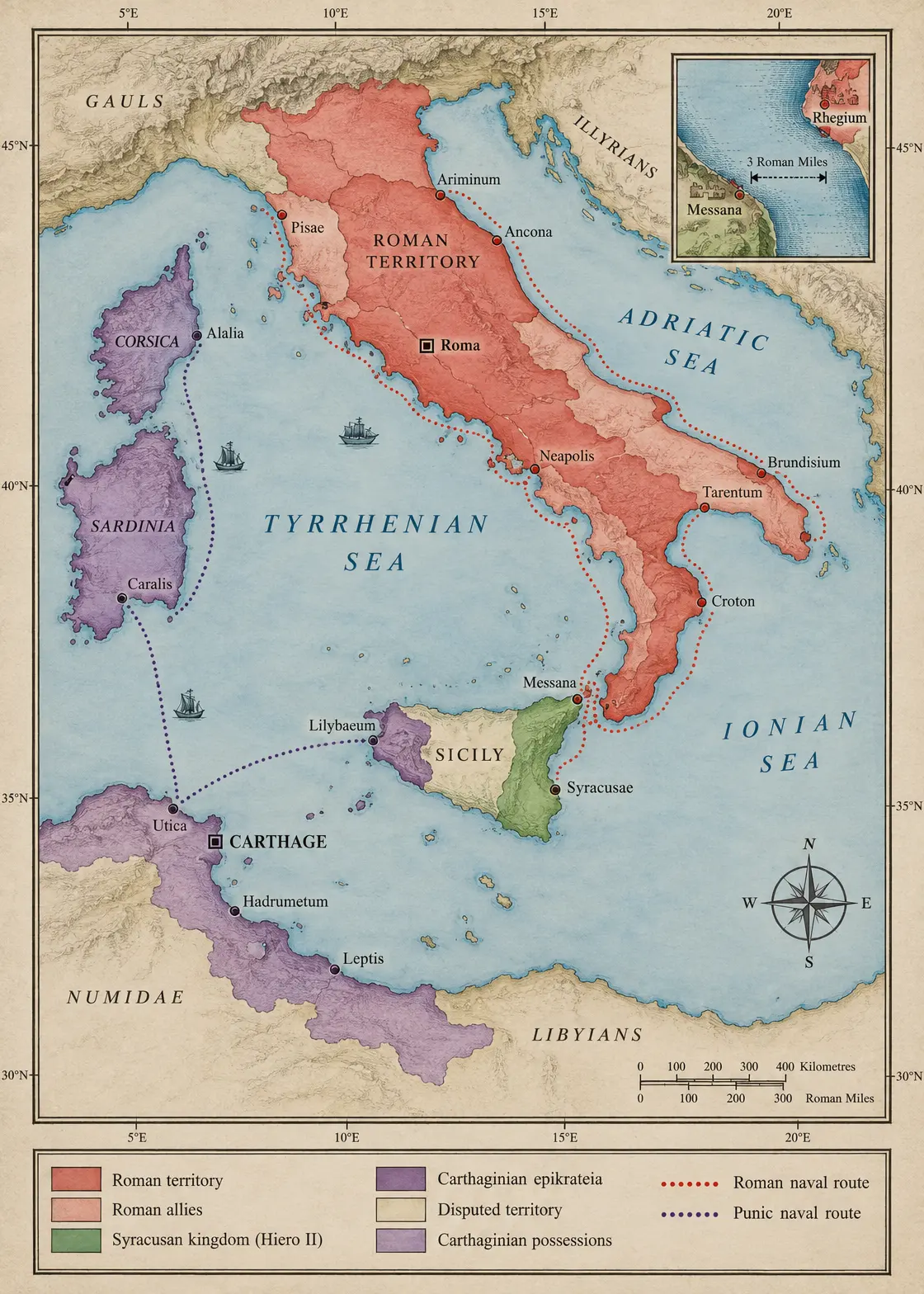
To understand why the Roman state, which had no naval tradition and no merchant marine of consequence, found itself within four years of Caudex's crossing committed to the construction of a battle-fleet on a scale unprecedented in Italian history, it is necessary to grasp the geography of the Sicilian theater. Sicily is a triangle of approximately 26,000 square kilometers — roughly the size of Roman Italy at the moment of the First Punic War's opening — separated from the Italian mainland by a strait at one point as narrow as three Roman miles and from the African coast by a sea passage of about a hundred miles. The island had been contested between Greek and Phoenician powers since the eighth century BC; by 264 BC its political configuration consisted of a Carthaginian-controlled western third (the epikrateia, centered on the great fortified base at Lilybaeum and including Drepana, Selinus, and several lesser fortified cities), an independent Greek Syracusan kingdom of perhaps a third of the eastern and southern coast under Hiero II, and a patchwork of smaller Greek and Sicel cities in varying states of dependence on one or the other major power. Messana, at the northeastern tip, controlled the strait and so the passage between Italy and the island.
For Rome, the strategic significance of Messana lay not in the city itself but in what its control implied. Whoever held both sides of the strait controlled the passage between the Tyrrhenian and Ionian seas, and so controlled the maritime axis along which the western Mediterranean would be either consolidated or divided. The Roman acquisition of Messana, however ambiguously legitimate (the Mamertines were, after all, brigands), gave Rome a foothold on the island from which she could not be evicted without a major Carthaginian effort, and from which she could be drawn — by the logic of consolidation, the same logic that had governed her Italian expansion — into involvement with the other Sicilian cities. For Carthage, by contrast, the strategic significance of Messana lay in its potential as a Roman bridgehead. So long as Rome held only her side of the strait, the Mediterranean status quo was undisturbed; once Roman armies stood on the Sicilian side, the entire Carthaginian epikrateia lay within potential Roman reach.
The war that followed was, in its strategic geometry, comparatively simple. Rome would attempt to expel Carthage from Sicily by reducing the Carthaginian fortified positions on the island, principally Lilybaeum and Drepana. Carthage would attempt to maintain her positions on the island and, when possible, to inflict sufficient damage on Rome — by sea, by raids on Italian coasts, by exploitation of Roman strategic missteps — to compel a peace on terms preserving the epikrateia. The war's operational complexity arose from a single fact: the Carthaginian fortified bases on Sicily could not be reduced except by a combination of land siege and naval blockade, and Rome did not, at the war's opening, possess a navy. The construction of a Roman fleet capable of contesting Carthaginian sea-power was the central institutional and technical innovation of the war's first decade, and it is the story to which most of the present chapter is devoted.
The Opening Campaign264 BC
Appius Claudius Caudex's crossing of the strait was effected, according to Polybius, against active Carthaginian opposition. A Carthaginian squadron under Hanno (a name that recurs many times in this war and must be distinguished by context) attempted to intercept the Roman transports at the strait; the Romans, by various accounts including ingenuity, a fortunate change of wind, and possibly a deliberate Carthaginian decision not to engage at full intensity, succeeded in crossing without serious loss. The Carthaginian commander Hanno was reportedly castigated by his government for the failure, recalled, and (in the manner that the Carthaginian political system would so often display in the wars to come) crucified. Whether the crucifixion is historical or a piece of pro-Roman polemic about Carthaginian cruelty toward their own commanders, the institutional pattern was real: Carthage frequently executed her military leaders for failure, a habit that worked against the development of an officer corps of accumulated experience and that contrasts unfavorably with the Roman practice of returning failed commanders to private life and sometimes restoring them to command on later occasion.
Once across the strait, Caudex marched on Messana itself. The Carthaginian garrison under Hanno (a different Hanno) had, as already noted in the previous volume, evacuated the city upon the Roman approach. Caudex installed a Roman garrison in the citadel, formalized the Roman alliance with the Mamertines (who would remain — improbably, given their history — Roman socii throughout the rest of the war and beyond), and proceeded to demonstrate that Roman intervention in Sicily was not merely the rescue of one city. He marched south against Syracuse itself, the principal Greek city of the island, and conducted a siege of perhaps two months. The siege did not result in the city's fall, but it placed Hiero II in an impossible strategic position: he could not realistically resist Roman power on the scale that was now being deployed, and his only available alternative was alliance with Carthage, the traditional rival of Syracuse and not a power he wished to depend upon. Hiero, calculating wisely, opened negotiations with Caudex's successor in command, the consul Manius Valerius Maximus (later given the cognomen Messalla from the city). The terms agreed in 263 BC made Syracuse a Roman ally on remarkably favorable conditions: she retained her independent kingdom, paid a one-time indemnity of one hundred talents, and committed her substantial fleet and treasury to the Roman war effort. The Hieronic alliance, in fact concluded a year later, would prove one of the most durable Roman alliances of the entire war: Hiero II would remain faithful to Rome until his death in 215, providing supplies, money, and naval support across half a century. The Roman acquisition of Syracuse as a partner — without conquest, by simple recognition of strategic reality — was one of the great diplomatic strokes of the early war.
With Syracuse aligned and Messana secured, Rome controlled the eastern third of Sicily by the end of 263 BC. The remaining objective was the Carthaginian epikrateia in the west, with its principal positions at Lilybaeum and Drepana, and a secondary objective at the great fortified city of Acragas (modern Agrigento) on the southern coast.
The Siege of Acragas262–261 BC
Acragas, the second city of Sicilian Greece, had been under Carthaginian control since the time of Hannibal son of Gisgo's invasion of the late fifth century. The Carthaginian garrison commander in 262 was the older Hannibal son of Gisgo, a different man from the great Hannibal who would later cross the Alps. The Roman strategy was to take Acragas as the first step in the reduction of the epikrateia, both for its intrinsic value as a wealthy and populous city and for its position as a forward base from which further operations against Lilybaeum could be mounted.
The siege began in the spring of 262 BC under the consuls Lucius Postumius Megellus and Quintus Mamilius Vitulus, with a Roman force of approximately four legions and the corresponding allied contingents. The Carthaginian garrison was perhaps fifty thousand strong, including mercenary contingents that had been concentrated in the city as a defensive precaution. The Roman approach was the standard reduction of a fortified Greek city by lines of circumvallation: two siege lines, the inner facing the city's walls and the outer facing the country to prevent relief. The siege lasted seven months, the longest yet conducted by a Roman army, and provided the first major test of Roman siege-craft against a position of Greek architectural quality.
The crisis came in the autumn of 262 when a Carthaginian relief force under Hanno (yet another Hanno, this one the son of Hannibal Bomilcar) approached from the west with some fifty thousand men, sixty elephants, and a strong cavalry contingent. The Roman besieging army was now caught between the city and the relieving force. The decision facing the consuls was whether to maintain the siege and accept battle against the relief force on whatever terms it imposed, or to withdraw and accept the loss of the position and the prestige already invested. They chose to fight. The Battle of Acragas, fought somewhere between the Roman siege lines and the approaching Carthaginian relief force, was a Roman tactical victory of significant proportion: the Carthaginian army was driven from the field, the elephants were dispersed, and the city's relief was prevented. Hannibal son of Gisgo, inside Acragas, recognized that the position was now unrelievable; he succeeded in breaking out of the city by night with the bulk of the surviving garrison, leaving the populace to the Romans. The Roman entry into the city was followed by a sack of unusual severity: the wealth of Acragas was carried off, twenty-five thousand Greek inhabitants were sold as slaves, and the city itself was left in a condition from which it would not fully recover for several generations.
The Roman conduct at Acragas was, even by the standards of ancient sieges, harsh. The Greek population had been not actively hostile to Rome but simply caught in the strategic configuration of the war; the brutality of the sale into slavery, in particular, would be remembered by the other Greek cities of Sicily and would significantly affect Roman diplomacy on the island for the rest of the war. Polybius, generally sympathetic to Rome, treats the Acragas sack with some discomfort, suggesting that the consuls misjudged the political consequences of the harsh treatment. The lesson was learned, and subsequent Roman sieges in Sicily (notably Panormus in 254, the various blockades of Lilybaeum and Drepana) would be conducted with more political restraint.
The Decision to Build a Fleet
The strategic deadlock that emerged after Acragas — Roman dominance on land, Carthaginian dominance at sea, and the impossibility of reducing Lilybaeum without contesting both — produced, in the winter of 261/260 BC, the Roman decision that would define the rest of the war. The Senate voted to construct a battle-fleet capable of engaging the Carthaginian navy in open water. The scale of the program was extraordinary: one hundred and twenty quinqueremes (the standard heavy battle-ship of the period, propelled by approximately three hundred rowers organized in a system whose exact technical details are still disputed) and twenty triremes (lighter and faster ships used for scouting and skirmishing). The construction was to be undertaken in Roman and allied harbors simultaneously, using timber felled in the Italian forests, with skilled shipwrights drawn from the Greek allied cities and from Syracuse.
Polybius's famous account of the program — which has been doubted in its more romantic details but whose central claim is broadly credible — reports that the Romans were guided in their design by a captured Carthaginian quinquereme that had run aground on the Italian coast and been salvaged early in the war. The Romans, by this account, took the ship apart, studied its construction, and used it as a template for their own fleet. They trained their rowers on benches set on dry land, simulating the strokes of an actual ship, while the vessels themselves were under construction. They concentrated the construction in a remarkable sixty days, by some traditions, or two months, by others — figures which are doubtless compressed but which reflect a genuine institutional achievement of crash-program speed and scale.
The technical innovation that would distinguish the Roman fleet from the Carthaginian was the corvus (the "crow" or "raven"), a boarding device of remarkable design whose specifications Polybius preserves with unusual technical detail. It consisted of a pole approximately twenty-four Roman feet (about 7.2 meters) tall, mounted near the bow of the ship, with a hinged gangway about thirty-six Roman feet (10.8 meters) long and four feet (1.2 meters) wide that could be rotated and dropped onto an enemy vessel. The end of the gangway was equipped with a heavy iron spike — the "beak" of the crow, from which the device took its name — which would lock the gangway to the enemy deck when dropped. Once locked, Roman marines could cross the gangway and engage the enemy crew at close quarters, converting the naval engagement into a land battle conducted on wooden platforms.
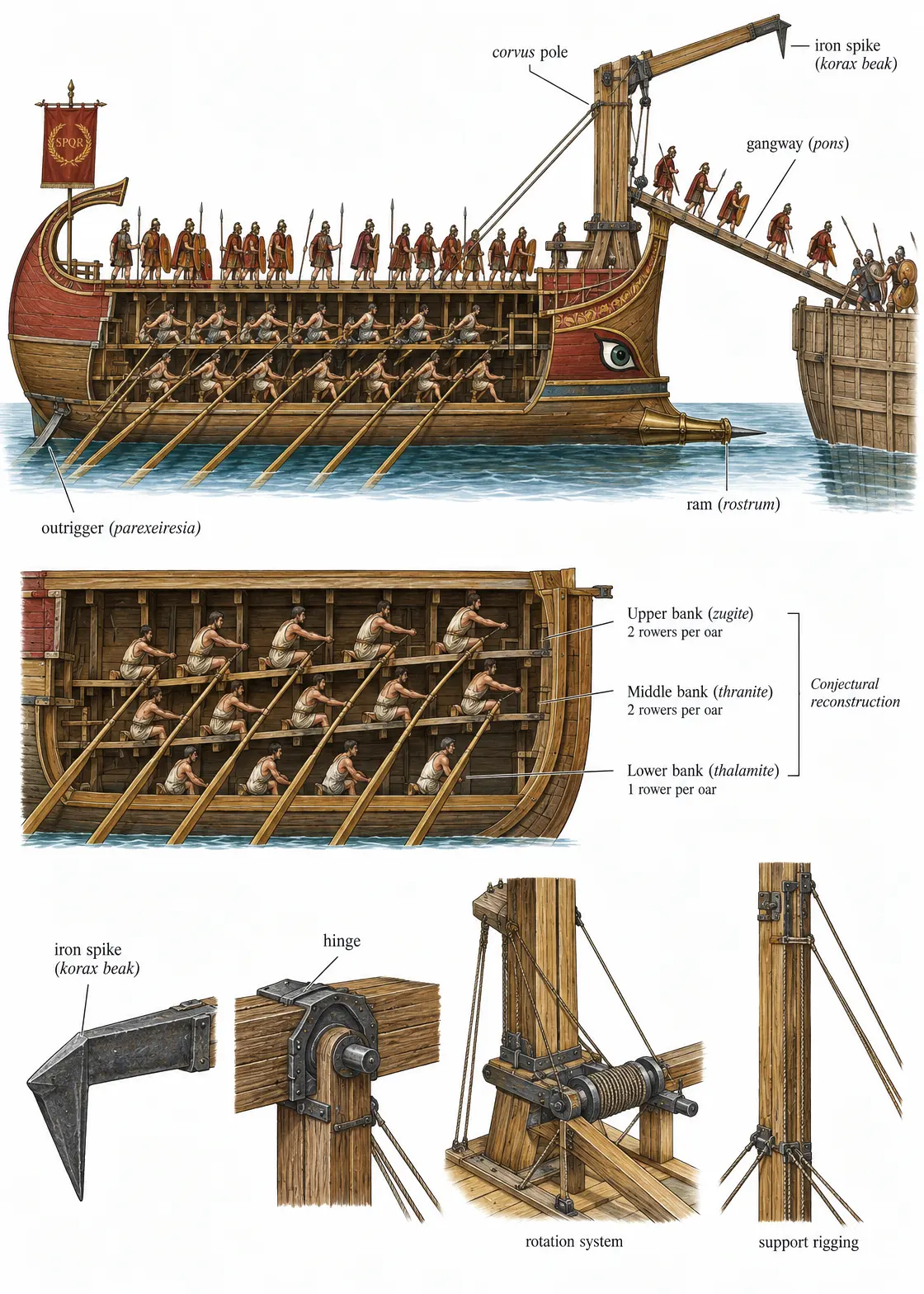
The corvus was a Roman institutional response to a Carthaginian technical advantage. The Carthaginian navy was master of the ramming-and-maneuver tactics that had been the dominant Greek and Phoenician naval doctrine since the fifth century: skilled crews who could outsail and outmaneuver opponents would ram the enemy at the prow or sides, withdraw, and ram again until the opposing vessel was disabled or sunk. The Roman marines were better at hand-to-hand combat than the Carthaginian; if the Romans could force a boarding engagement, they would have the advantage. The corvus allowed them to do precisely that — to negate the Carthaginian advantage in seamanship by transforming the engagement into a land battle. The device had drawbacks: it added weight to the bow that compromised the ship's stability in heavy seas, and it required a degree of maneuvering accuracy in the approach that demanded considerable training. But within its limits it was a brilliantly conceived weapon, and its use would prove decisive in the early naval engagements of the war.
The Battle of Mylae260 BC
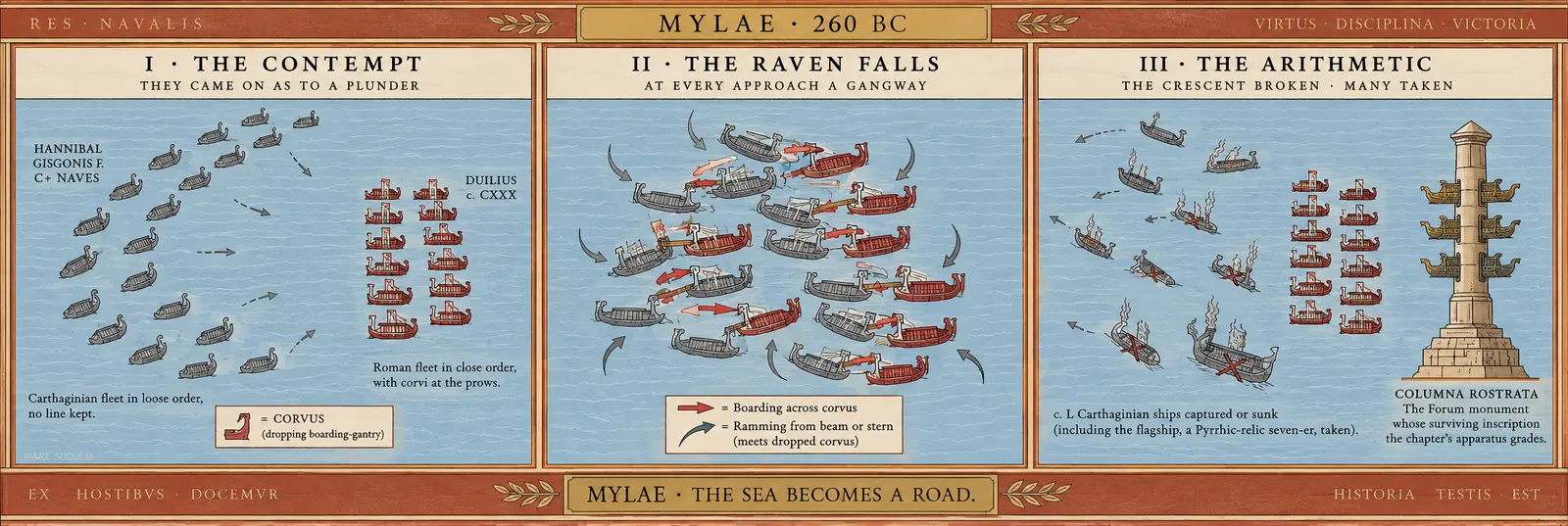
The first major naval engagement of the war was fought in the late summer of 260 BC off the north coast of Sicily, near the promontory of Mylae (modern Milazzo, just west of Messana). The Roman fleet, now under the command of the consul Gaius Duilius — a man whose career to this point had given no indication of naval competence and whose appointment to fleet command had been a matter of the rotational distribution of consular provinciae rather than of demonstrated capacity — engaged a Carthaginian fleet under Hannibal son of Gisgo (the same who had defended Acragas) with approximately equal numbers of vessels on each side: about a hundred and thirty on the Roman side, somewhat over a hundred on the Carthaginian.
The Carthaginian commander, confident in the superior seamanship of his crews and unaware of the corvus, approached the Roman line in standard Punic battle formation. The Roman ships, when contact was made, deployed their corvi and locked the leading Carthaginian vessels into boarding actions. The Carthaginian crews, taken by surprise and ill-prepared for hand-to-hand fighting on their own decks against Roman heavy infantry, were overrun. The Carthaginian wings, attempting to circle around the Roman line for flank ramming attacks, found that the Roman ships could pivot to face them and deploy the corvus in any direction. The Carthaginian fleet, after losing perhaps fifty ships captured or sunk and most of their crews, withdrew in disorder. Hannibal son of Gisgo himself escaped only by transferring to a fast vessel.
The political and psychological impact of Mylae far exceeded its tactical scale. For the first time in over a century, a Carthaginian fleet had been defeated in open battle. The myth of Punic invincibility at sea was broken. Duilius was awarded a triumph of unprecedented form — a triumphus navalis — and was honored at Rome with the erection of a monumental rostral column in the Forum, decorated with the bronze rams (rostra) of captured Carthaginian ships. The column itself does not survive, but a substantial fragment of its inscription, the Columna Rostrata Duilii, was discovered in the Renaissance and is preserved in the Capitoline Museums. The inscription, though heavily restored and partly conjectural in its modern reading, preserves the substantive content of Duilius's triumph and is among the most important contemporary documents for the First Punic War; it stands as a AGrade A epigraphic source against which the Polybian narrative can be checked.
Operations in Sardinia and Corsica259–258 BC
With naval superiority in the Tyrrhenian provisionally established, the Roman strategic options expanded. The consuls of 259 BC undertook a campaign in Sardinia and Corsica, the two great Carthaginian-held islands in the central Tyrrhenian. The consul Lucius Cornelius Scipio (the elder, grandfather of Scipio Africanus) captured the Corsican port of Aleria after a brief siege, raided the Sardinian coast, and engaged a Carthaginian fleet under Hannibal son of Gisgo near Sardinian waters. Hannibal was captured by his own troops in the subsequent confused operations and crucified in the Carthaginian manner — the second high command-level execution of the war. The Roman gains in Sardinia were limited and could not be consolidated against the Carthaginian counter-attacks of 258, but the operations served the strategic purpose of distributing Roman naval pressure across multiple theaters and preventing Carthaginian concentration in Sicilian waters.
The year 258 saw also several minor naval engagements (Sulci off Sardinia, Tyndaris off northern Sicily) which were Roman tactical victories of declining significance. The strategic position had stabilized: Rome controlled the seas in the central Mediterranean within range of her bases at Messana and the Italian coast; Carthage retained dominance in the western Mediterranean and access to Lilybaeum from Africa; the question of whether the Carthaginian epikrateia in Sicily could be reduced remained open and was the principal strategic question facing both sides.
The Roman strategic response, in 256 BC, was an extraordinary projection of force: a direct attack on Carthage itself.
The African Expedition: Ecnomus256 BC
The decision to carry the war into Africa was made by the Roman Senate in the winter of 257/256 BC. The strategic logic was clear enough: if Carthage could be threatened directly, the Carthaginian forces in Sicily would have to be recalled to defend the metropolis, and the Sicilian epikrateia would fall into Roman hands by default. The risks were considerable: any Roman expeditionary force in Africa would be at the end of a long maritime supply line vulnerable to Carthaginian naval action, and the African theater itself was unknown country in which the Romans had no allies and no familiarity with the terrain. But the strategic prize justified the risk, and the Senate authorized the expedition.
The fleet assembled in the summer of 256 was the largest single naval force yet committed by either side in the war. The Roman fleet consisted of 330 warships (principally quinqueremes), with embarked legions and the maritime support vessels for an African campaign. Polybius estimates the embarked force at 140,000 men, a figure that is doubtless inflated (modern reconstructions suggest perhaps 100,000 to 120,000 including crews) but indicates the scale of the enterprise. The fleet was commanded by the consuls of the year, Lucius Manlius Vulso and Marcus Atilius Regulus. The Carthaginian fleet, assembled to intercept the Roman expedition before it could reach Africa, was of comparable strength: 350 warships under Hamilcar (not yet the Hamilcar of Spain and the Barcid line, but an earlier commander of the same name) and Hanno (the Hanno of subsequent African operations). The two fleets met off Cape Ecnomus, on the southern coast of Sicily, in what was — by ship-count — among the largest naval engagements of the entire ancient world.
The Roman tactical disposition at Ecnomus was unconventional and is worth describing in some detail, both because the sources preserve it with unusual clarity and because it illuminates the operational creativity that the Roman navy had developed in the four years since Mylae. The Roman fleet was deployed in four squadrons forming a wedge or triangle: the first and second squadrons formed the two leading sides of the triangle (each consul commanding one of these squadrons in his own flagship), the third squadron formed the base of the triangle behind them (towing the transport vessels carrying the cavalry and supplies for the African landing), and the fourth squadron was held in reserve behind the third. The Carthaginian disposition was a single long line drawn across the Roman line of advance, with the left wing extending toward shore.
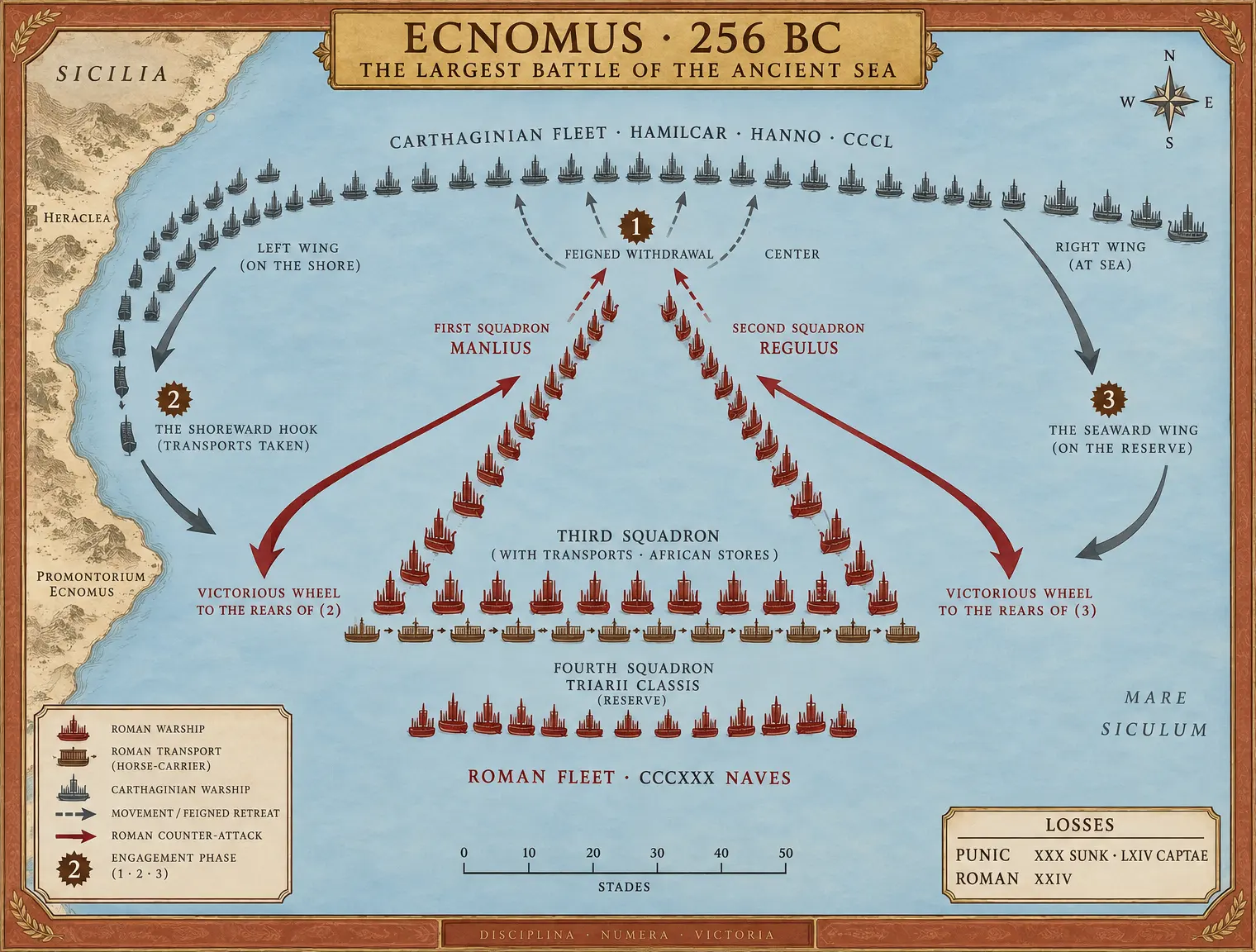
The engagement opened with the Roman wedge attacking the Carthaginian center. The Carthaginians, on contact, executed a feigned retreat (a maneuver requiring excellent crew training and confidence), drawing the leading Roman squadrons into pursuit and so separating them from the third and fourth squadrons. Once the Roman wedge was extended, the Carthaginian wings — which had been waiting for this opening — swept inward: the left wing attacked the Roman third squadron and the towed transports near the shore, while the right wing engaged the second squadron from the open-sea side. For perhaps an hour, three distinct engagements were taking place simultaneously across several miles of sea: the Roman first and second squadrons in pursuit of the Carthaginian center (which they were defeating, the Carthaginian "feigned" retreat having become real once they realized they could not bring the Roman wings to engagement), the Roman third squadron defending against the Carthaginian left near the shore, and the Roman second squadron being attacked by the Carthaginian right.
The decisive moment came when the Roman first and second squadrons, having dispersed the Carthaginian center, turned about and engaged the Carthaginian wings from behind. The Carthaginian left wing, caught between the third squadron and the returning first squadron, was driven into the shore and largely destroyed. The Carthaginian right, recognizing that the engagement was lost, broke contact and withdrew. By the end of the day the Romans had captured or sunk approximately 80 Carthaginian vessels and lost 24 of their own. It was the largest Roman naval victory yet, and the one that opened the road to the African coast.
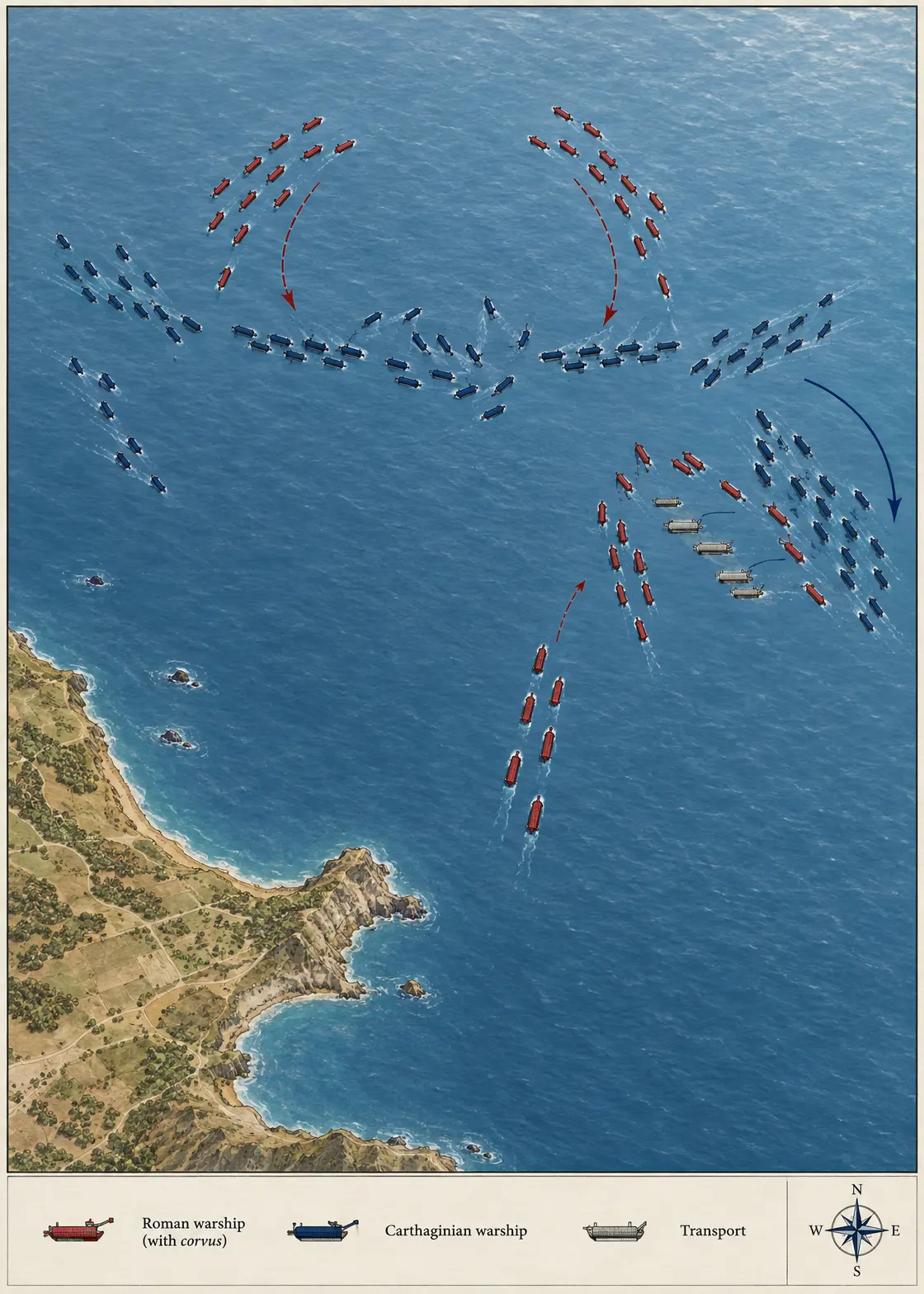
The Roman fleet, victorious at Ecnomus, proceeded to land the consular armies on the African coast at the promontory of Aspis (modern Kelibia, on the Cape Bon peninsula), about a hundred miles east of Carthage itself. The Carthaginian naval defense had been beaten; the African theater was now open. The campaign that would follow would test, in different ways than the Italian theater had ever tested, the institutional capacities of the Roman state.
The Crossroads · Winter of 261–260 BC · The Senate, Rome
The Decision to Build a Fleet
You are a Roman senator called to the Curia during the winter following the fall of Acragas, weighing whether the Republic should risk its manpower and treasury on the sea.
Following seven months of siege and a pitched victory against Hanno's relief force, Roman legions have taken and brutally sacked Acragas, selling twenty-five thousand Greek inhabitants into slavery. Together with Hiero II of Syracuse, Rome now controls the eastern two-thirds of Sicily. Yet the war has reached an impasse. Carthage's fortified strongholds in the western epikrateia—principally Lilybaeum and Drepana—cannot be starved or taken by land armies alone because Carthaginian squadrons feed and reinforce them at will from Africa. Rome has no naval tradition and no merchant marine of consequence, whereas Carthage has dominated the western Mediterranean for centuries with swift quinqueremes and seasoned crews. To break the deadlock, Rome must choose whether to step onto an untried element.
How should the Roman Republic break the strategic deadlock in Sicily?
Weigh each course: open it to hear your own inner voice. Then decide. Nothing is scored.
- Your inner voiceThe course taken
We cannot starve Lilybaeum or Drepana while Carthaginian ships feed them at will. We have copied their stranded quinquereme, and our carpenters can shape timber from Italian forests alongside Greek shipwrights. If our farmers cannot outrow Phoenician sailors, we will mount gangways and boarding spikes to turn their decks into Roman soil. It will drain our treasury and risk thousands on water, but without a fleet, Sicily remains forever half-conquered.
- Your inner voiceThe course taken
Syracuse commands a substantial fleet and treasury, and the Greek coastal cities of Italy understand the sea far better than we do. Let our allies bear the burden of the water while we concentrate our four legions on the march. We can supply money and infantry to man Greek vessels rather than constructing an untried fleet of our own. If their squadrons are battered, our own citizens and timber remain intact on land.
- Your inner voiceThe course taken
Our strength lies in the legionary's sword and spear, not in timber and untried oars. We have taken Acragas and scattered their elephants in the field; we can march our legions overland, throw up lines of circumvallation, and assault their western strongholds from the land. Rome has no naval blood. To sink our wealth and citizens into open water is to invite shipwreck and disaster before a Phoenician navy that has ruled the sea for generations.
What was done
The Senate voted to construct a battle-fleet of one hundred and twenty quinqueremes and twenty triremes. Shipwrights used a stranded Carthaginian quinquereme as a design template, felling Italian timber and training crews on wooden benches set on dry land, completing the work within two months. To overcome Phoenician superiority in ramming and maneuver, the ships were fitted with the corvus, an iron-spiked boarding gangway that locked enemy decks and allowed legionary marines to fight hand-to-hand. In 260 BC, the consul Gaius Duilius engaged Hannibal son of Gisgo off Mylae. The Roman boarding tactics overwhelmed the Carthaginian line, sinking or capturing roughly fifty Punic vessels while Hannibal fled. The victory shattered the aura of Carthaginian maritime supremacy. Duilius celebrated an unprecedented naval triumph (Fasti Triumphales, AGrade A), and a rostral column adorned with captured bronze rams was erected in the Forum (confirmed by the surviving inscription, AGrade A; Polybius, BGrade B).
The evidence Polybius 1.20–28 (BGrade B) provides the central narrative of the Senate's decision to build the fleet, the dry-land rower training, and the design of the corvus. Supporting and supplementary details appear in Pliny's Naturalis Historia 16.74 and 34.20 on fleet construction and the rostral column (BGrade B), the contemporary epigraphy of the Columna Rostrata Duilii (CIL VI 1300, AGrade A), the Fasti Triumphales (AGrade A), fragments of Diodorus 23 (CGrade C), Cassius Dio via Zonaras 8.10–12 (BGrade B), and Livy Periochae 17 (BGrade B).
If you choose to walk through itAt every scale
- Yourself
When you vote to commit thousands of citizens and allies to an unfamiliar element where courage cannot prevent drowning, how do you balance personal honour against the dread of sending men into a disaster you will not share?
- Those beside you
How do you justify to Italian allied communities and Roman farming households that their sons must row in wooden hulls rather than march under familiar legionary standards?
- Rome
Can an agrarian republic, governed by yearly magistrates with no naval tradition, transform its institutions and economy to sustain an enormous permanent fleet without forfeiting the military character that made it master of Italy?
- The wider world
Does the entry of a land power into maritime war offer the Greek cities of Sicily genuine deliverance from Carthaginian dominion, or merely substitute one crushing imperial master for another?
- Our own time
When a nation decides to compete in a domain where an adversary holds complete established mastery, what determines whether its innovation succeeds or brings ruin?
In the late nineteenth century, Imperial Germany, historically a continental power whose security rested upon its formidable army, resolved to build a massive high-seas battle fleet to challenge Britain's long-standing naval supremacy. The state diverted immense fiscal and industrial resources into steel shipyards, believing that naval power was essential to project authority beyond its land borders and compel rival recognition.
Where the comparison fails. Rome transformed the nature of naval warfare by inventing the corvus to exploit its infantry advantage, whereas Germany built symmetric dreadnoughts within Britain's existing tactical doctrine and failed to achieve operational breakout during general war.
What does the chapter tell us?
Why did Rome conclude that Lilybaeum and Drepana could not be reduced without building a war fleet?
The chapter explains that Carthage's western bases in Sicily could not be taken by land armies alone because Carthaginian maritime superiority enabled continuous supply and reinforcement, requiring Rome to combine land sieges with a naval blockade.
Polybius 1.10–19 (BGrade B) and the chapter's narrative
How did Rome solve the tactical problem of facing Carthaginian crews trained in traditional ramming and maneuver?
The corvus was an iron-beaked boarding bridge that locked onto enemy vessels upon impact, converting naval maneuvers into a close-quarters infantry battle where Roman heavy infantry held the tactical advantage.
Polybius 1.20–28 (BGrade B)
What does the chapter identify as a significant negative consequence of the Roman capture of Acragas in 261 BC?
Polybius notes that selling twenty-five thousand non-hostile Greek residents into slavery damaged Roman diplomacy on the island, teaching Rome a lesson in political restraint that modified its conduct in subsequent sieges.
Polybius 1.10–19 (BGrade B)
What primary contemporary epigraphic evidence corroborates the Polybian narrative of the naval victory at Mylae?
The Columna Rostrata Duilii inscription (CIL VI 1300), though partly restored, is a AGrade A contemporary epigraphic record in the Capitoline Museums confirming Duilius's naval victory and triumph.
CIL VI 1300 (AGrade A)
According to the chapter's account of the battle of Ecnomus in 256 BC, what tactical development decided the engagement?
After Carthaginian feigned retreats drew the leading Roman squadrons apart, the consuls dispersed the Punic center, reversed course, and trapped the Carthaginian wings that had attacked the trailing Roman squadrons against the shore.
Polybius 1.20–28 (BGrade B)