Book II · The Mediterranean Wars
Chapter 3
The Interwar Years: Mercenary War, Sardinia, Gauls, and Illyrians
The Mercenary War240–237 BC
The peace of 241 BC ended hostilities between Rome and Carthage but did not end the violence in the Carthaginian world. The Carthaginian state, exhausted by twenty-three years of war and now burdened with the indemnity payments of the Peace of Lutatius, was financially incapable of paying off the mercenary armies that had served the war in Sicily. The mercenaries — perhaps twenty thousand men, including Libyan, Iberian, Gallic, Greek, and Italian contingents under various national leaders — were brought back to Africa in the months following the peace and were stationed at the town of Sicca Veneria, southwest of Carthage, while the Carthaginian government deliberated over how to pay them.
The deliberation took too long. The mercenaries, sensing that the city intended to negotiate down the back-pay rather than pay it in full, mutinied. Their leaders — principally a Campanian named Spendius (a former slave who had escaped from Roman captivity) and a Libyan named Mathos — organized the army into a coherent fighting force, recruited Libyan auxiliaries from the Carthaginian-subject populations of the African hinterland (who had their own grievances against Carthaginian rule and saw the mutiny as an opportunity for liberation), and turned the mercenary army into an instrument of revolt. By the autumn of 240 BC, what had begun as a pay dispute had escalated into a full-scale civil war that threatened the survival of the Carthaginian state itself.
The conflict that followed — Polybius calls it the Truceless War (polemos aspondos) for its unusual ferocity, and the standard modern historiographical name Mercenary War — was conducted on both sides with a brutality that exceeded even the cruelty conventional in ancient warfare. The mercenaries, fighting for their own survival in a hostile country and against a state that had repeatedly broken faith with them, tortured and killed Carthaginian prisoners with elaborate cruelty; the Carthaginians, fighting against an enemy on their own doorstep and recognizing that defeat meant the destruction of the city, retaliated in kind. The cycle of atrocity was such that the war was conducted in the manner of a war of extermination rather than the regular combat of ancient state warfare.
The Carthaginian field command was given initially to Hanno (the same Hanno who had commanded the unsuccessful relief fleet at the Aegates Islands — his political position was such that he was given the command despite his recent failure), who proved tactically inadequate against the mercenary forces. After eighteen months of inconclusive operations and serious defeats, Hanno was replaced by Hamilcar Barca, returned from his Sicilian command and now charged with the salvage of the situation. Hamilcar's command against the mercenaries was one of the great military performances of the era. Operating with limited Carthaginian field forces (perhaps ten thousand foot, two thousand cavalry, and a small elephant corps), he conducted a series of operations that progressively isolated the mercenary forces from one another, defeated them in detail, and reduced them to surrender or massacre. The decisive engagement, fought in the autumn of 238 BC at a position called the Saw (so named for the topographical resemblance of the surrounding mountains to the teeth of a saw), trapped Spendius's main force in a position from which escape was impossible; the surrender was followed by the crucifixion of the surrendered leaders.
Mathos's faction held out somewhat longer, retreating to the Libyan city of Tunis and continuing resistance through 237 BC. Mathos himself was eventually captured and was executed in Carthage with elaborate cruelty — paraded through the streets while subjected to systematic torture for several hours before his death — by the Carthaginian populace whose feelings about the war had become unrestrained. The Mercenary War ended in early 237 BC with the suppression of the last mercenary holdouts and the reassertion of Carthaginian control over Africa.
The political consequences of the war were several and durable. The Barcid faction, having saved the city from destruction, emerged as the dominant political force in Carthaginian government. Hamilcar Barca and his sons-in-law (Hasdrubal the Fair preeminent among them) and his sons (Hannibal, Hasdrubal, and Mago) would direct Carthaginian state policy for the next four decades. The Carthaginian governing oligarchy, traumatized by the war and grateful to the Barcids, granted them a degree of strategic autonomy that effectively gave them dictatorial control over the state's foreign policy in particular regions. The Carthaginian populace developed a deep resentment of the mercenary tradition and would, for the rest of the Punic Wars, prefer Carthaginian citizens in the army even at significant strategic cost.
The Roman Seizure of Sardinia and Corsica238 BC
The Roman action that followed, in the closing phase of the Mercenary War, was one of the more morally questionable decisions of the entire Republican period and was so understood by some contemporaries. The Carthaginian garrisons in Sardinia, presented with the chaos of the Mercenary War and with the impossibility of receiving reinforcements or pay from the home city, themselves mutinied, killed their officers, and took control of the island. The Sardinian native population, having its own grievances against Carthaginian rule, joined the mutiny against the mercenaries themselves, and the island descended into chaos. The mercenary leaders, recognizing that they could not hold the island against either the Sardinian population or eventual Carthaginian return, appealed to Rome in 238 BC for Roman protection of their position.
The Roman Senate, after debate, accepted the appeal. The legal position was indefensible: the Peace of Lutatius had specifically reserved Sardinia and Corsica to Carthage, and Rome had no claim to either island. The political calculation, however, was that Carthage in her present state could not contest a Roman occupation, and that the strategic gain of acquiring the two major Tyrrhenian islands outweighed the diplomatic cost. The Roman garrisons were dispatched. The Carthaginians, on the partial recovery of their situation by mid-238 BC, protested and threatened war; the Romans, recognizing that Carthage was in no position to wage one, responded by demanding an additional indemnity of 1,200 talents and threatening immediate further hostilities if it were not paid. Carthage, having no real option, paid the indemnity and accepted the loss of the islands.
The episode is the strongest evidence available that Roman foreign policy in the period was driven by opportunistic acquisition rather than by adherence to treaty obligations. Polybius, generally a defender of Roman conduct, treats the Sardinia episode with explicit disapproval and identifies it as the principal cause of Carthaginian resentment that would, in the next generation, contribute to the Hannibalic War. The Barcid family, in particular, took the Sardinian seizure as evidence that Rome could not be trusted in peace and that the only secure path for Carthaginian survival was the development of an independent power-base from which Rome could be confronted on more equal terms. The path led directly to Spain.
Hamilcar Barca in Spain237–228 BC
Hamilcar Barca's Spanish enterprise, undertaken in the autumn of 237 BC, was authorized by the Carthaginian Senate with reluctance and would prove the most consequential single decision of the entire interwar period. The strategic conception was Hamilcar's own: that the Carthaginian state could not recover its position in the western Mediterranean by remaining within its existing geographical confines, and that an aggressive program of expansion into Iberia would provide both the manpower (in Iberian mercenary recruits) and the wealth (in the silver mines of southern Spain) necessary to challenge Rome in any future conflict. The Carthaginian Senate accepted the program but extracted no firm commitments from Hamilcar about its strategic limits; he was, in effect, given a free hand to develop a new Carthaginian power-base in Iberia on whatever terms his judgment dictated.
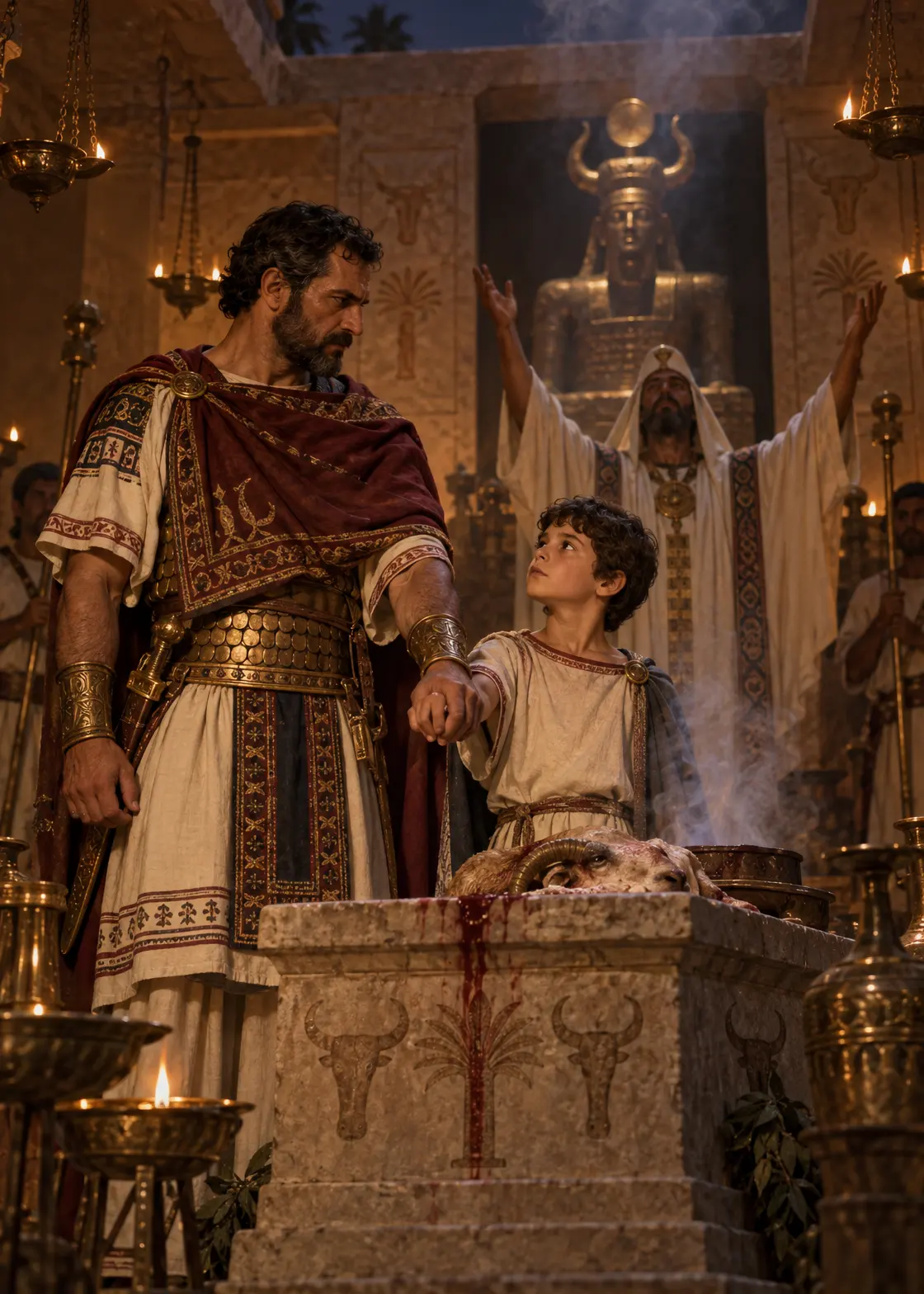
Hamilcar crossed to Spain in late 237 BC with his army and his family, including his nine-year-old son Hannibal. The famous tradition — preserved in Polybius and Livy — that Hamilcar made Hannibal swear, before an altar in Spain, eternal enmity to Rome dates to this moment; Hannibal himself, fifty years later, would tell the story to Antiochus III of Syria, and through that channel it entered the historiographical tradition. The historicity of the oath is generally accepted, though its precise form is uncertain. What is firmly historical is that the Barcid family from this point conducted Spanish affairs as a quasi-royal undertaking, with the territory becoming progressively a Barcid principality only nominally subject to the home government.
Hamilcar's military operations in Spain were conducted with the characteristic mix of force and diplomacy that the Barcid school of warfare would make its trademark. He defeated the Iberian tribes of the south and east in a series of engagements (the precise tactical details are not well preserved), incorporated subdued populations into his army as auxiliaries, recruited mercenaries from the Celtiberian and Iberian tribal nobility, and established Carthaginian-controlled cities at strategic points (notably Acra Leuke, modern Alicante, founded as a base on the southeastern coast). By 230 BC he had brought all of southern Spain under Carthaginian control and was extending operations into the central peninsular plateau. He himself died in 229 BC in an engagement against the Oretani tribe — drowned, by Polybius's account, while attempting to escape across a river after an ambush. His command devolved upon his son-in-law Hasdrubal, called the Fair for his striking appearance and for his diplomatic-political abilities.
Hasdrubal the Fair and Carthago Nova228–221 BC
Hasdrubal's command in Spain extended for seven years, from 228 to 221 BC. His policy was distinguished from Hamilcar's by a greater emphasis on diplomacy and political consolidation over direct military conquest. He concluded marriage alliances with the Iberian tribal nobility (his own marriage to a daughter of an Iberian chief is firmly attested; further such alliances among his lieutenants are recorded). He founded the city of Carthago Nova (New Carthage, modern Cartagena), the largest single Carthaginian foundation in Spain and the principal Barcid administrative and military center. Carthago Nova was conceived as a Carthaginian-style city of perhaps twenty thousand inhabitants, with elaborate fortifications, a substantial harbor, an arsenal, and access to the silver mines of southern Spain that were the principal financial base of the entire Barcid enterprise. The city served as the symbolic and administrative capital of what was, by 222 BC, effectively a Carthaginian colonial state in Spain — formally subordinate to the home city but in practice operating as an autonomous polity under Barcid governance.
The Roman state, after the conclusion of operations in Cisalpine Gaul that we will treat in a moment, became increasingly concerned about the development of Barcid power in Spain. The concern was strategic: a Carthaginian power-base in Iberia represented, in the longer view, a potential challenge to Roman dominance in the western Mediterranean of a kind that the original Peace of Lutatius had not anticipated. The Roman diplomatic response, conducted in 226 BC, was the negotiation of the Ebro Treaty with Hasdrubal. The treaty, the exact terms of which are debated in modern scholarship because of variations between the Polybian and Livian accounts, established the river Ebro (modern Ebro, in northeastern Spain) as the northern limit of Carthaginian expansion. The Carthaginians agreed not to cross the river under arms; the Romans, by implication and by some readings of the treaty, recognized Carthaginian dominance south of the river. The treaty was understood in Rome as a containment device; it was understood in Carthage as recognition of the Barcid sphere of influence; the ambiguity in interpretation would be a contributing factor to the war of 218.
Hasdrubal was assassinated in 221 BC by an Iberian slave whose master had been executed on Hasdrubal's orders — a personal revenge killing of the kind ancient sources frequently report and the historicity of which is firm. His successor was elected, on the spot in the Spanish army, by the soldiers themselves: Hannibal Barca, the elder son of Hamilcar, now twenty-six years old and with seven years of campaigning experience in Spain as a junior officer under his brother-in-law. The selection of Hannibal was ratified by the Carthaginian Senate after the fact — a political formality that recognized the fait accompli of Barcid family succession in the Spanish command.
The Cisalpine Gallic War: Telamon and Clastidium225–222 BC
While Carthaginian power was being consolidated in Spain, the Roman state was conducting its own program of expansion in the Po valley of northern Italy. The Cisalpine Gauls — principally the Boii (in the Bologna region), the Insubres (around modern Milan), the Cenomani (around Brescia), and remaining smaller tribes — had been independent neighbors of the Roman alliance system since the destruction of the Senones in 283 BC. Roman colonization in the ager Gallicus and at Ariminum in 268 had brought the Roman frontier to the southern edge of Cisalpine Gaul; subsequent Roman roads (the Via Flaminia, begun in 220 BC under the censor Gaius Flaminius, would not be completed for several years but its line of advance was already understood) extended Roman strategic reach into the region. The Roman Lex Flaminia of 232 BC, which authorized colonial settlement of the ager Gallicus by Roman citizens (not by Latin colony, an unusual departure from precedent), was understood by the Cisalpine tribes as preparing the way for direct Roman conquest of their own territories.
The Gallic response was the assembly, in 225 BC, of the largest tribal coalition that the Cisalpine peoples had mounted in over a century. The Boii, Insubres, and various smaller tribes were joined by trans-Alpine reinforcements from the Gaesatae — Gallic warrior bands from the upper Rhône valley, brought south at Insubrian pay to swell the coalition force. The total Gallic army, by Polybius's figure (which is doubtless inflated but probably reflects an army of unusual size), was about seventy thousand foot and ten thousand cavalry — perhaps eighty thousand men in all, with their families and dependents accompanying. This force assembled in the upper Po valley in the early summer of 225 BC and began to move south through the Apennine passes into Etruria, with the announced intention of advancing on Rome.
The Roman strategic response was the concentration of an unprecedented force: two consular armies (about eighty thousand citizen and Latin soldiers in total), supplemented by allied contingents from peninsular Italy and by the levy of additional manpower drawn from the socii. Polybius preserves what is probably an accurate copy of the Roman manpower roster of 225 BC — a document that the Senate had compiled in preparation for this campaign — that indicates the total available manpower of Roman Italy at this moment was approximately seven hundred thousand foot and seventy thousand cavalry, a figure that exceeds the manpower available to any single Hellenistic kingdom and that constitutes one of the most important Polybian passages for the demographic and military study of the period.
The two consular armies of 225 — Lucius Aemilius Papus, operating from Rimini in the north, and Gaius Atilius Regulus, operating from Sardinia and crossing back to the Italian mainland by sea — converged on the Gallic invasion force as it withdrew from Etruria back toward its own country, after the Gauls had completed a substantial raid through northern Etruria but had failed to engage the principal Roman force on terms favorable to themselves. The two Roman armies met the Gallic army at Telamon (modern Talamone, on the Tuscan coast near Grosseto) in the late summer of 225 BC. The tactical situation was the most favorable a Roman commander could hope for: the Gallic army was trapped between two converging Roman forces with no possibility of withdrawal.
The Battle of Telamon225 BC
The engagement was fought on the coast at Telamon, with the Roman army of Papus on the north and the army of Regulus on the south, the Gauls compressed between them on a ridge of high ground that they had occupied in the hope of conducting an orderly withdrawal. The Gallic deployment was characteristic of their style: a great mass of warriors organized by tribes, with the foot in the center and the cavalry on the wings, the warriors arrayed in the long undisciplined line that the Gauls of the period preferred. The Gaesatae — the trans-Alpine reinforcements, who fought according to the most ancient Gallic style — appeared in the front rank stripped naked, with only their swords and oblong shields, their bodies painted with woad in patterns of war. The sight was meant to be terrifying to the enemy; the practical effect, against Roman velites armed with javelins at thirty paces, was that the unprotected Gaesatae were killed or wounded in disproportionate numbers in the first phase of the engagement.
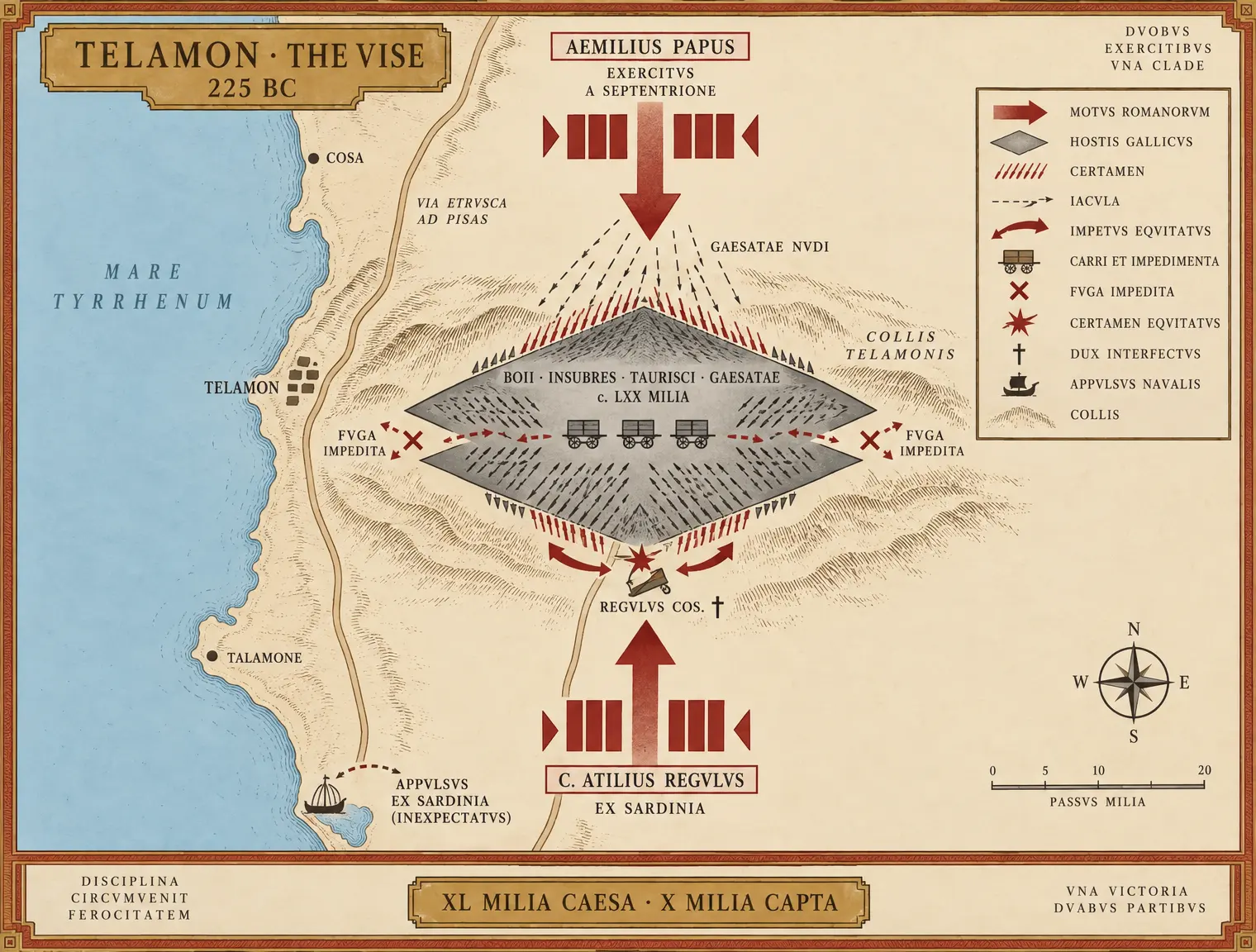
The Gauls, attacked from both sides simultaneously and unable to maneuver, fought with the desperate ferocity of a trapped force. The Roman cavalry, deployed on the wings of both consular armies, engaged the Gallic cavalry and broke it after extended fighting; the Roman cavalry then attacked the Gallic infantry from the flanks while the legions pressed the engagement from front and rear. The Gallic line, attacked from four directions and compressed into ever-smaller space, was systematically destroyed. By evening, approximately forty thousand Gauls were killed and ten thousand captured, while the bulk of the Gallic cavalry and a portion of the foot escaped northward through gaps in the Roman line. Roman losses were severe — the consul Regulus was killed in the engagement, and approximately six thousand Roman and allied soldiers fell with him — but the engagement was a decisive Roman tactical victory.
Telamon was, in some respects, the largest land battle ever fought in Italy up to that time, with perhaps a hundred and sixty thousand combatants engaged. It was also the last major engagement against a Cisalpine Gallic coalition; the destruction of the army of 225 effectively broke the Gallic capacity for offensive operations against Rome. The follow-up Roman campaigns in 224, 223, and 222 BC were offensive operations into Cisalpine Gallic territory aimed at completing the conquest. The Boii were subdued in 224 by Lucius Aemilius Papus (now serving a second consulship). The Insubres were attacked in 223 by Gaius Flaminius and Publius Furius Philus, who engaged the Insubrian army on the Po river in a confused engagement that resulted in Roman tactical victory but no decisive territorial change. The decisive year was 222 BC, under the consuls Marcus Claudius Marcellus and Gnaeus Cornelius Scipio Calvus.
The Battle of Clastidium and the Spolia Opima222 BC
The campaign of 222 BC began with the Roman objective of taking the Insubrian capital of Mediolanum (modern Milan). The Insubres responded by hiring further Gaesatae reinforcements from the trans-Alpine country and concentrating their forces in the central Po valley. A force of about ten thousand Gaesatae under the king Viridomarus advanced down the road toward the Roman position at the small fortified town of Clastidium (modern Casteggio, on the Po between Piacenza and Milan), intending to engage a Roman force that was investing the town.
The Roman force at Clastidium was a relatively small detachment under the consul Marcellus, perhaps six thousand foot and a few hundred cavalry, drawn from the larger consular army that was operating elsewhere. Marcellus, learning of the Gaesatae approach and recognizing both the strategic opportunity and the personal one (the prospect of single combat against the Gallic king, in the manner that Roman heroic tradition celebrated), advanced to meet Viridomarus with his available force. The engagement, fought on a plain near Clastidium, was opened by Marcellus himself: he engaged Viridomarus in single combat at the head of the Roman line, killed the Gallic king with a thrown javelin followed by a sword stroke, and stripped his body of the elaborate Gallic royal armor. This was the spolia opima — the supreme spoils, won by a Roman commander killing the supreme commander of the opposing army in single combat. The Roman tradition recognized the spolia opima as the highest of all military honors, more prestigious than the triumph itself; only three Roman commanders in the entire history of the Republic were credited with winning it (Romulus against Acro of Caenina, Aulus Cornelius Cossus against the Etruscan king Lars Tolumnius, and now Marcellus against Viridomarus). Marcellus deposited the captured armor in the temple of Jupiter Feretrius on the Capitoline, in the rite that the tradition had preserved from the Romulan-era foundation. The Gaesatae army, demoralized by the death of their king and engaged by the now-confident Roman force, broke and was destroyed.
The campaign continued. Mediolanum was taken in the same year; Acerrae and Comum were captured shortly after; the Insubres surrendered on terms in the winter of 222/221 BC. The Cisalpine Gallic conquest was, in essence, complete by the beginning of 221 BC, with the Roman frontier now established at the foot of the Alps. The strategic value of the conquest was substantial: it secured the entire Po valley as Roman territory, eliminated the recurring Gallic threat to northern Italy, opened the road for the eventual Roman alliance with the trans-Alpine populations of southern Gaul, and added a substantial new manpower base to the Roman alliance system. The conquered Gallic populations would be slowly integrated into the Roman alliance system over the next generation, with Latin colonies founded at Cremona and Placentia in 218 BC (immediately before the outbreak of the Hannibalic War, in fact, with the colonists arriving at their new settlements just as Hannibal's army was beginning the crossing of the Alps). The integration would not be complete — the Boii and Insubres would join Hannibal in 218 with substantial forces, betraying the Roman alliance only six years after their subjugation — but the institutional process had been set in motion.
The Illyrian Wars229–228 BC, 219 BC
Parallel to operations in Cisalpine Gaul, the Roman state conducted two short and decisive campaigns in the eastern Adriatic against the Illyrian tribal coalition under the regent-queen Teuta. The First Illyrian War was triggered by Illyrian piracy in the southern Adriatic, which had been disrupting Italian and Greek commerce for several decades and which had become intolerable to the Roman commercial community in 230 BC. A Roman embassy to Teuta, demanding the suppression of the piracy, was treated with the same disrespect that earlier embassies (notably to the Tarentines in 282) had received: the principal ambassador, Lucius Coruncanius, was assassinated on Teuta's orders. The Senate responded with a declaration of war.
The Roman expedition of 229 BC was a combined fleet-and-army operation under the consuls Gnaeus Fulvius Centumalus and Lucius Postumius Albinus. The fleet of approximately two hundred ships and the field army of approximately twenty thousand reduced the Illyrian coastal positions one by one across a single campaigning season. Demetrius of Pharos, a local Illyrian dynast who held the strategic position of Pharos (modern Hvar in the central Adriatic islands), defected to Rome and provided naval and military support. Teuta's principal positions — Corcyra, Dyrrhachium, Apollonia, and the inland city of Skodra — were taken in turn. By the end of 229 the Illyrian state had been broken; Teuta withdrew to a small remnant kingdom in the interior; Demetrius was installed as a Roman client-ruler of substantial coastal territory; the Greek cities of the Adriatic coast (Apollonia, Dyrrhachium, Corcyra) were established as Roman protected allies; and the piracy was, at least temporarily, suppressed.
The First Illyrian War's importance was less in its military character (which was modest) than in its strategic implications. It was the first Roman military operation conducted east of the Adriatic; it brought the Roman state for the first time into formal diplomatic relations with the major Hellenistic powers (Macedonian and Achaean embassies of congratulation arrived at Rome in 228, recognizing the new Roman power in the region); it established the principle that Rome would intervene to suppress eastern Mediterranean piracy threatening Italian commerce; and it brought the Greek cities of the eastern Adriatic into the Roman alliance system, providing a foothold from which subsequent operations in the Balkans and Greece would be undertaken. The eastern Mediterranean was no longer beyond the Roman strategic horizon.
The Second Illyrian War (219 BC) was a brief campaign against Demetrius of Pharos himself, who had used his Roman-supported position to expand his power on his own account, who had violated his treaty obligations by raiding Greek shipping under his control, and who had increasingly allied himself with the Macedonian king Antigonus Doson (in succession to whom Philip V would shortly become Macedonian king). The Roman response was a swift expeditionary campaign under the consul Lucius Aemilius Paullus, who captured Demetrius's Pharos fortress in a single season and drove the Illyrian dynast into exile at Philip's court (where he would shortly contribute to the diplomatic crisis that would produce the First Macedonian War). The campaign was completed in 219 BC just as the diplomatic crisis with Carthage over Saguntum was reaching its breaking point. The Roman Senate had spent the spring and summer of 219 dealing with the eastern Mediterranean question; by the autumn it would be turning to the western one again.
The Crossroads · 238 BC · The Senate House at Rome
The Seizure of Sardinia
You are a Roman senator sitting in the Curia as the Senate debates an appeal from the rebellious mercenary garrison holding Sardinia.
Three years after the peace of 241 BC, Carthage is convulsed by the Mercenary War, fighting for its survival against twenty thousand mutinous soldiers under Spendius and Mathos. The Carthaginian garrison on Sardinia has also mutinied, killed its officers, and seized the island, but has now fallen into conflict with the native Sardinian population. Trapped between hostile islanders and an eventual Carthaginian expedition, the mutineers appeal to Rome for protection. Under the Peace of Lutatius, Sardinia was expressly reserved to Carthage, and Rome holds no treaty claim to either Sardinia or Corsica.
How should the Roman Senate respond to the appeal of the Sardinian mutineers?
Weigh each course: open it to hear your own inner voice. Then decide. Nothing is scored.
- Your inner voiceThe course taken
We bound the Republic by solemn oath when we concluded the Peace of Lutatius, expressly acknowledging Carthaginian possession of Sardinia and Corsica. To answer mutinous mercenaries who butchered their own officers would make Rome a harbor for oath-breakers and traitors. Let the Carthaginians extinguish their own rebellion or let the Sardinians drive them out. Our honor and our adherence to treaties preserve our standing among nations far more than an opportunistic grab across the water.
- Your inner voiceThe course taken
If we send legions into Sardinia uninvited by Carthage, we risk reviving a war we only just concluded after twenty-three exhausting years. Yet an island abandoned to runaway soldiers and rebellious natives endangers every merchant sailing the Tyrrhenian. We should reject the mutineers' plea to take over the island, but offer Carthage our mediation or naval patrol to restore commerce until their African war is concluded, ensuring the peace stands without exposing our shores to lawlessness.
- Your inner voiceThe course taken
Carthage is shattered by war on her own doorstep and cannot contest our legions crossing the Tyrrhenian. The Peace of Lutatius may have left Sardinia in Punic hands, but leaving these waters unsettled invites chronic chaos on our flank. Let us seize the two islands while Carthage bleeds. Whatever diplomatic complaints follow, our rivals possess neither the ships nor the men to enforce them. We secure our home sea at minimal cost.
What was done
The Senate accepted the appeal and dispatched Roman garrisons to take possession of Sardinia and Corsica. When Carthage began to recover from the Mercenary War by mid-238 BC and protested the occupation with threats of war, Rome recognized that her rival was powerless to fight. The Senate answered the protest by demanding an additional indemnity of 1,200 talents and threatening immediate war if it went unpaid. Carthage yielded, paid the fine, and surrendered the islands. Polybius (BGrade B) treats this seizure with explicit disapproval, recording that Rome had no lawful claim under the Peace of Lutatius. The episode became the chief source of Carthaginian resentment. It convinced Hamilcar Barca and the Barcid family that Rome could never be trusted in peace, directly prompting Hamilcar's enterprise in 237 BC to build an independent base of wealth and manpower in Spain to confront Rome on more equal terms.
The evidence Polybius 1.88 (BGrade B) provides the principal account and explicit criticism of the Roman seizure of Sardinia, supplemented by Cassius Dio via Zonaras 8.18 (BGrade B) and Livy, Periochae 20 (BGrade B).
If you choose to walk through itAt every scale
- Yourself
Can you preserve your personal integrity as a senator when voting to violate a solemn treaty sworn before the gods by Roman commanders?
- Those beside you
How do you answer fellow senators who argue that sparing Carthaginian feelings today will only leave Roman coastal estates vulnerable to renewed Punic naval threats tomorrow?
- Rome
Does the Republic gain more strength from securing naval mastery over the Tyrrhenian Sea, or does it risk its moral authority by proving that Roman treaties hold only while convenient?
- The wider world
How will neighboring nations and Mediterranean states regard future covenants with Rome once they see Carthage stripped of islands reserved to her by formal pact?
- Our own time
Under what circumstances, if any, do modern nations justify breaking signed international agreements to exploit a rival power's domestic collapse or preempt a perceived strategic threat?
In 1908, Austria-Hungary formally annexed Bosnia and Herzegovina, territories it had administered under the 1878 Treaty of Berlin while nominal Ottoman sovereignty remained reserved. Taking advantage of the Young Turk Revolution that paralyzed the Ottoman government, Vienna chose to disregard its treaty commitments and absorb the provinces to secure its southern border, provoking enduring diplomatic hostility across Europe and the Balkans.
Where the comparison fails. Austria-Hungary had already administered and garrisoned Bosnia and Herzegovina for thirty years under an internationally recognized treaty framework, whereas Rome had zero administrative standing or military presence on Sardinia prior to its sudden military occupation in 238 BC.
What does the chapter tell us?
What caused the outbreak of the Mercenary War in 240 BC?
Burdened by indemnity payments under the Peace of Lutatius and exhausted by war, Carthage delayed pay and sought to negotiate down back-pay owed to twenty thousand mercenaries at Sicca Veneria. Sensing this bad faith, the soldiers mutinied under Spendius and Mathos.
Polybius 1.65–88 (BGrade B)
On what legal basis did Rome occupy Sardinia and Corsica in 238 BC?
The chapter notes that Rome's legal position was indefensible: the Peace of Lutatius had specifically reserved Sardinia and Corsica to Carthage, giving Rome no legal claim. Rome acted out of opportunistic calculation while Carthage was paralyzed by mutiny.
Polybius 1.88 (BGrade B)
What was the primary strategic objective of Hamilcar Barca's campaign in Spain begun in 237 BC?
Hamilcar recognized that Carthage could not recover within her existing African confines. By expanding into Iberia, he sought to secure silver mines for wealth and recruit Iberian mercenaries to challenge Rome on equal terms in the future.
Polybius 2.1–13 (BGrade B)
What exceptional honor did Marcus Claudius Marcellus achieve at the Battle of Clastidium in 222 BC?
Marcellus slew the Gaesatae king Viridomarus in single combat with a thrown javelin and sword stroke, stripping his royal armor. This won the spolia opima, the highest military distinction in Roman tradition, credited to only three commanders in Republican history.
Plutarch Marcellus (BGrade B)
What was the significance of the First Illyrian War (229–228 BC) for Roman foreign policy?
The expedition against Teuta was the first Roman military operation conducted east of the Adriatic. It established client rulers like Demetrius of Pharos, protected Greek coastal cities, and brought embassies from Macedonia and Achaea recognizing Rome's presence.
Polybius 2.2–12 (BGrade B)