Book II · The Mediterranean Wars
Chapter 4
The Coming of Hannibal: From Saguntum to the Alps
Hannibal Barca: A Character Study
It is appropriate at this point to pause the narrative and to draw the portrait of the figure whose strategic and tactical decisions would dominate the next sixteen years of Mediterranean history. The reader who has come this far in the present volume will already know Hannibal Barca by his outline: born in 247 BC, the eldest son of Hamilcar Barca, brother-in-law of Hasdrubal the Fair, taken to Spain at the age of nine, made to swear at the altar against Rome, serving as junior officer through the Spanish wars of his father and brother-in-law, elected supreme commander by acclamation of the army upon Hasdrubal's assassination in 221 BC at the age of twenty-six. What manner of man this Hannibal was, the ancient sources have left us in remarkable detail — and the modern student of his career remains continuously impressed by the consistency with which the sources, hostile and friendly alike, describe him.
Polybius, writing seventy years after Hannibal's death and with no political stake in his memory, devotes a substantial portion of his Book 9 to a character study (Polybius 9.22–26) that may stand as the foundation of all subsequent treatments. Polybius's Hannibal is a man of exceptional physical hardiness — he could sleep on the ground wrapped in his cloak, indistinguishable from his soldiers; he could fast or eat as the campaign required; he was indifferent to heat and cold and weather — combined with an intellectual capacity for strategic synthesis that was, in Polybius's view, surpassed by no commander of the age. He spoke at least four languages fluently (Punic, Greek, Latin, and Iberian), he had been educated in Greek military theory by his tutor Sosylus of Lacedaemon, and he commanded the loyalty of armies of mixed national composition (Carthaginian, Iberian, Celtic, Numidian, Italian after 218) by personal example and by what every source agrees was an unusual sensitivity to the cultural and psychological particularity of each contingent under his command. His tactical instincts were the keenest of any commander in the period; his strategic vision was matched, perhaps, only by Pyrrhus before him and by Scipio Africanus after; his patience with long-term political objectives, and his capacity for absorbing reversals without losing strategic orientation, exceeded both of these.
The ancient tradition records, alongside the admiration, certain criticisms. Hannibal was, according to the Roman sources (chiefly Livy 21.4), capable of perfidia punica — Punic faithlessness, the breaking of treaty obligations when strategic advantage required — and crudelitas in the conduct of war, including the massacre of populations and the torture of prisoners. The Roman charges are coloured by the propaganda needs of the war and by the cultural antipathy of Roman to Carthaginian; modern scholarship generally treats them with skepticism. What is fair to say is that Hannibal conducted war by the standards of his time and his cultural background, which did not preclude harsh measures when strategic objectives required them but did not particularly favor cruelty for its own sake. His treatment of Roman prisoners was unusual for its political calculation: Roman citizens were ransomed back to Rome on terms designed to maximize political pressure; Italian allies were released without ransom in an effort to detach them from the Roman alliance system. The strategy was sophisticated and was not based on cruelty.
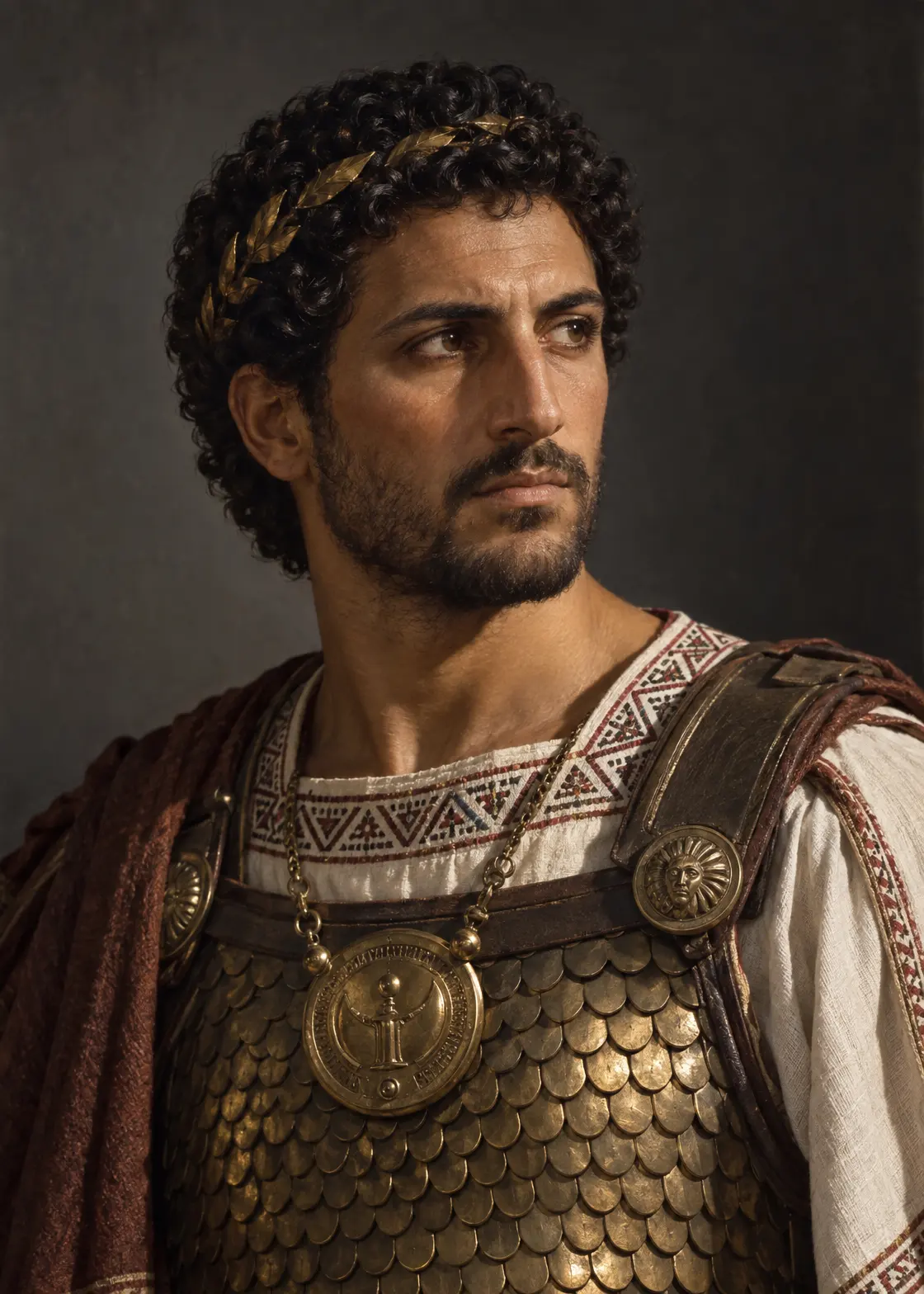
In one further dimension Hannibal must be understood. His commitment to the war against Rome was not a personal hatred — though the Roman tradition liked to imagine it as such — but a strategic and political analysis that had been formed in him over twenty years of close observation of Roman conduct from the Spanish vantage point. He had grown up watching Roman opportunistic acquisitions (the seizure of Sardinia, the Ebro Treaty's ambiguous terms, the steady extension of Roman power in the western Mediterranean) and had concluded that the Carthaginian state could not coexist with the Roman state as currently configured. Either Rome would be defeated and contained, or Carthage would eventually be destroyed. The choice was clear; the only question was whether the means to defeat Rome could be assembled. Hannibal's career was the answer to that question, and his judgment that the means could be assembled was, by the standards of the time and the strategic calculus available to him, defensible. He was, in the end, wrong; but his being wrong required a level of Roman institutional resilience that no Mediterranean power of the prior history had possessed, and Hannibal's strategic calculation was reasonable to the extent that it underestimated this resilience.
The Saguntum Crisis220–219 BC
Saguntum (modern Sagunto, in the Valencian region of Spain) was a small Iberian city of perhaps twenty thousand inhabitants, located on the Spanish east coast about a hundred and twenty miles south of the Ebro river. It had been an ally of Rome since approximately 226 BC, the alliance having been concluded as part of the diplomatic activity surrounding the negotiation of the Ebro Treaty. Its strategic position was anomalous: it lay clearly south of the Ebro, within the territory the Ebro Treaty had reserved for Carthaginian expansion, and yet it had been brought into Roman alliance during precisely the period when the Carthaginian sphere of influence in Spain was being recognized. The anomaly is partly explained by the political circumstances of 226: the Romans were primarily concerned with the Cisalpine Gallic threat that would culminate at Telamon and were focused on negotiating Spanish stability for as long as that threat was active; they accepted the Saguntine alliance principally as a diplomatic counter-weight to Hasdrubal's growing power, not because they expected the alliance to have substantial military implications.
By 220 BC the situation had changed. The Cisalpine threat had been resolved at Telamon and the follow-up campaigns; the Roman strategic capacity in the central Mediterranean was now greater than it had been since the Punic War's end; and Hannibal's accession to the Spanish command had introduced a new factor — an aggressive Carthaginian leader whose long-term intentions toward Rome were uncertain but were, by the consensus of the Roman senatorial class, likely to be hostile. The Saguntine alliance, which had been a low-cost diplomatic gesture in 226, was now a potential trigger for war.
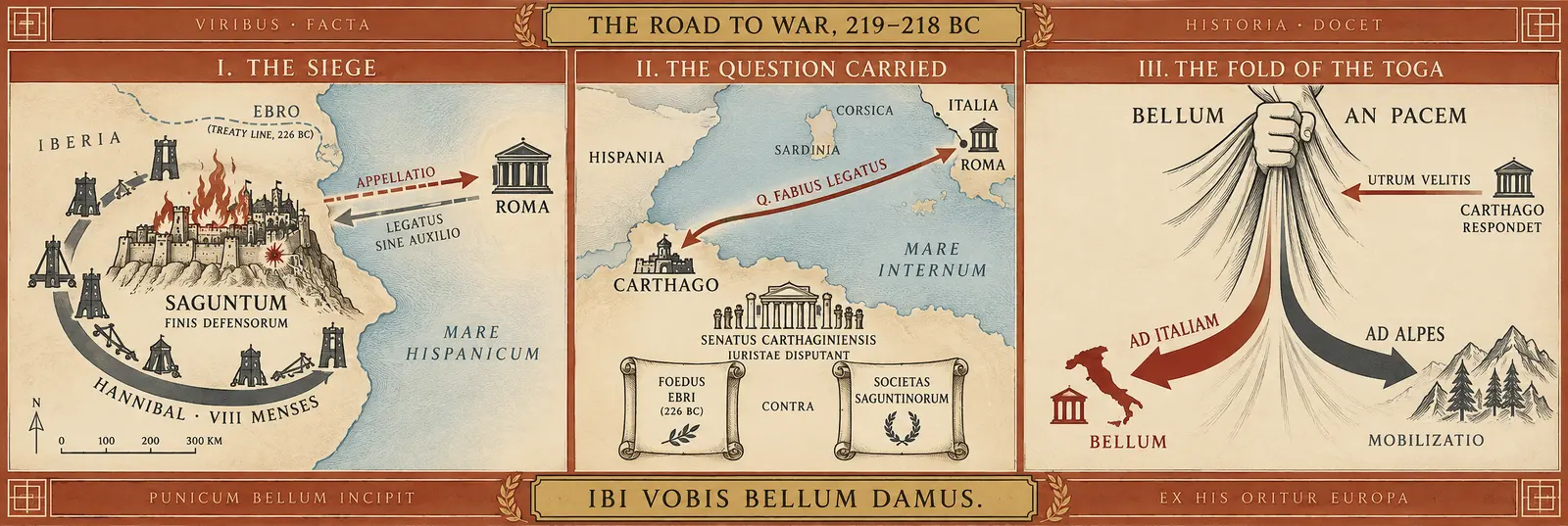
The crisis was precipitated by Saguntum itself. In 220 BC, the Saguntine government — supported by the Roman embassies that periodically visited the city — pursued an aggressive policy toward neighboring Iberian tribes that were within the Barcid sphere of influence. Border conflicts, the deposition of Saguntine-aligned tribal leaders by Carthaginian-aligned competitors, and several documented Saguntine raids against Carthaginian-protected territories produced a steady accumulation of grievances on the Carthaginian side. Hannibal, after consulting with the home government and (according to some accounts) waiting until the diplomatic situation was clear, undertook in the late spring of 219 BC a direct military operation against Saguntum.
The siege of Saguntum lasted approximately eight months, from the spring through the autumn and winter of 219 BC. The Saguntines defended their city with notable courage; their walls were strongly built; their position was reasonable from the standpoint of defense. The Carthaginian siege was conducted with the technical skill that the Barcid army had developed in years of Iberian campaigning: rams against the walls, mining and counter-mining, escalades from belfries, the use of pickets and supply control to prevent any external relief from reaching the city. Hannibal himself was wounded at some point during the siege (a thrown javelin through the thigh by Polybius's account) but recovered and continued the operation.
Throughout the siege, the Saguntines appealed repeatedly to Rome for relief. Roman embassies were dispatched to Hannibal's camp and to Carthage demanding the suspension of the siege; Hannibal received the embassies courteously but declined to suspend the siege, arguing (with a legal sophistication that the Roman tradition has somewhat obscured) that the Saguntine aggressions had themselves been provocative and that the operation was a legitimate Carthaginian response to violations of treaty obligations. The Roman embassies to Carthage demanded that the home government order Hannibal to withdraw; the Carthaginian Senate, after debate, refused. The Carthaginian government's refusal was understood in Rome as a state-level commitment to the Barcid position and as effective Carthaginian responsibility for Hannibal's conduct.
In the late autumn of 219 BC, with the city's defenses crumbling and external relief impossible, the Saguntine leaders made the decision that became the dramatic centerpiece of the Roman tradition of the event: they gathered the city's accumulated wealth into a public bonfire, killed their own families to prevent enslavement, and then either died defending the walls or threw themselves into the flames. When Hannibal's troops finally entered the city, they found it largely a charnel-house, with the bulk of the population already dead by their own hand and the survivors in no condition to be sold profitably as slaves. The siege of Saguntum thus ended in the worst possible political outcome from the Carthaginian perspective: Hannibal had taken the city but gained no significant booty (the wealth having been burned), had eliminated a population that could not be exploited (most of it dead), and had given the Roman state a casus belli of unanswerable moral force (the Saguntines as Roman allies, destroyed for their loyalty to Rome). The dramatic potential of the story was substantial, and the Roman tradition exploited it in the manner one would expect.
The Roman Declaration of WarSpring 218 BC
The Roman response was deliberate and proceeded according to careful diplomatic forms. In the spring of 218 BC, a senatorial embassy under Quintus Fabius Maximus (the man who would shortly become Cunctator, the Delayer, against Hannibal) traveled to Carthage with a formal ultimatum. The choice presented to the Carthaginian Senate was binary: either surrender Hannibal himself to Roman justice, or accept a state of war with Rome.
The famous scene of Fabius in the Carthaginian Senate House is preserved in detail in Livy (21.18) and in Polybius (3.20–21). Fabius, after delivering the Roman demand for the surrender of Hannibal, was reportedly asked by the Carthaginian senators what answer he wished to receive. He responded by holding up the front fold of his toga and saying that he carried in it both peace and war, and that the Carthaginians could choose which one to have. The Carthaginians, after some discussion, told him to let fall whichever the Romans preferred. Fabius dropped the fold and let war fall. The Senate of Carthage accepted the war.
The historicity of the dramatic toga-fold gesture has been doubted by some modern scholars but the substance is firm: a Roman ultimatum was delivered in the spring of 218, the Carthaginian Senate refused to surrender Hannibal, and a state of war was formally declared. The strategic situation that now obtained — with Roman armies and fleets being prepared for operations in Spain and Africa, and with Hannibal in Spain receiving the news of the war declaration and beginning his preparations for what would prove the most audacious operational decision of the entire period — would shortly resolve itself into the campaign that would carry Hannibal across the Alps and into Italy.
The Strategic Decision: To Go to Italy by Land
The Roman strategic conception for the war of 218 was straightforward and conventional. Two consular armies would be put in the field: one under the consul Publius Cornelius Scipio (father of the future Africanus) would proceed to Spain to engage Hannibal in his own theater; the other under Tiberius Sempronius Longus would cross to Sicily and prepare for an invasion of Africa. The strategic objective was to defeat Carthage where she was strong by the application of overwhelming Roman naval and military force; Italy itself was expected to remain a quiet rear area, providing manpower and supplies but seeing no major operations.
Hannibal's strategic conception was the precise opposite. The conventional war that the Roman Senate had planned would, by Hannibal's analysis, end in Carthaginian defeat. Roman naval superiority would prevent direct Carthaginian operations against Italy from the sea; Roman manpower and alliance-system depth would prevent any conventional Carthaginian gain from being permanent; the Carthaginian state's financial and demographic resources were inadequate to a war of attrition with Rome on the strategic geometry the Roman plan implied. The only path to Carthaginian victory was a war fought in Italy itself, with the Italian alliance system as the target — the dissolution of the Roman alliance, the detachment of the Italian socii from Rome, the reduction of the Roman state to its bare Roman-citizen base by the political destruction of the very institutional achievement of Book I's final chapters. If the alliance system could be broken, the Roman demographic and military advantage that had defeated Pyrrhus and that was now preparing to defeat Carthage on conventional lines would itself be broken; if the alliance system held, the war could not be won.
The strategic insight was correct in its identification of the Roman alliance system as the center of gravity. It was also correct in its identification of land-invasion of Italy as the only available means of attacking that center of gravity. What it underestimated was the institutional resilience of the Roman alliance system itself — the capacity of the relationship between Rome and her allies to survive even military defeats of unprecedented scale. The error was not visible in 218; it would become visible only after Cannae had been fought and the alliance had nevertheless not broken.
Hannibal's tactical solution to the strategic problem was the land march from Spain to Italy. The route was approximately a thousand miles by the path Hannibal selected (Carthago Nova to the Ebro, the Ebro crossing, the march along the southern coast of Gaul through the Massalian and Greek territories, the crossing of the Rhône, the ascent of the Alps, the descent into the Po valley). It would require the maintenance of an army's discipline and supply across hostile or uncertain territory over a march of perhaps five months. It would expose the army to the certainty of attrition from desertion, casualty, and the loss of equipment. It would deliver Hannibal into Italy with an army significantly smaller than the one he had begun the march with — a fact Hannibal himself accepted, calculating that the strategic effect of arriving unexpectedly in Italy would outweigh the operational cost.
The march was a calculated risk on a scale unparalleled in the prior strategic history of the Mediterranean. The closest analogue was Alexander's march from the Aegean to the Indus, but Alexander had marched with a supply system and a series of conquered cities behind him; Hannibal would march without rear support and through populations who were either neutral or hostile. If the march succeeded, the strategic advantage would be Carthaginian; if it failed, the war would be lost before it had really begun.
The Departure and the Spanish CrossingSpring–Summer 218 BC
Hannibal departed from Carthago Nova in the spring of 218 BC with a field army of approximately 90,000 foot and 12,000 cavalry, including 37 war elephants. The composition of the army is preserved with unusual detail by Polybius, who appears to have drawn his information from a bronze inscription that Hannibal himself erected at the Lacinian promontory in Italy (the temple of Juno Lacinia, near the modern Crotone) recording the army's composition; Polybius read this inscription personally during his Mediterranean travels, and his preservation of its content is one of the few cases in which an ancient historian was able to consult contemporary primary documentation for the events he described.
Hannibal's first operation was to leave a substantial portion of his force in Spain under his brother Hasdrubal (a different Hasdrubal from Hasdrubal the Fair: this was Hannibal's younger brother, who would command in Spain throughout the war and would eventually attempt to bring reinforcements through southern Gaul into Italy, only to be intercepted at the Metaurus in 207 BC). The Spanish garrison force was approximately 15,000 foot and 2,000 cavalry, with about 20 elephants. Hannibal's mobile field army for the march was therefore reduced from the original 90,000 to approximately 75,000 foot and 10,000 cavalry, with 17 elephants. This was still a substantial force — larger than any single field army Carthage had previously deployed in any war — but the reductions from natural attrition, garrison detachments, and the eventual march casualties would bring the force entering Italy down to approximately 26,000 fighting men.
The Spanish-Gallic crossing was conducted in the late spring and early summer of 218 BC. The Ebro was crossed in early summer; the Iberian populations between the Ebro and the Pyrenees were either subdued or bypassed; the Pyrenees were crossed in mid-summer; the army entered southern Gaul in late June or early July. The Roman embassies that had been dispatched to negotiate with the Gallic tribes of southern France against Hannibal's passage had been notably unsuccessful — the Gallic populations were generally indifferent to the Roman cause and were prepared to receive Hannibal as a passing power rather than a permanent presence. Several Gallic tribes provided guides and supplies; others remained neutral; only a few attempted resistance, and these were generally defeated in small engagements that did not significantly delay the march.
The Crossing of the RhôneLate August 218 BC
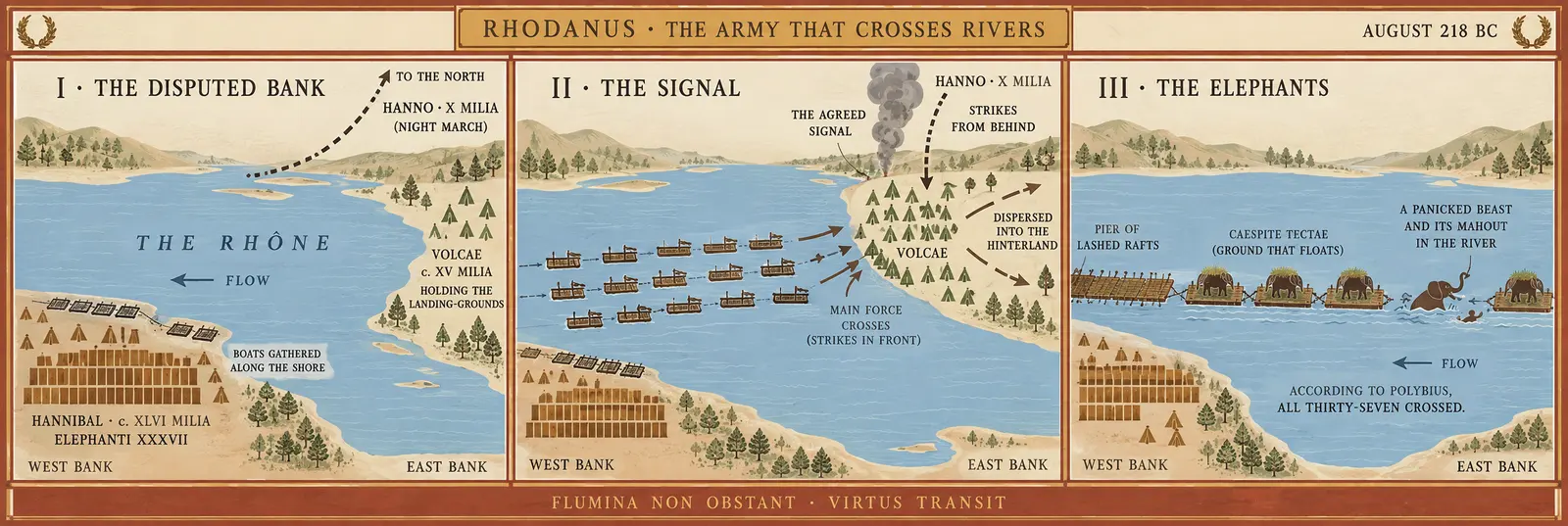
The first major obstacle of the march was the Rhône river, crossed at a point that Polybius locates approximately four days' march from the sea — probably in the vicinity of the modern Tarascon or Avignon, though the exact ford is debated. The river at this point is approximately 250 meters wide, with strong current. The crossing presented two problems: the river itself, and a body of Gallic warriors (Volcae, perhaps fifteen thousand strong) gathered on the eastern bank to dispute the passage.
Hannibal's solution to the second problem was characteristic of his operational creativity. He dispatched a detachment of about ten thousand picked troops under Hanno son of Bomilcar on an upstream march to a crossing point about thirty miles north of his main position, with orders to cross the river at that upstream point and to march down the eastern bank to attack the Volcae from behind. While Hanno's detachment was making this circuit (which took perhaps three days), Hannibal had his main army construct rafts and boats from local timber under the noses of the Volcae, who took this preparation as the standard preparation for a frontal river crossing. On the morning of the planned crossing, the smoke signals from Hanno's detachment — now established on the eastern bank south of the Volcae position — were the signal for Hannibal's main army to launch its assault. The Volcae, attacked from the rear by Hanno's force just as they were preparing to repel Hannibal's frontal crossing, broke and were dispersed; Hannibal's army crossed the river in good order, with the only difficulty being the transportation of the elephants.
The elephant crossing of the Rhône is one of the more technically interesting episodes in the ancient military record and is described by Polybius (3.46) with the kind of detail that suggests it had attracted contemporary discussion. The Carthaginian engineers constructed two great rafts each large enough to support several elephants, covered them with earth and turf to make them resemble dry ground, and led the elephants onto the rafts as if they were continuing along the bank. Once the elephants were aboard, the rafts were detached from the bank by tug-boats and rowed across the river. Some of the elephants, recognizing they were on water, became frightened and either jumped into the river (where they could partially walk along the bottom with their trunks above water, a fact contemporary observers were impressed to discover) or were brought across with their mahouts. By Polybius's account, all thirty-seven elephants made the crossing without loss — a fact which, given the scale of the operation and the inherent risks, is itself a remarkable testament to the technical competence of Hannibal's army.
The Ascent of the AlpsSeptember–October 218 BC
With the Rhône successfully crossed, the army turned eastward toward the Alps. The specific route Hannibal followed across the mountains has been debated by classical scholars and Alpine geographers for over two thousand years, with at least four major candidate passes (the Col de Clapier, the Col du Mont-Cenis, the Col du Petit Saint-Bernard, and the Col de Larche) having been proposed at various times. Polybius (3.50–56) describes the crossing in detail but with topographical references that do not unambiguously identify the route. The modern consensus, supported by the recent geochemical work of Mahaney and others (who in 2016 identified deposits of horse dung at the Col de la Traversette consistent with the passage of a large army in the autumn of 218 BC), tends toward a southern route via the Col de la Traversette or the Col du Clapier. The matter is not entirely settled.
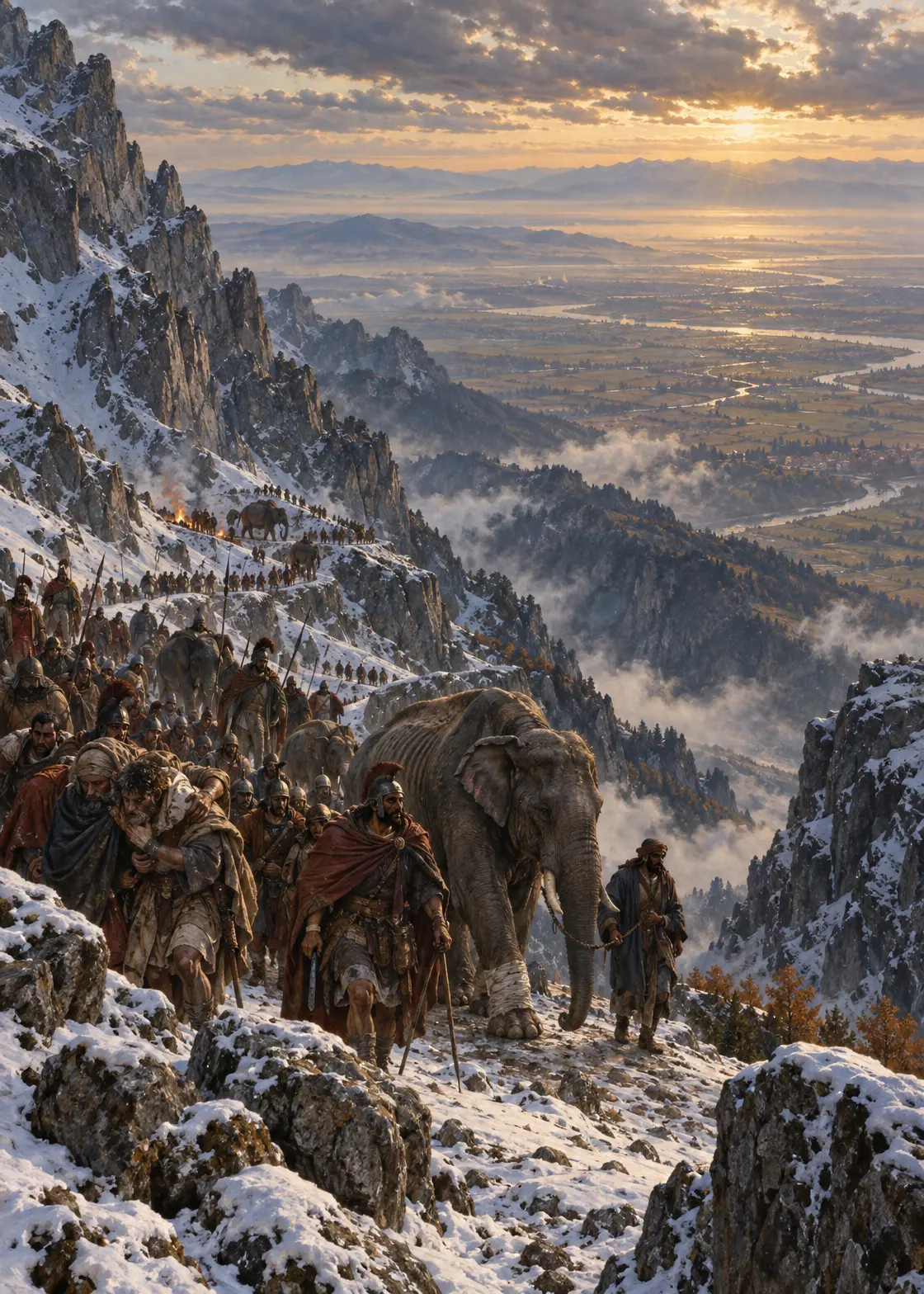
What is firmly preserved by the sources is the general character of the crossing: it was conducted in the early autumn (September and early October 218 BC), at the very edge of the season when Alpine passes are still negotiable for large forces; it was bitterly cold for the African and Iberian troops in Hannibal's army; it was conducted under intermittent harassment by the Alpine Gallic populations (Allobroges in the lower foothills, various smaller tribes higher up) who attacked the column at narrow points and inflicted significant casualties before being dispersed or bought off; it was punctuated by the kind of physical difficulties (snow on the high passes, the necessity of cutting paths through rocks frozen with ice, the difficult management of pack animals on narrow tracks) that the Polybian description captures in detail.
The most dramatic single moment of the ascent, in Polybius's account, was the engineering operation by which Hannibal's army descended from the highest pass into the Po valley. The descending track, narrow and steep, was found to be blocked at one point by a major rockfall (recent or ancient is uncertain) that could not be passed by men and certainly not by elephants. Hannibal's troops, with rations and time running short and the elephants in particular suffering severely from the cold and altitude, attacked the rockfall directly: they built fires against the rocks, heated them through the night, then poured sour wine (vinegar, the only acidic liquid available in quantity) over the heated stone to crack it. Polybius reports that by this method the rocks were reduced to a passable state in three days of continuous work, the path was opened, and the army made its descent. The technical credibility of the procedure has been variously assessed by modern engineers (the vinegar's specific role is doubtful, but the heating-and-quenching technique is consistent with traditional rock-breaking methods of the period), but the underlying narrative of an emergency engineering operation under extreme conditions is preserved with consistency in the source tradition.
Arrival in Italy
Hannibal's army emerged from the Alps into the territory of the Insubres in late October or early November 218 BC. The army that arrived in Italy was substantially smaller than the army that had departed Spain. Polybius's figures — drawn, again, from Hannibal's own Lacinian inscription — record the arrival force as approximately 20,000 foot and 6,000 cavalry: about 26,000 men in all, of whom 12,000 were African and 8,000 Iberian heavy infantry, the remainder Numidian cavalry and miscellaneous detachments. Of the 37 elephants that had begun the crossing, perhaps 20 (the sources vary somewhat) survived the descent. The army had lost approximately two-thirds of its strength on the march from Carthago Nova, principally to desertion in southern Gaul (mercenary contingents who had refused to continue at the Rhône or in the Alps), to casualties in the Alpine fighting, and to attrition from cold and exhaustion in the high passes.
What Hannibal had brought to Italy, however, was an army of unprecedented quality. The 26,000 men who had survived the march were the most resilient elements of his original force, hardened by months of campaigning under extreme conditions and bound to their commander by a degree of personal loyalty that no other ancient army of the period possessed. They were now in central position to attack the Roman alliance system; they were resupplied immediately by the Cisalpine Gauls of the Boii and Insubres, who joined Hannibal's army with substantial reinforcements (perhaps 14,000 Gallic foot and cavalry in the first weeks); they would shortly be tested against the Roman armies that had been hastily redirected from their original Spanish destination to confront the unexpected Italian invasion.
The first encounter would be at the Ticinus.
The Crossroads · Spring 218 BC · Carthago Nova, Spain
The Strategy of Descent: Hannibal at Carthago Nova
You are Hannibal Barca, supreme commander of Carthaginian forces in Spain, twenty-nine years old, planning your campaign following Rome's declaration of war.
Following your eight-month siege and capture of Saguntum, a Roman embassy under Quintus Fabius Maximus traveled to Carthage and declared war. Rome is mobilizing two consular armies: Publius Cornelius Scipio is dispatched toward Spain, while Tiberius Sempronius Longus prepares in Sicily for an invasion of Africa. Rome commands the western seas and possesses vastly superior manpower reserves through her Italian alliance system. You have assembled ninety thousand infantry, twelve thousand cavalry, and thirty-seven war elephants at Carthago Nova, knowing that Carthage's finances and demographics cannot endure a prolonged conventional war of attrition.
How will you deploy the Barcid forces to prosecute the war against Rome and secure the survival of Carthage?
Weigh each course: open it to hear your own inner voice. Then decide. Nothing is scored.
- Your inner voiceThe course taken
If I remain in Spain, our army holds rich silver country and familiar ground. We can detach veterans to shield Carthage against Sempronius while meeting Scipio's legions in the Iberian interior with ninety thousand men. Yet Roman demographic reserves are practically inexhaustible. If we wage a conventional war of defense, Roman fleets will cut our sea lanes, and our tactical victories here will leave their heartland untouched while Carthage slowly bleeds.
- Your inner voiceThe course taken
Rome expects to dictate this war in Spain and Africa. To survive, we must strike her center of gravity: the Italian alliance system that feeds her legions. Since Roman fleets bar the sea, we must march overland across the Ebro, southern Gaul, and the high Alps into the Po valley. The thousand-mile march will cost thousands of men to cold and exhaustion, but arriving unexpectedly in Italy seizes the initiative.
- Your inner voiceThe course taken
If the Italian alliance system must be our target, sending our army by sea directly to southern Italy or Sicily would preserve our pack animals, elephants, and soldiers from the attrition of a thousand-mile march. We could appear suddenly off their coasts within weeks. But Roman naval superiority is absolute. If consular fleets intercept our laden transports on open water, our entire field army will perish without striking a blow upon land.
What was done
Hannibal chose the overland march. Leaving his brother Hasdrubal with approximately 15,000 foot, 2,000 cavalry, and 20 elephants to secure Spain, Hannibal departed Carthago Nova in spring 218 BC. His mobile column crossed the Ebro, traversed the Pyrenees, and outmaneuvered the Volcae at the Rhône using an upstream envelopment by Hanno son of Bomilcar. In September and October, Hannibal forced his army across the high Alpine passes despite hostile tribes, bitter snow, and a blocked track cracked with heat and sour wine. Hannibal emerged into the territory of the Insubres in late autumn with approximately 20,000 foot, 6,000 horse, and perhaps 20 elephants—a surviving force of 26,000 men confirmed by Polybius's reading of Hannibal's own Lacinian inscription (AGrade A). Though the march had cost roughly two-thirds of his starting army, the Boii and Insubres immediately provided 14,000 reinforcements, placing Hannibal in central position to strike the Roman alliance system.
The evidence Polybius 3.6–56 provides the primary narrative (BGrade B), incorporating contemporary troop and casualty figures directly from Hannibal's bronze Lacinian inscription (AGrade A). Livy 21 offers a parallel account with rhetorical elaboration (BGrade B). Further notices survive in Cassius Dio via Zonaras (BGrade B), Cornelius Nepos, Appian, Diodorus, Florus, and Eutropius (all CGrade C), alongside Silius Italicus (DGrade D). Physical evidence at the Col de la Traversette provides material support for an Alpine passage (AGrade A).
If you choose to walk through itAt every scale
- Yourself
Having sworn at the altar against Rome as a child of nine, how do you distinguish your strategic duty to preserve Carthage from the personal destiny imposed by your father Hamilcar?
- Those beside you
What obligation do you owe to the veterans who acclaimed you supreme commander and your brother Hasdrubal, whom you leave behind in Spain to face consular invasion alone?
- Rome
Can a state structured around annual consular commands and civic loyalty withstand an existential military campaign fought entirely within its own domestic territory?
- The wider world
How can independent Gallic and Italian communities preserve their autonomy when two great imperial powers turn their homelands into theaters of continental war?
- Our own time
When facing a rival of vastly superior demographic and industrial scale, is an audacious and attritional high-risk offensive ever more rational than a stubborn defense?
In modern asymmetric or coalition conflicts, weaker states or non-state entities often realize that fighting an adversary with overwhelming industrial capacity on conventional battlefields guarantees eventual defeat. Instead, strategists attempt to leap over conventional defensive lines to attack the adversary's domestic political will or fragile alliance structure directly. By forcing the conflict into the opponent's home territory or political sphere, the weaker belligerent wagers that political fracturing will achieve what military parity never could.
Where the comparison fails. Modern land borders, electronic reconnaissance, and mechanized logistics make surprise overland movements of tens of thousands of men virtually impossible. Furthermore, modern nation-states possess formal citizenship and centralized constitutional bureaucracies rather than the fragile confederacies of coerced city-state allies that Hannibal sought to dissolve.
What does the chapter tell us?
Why did Hannibal conclude that a conventional defensive war against Rome would inevitably fail?
Hannibal recognized that Roman naval superiority blocked direct maritime routes, while Rome's deep alliance manpower ensured that Carthage's limited demographic and financial resources could not withstand a conventional war of attrition in Spain or Africa.
Polybius 3.6–56 (BGrade B for narrative)
Why was the city of Saguntum an anomalous point of friction between Rome and Carthage in 219 BC?
Saguntum was located roughly 120 miles south of the Ebro within the recognized Carthaginian sphere, yet Rome had formed an alliance with it around 226 BC as a low-cost diplomatic counterweight during the Cisalpine Gallic crisis.
Polybius 3.6–56 (BGrade B for narrative)
Why do historians assign a AGrade A level of attestation to the specific figures for Hannibal's arriving army in Italy?
Polybius traveled to the temple of Juno Lacinia and personally read the bronze inscription erected by Hannibal, providing rare contemporary primary documentation for the army's composition and strength upon reaching Italy.
the Lacinian inscription itself via Polybius 3.33, 3.56 (AGrade A)
How did Hannibal overcome the Volcae force disputing his crossing of the Rhône river?
Hannibal ordered Hanno son of Bomilcar to march about thirty miles upstream with ten thousand troops, cross unnoticed, and signal with smoke before attacking the Volcae rear just as the main army launched its assault.
Polybius 3.6–56 (BGrade B for narrative)
According to the chapter's analysis, what was Hannibal's critical strategic error when he designed the invasion of Italy?
Hannibal accurately identified Rome's Italian alliance system as its center of gravity, but he underestimated its institutional resilience—its capacity to survive unprecedented military disasters, which became clear only after Cannae failed to shatter it.
the chapter's narrative