Book II · The Mediterranean Wars
Chapter 5
The Year of Hannibal: Ticinus, Trebia, Trasimene, and the Fabian Strategy
The Roman Response to the Alpine Crossing
The news that Hannibal had crossed the Alps and was in the Po valley reached Rome in November 218 BC, arriving as a strategic surprise of the first magnitude. The Roman war plan had assumed that the war would be fought principally in Spain and Africa, with the Italian theater serving as supply base and recruitment ground rather than as the principal arena of operations. The consul Publius Cornelius Scipio, dispatched in the early autumn with his consular army to Spain, had paused at Massalia to discover that Hannibal had already crossed the Rhône north of his position; he had then conducted a brief reconnaissance, found the Carthaginian army gone into the mountains, and made the strategically decisive judgment that he could not now reach Spain in time to interfere with Carthaginian operations there. He sent the bulk of his army on to Spain under his brother Gnaeus Cornelius Scipio Calvus (which decision would prove, in the long run of the war, one of the most consequential of the period: the elder Scipio's command in Spain would establish a Roman foothold on the peninsula that Hannibal had failed to suppress before his march, and would tie up Carthaginian resources for the remaining decade of the war). Publius Cornelius Scipio himself returned by sea to northern Italy with a small detachment, taking command of the legions that had been raised in Cisalpine Gaul to defend against the Gallic risings of the previous year and that were now to be redirected against Hannibal's invading army. The other consul, Tiberius Sempronius Longus, who had been preparing his army at Lilybaeum for the African expedition, was recalled by Senate decree to march north to join Scipio. The combined Roman force assembled in the Po valley by mid-December would amount to approximately four legions and the corresponding allied contingents — perhaps 40,000 men in all, against Hannibal's somewhat smaller but more cohesive 26,000 plus the new Gallic reinforcements.
The Cisalpine political situation, however, was strongly in Hannibal's favor. The Insubres and Boii — the principal Gallic peoples of the Po plain — had risen against Rome in 218 BC in a coordinated revolt that the Senate had attributed to Carthaginian instigation and that had certainly been at least encouraged by Carthaginian diplomatic agents in the years before the war. Two Roman colonies that had been founded in the area in 218 (Placentia and Cremona) were under siege or threat; the praetor commanding the Cisalpine garrison had been ambushed and his army badly mauled. The arrival of Hannibal's army was, for the Cisalpine Gauls, the signal for a general rising: tribes that had previously hedged their bets between Rome and revolt now committed openly to Hannibal, supplying reinforcements, supplies, and intelligence on Roman movements. The strategic environment in the Po valley by the time Scipio's combined army reached it was, to the Roman commander's evident dismay, no longer the friendly home territory of Roman colonies and reliable Latin allies but a hostile theater in which Hannibal enjoyed local advantage even before the first set-piece engagement.
The Skirmish at the TicinusLate November 218 BC
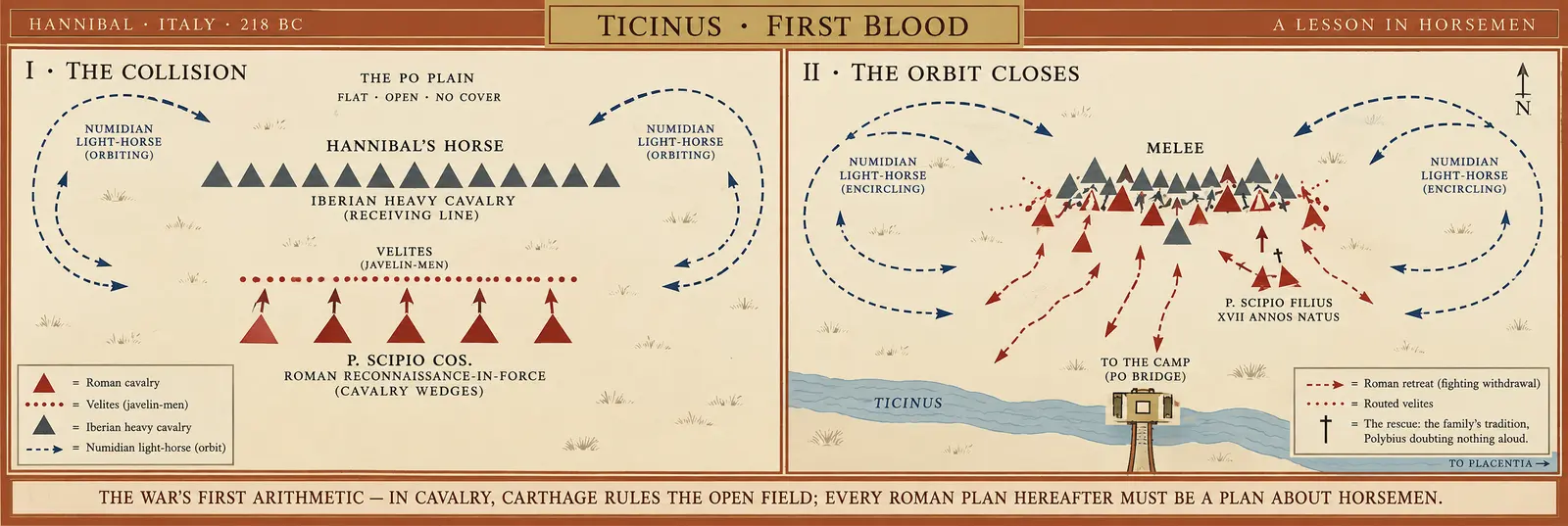
The first contact between the Roman and Carthaginian main armies occurred at the river Ticinus, a tributary of the Po that runs from the Alpine foothills southward through the western Po plain. Scipio had established his camp on the south bank of the Po; Hannibal's army was advancing eastward across the plain. Both armies were probing for information about the other's position and intentions; both commanders elected to lead substantial reconnaissance forces personally — Scipio with about 4,000 mostly Roman cavalry, supported by light infantry, and Hannibal with a comparable force of mixed Numidian and Iberian cavalry. The two reconnaissance forces met on level ground west of the modern town of Pavia, and the engagement that resulted was the first taste of Carthaginian operational tempo that the Roman army experienced in the Italian theater.
The action was sharp and brief. The Roman cavalry charged with their accustomed shock tactic; the Numidian cavalry on Hannibal's wings circled and engaged the Roman flanks while the heavy Iberian cavalry held the Roman center; the engagement degenerated into the kind of fluid cavalry-versus-cavalry melee that the Romans had little experience of conducting and at which the Numidians, in particular, excelled. After perhaps two hours of fighting the Roman cavalry began to give way; Scipio himself was wounded — by some accounts severely — and was extracted from the field only by what the Roman tradition would later commemorate as an act of filial heroism. His young son Publius (the future Scipio Africanus, then about seventeen years old and serving on his father's staff as a junior officer), seeing his father wounded and surrounded, charged into the melee with his personal squadron and brought the elder Scipio out of danger. The episode is preserved by Polybius (10.3) and by Livy (21.46) with the kind of family-historical care that suggests it was preserved by the Scipionic family tradition and may not be a complete invention even if the dramatic details have been improved.
Scipio's reconnaissance force withdrew to the Roman main camp; the Roman army's first engagement with Hannibal had been a tactical defeat of modest scale but considerable strategic significance, because it had demonstrated that the Carthaginian cavalry was substantially superior to the Roman, and that the Roman army in the field would have to find ways to compensate for this deficit if it was to fight Hannibal on anything like equal terms.
Scipio, recognizing that his army was now strategically vulnerable on the western bank of the Po, made the decision to withdraw south of the river to a position where he could await the arrival of Sempronius's army from the south. He executed the withdrawal at night, in good order, breaking down the bridge over the Po behind him. Hannibal, finding the Roman army gone in the morning, marched some way up the Po to find another crossing, and by mid-December had brought his army south of the river as well. The two armies were now within a day's march of each other, both encamped near the small river Trebia, a tributary of the Po that runs through the foothills south of Placentia.
The Battle of the TrebiaLate December 218 BC
The Battle of the Trebia is the first set-piece engagement of the Hannibalic War and the first occasion on which Hannibal's tactical genius was demonstrated to the Roman command system in unambiguous form. The engagement was determined as much by Hannibal's operational understanding of his opponent — specifically, of the temperament of the consul Sempronius Longus — as by the dispositions on the day of battle itself. Hannibal recognized that Sempronius, whose army had recently arrived from the south and who had not yet engaged Hannibal personally, was both ambitious for a victory and inclined to act independently of his more cautious colleague Scipio (who was still recovering from his Ticinus wound and had been counseling delay). Hannibal also recognized that Sempronius's consular year was almost over — the new consuls would take office at the Ides of March — and that Sempronius would therefore be under pressure to seek battle before he was superseded.
Hannibal accordingly set about provoking the Roman army into engagement on terms of his own choosing. He dispatched his Numidian cavalry to raid Roman foraging parties along the Trebia and to insult the Roman camp; he placed a substantial detachment of his light troops in concealment behind a ridge of the lower Trebia, in a fold of dry watercourse that ran into the river from the south; he prepared his main army to march out at first light on the chosen day and to draw up across the river from the Roman camp.
The choice of ground was characteristic. The plain on the Carthaginian side of the Trebia was firm and dry; the plain on the Roman side was marshy and broken by the Trebia's lesser tributaries. Hannibal had selected ground on which his cavalry could maneuver and his elephants could be deployed effectively, while the Roman heavy infantry would have to advance across cold water and broken ground to reach him. The morning of the battle was bitterly cold — Polybius (3.72) reports a sleet storm, a winter wind from the Apennines, and the men of both armies suffering from the cold — and the Roman troops were called out of their warm tents to fight without breakfast on Sempronius's order, because Hannibal's Numidians had begun their morning provocations early and Sempronius had committed himself to immediate engagement.
The Roman army crossed the Trebia in column and formed in the manipular triplex acies on the western bank: four legions and the corresponding allied wings, perhaps 36,000 fighting men with about 4,000 cavalry. Hannibal's army was approximately 28,000 foot and 10,000 cavalry, with the surviving elephants in his center. Sempronius's deployment was conventional and his tactical intentions transparent: the Roman heavy infantry would advance frontally against Hannibal's center, the cavalry on the wings would protect the infantry flanks, and the engagement would be decided by the customary contest of legionary infantry against an opponent expected to be inferior in close combat.
The engagement opened with the cavalry actions on the wings. Hannibal's Numidian and Iberian cavalry, substantially superior in numbers and quality, drove the Roman cavalry from the field within perhaps an hour of the engagement's beginning. The Roman infantry's wings were now exposed, but the legion had been designed to fight in conditions where the wings could be threatened, and the triplex acies could redress flank pressure by maneuver. Hannibal's plan, however, was more sophisticated than a frontal infantry engagement supported by cavalry envelopment. He had concealed in the dry watercourse south of the battlefield, before the engagement began, a detachment of approximately 1,000 picked infantry and 1,000 cavalry under his youngest brother Mago Barca. This detachment had been ordered to remain absolutely concealed until the main infantry engagement was at its height, and then to attack the Roman rear from the unexpected direction.
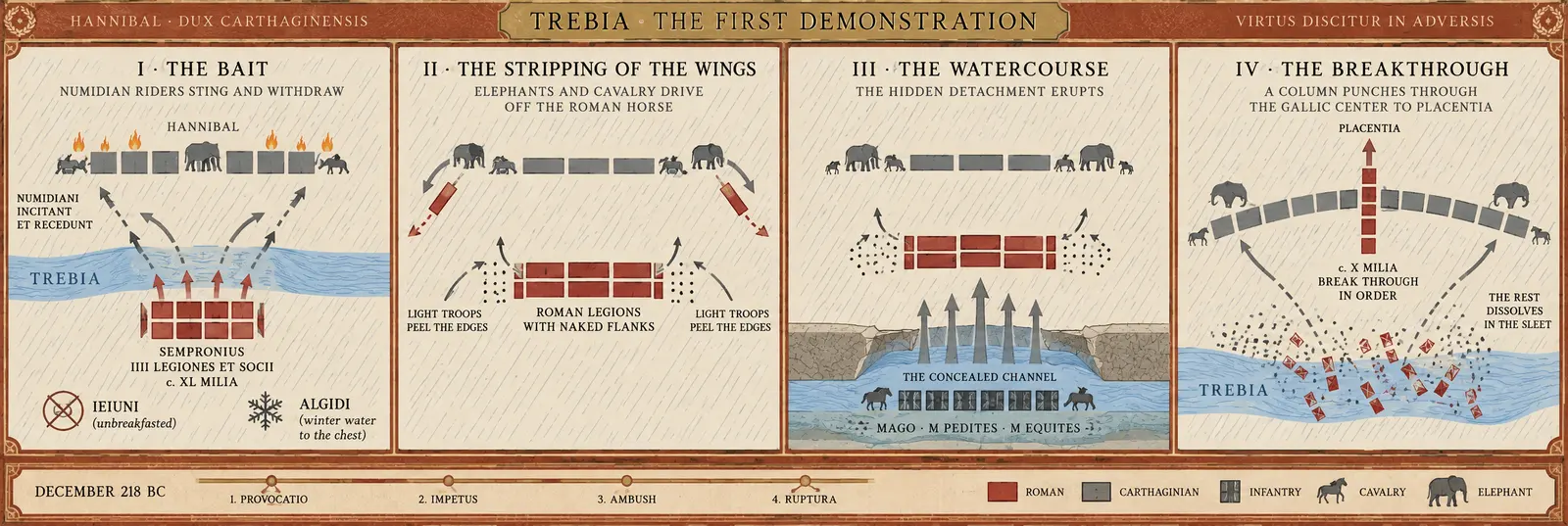
When Mago's detachment emerged from concealment and attacked the Roman rear, the Roman line — already engaged frontally with Hannibal's infantry and elephants and unable to disengage — broke under the converging pressure. The Roman left wing dissolved first; the right, where the allied contingents had borne the brunt of the elephant attack, dissolved next; the center, the hastati and principes of the Roman legions, was the last to give way. A substantial portion of the Roman center — perhaps 10,000 men, by Polybius's account — cut through the Carthaginian line in front of them by a furious frontal attack and escaped northward toward Placentia. The rest of the army — the broken wings, the cavalry, the camp servants and supply troops — was destroyed in the rout or driven into the cold Trebia, where many drowned.
The casualties at the Trebia are given by Polybius as approximately 20,000 Roman dead and a comparable number of allied; Carthaginian losses were heavy among the Gauls in the front line (perhaps 5,000) but light among the African and Iberian core troops. The strategic consequence was decisive: the Roman attempt to defend the Cisalpine theater was ended, the Po valley fell entirely into Hannibal's hands, and the surviving Roman forces (about 10,000 of Sempronius's army that had cut through the line at Placentia, with Scipio's smaller force already at the other Roman colony at Cremona) withdrew southward across the Apennines into central Italy. The Cisalpine Gauls flocked to Hannibal's standard in increasing numbers; his army was reinforced to perhaps 45,000 effectives by the spring of 217. The war in Italy had begun in earnest.
Hannibal's Crossing of the ApenninesSpring 217 BC
The winter of 218–217 BC was spent by both armies in recovery and reorganization. Hannibal wintered his army in the Cisalpine plain among the Insubres and Boii, who provided substantial supplies and reinforcements. He himself, according to Polybius and Livy, fell ill during the winter and lost the use of one eye through a severe infection of the conjunctiva — a fact preserved in the source tradition and confirmed by later coin portraits which represent him in profile from the right side only. The disability did not impair his command capacity, but it was the kind of small physical detail that gave subsequent tradition material for the portrait of Hannibal as a man marked by personal suffering as well as by the strategic ferocity of his campaign.
The strategic situation in the spring of 217 BC had two principal features. First, the Roman Senate had elected two new consuls — Gaius Flaminius and Gnaeus Servilius Geminus — to whom the prosecution of the war was now formally entrusted. Flaminius, a man with strong popularis political affiliations and a strained relationship with the senatorial aristocracy, had been elected consul on a platform that included aggressive prosecution of the war against Hannibal. Servilius was a more conventional senatorial figure. The two consular armies were to operate separately: Flaminius would hold central Etruria with his army at Arretium (modern Arezzo), Servilius would hold the eastern approach at Ariminum (modern Rimini). The strategic conception was that Hannibal, blocked at both Apennine passes, would be unable to penetrate into central Italy without giving one of the consuls a chance to engage him on favorable terms. Second, Hannibal's strategic intention — though it could not yet be confirmed by Roman intelligence — was to move into central Italy as soon as the Apennine passes opened in the spring, with the objective of detaching the Italian allies from Rome by demonstrating Roman incapacity to protect Italian territory from invasion.
Hannibal's choice of route into central Italy was characteristic of his preference for the unexpected. Rather than crossing the Apennines by one of the well-known eastern or central passes that the consular armies were watching, he chose a route that took his army across the Arno marshes and through wet ground that the Roman command system had not regarded as a likely passage for a major army. The march across the marshes — Polybius (3.78–79) describes it with vivid detail — was conducted in the spring of 217 BC under conditions of extreme physical hardship. The army spent three days and four nights wading through standing water (in some places, Polybius reports, up to chest-deep), with the men unable to lie down or rest properly and many of the pack animals dying of exhaustion. Hannibal himself, suffering from his recent ophthalmia, was reportedly carried on the back of one of his surviving elephants — the last of the elephants to die, which expired shortly after Hannibal dismounted on the southern side of the marshes. The army emerged from the marshes onto firm ground in central Etruria, having bypassed both consular armies and placed itself in a position from which it could threaten Rome's central Italian alliance system directly.
The Roman command system was thrown into disarray. Flaminius, at Arretium, learned of Hannibal's appearance south of the Apennines only after the Carthaginian army was firmly established in Etruria and was beginning to raid Roman allies in the area. The strategic options now available to the Roman command were narrow: Servilius's army at Ariminum could not reach Hannibal's position in less than several weeks; Flaminius's army at Arretium was the only Roman force in position to engage. The senate's instructions to Flaminius, in so far as they can be reconstructed from Polybius and Livy, were that he should remain at Arretium, await reinforcement from Servilius, and avoid a decisive engagement until the combined Roman forces could be brought to bear. Hannibal, however, calculated that Flaminius — politically vulnerable, aware that the Roman political class would not forgive a perception of military passivity, and personally ambitious for the kind of decisive victory that would secure his political position — could be drawn into pursuing the Carthaginian army by being insulted in the appropriate way. Hannibal marched his army past Arretium toward the south, deliberately wasting the territory along his line of march, allowing Flaminius to see the smoke of burning Italian farmsteads and to hear the reports of devastated allied communities. Flaminius, exactly as Hannibal had calculated, broke camp and pursued.
The Battle of Lake Trasimene21 June 217 BC
Hannibal's selection of ground at Lake Trasimene was the most perfect tactical disposition of his entire Italian campaign. The lake is approximately seventeen kilometers long and lies in a depression bounded on the north by a range of hills that fall away in a series of spurs and re-entrants to the lake shore. The road from Cortona to Perugia — the road on which Flaminius's army was marching in pursuit of Hannibal — ran along the narrow strip of land between the lake on the south and the hills on the north. At the western end of this strip, where the road entered the defile between lake and hills, was a narrow passage; at the eastern end, where the road emerged into more open country, was another. The defile in between was approximately five kilometers long, and at its narrowest perhaps two hundred meters wide. An army caught in this defile by a force holding both ends would be unable to deploy from column into line, would have its flanks pinned against the lake to the south and the hills to the north, and would have no possibility of strategic withdrawal.
Hannibal arrived at the eastern end of the defile on the evening of 20 June 217 BC. He deployed his army with characteristic precision. His African heavy infantry he placed in plain sight at the eastern end of the defile, in such a way that they could be seen from a distance as the Roman vanguard approached, presenting the appearance of the Carthaginian main army drawn up for battle. His Iberian and Gallic infantry he concealed along the wooded slopes of the hills north of the road, in detachments hidden by trees and folds of ground, with strict orders to remain motionless until his signal. His cavalry — the Numidians and the Iberian heavy horse — he stationed at the western end of the defile, in a position from which they could ride down the road behind the Roman army once it had committed itself fully to the passage. The trap was therefore set on two axes: the Roman army would be drawn into the defile by the visible main body at the eastern end; once fully committed, it would be attacked simultaneously by the concealed forces on the northern flank and the cavalry at the western end.
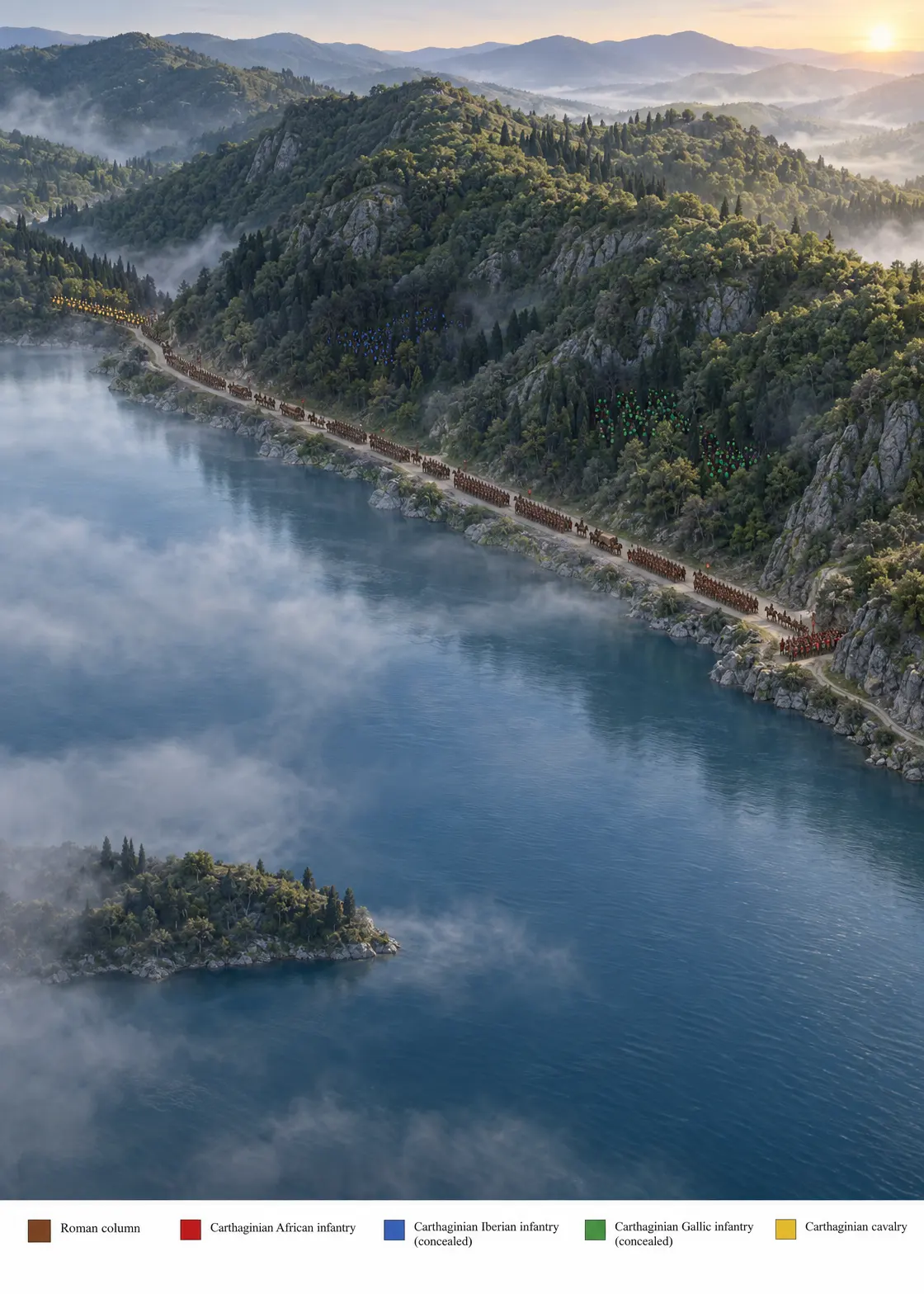
The Roman army approached the defile in the early morning of 21 June 217 BC. Polybius (3.83) reports that a heavy mist was rising from the lake — characteristic of summer mornings on Trasimene — which limited visibility severely on the road itself but left the higher ground above the mist relatively clear. From Hannibal's elevated position the Roman column could be observed as it advanced into the defile; from the Roman column's position, however, the slopes north of the road and the eastern end of the defile were both obscured. Flaminius's vanguard advanced into the defile in standard marching order, with the consul himself in the center of his army; the rear elements of the column had not yet entered the defile when the leading elements were within a kilometer of the eastern end. The army was thus extended in a column perhaps five kilometers long along a narrow passage, with no part of it in a position to deploy properly into line.
Hannibal gave his signal at the moment of maximum Roman extension. The concealed infantry on the slopes north of the road poured down the hillsides into the column, attacking the Roman flank simultaneously along the entire length of the defile. The African heavy infantry at the eastern end advanced to engage the Roman vanguard frontally. The cavalry at the western end rode forward to close the trap from the rear. The Roman column had perhaps fifteen minutes to recognize what was happening before it was simultaneously attacked from front, both flanks, and rear.
The destruction of Flaminius's army at Trasimene was the most complete tactical annihilation of a Roman army on a single day before Cannae, and it was conducted with a kind of cold operational precision that has very few parallels in ancient military history. The Roman army was unable to form line; its maniples could not coordinate; its officers could not communicate above the noise of attack from all directions; the legionary discipline that had won the Italian wars proved inadequate to the conditions imposed by the surprise. The fighting lasted perhaps three hours, principally because the Roman vanguard fought with the discipline characteristic of a beaten army that has not yet given up; but the outcome was determined within the first hour. Flaminius himself, attempting to rally his troops at the head of his army, was killed in the fighting — the sources differ as to whether by a chance javelin or by a deliberate attack from an Insubrian Gaul named Ducarius who reportedly recognized Flaminius from his consular regalia and had personal vengeance to take for some prior offence Flaminius had committed in his consulship during the Cisalpine war of 223 BC. The sources are consistent that Flaminius died fighting in the front line, which is creditable to him personally even if his strategic and operational judgment is to be condemned.
The casualties at Trasimene are given by Polybius as approximately 15,000 Roman and allied dead with another 10,000 captured (the captives — the Roman citizens released without ransom in a deliberate gesture of Carthaginian magnanimity, the Italian allies held for ransom and eventually released — were the largest single category of Roman prisoners taken in any single battle of the war so far). A further 6,000 Romans cut their way through the eastern end of the defile and reached the village of Maggione, but were surrounded by Hannibal's cavalry the next morning and forced to surrender. Total Roman losses for the engagement were therefore approximately 25,000 — about three-quarters of Flaminius's army. Carthaginian losses were approximately 1,500, principally among the Gallic light infantry on the slopes north of the road.
The news of Trasimene reached Rome by the standard couriers within four or five days. The praetor Marcus Pomponius, charged with the public announcement, made it in the Comitium with characteristic Roman directness: "We have been beaten in a great battle." The Roman tradition would preserve, with rather more dignity than the news perhaps merited, the calm public response of the Roman political order to the catastrophe. The Senate met, the people assembled, the emergency procedures were activated, and the institution that had been designed for moments of supreme crisis was put into motion. Quintus Fabius Maximus Verrucosus, an elder statesman of the senatorial class with the cognomen Cunctator (the Delayer) that he would shortly earn but had not yet been given, was appointed dictator with full emergency powers, with Marcus Minucius Rufus as master of horse. The dictator's first task was to assess the strategic situation and to develop a response that would not produce a third catastrophe in less than seven months.
The Fabian Strategy
What Fabius designed in the summer of 217 BC was the strategic doctrine that would eventually win the Hannibalic War, though its full effects would not be visible until many years had passed and the war had passed through several further phases. The doctrine had two principal elements. First, the Roman army would avoid set-piece battle with Hannibal. Hannibal's tactical superiority had been demonstrated three times in succession (Ticinus, Trebia, Trasimene); a fourth engagement on terms of his choosing would produce a fourth catastrophe; the Roman state could absorb perhaps two more such defeats before the strategic balance shifted irrecoverably against her. Second, the Roman army would shadow Hannibal's force at close range, occupying high ground in parallel to his line of march, attacking only when local conditions made an isolated detachment vulnerable, intercepting Carthaginian foraging parties, and denying Hannibal the strategic objective of unconstrained operation in the Italian theater. The strategy was, in modern strategic vocabulary, that of deterrence by denial: Rome would not seek to destroy Hannibal in the field, but to prevent him from achieving his strategic objective (the dissolution of the Italian alliance system) while waiting for the conditions that would eventually allow his defeat at lower cost.
The strategy was deeply controversial within the Roman political system, for reasons both legitimate and ignoble. The legitimate criticism was that the Fabian strategy ceded the Italian countryside to Carthaginian depredation: while Hannibal's army was being shadowed but not engaged, his troops were burning Italian farms, taking Italian cattle, and demonstrating to the Italian allies that Rome could not protect them from harm. The political consequence of this — over time — would be the very alliance defection that the strategy was designed to prevent. The ignoble criticism was the senatorial-aristocratic resentment of the unconventional senior figure whose personal authority Fabius's command implied: the Roman political system was organized around the annual consular magistracies, and the appointment of a dictator with extended powers, while constitutionally provided for in emergencies, was inherently in tension with the normal operation of the political order. Fabius's prestige and authority during his dictatorship made him a target of political resentment from senatorial figures who would, in normal circumstances, have been his peers and competitors.
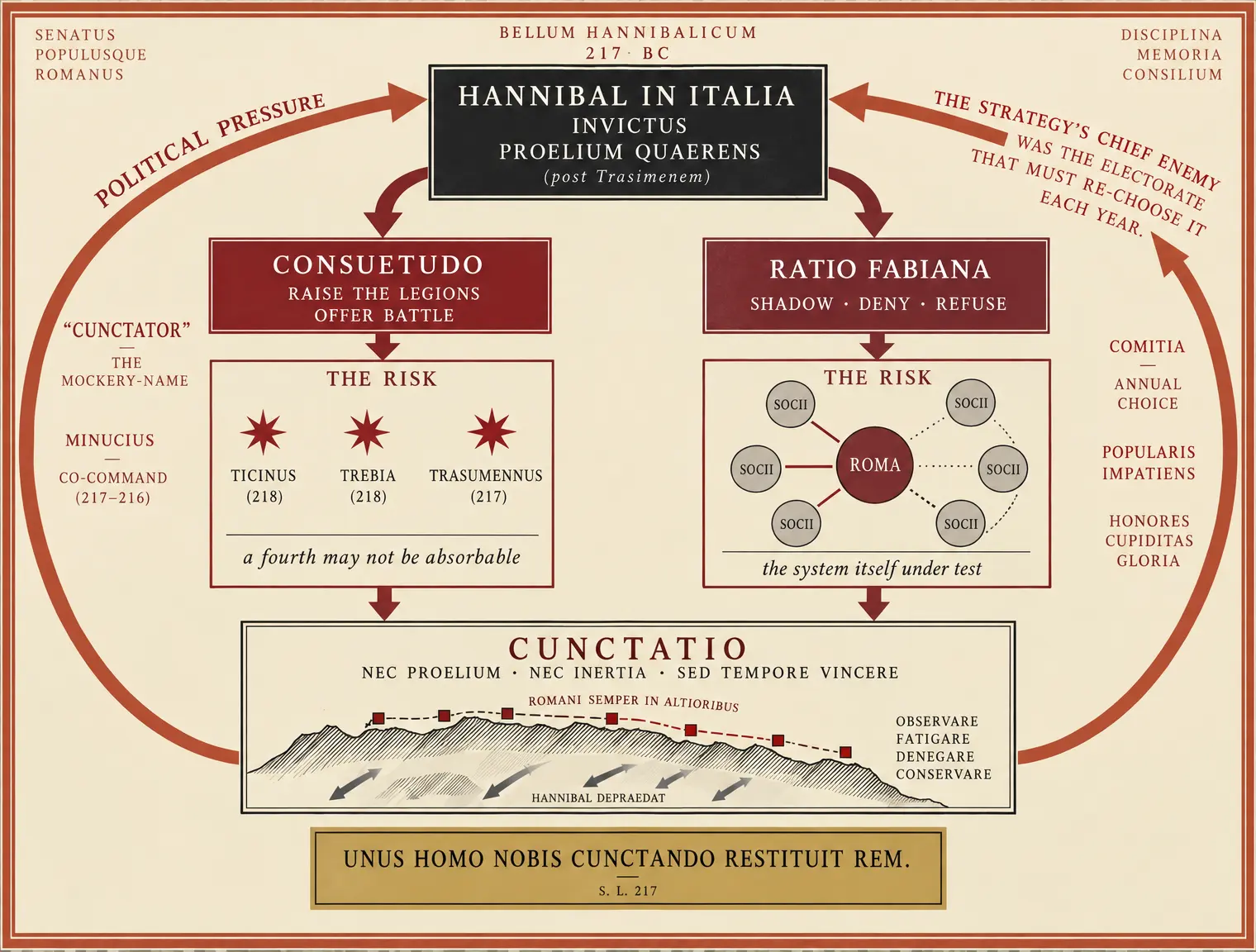
Across the summer of 217, Fabius implemented his strategy with discipline. Hannibal's army marched south through Umbria into Picenum, then crossed the Apennines into Apulia, then turned westward into Samnium and finally into Campania, looking continuously for an opportunity to bring Fabius to battle. Fabius's army shadowed the Carthaginian column at a distance of one or two days' march, occupying defensible positions on the ridges parallel to Hannibal's line of march, declining engagement at every opportunity. Hannibal's strategic objective — to detach the Italian allies — was being achieved only partially: some isolated communities suffered Carthaginian raids and were not relieved by Roman action, but no major Italian city defected during the campaign of 217. The strategic patience of the Fabian doctrine appeared, on balance, to be holding.
The Cassilinum Campaign and the Geronium Incident
The most dramatic episode of the Fabian dictatorship — and the moment at which the doctrine's logic was most clearly demonstrated — was the so-called Cassilinum campaign of late summer 217. Hannibal, after spending some weeks raiding the fertile Falernian plain in northern Campania, found his army caught in a strategic cul-de-sac: the only practicable exit from the Falernian plain to the north was a single mountain pass that Fabius had occupied with the main Roman army. Hannibal could not retreat the way he had come without abandoning a substantial quantity of plunder; he could not break through Fabius's position without giving battle on the disadvantageous terrain Fabius had selected; he could not remain in the Falernian plain indefinitely, as his food supplies would be exhausted before winter. The Roman strategic position had, for the first time since the war's beginning, brought Hannibal to a moment of real operational difficulty.
Hannibal's solution was characteristic of his operational creativity. He gathered approximately two thousand head of cattle from the plundered countryside, tied bundles of dry brush to their horns, set the brush on fire at nightfall, and drove the panicked cattle in a great mass up the slopes of a ridge near Fabius's blocking position. The Roman troops on the ridge, seeing what appeared to be a Carthaginian army advancing under torches across an unexpected approach, moved to engage; while their attention was thus diverted, Hannibal led his main army out of the trap by the unguarded route his ruse had created. The episode is preserved in detail by Polybius (3.93–94) and is one of the more famous tactical inventions of the war.
The political consequence of Hannibal's escape was, however, more damaging than the operational consequence. The Roman political class — already restive under Fabian discipline — regarded the Cassilinum episode as a humiliation that vindicated the criticism of the Fabian strategy. Within a short period, the master of horse Marcus Minucius Rufus, who had been chafing under Fabius's authority and who represented the popularis faction at the level of senior military command, was granted by an extraordinary act of the popular assembly co-equal authority with the dictator. The army was divided between Fabius and Minucius — a decision unprecedented in Roman constitutional history and almost certainly catastrophic in operational terms. Minucius, given his own half of the army to command independently, immediately sought to demonstrate by aggressive action the superiority of his approach to Fabius's.
The result was an ambush near Geronium in central Italy in late autumn 217. Hannibal, recognizing that the political division within the Roman command had produced an opportunity, drew Minucius into an engagement on terrain of his (Hannibal's) choosing. Minucius's army was on the verge of complete destruction when Fabius, abandoning his strategic shadowing position and marching the rest of the Roman army to the field, intervened in time to extract Minucius's force from the trap. The intervention saved Minucius's army but cost it perhaps three to four thousand casualties; the political vindication of Fabius was complete; Minucius, in a public scene preserved by Livy with appropriate dramatic detail, restored his command to Fabius and acknowledged the dictator as his superior in both rank and judgment. The remainder of the campaigning season passed without further engagement; Hannibal wintered in northern Apulia, the Roman army in the central Italian foothills, and the two sides prepared for the campaign of 216.
The Crossroads · Late December 218 BC · The south bank of the river Trebia, south of Placentia
The Frost at the Trebia
You are Tiberius Sempronius Longus, consul of Rome, commanding the combined consular army encamped along the Trebia.
Recalled by Senate decree from Lilybaeum, where your legions prepared for an expedition to Africa, you have marched north to join your colleague Publius Cornelius Scipio in the Po valley. The Cisalpine Gauls have risen; the colonies of Placentia and Cremona are imperiled; and at the Ticinus, Carthaginian cavalry mauled Scipio's reconnaissance force, leaving him severely wounded. Scipio now lies in his tent counseling caution and delay. Yet your consular year draws near its close at the Ides of March, when newly elected consuls will supersede your command. At dawn, under a bitter winter wind and sleet storm blowing from the Apennines, Hannibal's Numidian horsemen ride across the Trebia, raiding your foraging parties and insulting your ramparts. Across the cold river, Hannibal's main army of twenty-eight thousand infantry, ten thousand cavalry, and war elephants deploys on the firm plain, offering set-piece battle.
How do you respond to Hannibal's dawn provocation along the freezing waters of the Trebia?
Weigh each course: open it to hear your own inner voice. Then decide. Nothing is scored.
- Your inner voiceThe course taken
Publius Scipio lies wounded in his tent, counseling caution and delay after his mauling at the Ticinus. But my consular year draws to its close; at the Ides of March, new consuls will arrive from Rome to supersede my command. If I sit idle behind our ramparts while Hannibal gathers the Cisalpine Gauls, the Senate will judge that I squandered forty thousand men in passivity, and another commander will reap the glory of driving Carthage from Italy.
- Your inner voiceThe course taken
Our heavy infantry remains the master of close combat. If we call the four legions and allied wings from their warm tents, ford the freezing Trebia, and deploy our manipular triplex acies on the western plain, thirty-six thousand men can shatter Hannibal's center frontally. Sleet blows from the Apennines and the men march without breakfast, but Roman discipline will overwhelm his line before his superior Numidian and Iberian horsemen can envelop our flanks.
- Your inner voiceThe course taken
Hannibal sends his Numidians to insult our camp and scatter our foraging parties along the river. We could dispatch our four thousand cavalry and light troops to drive them off, safeguarding our provisions without risking the main army across the cold water. Yet at the Ticinus, Carthaginian horsemen proved distinctly superior to our own. If our cavalry breaks in the frozen marsh, our foragers will be cut down while thirty-six thousand legionaries stand idle in camp.
What was done
Sempronius ordered the army to march out immediately into the sleet storm without breakfast. The Roman troops crossed the cold Trebia and formed in triplex acies on the western bank. Hannibal's superior Numidian and Iberian cavalry drove the Roman horse from the field within an hour, exposing the legionary flanks. As the Roman infantry pressed Hannibal's center, Mago Barca emerged from concealment in a dry watercourse with one thousand infantry and one thousand cavalry to strike the Roman rear. The Roman wings dissolved; approximately ten thousand legionaries cut through the Carthaginian center and escaped to Placentia, but the rest were destroyed or drowned in the river. Polybius records approximately twenty thousand Roman and allied dead, against Carthaginian losses concentrated among Gallic auxiliaries (BGrade B). The Roman defense of Cisalpine Gaul collapsed, the Po valley fell to Hannibal, and the surviving Roman forces withdrew southward across the Apennines into central Italy.
The evidence The Editor's Note assigns an overall attestation grade of B to the accounts of the Ticinus and Trebia campaigns. Polybius (3.65–74, BGrade B) and Livy (21.39–48, BGrade B) serve as the primary narrative authorities, with Polybius judged more reliable in tactical detail. Mago's concealed ambush is corroborated by Frontinus (Strategemata 2.5.23, CGrade C). Parallel accounts appear in Cassius Dio (fragments 56–57 via Zonaras 8.23, CGrade C), Appian (Hannibalica 4–7, CGrade C), Cornelius Nepos (Hannibal 4, CGrade C), and Silius Italicus (Punica 4, DGrade D).
If you choose to walk through itAt every scale
- Yourself
How far does personal ambition and the fear of being superseded at the end of a fixed term distort a commander's assessment of operational peril?
- Those beside you
What moral obligation does a magistrate owe to soldiers ordered out of warm tents to cross a freezing river without food, before battle is even joined?
- Rome
How can an institutional system that rotates supreme military commands every year prevent generals from forcing premature, high-risk battles to secure personal glory?
- The wider world
When an invading commander seeks to dismantle a regional alliance system, how does a disastrous defeat affect the allegiance of contested border populations?
- Our own time
In modern institutional and corporate governance, how should organizations restrain executives from taking reckless, existential risks to produce visible results before their tenure concludes?
Corporate executives facing the imminent expiration of their leadership contracts or approaching a crucial fiscal deadline frequently launch hasty, unhedged capital acquisitions or premature product releases to show immediate gains before departure. Aware that replacement or board review is near, leadership may brush aside cautious internal warnings, underestimate competitor positioning, and commit core organizational assets into volatile market conditions under adverse operating environments.
Where the comparison fails. A failed corporate venture or missed fiscal projection entails balance sheet impairment, board censure, or financial restructuring, but it does not involve the slaughter of twenty thousand men, the physical devastation of allied territories, or the immediate military peril of the republic.
What does the chapter tell us?
Why did Publius Cornelius Scipio return to northern Italy rather than continue with his full consular army to Spain in the autumn of 218 BC?
After discovering at Massalia that Hannibal had already crossed the Rhône, Scipio judged he could not intercept him in Spain. He sent his army on under his brother Gnaeus and returned to Italy to command the legions in the Po valley.
the chapter's narrative
What critical operational lesson did the cavalry skirmish at the river Ticinus reveal to the Roman command?
The sharp engagement at the Ticinus degenerated into a fluid cavalry melee where Numidian and Iberian horse outmaneuvered the Romans, proving Carthaginian mounted superiority and wounding Scipio before his son rescued him.
Polybius 3.65 and Livy 21.46 (BGrade B)
By what tactical disposition did Hannibal break the Roman rear during the Battle of the Trebia?
Hannibal hid one thousand infantry and one thousand cavalry under his brother Mago Barca in a dry fold of ground south of the field. When the main clash was at its peak, Mago struck the exposed Roman rear.
Polybius 3.72–74 and Frontinus, Strategemata 2.5.23 (BGrade B and CGrade C)
Which environmental and topographical factor contributed decisively to the Roman catastrophe at Lake Trasimene?
Flaminius entered the narrow five-kilometer strip along Lake Trasimene in standard column under heavy summer mist. Hannibal had concealed his Iberian and Gallic infantry on the slopes above, launching a simultaneous attack from all sides.
Polybius 3.83 (AGrade A)
What was the primary legitimate political and strategic criticism leveled against the Fabian strategy in 217 BC?
By declining pitched battle and shadowing Hannibal from high ground, Fabius left the countryside open to pillage and burning. Critics argued this demonstrated Roman inability to protect its confederates, encouraging allied communities to defect.
the chapter's narrative