Book II · The Mediterranean Wars
Chapter 6
Cannae
The Strategic Situation in the Spring of 216
The Roman political response to the dictatorial year of 217 BC was a return to constitutional normality combined with an unmistakable political decision to abandon the Fabian doctrine. The consuls elected for 216 were Gaius Terentius Varro and Lucius Aemilius Paullus, men of contrasting political background and military temperament whose joint command would produce the catastrophe of the year and would furnish the Roman tradition with a permanent type for the dangers of divided authority in war. Varro was the candidate of the popularis faction — a man of relatively low senatorial standing (the tradition has him the son of a butcher, which is probably an aristocratic insult rather than literal genealogy, but the political point is real) elected on a platform of aggressive prosecution of the war against the temporizing of the senatorial establishment. Paullus was a senatorial conservative, a veteran of the Illyrian campaigns, a man whose strategic instincts were closer to those of Fabius than to the popular demand for decisive engagement. The two consuls were temperamentally incompatible from the moment of their election; their joint command would be exercised through the device of alternating supreme authority on each successive day, with command passing from one to the other at dawn — a constitutional arrangement that, while in form symmetrical, in practice produced the operational result that the day on which battle was offered would be the day on which the more aggressive of the two consuls held command. Hannibal, as the campaign would shortly demonstrate, was capable of waiting until that day arrived.
The Roman military mobilization for 216 BC was the largest single-year mobilization in the entire history of the Republic to that date. The Senate, recognizing that the Fabian doctrine had become politically unsustainable and that a decisive engagement with Hannibal could be undertaken only with overwhelming force, authorized the levy of eight Roman legions (twice the standard consular establishment) supplemented by eight legions' worth of Italian allied contingents. The total Roman force assembled for the campaign of 216 was therefore approximately 86,000 men — 80,000 infantry and 6,000 cavalry — under the joint command of the two consuls. By comparison, Hannibal's army by the early summer of 216 was approximately 40,000 foot and 10,000 cavalry, supplemented by a substantial body of Gallic, Lucanian, and Italian irregular reinforcements that brought his total mobilizable strength to perhaps 55,000. The Roman numerical advantage was therefore in the order of 3:2 in infantry, with the Carthaginian cavalry holding a numerical advantage that the Romans had not yet learned to compensate for tactically.
The strategic objective of the Roman campaign was the recovery of central Italy and the restoration of Roman strategic credibility. Hannibal had wintered his army at the agriculturally rich town of Gerunium in northern Apulia and had spent the early spring of 216 in foraging operations and small-scale skirmishing. In May, he made the operationally bold decision to march his army southward to the Apulian coast and to seize the great Roman supply magazine at Cannae — a town on a low ridge overlooking the lower Aufidus river (modern Ofanto), about ten kilometers from the Adriatic coast. The seizure of Cannae served three strategic purposes: it deprived the Roman army of a critical forward supply position; it placed the Carthaginian army in a region whose flat terrain favored the cavalry-based tactical doctrine Hannibal preferred; and it offered Hannibal a strategic position from which he could threaten the Greek and Italian cities of the southern Adriatic coast, the political consolidation of which would be a major step toward the dissolution of the Italian alliance system. The Roman army, by the time Cannae fell to Hannibal in early June, was already on the march south to confront him, and was now obligated to do so on terrain that strongly favored the Carthaginian tactical disposition.
The Approach to BattleJune–July 216 BC
The Roman army marched from Apulian Lucera south to the upper valley of the Aufidus, where it took up position on a ridge overlooking the river some miles upstream from Cannae itself. The march had been conducted in characteristic Roman style: a single combined army moving in column, with the two consular commands operating in nominal unison. The disagreement between Varro and Paullus, however, became visible immediately upon the army's arrival in the Aufidus valley. Paullus, surveying the terrain, recommended that the army take up a defensive position on the higher ground north of the river, in country broken enough to limit the effectiveness of Hannibal's cavalry. He recognized — correctly, as the battle would prove — that the Roman tactical doctrine could not be expected to succeed against Hannibal's cavalry-cooperated infantry on level terrain. Varro disagreed, arguing that the political mandate under which the army had been mobilized required decisive engagement and that the level ground on the south bank of the Aufidus was the terrain on which the Roman numerical advantage could be brought to bear most effectively. The dispute was not resolved.
What followed was a brief operational sequence that perfectly illustrated the inadequacy of the alternating-command system. On the day Paullus held command, the Roman army moved to the higher ground; on the day Varro held command, the army moved back to the level plain. Across several days of this oscillation, with the Roman army moving back and forth between two positions while Hannibal observed from the south bank of the Aufidus, the strategic patience that the Fabian doctrine had achieved across the previous year evaporated. Hannibal, deploying his army in deliberate provocation at the edge of the Roman camp each morning, was able to wait for the day on which Varro held supreme command and would commit the army to engagement on terms favorable to the Carthaginians.
That day was 2 August 216 BC.
The Disposition of the Armies
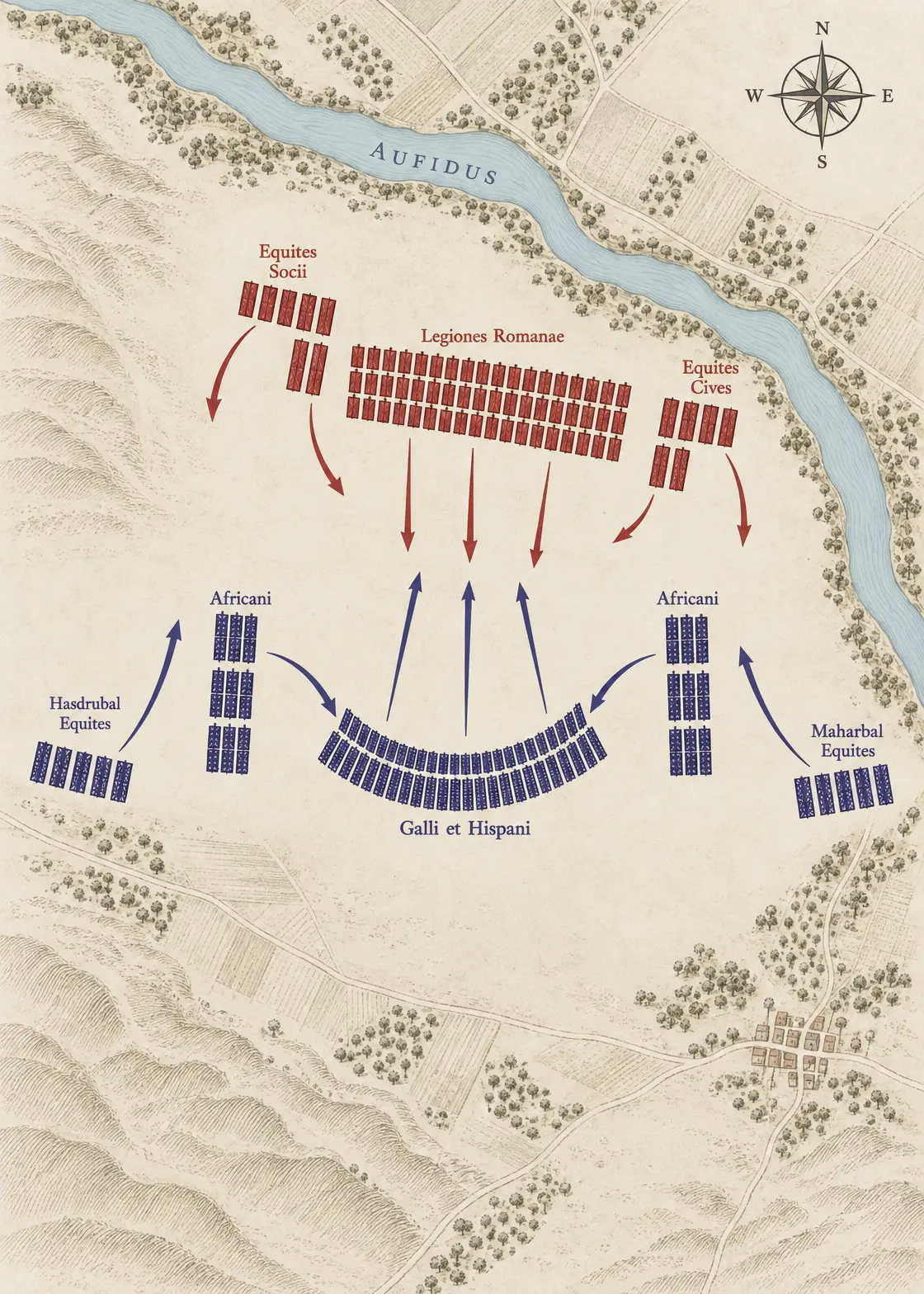
The Roman army on the morning of 2 August 216 BC was deployed in a manner that has been the subject of scholarly debate for two and a half millennia. The principal feature of the Roman disposition was its unusual depth: the infantry was drawn up in a formation deeper than the standard manipular triplex acies, with the hastati, principes, and triarii compressed into a narrower front than was customary. The intent of the disposition, as Polybius (3.113) explains it, was to use the Roman numerical advantage in infantry to deliver an overwhelming frontal blow against the Carthaginian center, breaking through Hannibal's line by main force. The deep formation was, in this conception, a kind of human ram designed to convert numerical superiority into kinetic concentration. The corresponding sacrifice was tactical flexibility: the deeper the infantry formation, the more difficult it became for individual maniples to operate independently, and the more the legion's characteristic capacity for tactical maneuver was sacrificed to the priority of frontal mass.
The Roman cavalry was disposed on the wings of the army in the conventional manner: Roman citizen cavalry on the right wing (against the river Aufidus), allied cavalry on the left wing. The total Roman cavalry was approximately 6,000 — substantially outnumbered by the Carthaginian cavalry on the field. The Roman command was held that day by Varro, with Paullus on the right wing in tactical command of the citizen cavalry and the right of the infantry line. The two former consuls of 217 BC — Servilius Geminus and Atilius Regulus — were also present in subordinate command positions, having been retained in army command for the campaign in recognition of their experience.
Hannibal's disposition was the masterpiece for which the battle is principally remembered. The Carthaginian commander deployed his army in a configuration that combined three distinct tactical elements into a single integrated whole. The center of his line was held by his Gallic and Iberian heavy infantry — the troops least reliable in close combat against Roman heavy infantry, but the most numerous of his infantry contingents and the most expendable from the standpoint of the long-term Carthaginian war effort. The Gauls and Iberians were placed in a convex crescent projecting forward from the main Carthaginian line — that is, the center of the line was thrown forward, while the wings of the infantry line were drawn back from the front. This was a most unusual disposition by ancient standards; the conventional Hellenistic and Roman disposition was either a straight line or, more rarely, a slightly concave line designed to draw an attacker into a partial envelopment. The convex disposition was a tactical innovation specific to Cannae.
On the wings of the Carthaginian infantry line, drawn back from the center, were Hannibal's African heavy infantry — the elite of his army, equipped (after their hard service in the Italian campaigns) substantially with Roman-style armor and weapons captured at Trebia and Trasimene, so that they appeared at first glance to be Roman troops. The African contingents were drawn up in column rather than in line — that is, in deeper formations with narrower frontages than the standard infantry deployment — and positioned at the rear of the wings in such a way that they could wheel inward toward the center of the battle when the Roman infantry had pressed forward into the Carthaginian crescent.
On the wings of the army proper, beyond the infantry, was Hannibal's cavalry. The heavy Iberian and Gallic horse under Hasdrubal (Hannibal's lieutenant, not his brother of the same name) was placed on the Carthaginian left wing, facing the Roman right where Paullus commanded the citizen cavalry. The Numidian light horse under Maharbal was placed on the Carthaginian right wing, facing the Roman left where the allied cavalry was deployed. The total Carthaginian cavalry on the field was approximately 10,000 — somewhat outnumbering the Roman cavalry by a substantial margin and possessing both tactical superiority and the operational initiative.
The BattleMorning to Mid-Afternoon, 2 August 216 BC
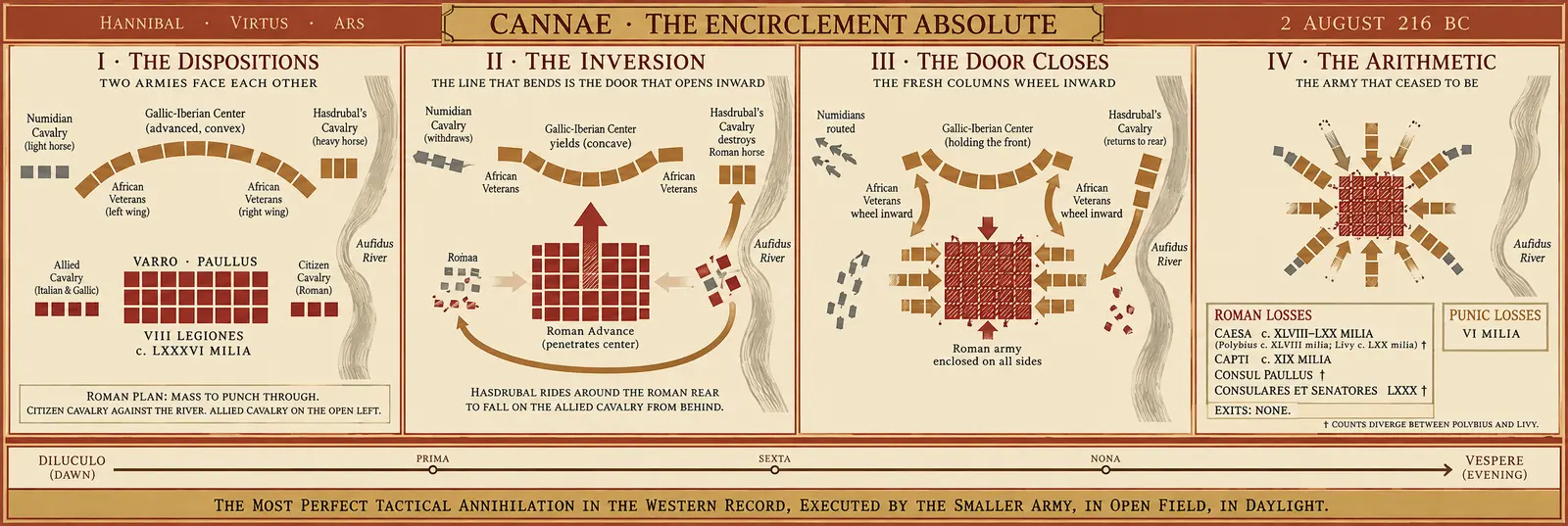
The battle opened in the conventional manner with the engagement of light troops between the armies, followed by the advance of the cavalry on the wings to engage. The cavalry actions developed quickly and produced the decisive operational consequence that Hannibal had planned. On the Carthaginian left, Hasdrubal's heavy cavalry engaged the Roman citizen cavalry under Paullus's direct command and, after a sharp action of perhaps forty-five minutes, drove the Roman horse from the field. The terrain on the right wing — squeezed between the Roman infantry line and the river Aufidus — left the outnumbered and outclassed Roman cavalry with little room for maneuver; the engagement was therefore concluded quickly and with substantial Roman casualties. Paullus himself was wounded — by a slingstone, according to Livy — and was carried to the rear, where he would continue to command the right of the infantry line for the rest of the day until killed in the final phase. On the Carthaginian right, the Numidian cavalry under Maharbal engaged the allied cavalry of the Roman left wing in a longer and less decisive engagement, with the Numidian skirmishing tactics keeping the allied cavalry occupied without producing decisive results. (The Numidians' role in the broader battle plan, however, was less to defeat the allied cavalry than to keep it occupied; the decisive cavalry stroke would be delivered by Hasdrubal's heavy horse, which after defeating the Roman right cavalry would ride around behind the Roman army to attack the allied cavalry from the rear.)
While the cavalry actions on the wings were developing, the infantry lines engaged in the center. The Roman infantry — eight legions deep, with their compressed mass behind them — advanced against the Carthaginian crescent with the disciplined frontal pressure for which the manipular legion had been designed. The crescent itself, projecting forward from the Carthaginian main line, met the Roman advance first; the Gallic and Iberian infantry holding the apex of the crescent were the principal targets of the Roman attack. As the Roman pressure built up, the crescent gave way slowly — exactly as Hannibal had intended. The Gallic and Iberian troops were not, however, breaking; they were being pressed back by the Roman advance, but in good order, fighting hard as they retired, their backward movement compressing them into a steadily reducing space behind the original line of contact. From the convex crescent the formation was being transformed by the Roman pressure into a concave pocket — a hollow in the Carthaginian center into which the Roman infantry was advancing, with the Carthaginian wings (the African heavy infantry) now flanking the Roman advance on both sides.
The moment Hannibal had constructed the battle to achieve was the moment at which the African heavy infantry, drawn up in column at the rear of the Carthaginian wings, would wheel inward against the Roman flanks. The timing of this wheel was the critical operational decision of the battle. Too early, and the Roman infantry would not yet have advanced deeply enough into the pocket; too late, and the Gallic and Iberian center would have given way completely and the Roman advance would have broken through. Hannibal, observing the developing engagement from his command position in the center of the line, judged the moment with what the Greek historians would later describe with admiration. The African columns wheeled inward — by some accounts at a controlled pace, by others at the run — and struck the Roman infantry mass on both flanks simultaneously, while the Roman infantry was still pressing forward into the Carthaginian center.
The Roman infantry now found itself attacked on three sides: by the Gallic and Iberian troops of the center (still giving ground but not broken), and by the African heavy infantry on both flanks (advancing inward, attacking exposed Roman maniples that had been formed for frontal combat and could not easily redress their lines to face the side). The deep Roman formation that had been intended to deliver overwhelming frontal force now became a liability: the troops in the interior of the formation could not effectively fight, while the troops at the edges of the formation — the only ones capable of meeting the African flank attacks — were progressively destroyed and replaced by troops drawn from the interior who were themselves immediately destroyed in their turn. The Roman tactical doctrine, designed around the assumption that a legion would always be capable of operating with all its troops engaged simultaneously, had no answer to a battle in which most of the army could not fight at all.
The fourth side of the encirclement was provided by Hasdrubal's heavy cavalry, which after defeating the Roman citizen cavalry on the right wing had ridden around behind the Roman army, joined Maharbal's Numidians on the Carthaginian right, and then turned to attack the Roman infantry from the rear. By approximately mid-afternoon, the Roman army was completely surrounded on a contracting battlefield, with the African infantry pressing inward on both flanks, the Gallic and Iberian troops pressing on the front (now reformed and advancing), and the heavy cavalry attacking from the rear.
The Killing
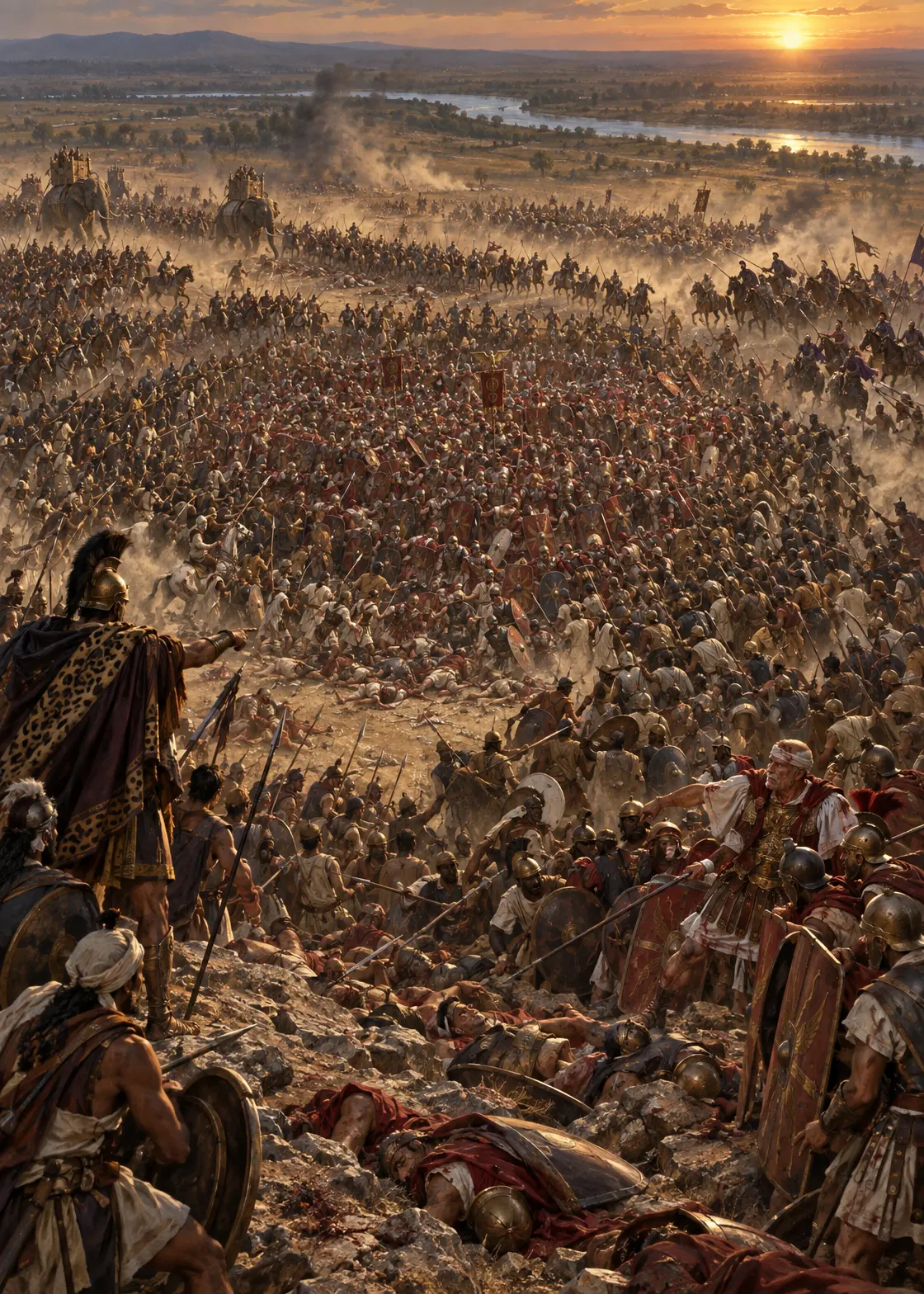
What followed across the late afternoon and into the evening of 2 August 216 BC was the most concentrated military slaughter in the prior history of the western Mediterranean and a strong candidate for the most concentrated in the entire ancient world. The Roman army, surrounded on all sides, with no possibility of orderly withdrawal, with the terrain constricting and the Carthaginian forces converging, became a single great mass of men into which weapons could be inserted with mechanical efficiency. Polybius's description (3.116) emphasizes the awful nature of the killing: the Carthaginian and African troops, attacking inward on every front, found a target so densely packed that their swords and spears could scarcely miss; the Roman soldiers in the interior of the mass, unable to fight and unable to flee, stood waiting for the killing to reach them; the Roman commanders, attempting to rally what could be rallied, fell one after another in the front lines.
The casualty figures for Cannae are preserved by multiple sources with substantial agreement, which is itself an indication of the scale and the consequent unusual care with which the data were recorded. Polybius (3.117) gives Roman dead at approximately 70,000 — a figure most modern historians regard as somewhat high, partly because it appears to include allied troops in a way the contemporary Roman casualty conventions did not always specify. Livy (22.49) gives 45,500 infantry and 2,700 cavalry, or about 48,200, with a further 10,000 captured. The modern consensus is that Roman and allied dead at Cannae were probably between 45,000 and 55,000, with a further 10,000 to 20,000 captured. The dead included the consul Aemilius Paullus (killed in the final phase, fighting on foot after his horse had been killed), the proconsul Servilius Geminus, the master of horse Marcus Minucius Rufus (the same who had been Fabius's controversial deputy the previous year), 80 men of senatorial rank, 29 military tribunes, and a substantial fraction of the equestrian order serving in the cavalry and in junior command positions. The political losses were the equivalent of a generation of senior Roman aristocracy in a single afternoon. Varro himself, the surviving consul, fled the field with about 70 horsemen at the moment of the army's final collapse and escaped to the nearby town of Venusia; he would survive to be received at Rome on his return with what the tradition has agreed to call magnanimous restraint (the Senate met him at the gates and thanked him for not despairing of the Republic, an act of constitutional courtesy that the Romans would remember as one of the finest of the period).
The Carthaginian losses at Cannae were heavy by any normal standard but light compared to the Roman: Polybius gives 5,700 dead, including 4,000 Gauls (the contingent that had held the apex of the crescent and had borne the brunt of the initial Roman attack), 1,500 Iberians and Africans, and 200 cavalry. The casualty ratio of about 1:10 against the loser is among the most extreme in recorded ancient military history; Cannae stands with Granicus, Issus, Gaugamela, and the great Hellenistic battles of annihilation as one of the model tactical engagements in which the loser's losses approached total destruction.
The dimensions of the catastrophe at Rome may be illustrated by a single comparative observation. The total Roman and allied male population of military age in 216 BC was approximately 770,000. Of these, between 45,000 and 55,000 had been killed at Cannae alone — about six to seven percent of the total mobilizable manpower of the Roman state in a single afternoon. The 80 senators killed represented approximately one-quarter of the total senatorial order of the period; the 29 military tribunes represented a substantial fraction of the year's command class. The dead included men from virtually every aristocratic gens in the Roman political class. There was, by the late summer of 216, scarcely a senatorial family in Rome that had not lost a son, a brother, a nephew, or a father at Cannae.
The Aftermath at Rome
The news of Cannae reached Rome in the third week of August 216 BC. The praetor Marcus Pomponius — the same who had made the announcement of Trasimene the previous year, an unfortunate consistency of role for which he would be remembered — appeared in the Comitium to deliver the news, this time with words that the tradition would preserve as one of the great moments of Roman constitutional rhetoric: Pugna magna victi sumus, "We have been defeated in a great battle." There was no explicit announcement of the casualty figures, because they were not yet known with precision; the report indicated only that the army had been destroyed, that the consul Paullus and several senior officers were dead, and that the consul Varro and a small body of survivors had reached Venusia. Over the following days, as further dispatches arrived, the full scale of the catastrophe became known.
The Roman political and emotional response to Cannae has been preserved by the sources with what one is tempted to call religious care, because the tradition treats it as a moment of national near-extinction from which the Roman political order recovered by an act of institutional and ethical will. The principal features of the response, as Polybius (3.118) and Livy (22.55–61) describe them, were as follows. First, the Senate met in continuous session for three days, suspending the normal political business of the Republic to address the strategic emergency. Second, the matrons of Rome were ordered to confine their public mourning to thirty days, after which all public expressions of grief were prohibited as inconsistent with the state's continued military prosecution of the war — a remarkable decree which reveals more about the Roman tradition's understanding of state morale than perhaps any other single document of the period. Third, the Senate appointed Marcus Junius Pera as dictator with full emergency powers, with Tiberius Sempronius Gracchus (a man of considerable energy and political conviction) as master of horse. Fourth, the recruitment laws were extended to permit the enlistment of younger men (down to age seventeen), slaves (purchased by the state from their owners and freed upon enlistment, the so-called volones who would form two new legions), debtors and criminals (relieved of their obligations in exchange for military service), and even the cavalry of those normally exempt from foot-soldier service. Fifth, the city walls were manned and the citizens prepared for siege — though, as it turned out, no siege would be undertaken.
The decision that more than any other determined the survival of the Roman state in the aftermath of Cannae was, however, made not at Rome but in the Carthaginian camp at Cannae itself, by Hannibal and his senior officers. The decisive question was whether the Carthaginian army should march immediately on Rome, exploit the strategic shock of the victory to compel a Roman surrender, and end the war before the Roman state could recover. The case for the immediate march was made most forcefully by Maharbal, the Numidian cavalry commander, who is reported by Livy (22.51) and by Cato (in a fragment preserved by Aulus Gellius) to have said to Hannibal that within five days Hannibal could be dining on the Capitoline if he would only march at once. Hannibal, after consideration, declined. His reasons — preserved imperfectly but with consistent themes across the sources — were several. The Carthaginian army, though victorious, was tired and reduced; the cavalry's horses had been ridden hard for two days; the infantry needed rest and resupply. The siege of Rome itself would be a major undertaking against a city of substantial fortification and considerable garrison resources; the kind of siege equipment such an operation would require was not in the Carthaginian field train, and would have to be constructed or imported. The strategic logic of Hannibal's entire campaign was the dissolution of the Italian alliance system by demonstration of Roman military weakness; the immediate march on Rome, if it failed (and it might fail, however weak the city's military position appeared), would have squandered the strategic capital of Cannae for an uncertain operational gain. Better, Hannibal calculated, to consolidate the political effect of the victory — to receive the Italian and Greek cities that would now defect, to organize a southern Italian alliance system as a counterweight to Rome's central Italian one, to prepare for further engagements at moments and on terrain of Carthaginian choosing. The march on Rome would not be made.
Maharbal's reported response is one of the most quoted single sentences from any ancient source: Vincere scis, Hannibal; victoria uti nescis — "You know how to win a victory, Hannibal; but you do not know how to use one." Whether or not Maharbal actually said this, the historical question it raises has been debated by military historians and strategists ever since. The dominant modern view — held by most twentieth-century military theorists who have addressed the question, including Liddell Hart and Hans Delbrück — is that Maharbal was wrong: that a siege of Rome in the late summer of 216 BC, with the resources Hannibal then possessed, would have failed, and that Hannibal's actual strategic decision (to consolidate his gains in southern Italy and to await the Italian alliance system's progressive disintegration) was the correct one, even though it eventually led to defeat for reasons that could not have been foreseen in 216. The minority view holds that the immediate post-Cannae moment was the one strategic window in which the Hannibalic War could have been won, and that Hannibal's failure to exploit it doomed his campaign to ultimate failure. The question is unresolvable from the available evidence, but it has the merit of focusing attention on the strategic logic by which wars are actually decided — which is rarely the logic of single battles, however dramatic.
The Italian Alliance System Holds
What Hannibal had not predicted, and what the post-Cannae weeks would reveal, was the resilience of the Italian alliance system in the face of Roman military catastrophe. The strategic logic of the Hannibalic campaign had been built on the assumption that a sufficient demonstration of Roman military weakness would produce mass defection of the Italian allies; the alliance would dissolve, Rome would be left with her bare citizen base, and the strategic and demographic foundations of Roman power in the Mediterranean would be broken. This assumption now received its definitive test, and it failed — though not completely.
A substantial number of Italian and Greek cities did defect to Carthage in the months following Cannae. Capua — the second city of Italy, the great prize of Campania, the city whose defection from Rome during the Latin War had nearly broken the Roman alliance system in the fourth century — declared for Hannibal in late autumn 216 and admitted a Carthaginian garrison. The cities of Bruttium and most of Lucania defected during the same period. The Greek cities of Magna Graecia — Tarentum, Croton, Locri, Heraclea, Thurii — declared variously for Hannibal across 216 and 215. Several Samnite communities — though not the Pentri Samnites, who remained surprisingly loyal — joined the Carthaginian alliance. The Italian and Greek south, by the spring of 215, was largely outside the Roman alliance system and within the Carthaginian.
But the central and northern Italian alliance system — the core of Roman manpower and political support — did not defect. The Latin colonies remained loyal to Rome with virtually no exception; the cities of Etruria, Umbria, Picenum, and the Sabine country remained loyal; the Latin and Campanian coloniae civium Romanorum held their walls and sent their contingents to the new Roman armies being raised in the post-Cannae mobilization. The central Italian alliance system that had been forged in the wars covered by Book I of this compendium — the graduated incorporation system established after the Latin Settlement of 338 — proved capable of absorbing even the catastrophe of Cannae without losing its essential coherence. Hannibal's strategic gain from the southern Italian defections was therefore real but partial: he had acquired allies and resources in the south, but the central and northern manpower base of Rome was intact, and the war would continue.
The post-Cannae Roman recovery would prove the matter on which the entire Hannibalic War would eventually be decided. Across the four years from 215 to 211, Rome would raise army after army from the available manpower base — at peak nearly twenty-five legions in simultaneous service, an unprecedented mobilization that exceeded by half again the previous Roman record — and would deploy them in a long war of attrition across Italy, Sicily, Spain, and Africa. Hannibal's army, never reinforced from Africa in significant numbers (the Carthaginian state's failure to support its general's Italian campaign with the scale of resources his strategic position required is one of the great underconsidered factors in the war's outcome), would gradually be worn down by the Roman strategic patience that had been provisionally established by Fabius and that, after Cannae, became the unchallenged official doctrine of the Roman state. The war's eventual conclusion — at Zama in 202 BC, in Africa, with Hannibal facing Scipio Africanus across a battlefield Hannibal had not chosen — would come fourteen years after Cannae. The story of how it was reached belongs to Book III.
The Crossroads · August 216 BC · The Carthaginian camp near Cannae, on the Aufidus river in Apulia
The Gates of Rome: Hannibal's Choice at Cannae
You are Hannibal Barca, supreme commander of the Carthaginian army, surveying the battlefield of the Aufidus where your encirclement has annihilated the consular army of Rome.
Your tactical disposition has yielded a triumph unparalleled in Mediterranean warfare. Over forty-five thousand Roman and allied infantry and cavalry lie dead along the Aufidus, including the consul Lucius Aemilius Paullus, the proconsul Servilius Geminus, the master of horse Marcus Minucius Rufus, eighty senators, and twenty-nine military tribunes. The surviving consul, Gaius Terentius Varro, has fled to Venusia with only seventy horsemen. However, your own army has lost fifty-seven hundred men, primarily the Gallic infantry who held the apex of your convex crescent, and your surviving troops and horses are completely spent after two days of relentless exertion. Your Numidian cavalry commander Maharbal urges an immediate, forced march on the capital, insisting that within five days you could dine on the Capitoline. Yet Rome sits behind formidable stone fortifications several hundred miles away, your army carries no heavy siege equipment in its field train, and your overarching strategic aim has always been the dissolution of Rome's Italian alliance rather than an assault on her walls.
Do you heed Maharbal's counsel to launch an immediate march on Rome, or do you rest your army and turn to dismantle the Roman alliance system across southern Italy?
Weigh each course: open it to hear your own inner voice. Then decide. Nothing is scored.
- Your inner voiceThe course taken
Varro fled the field with barely seventy horsemen, seeking refuge behind the walls of Venusia where scattered survivors are now gathering. If we permit a surviving consul to reassemble the remnants, Rome retains a nucleus for command and resistance. Pursuing them across Apulia would cost little time and extinguish the last active field command of the Republic. Yet hunting broken fugitives distracts us from the greater prize: turning the cities of the south to our cause.
- Your inner voiceThe course taken
Maharbal promises we could feast on the Capitoline within five days if the horsemen ride hard. Rome is reeling from an unthinkable slaughter; terror alone might shatter their nerve before they can grasp the scale of their ruin. Yet our men are exhausted, our horses spent from two brutal days, and we carry no siege engines in our train. If the city's massive fortifications hold, our hard-won victory will wither against stone walls.
- Your inner voiceThe course taken
Our victory was bought with the blood of four thousand Gauls and countless wounded veterans. The cavalry needs rest, and Rome cannot easily replace fifty thousand fallen soldiers. My purpose has never been to break against fortified walls, but to dissolve Rome's alliance system by demonstrating her utter vulnerability in the field. By moving into the south, we can welcome Capua, Lucania, and the Greek coastal cities, building a coalition that strangles Rome from within.
What was done
Hannibal declined the immediate march on Rome, choosing instead to rest his exhausted soldiers, restore his cavalry, and exploit the political shock of Cannae across southern Italy. Maharbal's famous rebuke—that Hannibal knew how to win a victory but not how to use one—passed into ancient historical memory (Livy, BGrade B; Cato via Gellius). Modern strategic consensus broadly affirms Hannibal's choice: a direct siege of fortified Rome without specialized engines was militarily unfeasible. Hannibal instead directed his diplomacy southward, winning the defection of Capua, most of Lucania, Bruttium, several Samnite communities, and Greek cities of Magna Graecia including Tarentum, Croton, and Locri. However, the central Italian alliance and Latin colonies held firm to Rome, which refused to negotiate, appointed Marcus Junius Pera dictator, enrolled slaves (volones) and youths, and committed itself to a grinding fourteen-year war of attrition that Hannibal could not ultimately sustain.
The evidence The Editor's Note assigns Cannae an overall AGrade A (Tier 1/Tier 2). Polybius 3.107–118 (AGrade A) provides the foundational tactical narrative, drawing upon contemporary Greek and Carthaginian eyewitnesses, including Sosylus and Hannibal's own Hypomnemata. Livy 22.34–61 (BGrade B) preserves the debate between Hannibal and Maharbal alongside early fragments from Cato. Additional traditions survive in Cornelius Nepos (CGrade C) and Appian's Hannibalica (CGrade C, drawing on Silenus of Caleacte), supplemented by Plutarch (BGrade B), Cassius Dio via Zonaras (CGrade C), Frontinus (BGrade B), and contemporary Roman epigraphy (AGrade A).
If you choose to walk through itAt every scale
- Yourself
When immediate glory beckons in the flush of unprecedented triumph, what governs whether a commander pushes forward or exercises tactical restraint?
- Those beside you
How should a general weigh the exhaustion and physical limits of veteran soldiers against the demands of subordinate officers urging relentless pursuit?
- Rome
Can an imperial system survive the sudden loss of an entire generation of its ruling class if its legal and institutional machinery remains intact?
- The wider world
What determines whether subject allies defect to a victorious invader or remain tied to an established hegemon after an overwhelming military catastrophe?
- Our own time
In modern strategic doctrine, why do rapid tactical triumphs so frequently fail to yield long-term political resolution?
In modern warfare, an invading power frequently achieves rapid operational annihilation of an opponent's conventional field armies, anticipating the swift political capitulation of the adversary state. Yet once the standing army is destroyed, the victor often discovers that the defending state's institutional structure, civil population, and fortified urban centers refuse formal surrender. Lacking the administrative and siege resources required to occupy every territory, the victor finds tactical mastery transformed into an exhausting, multi-year asymmetric conflict.
Where the comparison fails. Modern states rely on centralized industrial mobilization, global diplomatic networks, and rapid communications unavailable in antiquity. Furthermore, Rome possessed a uniquely deep demographic reserve of citizen-soldier manpower and an integrated system of colonial treaties that bound central Italian communities to the capital through shared civic status, unlike modern territorial states.
What does the chapter tell us?
Why did Lucius Aemilius Paullus advocate taking a defensive position on the broken ground north of the Aufidus rather than offering battle on the southern plain?
Paullus recognized that the Roman tactical doctrine could not succeed against Hannibal's cavalry-cooperated infantry on level terrain, and therefore sought broken ground north of the river to limit the Carthaginian horsemen's effectiveness.
Polybius 3.107–118 (AGrade A)
What was the primary tactical purpose behind compressing the Roman legions into an unusually deep formation at Cannae?
As Polybius explains, the Roman disposition compressed the infantry into an unusually deep mass to convert numerical advantage into an overwhelming kinetic ram, intending to break through Hannibal's center by main force at the cost of tactical maneuverability.
Polybius 3.113 (AGrade A)
How did Hannibal arrange his infantry line at the start of the engagement to execute his envelopment?
Hannibal threw his Gallic and Iberian heavy infantry forward into a convex crescent, while holding his elite African heavy infantry back on the wings in deep columns, ready to wheel inward once the Roman infantry drove into the yielding crescent.
Polybius 3.107–118 (AGrade A)
What emergency manpower measures did the Roman Senate enact following the announcement of the catastrophe at Cannae?
Facing an existential deficit after losing approximately fifty thousand men, the Senate extended recruitment to seventeen-year-olds, bought and emancipated state-owned slaves to form two legions of volones, and accepted debtors and convicted criminals into military service.
Livy 22.55–61 (BGrade B)
Why did Hannibal decide against Maharbal's urging to march directly on the city of Rome immediately after the battle?
Hannibal recognized that his soldiers and horses were exhausted, his army lacked the siege engines necessary to assault Rome's heavy fortifications, and his grand strategy relied on dismantling Rome's alliance network by inducing widespread Italian defections.
Livy 22.51 (BGrade B)