Book II · The Mediterranean Wars
Proem
Proem
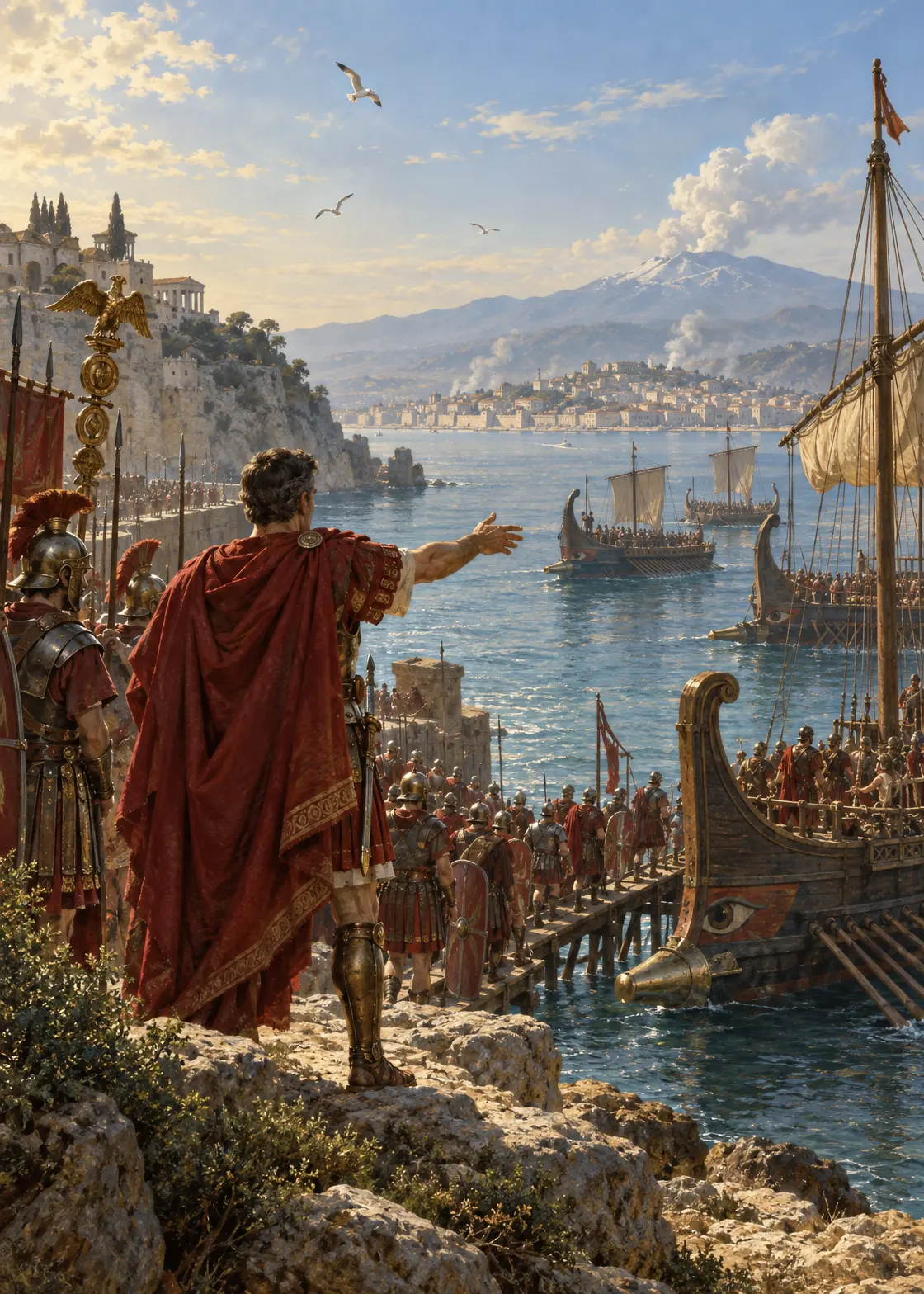
Of all the transformations a state may undergo in the course of its history, none is more decisive than that by which a regional power becomes a contender for the wider world. Such transformations are usually undertaken inadvertently, by men whose ambitions are limited to the immediate question before them, and whose successors find themselves in possession of strategic responsibilities for which neither institutions nor habits of mind have prepared them. The Roman state crossed this threshold in the period covered by the present volume. The Romans of 264 BC who voted, in some bewilderment, to authorize the consul Appius Claudius Caudex to ferry a single consular army across the Sicilian strait to defend a Campanian mercenary band against Carthaginian intervention, had no conception that they were committing themselves to a war that would last twenty-three years, that would draw Rome for the first time into the construction of a navy and the conduct of major naval operations, that would teach her how to fight on islands and across seas. They had even less conception that the war they were beginning would lead, by the unwinding of its consequences, to a second war within their own children's lifetimes, fought against the most formidable military genius the ancient world would produce, and that this second war would bring the Roman state, at one moment, to within a single battle of destruction.
The volume now in the reader's hands undertakes to tell the story of this great expansion from the strait of Messana to the bloody plain of Cannae. It is a story in two unequal parts: a long first part covering the First Punic War (264–241 BC), the interwar period including the Mercenary War in Africa, the seizure of Sardinia and Corsica, the wars against the Cisalpine Gauls and the Illyrians, and the diplomatic prelude to the second conflict (241–220 BC); and a shorter, more concentrated second part covering the opening campaigns of the Hannibalic War from Saguntum to Cannae (219–216 BC). The volume closes at the moment of Cannae because that catastrophe is the institutional and psychological terminus of a particular kind of Roman strategic confidence; the war from Cannae onward, the war of the Fabian strategy, of the Scipiones in Spain, of Nero and Hasdrubal at the Metaurus, of Zama, is a different war fought in a different temper and belongs to the third volume of this compendium.
The reader who has come to these pages from Book I will recognize most of the institutional apparatus described there: the manipular legion, the alliance system, the colonial program, the consular command structure with its dual magistracies and its annual rotation. These institutions, forged in the wars of Italian consolidation, would now be tested against entirely different opponents and entirely different demands. The Carthaginian state was unlike any Italian opponent the Romans had previously faced. It was a maritime power, with a navy that had been the unchallenged master of the western Mediterranean for two centuries. It possessed a mercantile economy capable of generating cash on a scale the agrarian Roman state could not match. Its military instrument depended principally on mercenaries — Iberian and Celtiberian heavy infantry, Numidian light cavalry, Balearic slingers, Greek and Italian condottieri, supplemented by a Carthaginian officer corps drawn from the merchant aristocracy of the city. And it commanded, in the persons of the Barcid family — Hamilcar, Hannibal, Hasdrubal, Mago — military talent of a quality that the Republican Roman state, with its system of annual magistracies and rotated commands, would find it institutionally difficult to match.
The First Punic War would teach the Romans how to build and use a fleet, a lesson they would never quite unlearn, even though their preference for land warfare remained constant. The interwar years would teach them how to integrate the territorial gains of the war into the existing alliance system, how to handle conquests outside Italy, how to confront the Gauls of Cisalpina at last with offensive force. The opening of the Hannibalic War would teach them, painfully, that the institutional and strategic resilience that had served them so well in Italy was not, by itself, a guarantee of victory against a commander whose tactical and operational instincts were better than theirs. Cannae would teach them — at a cost in dead Romans larger than any single day's loss in the entire prior history of the Republic — that an opponent might be better than they were and that they would have to find some other resource than tactical mastery to defeat him.
What they would find, in the years after Cannae that lie beyond the scope of this volume, was a combination of strategic patience, institutional resilience, and demographic depth that no other Mediterranean power of the period possessed. The story of how they applied these resources — under the guidance of Quintus Fabius Maximus Verrucosus, of the Scipiones, of the consuls and proconsuls of the long Hannibalic decade — is the story of the third book. The story of how they came, at Cannae, to need them, is the story of the present one.
The sources for the period covered in this volume are substantially better than those for Book I. We have, for the First Punic War, the surviving books of Polybius (his Book 1, devoted almost entirely to this war, is the principal narrative; he had access to contemporary or near-contemporary sources, including the work of Philinus of Acragas, who wrote from the Carthaginian side, and Fabius Pictor, who wrote from the Roman). For the Hannibalic War we have Polybius again (Books 3 and 9, with portions of 7 and 8), Livy in his great surviving books 21 through 30, supplementary material in Appian, Cornelius Nepos's Life of Hannibal, Diodorus, Cassius Dio, and a substantial body of Greek and Roman literary tradition that grew up around the figure of Hannibal in subsequent centuries. The historian of this period is no longer working principally with annalistic legend; he is working with two contemporary historiographical traditions — the pro-Roman tradition descending from Fabius Pictor and the pro-Carthaginian tradition descending from Philinus and from Sosylus of Lacedaemon, who served as Hannibal's tutor — which Polybius read against each other and which our surviving sources, however imperfectly, reflect. The Editor's Notes appended to each entry will attempt to indicate, in the manner established in the previous volume, where the sources are firm and where they are reconstructions. The reader may expect, on the whole, that the grading throughout this book will run higher than for Book I; we are now within reach of contemporary witness.
Let us begin, then, at Messana, in the spring of 264 BC, with Appius Claudius Caudex's transports drawn up at Rhegium and the Carthaginian garrison commander in Messana making the calculation that would have, eventually, all of the Mediterranean as its theater.