Chapter 6
Scipio in Africa
The Strategic Debate at Rome205 BC
Scipio returned to Rome in the autumn of 205 BC, having concluded the Spanish campaign, and stood for the consulship of 205 with the strategic intention of using the consular command to undertake the operation that the entire post-Cannae Roman strategy had been working toward: the invasion of Africa itself. The political debate that followed in the Senate is one of the most extensively documented strategic debates of the entire Republican period, preserved by Livy (28.40–45) at length and with substantial reconstruction of the principal speeches.
The senior senatorial figure who opposed Scipio's African plan was Quintus Fabius Maximus, the Cunctator, now in his old age (perhaps seventy-seven years old) and serving in the Senate as the unofficial leader of the conservative faction. Fabius's argument was, in summary: the war was being won by the strategy of attrition that had been pursued since the post-Cannae years; Hannibal's army in Bruttium was now strategically isolated, contained, and progressively wasting away; the proper Roman strategy was to continue the containment until Hannibal's army dissolved by natural attrition or until Carthage was compelled to recall it; an African expedition would require the diversion of substantial Roman resources from the Italian theater, would expose the Roman state to the risk of a major catastrophe at a distance from her demographic base, and would be undertaken for the sake of personal glory by a young general (Scipio was thirty at the time, still under the conventional minimum age for the consulship) whose political ambition exceeded his strategic judgment. The argument was, in its operational logic, internally consistent and historically defensible; Fabius's strategic vision had been the foundation of the Roman recovery since 217, and there were strong reasons to expect that its continued application would, in time, produce a satisfactory war conclusion without the additional risk of an African expedition.
Scipio's argument in response was, in summary: the strategy of containment in Italy could continue indefinitely without producing decisive results; Hannibal's army in Bruttium could be sustained for many additional years by Carthaginian sea-borne supply (though now without major reinforcement, after the destruction of Hasdrubal Barca's expedition and the elimination of the Spanish base); the Carthaginian state itself, however, was incapable of sustaining a major war in Africa against a Roman expeditionary force, because Carthage had no army of comparable size to her field forces in Italy and Spain (now both eliminated or rendered ineffective); an African expedition would, by threatening Carthage herself, compel the recall of Hannibal's Italian army to defend the home territory, thereby ending the Italian war by indirect means; the strategic risk was substantial but bounded, because the Roman expedition would be operating with naval support and could be recovered if the operation failed; and the strategic prize — a war-ending engagement on terms of Roman choosing — was sufficient to justify the risk. The argument was, also, internally consistent and historically defensible.
The strategic debate has been the subject of considerable modern military-theoretical analysis (notably by Liddell Hart, who treated it as a paradigmatic case of indirect-approach strategy versus direct-engagement strategy, with Scipio representing the indirect approach and Fabius the direct). The conventional modern view favors Scipio: the African expedition produced the strategic recall of Hannibal and the war-ending engagement at Zama within three years, while the Fabian continuation might have required many additional years and would in any case have eventually required an offensive operation against Carthage at some point. Some modern scholars (Goldsworthy, with qualifications) have, however, raised the question of whether Fabius's strategic judgment was as wrong as the eventual outcome suggests: the African expedition could have failed, the Carthaginian recall of Hannibal could have been preceded by a successful Numidian counter-offensive against Scipio, and the Italian theater could have been destabilized by the diversion of Roman forces. The argument is unresolvable, but the senatorial decision that followed is firm: the Senate authorized Scipio's election to the consulship of 205, assigned him the Sicilian provincia with explicit permission to undertake an African expedition if circumstances permitted, but withheld the substantial reinforcements he had requested. Scipio would proceed with the African operation, but with the forces he could raise on his own initiative.
Preparations in Sicily205–204 BC
Scipio's preparation of the African expedition was conducted across the consular year of 205 and the proconsular extension into 204, with the principal preparations taking place in Sicily. The forces available to him were limited: the two existing Sicilian legions (the Fifth and Sixth, composed substantially of the survivors of Cannae who had been deployed in the Sicilian theater under quasi-punitive conditions since 215; their morale and political status were complex and would prove a significant operational question) plus volunteers who could be recruited in Italy. Scipio's recruitment effort across 205 BC was substantially successful: approximately 7,000 volunteers came forward from Italian communities to augment the existing Sicilian forces. The composition of the volunteer contingents is interesting: many were drawn from communities that had defected to Carthage in the post-Cannae years and had been restored to Roman alliance subsequently; the volunteer service was, for these communities, a means of reconstituting their political standing with Rome through demonstrated military loyalty.
The Cannae legions in Sicily were a particular operational problem and opportunity. The Senate had decreed after 216 that the survivors of Cannae should not be permitted to return to Italy until the war's conclusion; they had served continuously in the Sicilian theater under quasi-punitive conditions for nine years. Their tactical experience was substantial — they had served through the Sicilian campaigns of Marcellus and through the post-Syracuse pacification operations — but their morale and political status were complicated by the conditions of their long service. Scipio's decision to incorporate the Cannae legions into the African expedition was strategically appropriate (they were experienced troops who would form a substantial portion of his army) and politically significant: he was offering them the opportunity to redeem the political stain of Cannae by service in the operation that would, if successful, end the war. The Cannae legions responded with what Livy describes as exceptional enthusiasm.
Scipio also conducted preparatory diplomatic operations during the Sicilian year. The most strategically important of these was the diplomatic approach to Masinissa, the young Numidian prince who would prove the most important Roman ally of the African campaign. Masinissa was the son of Gaia, king of the Massyli (the eastern Numidian kingdom), and had served as a junior officer in the Carthaginian army during the late Spanish campaign — he had been one of the Numidian cavalry commanders at Baecula and Ilipa. His political situation was complicated: his rival was Syphax, king of the Masaesyli (the western Numidian kingdom), who was supported by Carthage and was the more powerful of the two Numidian rulers; Masinissa's path to the Numidian throne required external support against Syphax. Scipio, recognizing Masinissa's strategic position, opened diplomatic contacts that promised Roman support for Masinissa's claim against Syphax in exchange for Masinissa's defection from the Carthaginian alliance. The negotiation was conducted across 205 and 204 BC; Masinissa's transition to the Roman alliance was completed approximately by the time of Scipio's landing in Africa, and Masinissa would prove, across the next two years, the indispensable ally of the African campaign.
The Landing and the Early OperationsSpring 204 BC
Scipio's expeditionary force sailed from Lilybaeum in Sicily in the spring of 204 BC. The exact size of the force is preserved with conflicting figures in different sources, but the most reliable estimate is approximately 25,000 infantry, 2,500 cavalry, and a fleet of perhaps 400 transport vessels with 40 quinqueremes for naval escort. The landing was effected at Cape Promonturium Pulchrum (literally "Beautiful Headland," near the modern Cape Farina), approximately fifty Roman miles east of Carthage itself. The choice of landing point was strategically calculated: it placed the expeditionary force close enough to Carthage to threaten the city directly, but far enough to allow operational flexibility and to permit junction with Masinissa's forces (which were operating in the Numidian interior at the time of the landing).
The initial operations of the African campaign were principally diplomatic and reconnaissance: Scipio established a fortified camp on the headland, made contact with Masinissa (who arrived with approximately 2,000 Numidian cavalry to join the Roman force in late spring 204), and began reconnaissance of the country between his landing position and Carthage itself. The Carthaginian response was the mobilization of a substantial field army under Hasdrubal son of Gisgo (who had been recalled from Spain after Ilipa and was now serving as the principal commander of Carthaginian field forces in Africa) and the simultaneous mobilization of Numidian forces under Syphax (whose Carthaginian alliance was reinforced by his marriage to Hasdrubal son of Gisgo's daughter, Sophonisba — a political-marital alliance that would have considerable subsequent consequences in the African campaign).
The strategic situation across the summer of 204 BC was therefore: Scipio's Roman expeditionary force was established on the African coast but was substantially outnumbered by the combined Carthaginian and Numidian forces under Hasdrubal and Syphax; the two principal Numidian factions (Masinissa with Scipio, Syphax with the Carthaginians) were aligned against each other in a civil-war dimension that paralleled the broader Roman-Carthaginian conflict; the diplomatic and military operations of the summer were principally concerned with positioning before the major engagements that would follow.
A serious early engagement was fought in late summer 204 BC near the town of Utica, which Scipio had attempted to bring under Roman control as a forward base for further operations. Utica refused to surrender voluntarily, and Scipio undertook the siege with the resources available to him; the siege was unsuccessful, partly because the city's fortifications were too strong for Scipio's available siege equipment and partly because Hasdrubal and Syphax brought up their armies to harass the besieging force. Scipio was compelled to withdraw from Utica and to winter in fortified positions on the coast.
The Burning of the CampsSpring 203 BC
The decisive operational episode of the African campaign was the famous "burning of the camps," conducted by Scipio in the spring of 203 BC. The episode is one of the more extensively documented operational events of the entire Hannibalic War, preserved by Polybius (14.1–5) in a narrative of unusual clarity, and demonstrates the kind of tactical creativity that had distinguished Scipio's campaigns from Carthago Nova onward.
The strategic situation in the spring of 203 was: the combined Carthaginian and Numidian armies under Hasdrubal son of Gisgo and Syphax were wintered in two large camps about a kilometer apart on the plain near Utica, with the Carthaginian camp closer to Scipio's position and the Numidian camp further out. Scipio, observing the disposition across the winter from his coastal base, had conducted careful reconnaissance of both camps through a series of feigned diplomatic missions: Scipio had sent embassies to Syphax with proposals for negotiated peace, and the embassies had included officers (notably the centurion Gaius Marcius Septimus and others) who had been instructed to observe the camp's construction, layout, supply organization, and security arrangements while ostensibly conducting diplomacy. By the end of the winter, Scipio had detailed intelligence on both camps that exceeded what the camp commanders themselves probably had.
The reconnaissance revealed a critical operational opportunity. Both camps were constructed substantially of wood and reed — the standard materials for Numidian and Carthaginian winter quarters, where stone was unavailable and timber was scarce — and were therefore highly vulnerable to fire. The internal organization of both camps placed the troops' quarters and the command tents in compact arrangements that would compound the effects of a major fire. The Numidian camp in particular, built with the casual construction characteristic of Numidian field practice, was almost entirely of reed and was effectively a tinderbox. The strategic conception that emerged from this reconnaissance was: a coordinated night attack on both camps, with the principal effort directed at setting them on fire and exploiting the resulting confusion to attack the troops as they emerged from the burning structures.
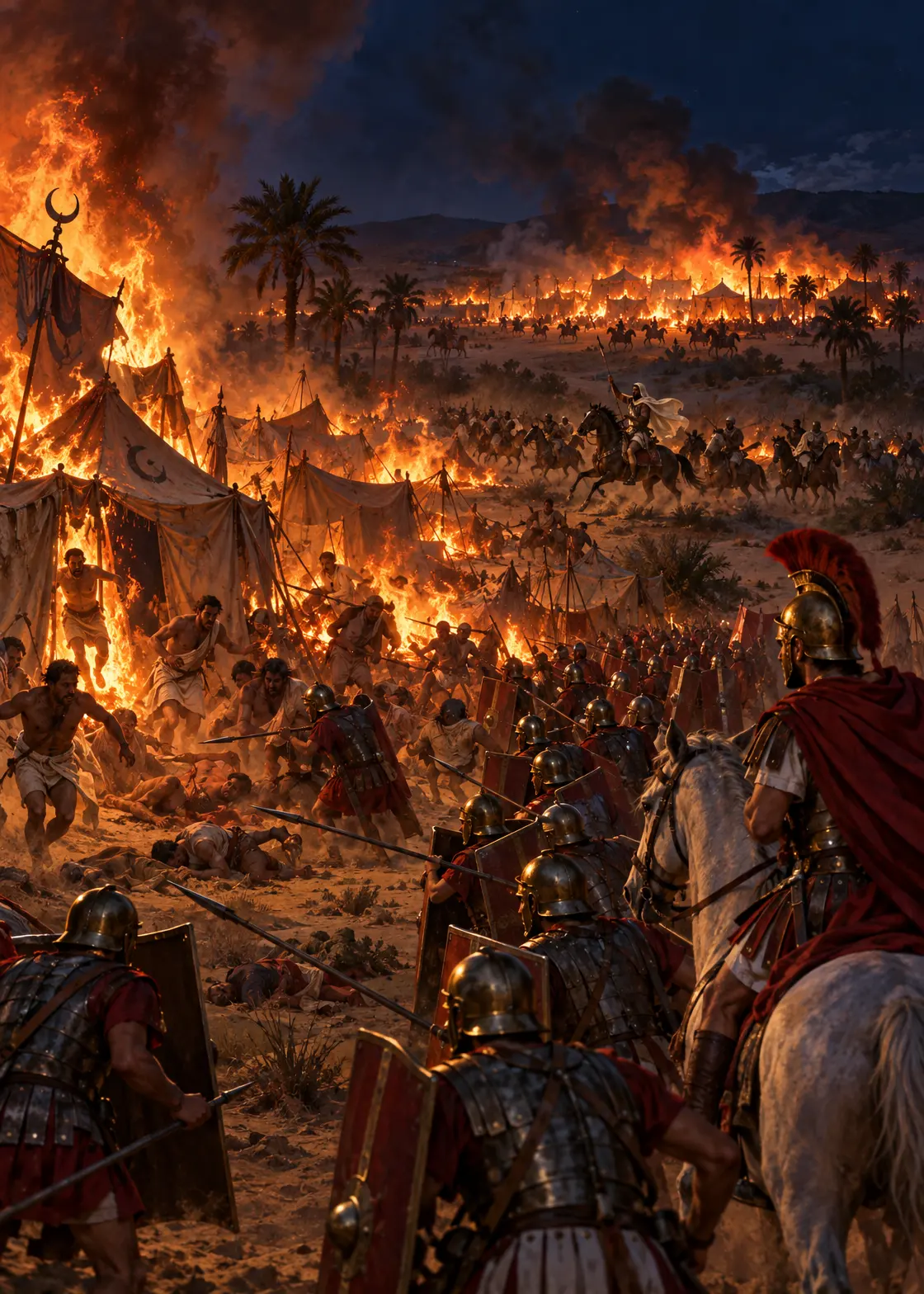
The operation was executed in early spring 203 BC (the precise date is not preserved but was probably in April). The Roman force was divided into two assault columns: Laelius commanded the column directed against the Numidian camp (the more vulnerable target), supported by Masinissa's Numidian cavalry; Scipio commanded the column directed against the Carthaginian camp. The columns approached the camps in darkness, deployed silently, and at the signal (probably a fire arrow visible to both columns) began the assault simultaneously. The Numidian camp was set on fire first, with reed structures igniting rapidly and spreading the flames across the camp within minutes; the Carthaginian camp was set on fire a few minutes later. Both camps were almost completely consumed within an hour; the troops emerging from the burning structures were engaged by the Roman forces deployed outside the camp perimeters and were slaughtered in detail.
The casualties at the burning of the camps were extraordinarily one-sided: Polybius gives Carthaginian and Numidian dead at approximately 40,000, with another 5,000 captured; Roman casualties were perhaps 100. The figures are probably somewhat inflated by Polybius (modern military historians have suggested that 25,000 to 30,000 enemy dead is the more credible figure), but the operational outcome is firm: the combined Carthaginian and Numidian field forces in Africa were effectively destroyed in a single night by an operation that combined intelligence preparation, tactical creativity, and the exploitation of an environmental vulnerability that the Carthaginian command had not adequately considered. Hasdrubal son of Gisgo escaped with a small entourage to Carthage; Syphax escaped to his Numidian capital at Cirta.
The Battle of the Great Plains and the Capture of SyphaxSpring 203 BC
The remnant Carthaginian and Numidian forces, having recovered from the initial shock of the camp burnings, were reorganized across approximately a month and engaged Scipio's army in a final field engagement at a location traditionally called the Great Plains (probably in the upper Bagradas valley, west of Utica). The combined Carthaginian-Numidian army at the engagement was approximately 30,000 men, hastily reassembled from various sources; Scipio's force was approximately the same size. The engagement was relatively brief: the Roman heavy infantry, supported by Masinissa's cavalry, broke the Carthaginian-Numidian center within perhaps two hours of the engagement's beginning; the Numidian cavalry under Syphax was outmaneuvered by Masinissa's cavalry; the Carthaginian and Numidian armies collapsed and were destroyed in the rout. Hasdrubal son of Gisgo again escaped; Syphax was captured by Masinissa's cavalry in the pursuit and was eventually brought to Rome as a prisoner, where he died in custody within a few years.
The capture of Syphax was strategically significant in two dimensions. First, it removed the Carthaginian alliance with the western Numidian kingdom, leaving Carthage without effective Numidian support for the first time in the war. Second, it placed Masinissa in position to claim the Numidian throne as the surviving senior Numidian king. The political consolidation of Masinissa's Numidian kingdom across the following months would create the geopolitical configuration that would shape North African politics for the next half-century, with the Numidian kingdom under Masinissa serving as the principal Roman ally on the African continent and as a regional power capable of constraining whatever Carthaginian recovery might be attempted in the post-war period.
The most famous individual episode of the post-Battle of the Great Plains period — the Sophonisba episode — is preserved by Livy (30.12–15) with characteristic dramatic elaboration. Sophonisba was the daughter of Hasdrubal son of Gisgo who had been married to Syphax as part of the Carthaginian-Numidian alliance; after Syphax's capture, she was taken in the fall of Cirta (Syphax's capital) and was claimed by Masinissa, who fell in love with her on sight and married her on the spot. Scipio, when informed of the marriage, objected on grounds that Sophonisba — as the daughter of a Carthaginian senior officer and as the former wife of an enemy king — should be considered a Roman prisoner of war and should be brought to Rome with the other captives. Masinissa, unwilling either to give Sophonisba up or to defy Scipio openly, resolved the dilemma by sending Sophonisba a cup of poison with which she ended her own life. The episode entered Roman literary tradition as a paradigmatic case of political tragedy under wartime conditions and has been the subject of substantial subsequent literary treatment (Petrarch wrote a Latin epic on the subject; Corneille and Voltaire both wrote tragedies). The historicity of the basic events is firm; the dramatic details of Sophonisba's speech to Masinissa upon receiving the poison cup are reconstructions.
The Carthaginian Decision to Recall HannibalLate 203 BC
The Carthaginian political response to the catastrophes of spring and summer 203 BC was the convening of the Carthaginian Senate in late summer or early autumn 203 to consider whether the war could be continued. The strategic situation by this point was: the Carthaginian field army in Africa had been destroyed twice (at the camps and at the Great Plains); the Numidian alliance with Syphax had been eliminated; Scipio's Roman force was operating in the Carthaginian hinterland with effective impunity; the Italian theater was holding (Hannibal's army was still in Bruttium, intact but strategically isolated), and the Spanish theater was lost; the only remaining Carthaginian field force capable of engaging Scipio on terms approaching equality was Hannibal's army itself.
The Carthaginian Senate's decision was to recall Hannibal from Italy. The dispatch of the recall order to Hannibal in late autumn 203 BC was the formal acknowledgment that the Italian campaign that had begun with the Alpine crossing fifteen years earlier had failed; that the original strategic conception of detaching the Italian allied system from Rome had not succeeded; that the war could no longer be sustained by Carthaginian operations on multiple fronts; and that the Carthaginian state's only remaining strategic option was to concentrate its remaining military resources for a defensive engagement against the Roman expeditionary force on African soil. Hannibal received the recall order in his camp in southern Italy in late 203 BC and made preparations for the evacuation. His army, by this point reduced by attrition to approximately 20,000 effective troops, was loaded onto transport vessels at the southern Italian ports across the autumn and winter of 203/202; the embarkation was conducted under loose Roman observation but without active interference, the Roman strategic objective being precisely the removal of Hannibal's army from Italy. Hannibal himself sailed in late winter 202 BC, reaching the African coast at Hadrumetum (modern Sousse) approximately seventy Roman miles south of Carthage.
It was nearly seventeen years since Hannibal had last set foot in Africa. He had crossed to Italy in 218 BC at the age of twenty-eight; he returned in 202 BC at the age of forty-five. He had spent the most consequential decade and a half of his life conducting a campaign that had brought Rome to within a single battle of strategic dissolution and that had failed to produce its strategic objective for reasons that had become progressively clearer across the years. He now returned, in the closing months of the war, to fight a final engagement against the Roman general who had constructed the strategic position that had compelled his recall — the same general who had been a teenage cavalry officer at the Ticinus when Hannibal had first defeated his father in 218 BC.
The Crossroads · Autumn 205 BC · Rome, the Senate
The African Command
A Roman senator present in the Curia during the consular debate of 205 BC, listening to the opposing strategic appeals of Quintus Fabius Maximus and Publius Cornelius Scipio.
Publius Cornelius Scipio has returned victorious from Spain to stand for the consulship of 205 BC, seeking authorization to invade Africa. He argues that threatening Carthage directly will break the Italian stalemate and compel the recall of Hannibal. Quintus Fabius Maximus, the seventy-seven-year-old leader of the Senate's conservative faction, vehemently resists. Fabius contends that Hannibal is contained in Bruttium and wasting under steady attrition, while an African expedition recklessly diverts Roman resources and risks catastrophe far from Rome's demographic base for the glory of an ambitious thirty-year-old general. The Senate must determine the strategic direction of the war.
How should the Senate assign consular command and allocate the republic's military forces for the coming year?
Weigh each course: open it to hear your own inner voice. Then decide. Nothing is scored.
- Your inner voiceThe course taken
Let us vote Scipio the consular armies and fleet he demands to strike Carthage directly. Hannibal sits contained in Bruttium, but Carthaginian ships will sustain him indefinitely if we remain passive. By carrying the war across the sea, we strike a vulnerable homeland that possesses no field army comparable to those we broke in Spain. The distance carries danger, yet an offensive into Africa is the only stroke that will decisively end this grueling war.
- Your inner voiceThe course taken
We must heed Quintus Fabius Maximus and refuse this reckless venture. For a decade, his strategy of attrition has preserved Rome while Hannibal's army steadily wastes away in Bruttium. Stripping Italy of legions to indulge a thirty-year-old commander's ambition invites catastrophe far from our demographic base. If we remain patient, Hannibal will dissolve through isolation, securing peace without gambling the republic's future on foreign sands.
- Your inner voiceThe course taken
We should assign Scipio the Sicilian provincia with permission to cross to Africa if circumstances permit, but withhold the state's reserve legions. Let him take the two disgraced Cannae legions stationed in Sicily and whatever Italian volunteers he can raise. If his indirect approach succeeds, Carthage falls at little cost to our treasury; if he fails, Rome's home defense remains intact to keep Hannibal contained in Bruttium.
What was done
The Senate authorized Scipio's consulship and granted him the Sicilian provincia with leave to cross to Africa, but withheld major reinforcements. Scipio assembled approximately 7,000 Italian volunteers alongside the Fifth and Sixth legions of Cannae survivors, crossing from Lilybaeum to Cape Promonturium Pulchrum in spring 204 BC. Forming an alliance with the Numidian prince Masinissa, Scipio executed a devastating night assault burning the wooden and reed camps of Hasdrubal son of Gisgo and King Syphax in spring 203 BC (AGrade A), inflicting tens of thousands of casualties for negligible Roman loss. After Scipio shattered their reorganized forces at the Great Plains (AGrade A) and Masinissa captured Syphax, the Carthaginian Senate had no field army left in Africa. In late 203 BC, Carthage dispatched the order recalling Hannibal and his 20,000 veteran troops from Bruttium, ending fifteen years of invasion in Italy exactly as Scipio had predicted.
The evidence The strategic debate between Scipio and Fabius Maximus is preserved principally by Livy (28.40–45, BGrade B), who reconstructs the senatorial speeches at length though with likely rhetorical elaboration. The subsequent operations of the African campaign are documented by Polybius (14.1–9, AGrade A), with supplementary accounts in Appian's Punica (CGrade C), Plutarch's Cato Major (BGrade B), and Cassius Dio (CGrade C).
If you choose to walk through itAt every scale
- Yourself
Does strategic caution born of long trauma represent genuine wisdom, or does it become an excuse to avoid the bold risks necessary to achieve decision?
- Those beside you
How should an assembly of elders weigh the proven record of an aging hero against the disruptive brilliance of a rising junior commander?
- Rome
When an empire is drained by prolonged attrition, at what point does conservative institutional caution endanger the state more than an overseas offensive?
- The wider world
What responsibility does a dominant republic incur toward former defectors seeking rehabilitation, or foreign rulers whose dynastic civil wars it exploits?
- Our own time
In modern strategic planning, how should governments weigh an indirect approach aimed at an adversary's political core against directly confronting their deployed field forces?
In 1943 and 1944, Allied planners debated whether to concentrate forces in the Mediterranean theater to attrite Axis forces gradually or mount a massive cross-Channel invasion of Western Europe. Conservative planners feared a catastrophic defeat on foreign beaches far from supply, while advocates of the cross-Channel operation insisted that only striking directly into the enemy's core perimeter could compel the diversion of German forces and break the continental stalemate.
Where the comparison fails. The comparison fails because Allied commanders commanded vast industrial output, total naval dominance, and secure amphibious logistics, whereas Rome faced manpower exhaustion, lacked modern supply systems, and compelled Scipio to cross with disgraced penal legions and unequipped volunteers.
What does the chapter tell us?
What was Quintus Fabius Maximus's principal strategic objection to Scipio's proposed African expedition?
Fabius argued that the war was already being won through steady containment in Italy. He maintained that Hannibal's isolated army in Bruttium would dissolve by natural attrition and that sending legions abroad risked disaster far from Rome's demographic base.
Livy 28.40–45 (BGrade B)
Why did Scipio integrate the Fifth and Sixth legions into his expeditionary force in Sicily?
The Fifth and Sixth legions were composed of Cannae survivors stationed in Sicily under quasi-punitive terms since 215 BC. Scipio capitalized on their nine years of continuous combat experience and offered them a path to redeem their standing by concluding the war.
the chapter's narrative
What environmental vulnerability enabled Scipio to destroy the Carthaginian and Numidian field armies in early 203 BC?
Reconnaissance conducted under the guise of peace embassies revealed that Hasdrubal and Syphax had built their winter quarters out of timber and reed. Scipio exploited this vulnerability by launching a synchronized night assault that incinerated both camps.
Polybius 14.1–5 (AGrade A)
What was the primary geopolitical consequence of the capture of King Syphax at the Great Plains?
Syphax's defeat and capture permanently severed Carthage from its western Numidian alliance. It cleared the way for Masinissa to unite Numidia under a pro-Roman crown, creating a regional counterweight against Carthage that lasted for half a century.
the chapter's narrative
Why did the Carthaginian Senate decide to recall Hannibal from Italy in late 203 BC?
After the destruction of Carthaginian and Numidian field forces at the camps and the Great Plains, Scipio operated unchecked in the Carthaginian countryside. Hannibal's veteran force in Bruttium was the only remaining army capable of defending the homeland.
the chapter's narrative