Chapter 7
Zama and the Peace
The Return of Hannibal and the Preliminary Maneuvers
Hannibal's landing at Hadrumetum in late winter 202 BC marked the convergence of three strategic trajectories that had been developing across the entire post-Cannae period: the Carthaginian acknowledgment that the war could no longer be sustained on multiple fronts, the Roman expeditionary force's establishment in the Carthaginian hinterland with effective operational freedom, and the diplomatic-military consolidation of the Roman alliance with Masinissa that had transformed the Numidian political landscape. The strategic situation that confronted Hannibal upon his return — preserved in his own subsequent recollections as relayed by later Greek interlocutors and indirectly by Polybius — was profoundly different from the situation he had left in Italy seventeen years earlier. He returned to a Carthage that had lost its Iberian fiscal-recruitment base, its naval dominance in the western Mediterranean, its Numidian eastern ally, and the strategic momentum that had carried his Italian campaign through the years of Trebia, Trasimene, and Cannae. He returned with an army reduced by attrition and demoralization to perhaps 12,000 of his Italian veterans, supplemented during the embarkation by some Bruttian troops who had remained loyal to the end. He returned to confront, as the principal Roman commander on African soil, the same man whose father he had wounded at Ticinus when both Scipio and Hannibal were young — and who had now constructed, by patient operational craft across seven years of independent command, the strategic position that had compelled Hannibal's recall.
The first weeks of Hannibal's African command were spent in army reorganization and in the recruitment of additional forces from such sources as remained available. The Carthaginian state mobilized what local manpower could still be raised — perhaps 12,000 newly-recruited Carthaginian citizen-soldiers, of doubtful tactical quality but of considerable political significance as the demonstration that the city's own population was committed to the defense — and several thousand Macedonian and Greek mercenary troops who had been retained at Carthage as garrison forces. A Numidian contingent of approximately 2,000 cavalry was furnished by Tychaeus, a chieftain who had remained loyal to Carthage after Syphax's fall; this small force would constitute the principal Carthaginian cavalry asset at the engagement to follow, and the qualitative inferiority of this contingent compared to Masinissa's Roman-allied Numidians would be among the most consequential operational facts of the campaign. Hannibal also obtained, from sources internal to Carthage and from some Numidian holdouts, a quantity of war elephants — perhaps 80 in number, the largest single contingent of elephants Hannibal had ever commanded, but consisting substantially of recently captured animals not adequately trained for battle. The total Carthaginian field force, by the time Hannibal felt prepared to engage, was approximately 36,000 infantry, 4,000 cavalry, and 80 elephants.
Scipio's force at the same moment was approximately 29,000 infantry and 6,000 cavalry, of which the cavalry advantage was decisive: approximately 4,000 Numidian cavalry under Masinissa, who had arrived in early summer 202 from the consolidation of his Numidian kingdom after Syphax's capture, plus 2,000 Roman and Italian cavalry. The cavalry imbalance — six thousand Roman-aligned horse against four thousand Carthaginian — was the precise inversion of the cavalry balance at Cannae fourteen years earlier, where Hannibal's superiority in cavalry had been the operational foundation of his greatest tactical success. The Carthaginian commander who had won Cannae by superior cavalry would now fight his last battle at a cavalry disadvantage that he himself had partly produced, by the political and military failures that had cost Carthage her Numidian alliance.
The strategic maneuvers of summer 202 BC consisted principally of the two armies positioning themselves for engagement. Hannibal had marched his army inland from Hadrumetum to Zama Regia, an inland Numidian town (the exact location is disputed in modern scholarship, with at least three candidate sites in the upper Bagradas valley and the Tunisian interior, but the general region is the high country approximately 130 Roman miles southwest of Carthage). Scipio, marching from his coastal base toward the same general region, established his camp on the plain near the town that the sources name as Naraggara, approximately a day's march from Hannibal's position. The two commanders had been within close range of each other for some weeks before the actual engagement; both were conducting reconnaissance, evaluating the terrain, and (according to the tradition that Polybius preserves) attempting to assess each other's intentions through observation and through such intelligence as their light cavalry could obtain.
The Pre-Battle Parley
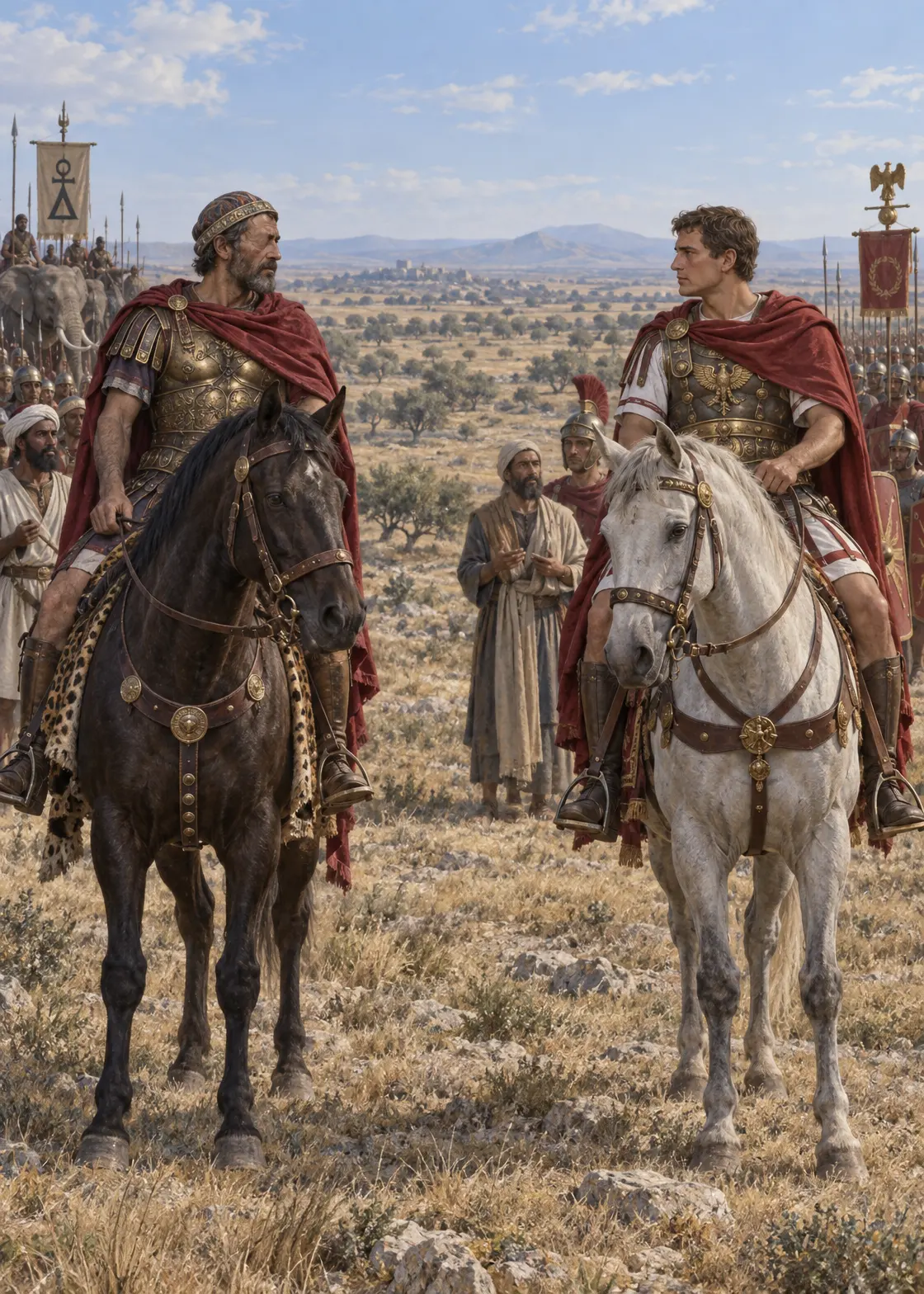
The pre-battle meeting between Hannibal and Scipio is one of the most famous individual encounters in ancient military history and is preserved by Polybius (15.6–8) in a narrative that has every appearance of substantial historical reliability, drawing apparently on the testimony of one of the interpreters present (probably Hannibal's own Greek interpreter, whose subsequent career brought him into contact with the Scipionic circle that was Polybius's principal source for the campaign). The meeting was Hannibal's initiative: he sent a herald to Scipio's camp the day before the projected engagement, requesting a personal interview between the two commanders for the discussion of possible terms before the decisive battle was joined. Scipio agreed, and the meeting took place on the plain between the two armies on the day before the engagement, with each commander accompanied only by an interpreter and a small escort.
Polybius's account preserves the substance of the exchange in language that may represent the actual words spoken (the interpreter's recollection would have been substantial) or may be a rhetorical reconstruction (in the manner of Thucydidean speech-composition that Polybius generally avoided but may have permitted himself for this particular moment). Hannibal's principal argument was that the war had reached the point at which both commanders should recognize the limits of military prediction: he himself had been at Cannae the most successful general in the ancient world, and was now reduced to fighting a defensive battle on his own continent against a Roman army of equal or superior quality; Scipio, on the other hand, had been a teenage cavalry officer at Ticinus when Hannibal had defeated his father, and was now the foremost Roman general of his generation, but his career too was subject to the contingencies that had reversed Hannibal's own. The strategic situation, in Hannibal's argument, permitted a negotiated settlement on terms more advantageous to both sides than the additional bloodshed of a decisive engagement would produce: Carthage would surrender her Mediterranean possessions outside Africa (Spain was already lost; the Balearic Islands and the smaller possessions could be formally ceded), would pay a substantial indemnity, would limit her naval forces, and would accept Roman strategic supremacy in the western Mediterranean.
Scipio's response, as Polybius preserves it, was direct: the terms Hannibal proposed were close to what Rome would in any case impose after victory at the projected engagement; the principal additional cost of fighting the battle would be the lives of soldiers on both sides; the principal additional benefit to Rome would be the formal demonstration of Roman military supremacy that a battlefield victory would constitute. Scipio could not, however, accept the negotiated settlement Hannibal proposed, for several reasons that he stated explicitly: the post-Cannae Roman position had been that no negotiations with Carthage would be conducted while Hannibal's army remained on Italian soil, and the recent removal of Hannibal's army from Italy did not yet constitute the comprehensive Carthaginian acknowledgment of defeat that would justify Roman negotiations; the Carthaginian state had recently broken a preliminary armistice that had been negotiated by the Roman commander Tuditanus during Scipio's siege of Utica (an armistice agreement of 203 BC that Carthage had abandoned upon Hannibal's arrival, in circumstances the Roman command regarded as bad-faith); and the strategic position now favored Rome to such a degree that the terms a negotiated settlement would produce would necessarily be worse for Carthage than the terms imposed after a Roman victory, because the Carthaginian negotiating position was deteriorating with each additional Roman strategic gain. The two commanders parted, according to Polybius, with mutual respect but without agreement; the engagement would be fought the following day.
The historicity of the pre-battle parley has been debated by modern scholars. The dominant view (Scullard, Walbank, Lazenby) accepts the meeting as historical, with the speeches as rhetorical reconstructions that may approximate but probably do not reproduce the actual words. A minority view (some German scholars in the early twentieth century) has held that the entire episode is a literary fabrication. The Polybian narrative is detailed enough, and Polybius's connection to the Scipionic circle is direct enough, that the dominant view appears correct: the meeting was historical, the substantive arguments are probably reasonably preserved, but the specific language is reconstruction.
The Battle of ZamaOctober 202 BC
The engagement that the Roman tradition called Zama (though it may have been fought at Naraggara or at one of the other candidate sites; the geographical question is unresolved) took place in October 202 BC, on terrain selected by mutual position rather than by either commander's specific choice. The two armies deployed at first light, in dispositions that reflected the strategic and tactical realities both commanders had recognized in the preceding weeks.
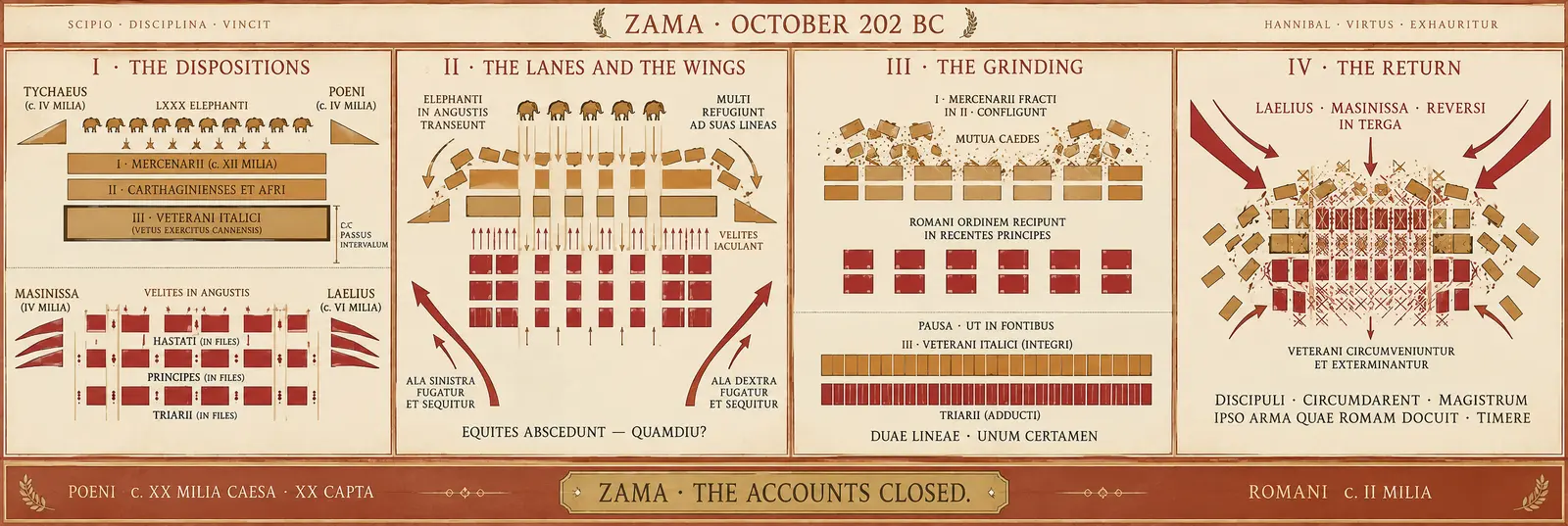
Scipio's deployment was a careful modification of the standard manipular triplex acies. The Roman infantry was drawn up in the three conventional lines (hastati, principes, triarii), but with a critical innovation in the spacing: rather than the conventional checkerboard arrangement in which the gaps between the maniples of the first line were covered by the maniples of the second line, Scipio arranged the maniples of all three lines in direct front-to-back alignment, creating continuous corridors running from the front of the army to the rear. The corridors were initially filled with velites (light infantry), but the velites had specific orders: when the Carthaginian elephants charged, they were to either retreat backward through the corridors to safety behind the triarii, or to deflect the elephants laterally into the corridors so that the great animals would charge through the Roman lines without contact with the heavy infantry formations on either side. The tactical conception was the systematic neutralization of Hannibal's elephant force, which Scipio had identified (correctly) as the principal Carthaginian asset for the engagement and which he had observed during his pre-battle reconnaissance to consist substantially of inadequately trained recent captures.
The Roman cavalry was deployed on the wings in the conventional manner: Laelius commanded the Roman and Italian cavalry on the left wing; Masinissa commanded the Numidian cavalry on the right wing. The total Roman cavalry strength of approximately 6,000 substantially outnumbered the Carthaginian cavalry of approximately 4,000. The cavalry positions were tactically critical: Scipio's expectation, based on the cavalry imbalance and on Masinissa's qualitative superiority over the Numidian troops on the Carthaginian side, was that the cavalry actions on both wings would be decided in Roman favor relatively early in the engagement, after which the victorious cavalry could be redirected against the rear of the Carthaginian infantry while the main infantry contest was still developing in the center.
Hannibal's deployment was the most carefully constructed tactical disposition of his African command and reflected his recognition that the engagement would have to be won by the African veteran core of his army, with the supporting infantry contingents serving as preliminary screens to absorb Roman pressure before the veterans engaged. The Carthaginian army was drawn up in three lines, but unlike the Roman triplex acies the three lines were of distinct ethnic composition and operational role:
-
The first line consisted of the mercenary contingents — approximately 12,000 men, principally the Ligurians, Gauls, Balearic Islanders, and Mauretanians who had been retained as Carthaginian field troops or recruited during Hannibal's return. These troops were tactically reliable but not exceptional; their function was to engage the Roman first line and to absorb the initial Roman pressure.
-
The second line consisted of the newly-raised Carthaginian citizen-soldiers and the African recruits — approximately 12,000 men of doubtful tactical quality, who would engage the Roman line after the first line had been broken or had withdrawn through them.
-
The third line, drawn up at a substantial interval behind the first two (approximately 200 paces, by Polybius's estimate), consisted of Hannibal's Italian veterans — the approximately 12,000 troops who had served with him through the entire Italian campaign and who constituted, on a man-for-man basis, the most experienced and resilient body of infantry on the field. The veterans were held in reserve as the operational mass that would deliver the decisive engagement against the Roman line after the preliminary lines had absorbed Roman strength.
In front of the entire infantry line, Hannibal placed his elephants in a single front rank of approximately 80 animals, with the intention of disrupting the Roman manipular formation by a mass elephant charge before the infantry engagement began. The Carthaginian cavalry was deployed on the wings in the conventional positions: the smaller Numidian contingent under Tychaeus on the Carthaginian left, facing Masinissa's larger Numidian force; the Carthaginian heavy cavalry on the Carthaginian right, facing Laelius's Roman and Italian cavalry.
The Engagement
The battle opened with Hannibal's elephant charge, which produced almost none of the operational disruption Hannibal had intended. The Roman trumpeters and signal horns, on Scipio's order, were sounded simultaneously across the entire Roman line at the moment the elephants began their advance; the unfamiliar noise (the elephants were largely recent captures, inadequately conditioned to the sounds of battle) panicked the front rank of the great animals, with several wheeling and charging back into the Carthaginian formation rather than forward against the Romans. Those elephants that did continue forward encountered the Roman line organized in the prepared corridors: the velites deflected them laterally into the gaps, allowing the elephants to pass through the Roman lines without contact with the heavy infantry formations. The elephants that emerged behind the Roman lines were then dealt with by reserve cavalry or were allowed to disperse harmlessly into the open ground beyond. Hannibal's elephant force, on which substantial Carthaginian operational hopes had rested, was effectively neutralized in the engagement's opening minutes, with the Carthaginian formation suffering more disruption from its own panicked animals than the Roman formation suffered from the surviving charging animals.
The cavalry engagements on the wings developed almost simultaneously and produced, as Scipio had calculated, decisive results in Roman favor. On the Carthaginian left, Masinissa's Numidian cavalry engaged Tychaeus's smaller and qualitatively inferior Numidian force and drove them from the field within approximately an hour of the engagement's beginning. On the Carthaginian right, Laelius's Roman and Italian cavalry engaged the Carthaginian heavy cavalry and produced a parallel result, though the engagement on this wing was somewhat longer (the Carthaginian heavy cavalry was of better quality than Tychaeus's Numidians and resisted longer before breaking). The critical operational consequence was that, by approximately mid-morning, both Roman cavalry wings had defeated their immediate opposition and were pursuing the broken Carthaginian cavalry off the field. Both Laelius and Masinissa pursued, in accordance with their preliminary instructions, far enough to ensure that the Carthaginian cavalry could not reform and reenter the engagement; both then turned their forces back toward the main battlefield to deliver the decisive rear attack that was the operational hinge of Scipio's plan.
While the cavalry actions were developing on the wings, the infantry engagement was unfolding in the center. The Roman hastati of the first line, supported by their accompanying maniples of principes, engaged Hannibal's first line of mercenaries in conventional manipular combat. The mercenary line fought with the determination characteristic of professional soldiers but was outmatched by the Roman heavy infantry's discipline and equipment; after approximately an hour of fighting, the mercenary line began to give way. Hannibal's tactical conception at this point required the mercenaries to withdraw through the gaps in the second line (the Carthaginian citizen-soldiers and African recruits), so that the second line could engage the now-tired Roman hastati with fresh troops. The withdrawal, however, was imperfectly executed: the second line of Carthaginian recruits, observing their first line falling back, panicked and either refused to open ranks to admit the withdrawing mercenaries or attacked them as traitors attempting to break the Carthaginian position. The first line, finding its escape route blocked, was caught between the advancing Roman line and its own second line; some of the mercenaries fought back against the Carthaginian citizen troops, producing what Polybius describes as a small intra-Carthaginian battle within the larger engagement. The first and second Carthaginian lines were both effectively dissolved within approximately the next hour of the engagement, with the survivors of both either killed in the disordered fighting or driven from the field.
The Roman line, having broken through the first two Carthaginian lines but having suffered substantial casualties in the process, paused at this point to reorganize. Scipio rode along the line giving instructions for the redeployment that would be required for the engagement of Hannibal's third line: the hastati maniples, now reduced and tired, were drawn back to the rear of the formation; the principes and triarii were brought forward to form a single continuous line opposite Hannibal's veteran third line, which had not yet been engaged and which was now visible at the rear of the Carthaginian position as the only remaining Carthaginian formation on the field. The reorganization required approximately half an hour, conducted under sporadic skirmishing from the broken Carthaginian troops still in the area. The disposition that resulted was the Roman line drawn up in a single continuous formation rather than in the conventional checkerboard maniples, facing Hannibal's veteran line drawn up in similarly continuous formation, with the field between the two lines littered with the dead and disabled from the morning's fighting.
The decisive engagement between Hannibal's Italian veterans and Scipio's combined Roman line is preserved in the source tradition with substantial care, principally by Polybius (15.13–14). The two lines engaged in a contest that the sources describe as the most evenly matched infantry fighting of the entire Hannibalic War. Hannibal's veterans had fought with him through Trebia, Trasimene, Cannae, and the long Italian campaign; they were the most experienced infantry on the African continent at that moment, possibly the most experienced anywhere in the Mediterranean world. Scipio's combined Roman line was somewhat outnumbered (perhaps 20,000 surviving Romans against 12,000 Carthaginian veterans, though the Roman troops were tired from the morning's engagement while the Carthaginian veterans were fresh) but possessed comparable tactical experience from the Spanish and African campaigns. The contest extended for approximately an hour without decisive result; neither side could break the other; casualties mounted on both lines without either side giving way.
The engagement was decided by the return of the Roman cavalry. Laelius and Masinissa, having pursued the broken Carthaginian cavalry far enough to ensure their dispersal, had reorganized their forces and were now riding back toward the main battlefield. They arrived at the Carthaginian rear at approximately the same moment, in the early afternoon, and attacked Hannibal's veteran line from behind. The Carthaginian veterans, who had been holding their own against Scipio's frontal pressure, now found themselves simultaneously attacked from front and rear. The formation could not redress to face two directions; the rear was overwhelmed first; the line then broke from rear to front as the Roman cavalry pressure compressed the Carthaginian formation into a steadily smaller area. Within perhaps an hour of the cavalry's arrival, Hannibal's veteran line had been destroyed.
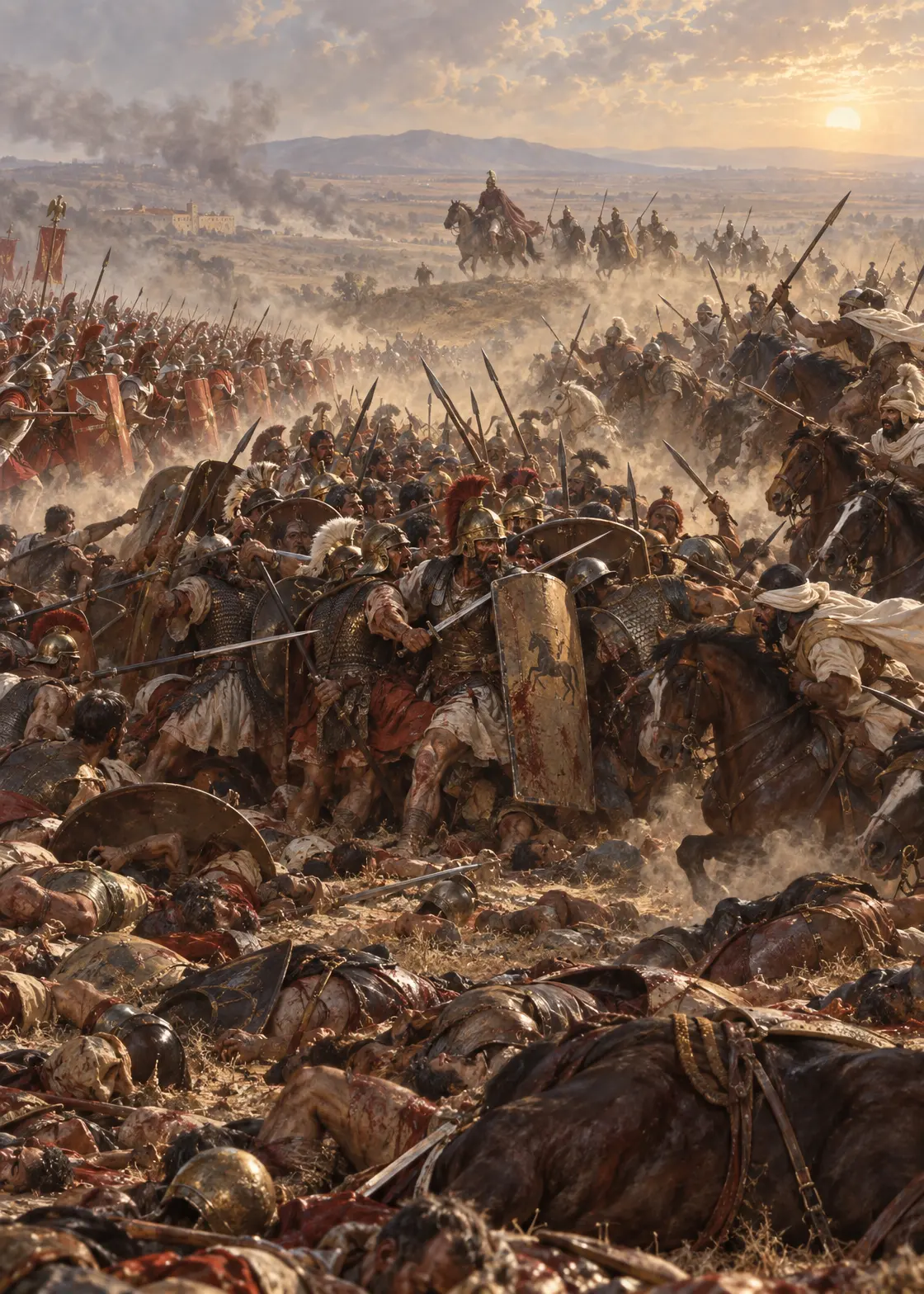
The casualties at Zama are given by Polybius (15.14) as Carthaginian dead at approximately 20,000 with another 20,000 captured; Roman losses were approximately 1,500 dead and 4,000 wounded. The figures are probably approximately accurate, with the qualification that the Carthaginian "captured" figure includes substantial numbers of the dispersed first and second lines who were rounded up by Roman cavalry across the day and the following morning. Hannibal himself escaped from the field with a small escort of cavalry, riding to Hadrumetum and from there eventually to Carthage itself. The retreat was conducted in good order despite the catastrophe, and Hannibal arrived at Carthage some days later with his command capacity intact, though his army had ceased to exist as a coherent formation.
The Peace Negotiations and Terms
The Carthaginian political response to Zama was the convening of the Carthaginian Senate within days of the engagement to consider what terms could be obtained from the victorious Roman commander. The principal speech in the debate, by the Carthaginian senator Hasdrubal Haedus, was reportedly cut short by Hannibal himself, who had returned to Carthage and who is reported by Livy (30.37) to have intervened in the Senate session by physically removing one of the speakers from the rostrum — an extraordinary act for a Carthaginian general toward a civilian senator, and an indication of the political crisis at the city. Hannibal's argument was that the negotiating position of Carthage had collapsed to such a degree that any terms the Roman commander offered should be accepted without further delay, lest the situation deteriorate further. The Carthaginian Senate, after some additional debate, accepted Hannibal's argument and dispatched a delegation to Scipio's camp.
The terms that Scipio proposed, and that the Carthaginian Senate accepted (subject to ratification at Rome), were preserved by Polybius (15.18) in the form of a formal treaty document. The principal provisions were:
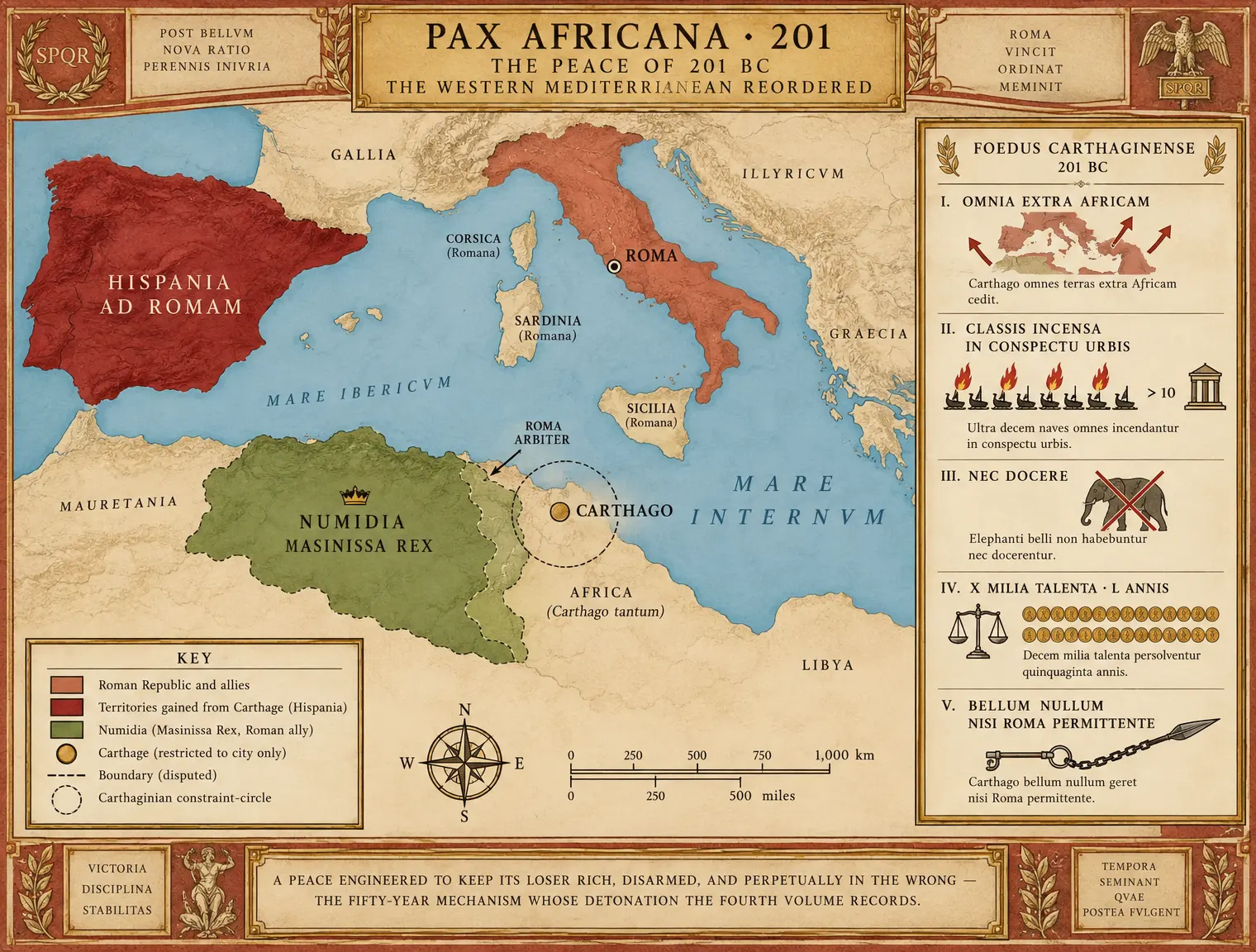
First, Carthage would surrender all her possessions outside Africa. Spain and the Mediterranean islands (Sardinia and Sicily had been lost long since; the Balearics and the smaller possessions were formally ceded) would become Roman territory or Roman dependencies; the Carthaginian presence in the western Mediterranean beyond the immediate African coast would be eliminated.
Second, Carthage would surrender all but ten triremes of her fleet. The remaining naval establishment of the great commercial empire of the western sea, which had once contested the Mediterranean with the Hellenistic monarchies and which had constructed the navies that fought Rome through the First Punic War, would be reduced to a coastal defense force of no operational significance. The surrendered ships were burned in the harbor of Carthage in the presence of the surviving senators, an act of strategic-symbolic significance that Polybius records as the most painful single moment of the peace for the Carthaginian political class.
Third, Carthage would pay an indemnity of 10,000 talents of silver over fifty years, in annual installments of 200 talents. The indemnity was, in absolute terms, substantial but not crushing — Carthaginian commercial wealth was sufficient to absorb the payment without fundamental damage to the city's economic foundations, and the city would in fact recover substantial economic prosperity across the half-century of the indemnity payments. The strategic significance of the indemnity was less the absolute amount than the political constraint it imposed: Carthage would be paying Rome for two generations, with the political relationship between the two states being structurally one of indebted dependency rather than of comparable powers.
Fourth, Carthage would not undertake any war outside Africa without explicit Roman permission, and would not undertake any war in Africa without Roman approval. The provision converted Carthage from a sovereign Mediterranean power into a dependent state with foreign policy controlled by Rome; the political-strategic significance of the provision exceeded that of the indemnity in long-term consequences.
Fifth, the Numidian kingdom of Masinissa would be expanded to include all the territories that had previously belonged to Syphax or that Masinissa could establish as ancestral Numidian lands; the boundaries between Carthaginian and Numidian territory would be subject to negotiation with Rome serving as the arbitrator. The provision created the geopolitical configuration that would shape African politics across the next half-century: an aggressive Numidian kingdom under Masinissa, supported by Rome, would steadily encroach on Carthaginian territory across the following decades, with Carthage unable to defend her territory militarily because of the constraint on her warfare. The slow Numidian-Carthaginian territorial dispute would, fifty years after Zama, provide the pretext for the Third Punic War and the destruction of Carthage in 146 BC.
Sixth, Carthage would surrender all war elephants and would not train new ones. The provision was perhaps more symbolic than strategically significant — the elephants of Zama had been operationally negligible, and the future strategic utility of war elephants was in any case declining — but it served to formally eliminate the most distinctive instrument of the Carthaginian military tradition.
Seventh, the prisoners and deserters would be returned to Roman custody. The provision had a particular sting: the deserters were not simply prisoners but included the Roman and Italian troops who had defected to Hannibal across the Italian campaign, particularly the troops from the post-Cannae defecting communities (Capua, Tarentum, Bruttium). These would be returned to Roman custody for punishment, with execution being the standard penalty for desertion.
The treaty was ratified at Rome in the spring of 201 BC, after the Roman political class — which had debated whether the terms were sufficiently harsh — had been persuaded by Scipio that the proposed peace would secure the strategic objectives of the war without the additional cost of a prolonged siege of Carthage itself, an operation that would have required substantial additional Roman investment and that could have produced unanticipated complications. The ratification of the treaty marked the formal end of the Hannibalic War, seventeen years after Hannibal's army had crossed the Pyrenees in the spring of 218 BC and seventy-three years before the destruction of Carthage in 146 BC. The strategic configuration that the treaty established — Roman supremacy in the western Mediterranean, Carthage as a constrained commercial city without strategic autonomy, the Numidian kingdom as a Roman ally on the African continent — would define the political geography of the western Mediterranean for the next half-century.
Scipio's Triumph and the Cognomen Africanus
Scipio's return to Rome in the spring of 201 BC was the occasion for the most spectacular triumph that had yet been celebrated in Roman history. The triumphal procession through the streets of Rome featured the spoils and prisoners of the African campaign, the displays of the Carthaginian war material captured during the campaign, the principal Carthaginian and Numidian prisoners (including Syphax, who had been brought from Numidia to be displayed in the triumph and who would die shortly afterward in Roman custody), and the figure of Scipio himself in the conventional triumphal regalia. The cognomen Africanus was awarded to Scipio in connection with the triumph; it was, by some sources, the first cognomen formally granted to a Roman general from a conquered territory, though the earlier honorific Messalla given to Manius Valerius Maximus for his Sicilian command in 263 BC provides a comparable precedent. The cognomen would be hereditary in Scipio's family for two further generations; the most famous subsequent bearer would be his adoptive grandson, Scipio Aemilianus Africanus, who would destroy Carthage in 146 BC and would be the patron of Polybius's residence at Rome and the principal source of the Polybian narrative of the Hannibalic War that the present compendium has drawn upon throughout.
The political consequences of Scipio Africanus's victory at Rome were substantial and not entirely positive for the Republican constitutional order. Scipio had constructed, across the seven years of his Spanish and African commands, the kind of personal strategic prestige that the Republican system had been designed to prevent any individual from accumulating. He had been granted proconsular imperium at an extraordinarily young age, had been given extended command beyond the conventional annual rotation, had constructed a personal alliance system in Spain and Africa that depended upon his individual political authority rather than upon institutional Roman commitment, and had returned to Rome as a figure whose individual strategic accomplishment exceeded that of any conventional consular career. The senatorial conservative faction, led after the death of Fabius Maximus in 203 by Cato the Elder (who had served under Scipio in Sicily and Africa and who had developed a personal antagonism toward him), regarded Scipio's accomplishment as the precursor of a political problem rather than as the conclusion of a strategic one: the model that Scipio had established — the extended extraordinary command, the personal alliance system, the individual strategic prestige — would, across the following century, be repeated by successive generals (Aemilius Paullus, Scipio Aemilianus, Marius, Sulla, Pompey, Caesar) with progressively more disruptive constitutional consequences. The path from Scipio Africanus to the Augustan principate runs through these progressively more powerful individual generals, and the Republican system's institutional capacity to contain individual military prestige would, across the following two centuries, prove inadequate to the kind of figures that the requirements of Mediterranean military operations would produce.
Hannibal's Subsequent Career
The subsequent career of Hannibal Barca, after the negotiation of the peace at Zama, occupies the closing decades of the third century BC and the opening decades of the second, and constitutes one of the more interesting epilogues in ancient political-military history. The treaty of 201 BC did not require Hannibal's surrender or exile; he remained at Carthage as a senior political figure, was elected suffete (the principal Carthaginian civic magistracy, somewhat analogous to the Roman consulship) in 196 BC, and undertook a substantial program of political and financial reform of the Carthaginian state. The reforms — principally directed at reducing the corruption of the Carthaginian oligarchic class and at increasing the efficiency of the indemnity payments to Rome — were politically controversial within Carthage, with the established oligarchic interests opposing Hannibal's reforms with substantial success.
The Roman response to Hannibal's political career at Carthage was, after some initial tolerance, increasing concern. Reports reached Rome (whether accurate or exaggerated is uncertain) that Hannibal was conducting secret communications with Antiochus III of Syria, the principal Hellenistic monarch of the eastern Mediterranean, with the implication that Hannibal was planning a renewed war against Rome in alliance with Antiochus. The Roman response was a diplomatic ultimatum to Carthage demanding Hannibal's surrender as a political prisoner; Hannibal, learning of the ultimatum before it could be formally delivered, fled Carthage in 195 BC and sailed eastward to the court of Antiochus at Antioch.
Hannibal's service with Antiochus across the years 195–189 BC is preserved in fragmentary sources and produced no major military operations of his own command. He served as a senior strategic advisor in Antiochus's preparation for the war with Rome (the Syrian War of 192–188 BC), proposed a strategic conception involving a Carthaginian-Syrian joint operation against Italy that Antiochus did not adopt, and held subordinate commands in the campaigns that followed without commanding the principal Syrian field forces. The strategic decisions of the Syrian War were made by Antiochus and his Greek and Macedonian advisors rather than by Hannibal; the war ended with the Roman victory at Magnesia in 190 BC and the Treaty of Apamea in 188 BC, on terms that included Antiochus's surrender of his European possessions and the explicit demand for Hannibal's extradition.
Hannibal, again fleeing before the Roman demand could be formally executed, transferred his service to Prusias I of Bithynia in northwestern Anatolia. He served Prusias as an advisor in the regional wars of the early 180s BC and reportedly designed one of the more famous tactical innovations of the period — a naval engagement in which Prusias's fleet defeated a Pergamene force by hurling pots filled with snakes onto the enemy ships, producing the kind of panic that decided the engagement without conventional weapon-based combat. The episode is preserved by Cornelius Nepos (Hannibal 11) and other sources, and is consistent with the kind of operational creativity that Hannibal had displayed throughout his career.
The end came in 183 or 182 BC. The Roman political class, having continued to monitor Hannibal's movements, dispatched a final embassy under T. Quinctius Flamininus (the conqueror of Macedonia in 197) to demand Hannibal's surrender from Prusias. Prusias, unwilling to defy the Roman demand and unwilling to surrender Hannibal openly, arranged to have Hannibal's residence at Libyssa (on the Bithynian coast near the modern Gebze in Turkey) surrounded by Bithynian troops. Hannibal, learning of the encirclement, recognized that escape was no longer possible. He drank poison that he had reportedly carried with him for many years for precisely this contingency, and died in his residence at the age of approximately sixty-three. His last words, as preserved in the tradition (Plutarch Flamininus 20, Livy 39.51, Cornelius Nepos Hannibal 12), were a complaint that the Roman political class could not let an old man die in peace — and a recognition that his life had been a single sustained campaign whose outcome had ultimately been determined by the Roman institutional capacity that no individual strategic genius could permanently overcome.
The historical assessment of Hannibal Barca has been remarkably stable across two thousand years of subsequent military thought. He is universally regarded as one of the greatest generals of the ancient world, on a par with Alexander, Caesar, and a small handful of others. His tactical innovations — the convex crescent at Cannae, the integrated cavalry-infantry doctrine, the strategic march to Italy itself — have been studied by every subsequent generation of military theorists from Polybius and Livy through Machiavelli and Frederick the Great to Liddell Hart and the twentieth-century strategists. His strategic conception — the dissolution of an enemy alliance system by tactical demonstration of military weakness — was the most ambitious operational design of the ancient world and would be attempted, in various forms, by subsequent generals from Pyrrhus through Napoleon without ever quite achieving the success that Hannibal himself achieved in the years 218 through 216 BC. His ultimate strategic failure was, as the more reflective ancient and modern commentators have recognized, not the failure of his strategic conception itself but the failure of the institutional resources behind him: the Carthaginian state proved incapable of sustaining the war that Hannibal's strategic genius had opened, and the Roman institutional capacity proved more durable than Hannibal had calculated. He was, in a phrase that the Roman tradition would not have appreciated but that captures the essential strategic truth, the greatest general defeated by the better institution.
The Crossroads · October 202 BC · The plain between Naraggara and Zama Regia
The Parley at Naraggara
Publius Cornelius Scipio, proconsular commander of the Roman army in Africa
You have led your expeditionary force inland to Naraggara, about a day's march from Hannibal Barca's encampment at Zama Regia. Hannibal has mobilized thirty-six thousand infantry—twelve thousand Italian veterans, twelve thousand mercenaries, and twelve thousand newly recruited Carthaginian citizens—along with eighty recently captured war elephants and four thousand cavalry under the loyal chieftain Tychaeus. Against him you command twenty-nine thousand infantry and six thousand cavalry, having secured four thousand Numidian horse under Masinissa after Syphax's fall, alongside two thousand Roman and Italian cavalry under Gaius Laelius. On the eve of battle, Hannibal sent a herald requesting a personal parley. Meeting between the two armies with only interpreters and small escorts, Hannibal reminds you of fortune's mutability: he who stood supreme after Cannae is now defending his homeland, while you, who saw your father wounded at the Ticinus as a youth, now hold the upper hand. He proposes peace terms: Carthage will cede Spain and the Balearic Islands, surrender all overseas Mediterranean claims, pay a substantial indemnity, limit her fleet, and accept Roman supremacy. In return, he asks you to spare the blood of both armies and avert the hazards of tomorrow's clash.
Do you accept Hannibal's proposed peace, or do you reject his terms and commit Rome's legions to decisive battle on the plain tomorrow?
Weigh each course: open it to hear your own inner voice. Then decide. Nothing is scored.
- Your inner voiceThe course taken
If I accept Hannibal's terms, seventeen years of slaughter end today without risking twenty-nine thousand Roman soldiers against eighty war elephants. Rome secures Spain, the Balearic Islands, naval dominance, and a heavy indemnity, achieving her strategic aims without another casualty. Yet Hannibal’s twelve thousand veterans remain armed in Africa, and the Carthaginian Senate broke Tuditanus’s armistice the moment Hannibal landed. If we sign now, has Carthage truly submitted, or merely bought time?
- Your inner voiceThe course taken
We must fight. Hannibal offers only territories Rome has already won by arms, and Carthage broke the armistice arranged by Tuditanus in bad faith. Merely sailing from Italy does not constitute the total acknowledgment of defeat Rome demands after Cannae. With Masinissa and Laelius giving us six thousand cavalry against his four thousand, and my corridors prepared for his untrained elephants, a victory on the field will prove Roman supremacy beyond any Carthaginian dispute.
- Your inner voiceThe course taken
I could demand immediate reparation for the broken armistice of Tuditanus and insist on harsher concessions—surrendering the elephants, the deserters, and the fleet—before referring any treaty to the Senate. If Carthage truly recognizes her deteriorating position, she must pay for her past bad faith before swords are sheathed. Yet Hannibal will never disarm his veterans without a blow. Demanding complete submission now merely provokes the very battle we would pretend to avert.
What was done
Scipio rejected Hannibal's proposals, and the two commanders parted without agreement (AGrade A). At first light the next morning, the armies engaged at Zama. Scipio's tactical innovation—aligning his maniples to form open corridors while sounding trumpets and horns—panicked Hannibal's eighty untrained elephants, deflecting the charge harmlessly. On the wings, Masinissa and Laelius routed the Carthaginian cavalry, leaving Hannibal’s infantry exposed. In the center, Roman discipline shattered Hannibal's first two lines of mercenaries and citizen recruits, who fell into disordered fighting among themselves. Scipio then reformed the principes and triarii into a continuous front against Hannibal’s twelve thousand Italian veterans. The bitter infantry contest was decided when the Roman and Numidian cavalry returned to strike Hannibal's rear. Carthage suffered roughly 20,000 dead and 20,000 captured against 1,500 Roman dead. Hannibal fled to Hadrumetum and persuaded the Carthaginian Senate to accept Scipio's severe peace terms (BGrade B), ratified at Rome in 201 BC.
The evidence The parley and the engagement at Zama are preserved in Polybius 15.5–14 (AGrade A), drawing upon the Scipionic circle and Hellenistic sources (Silenus of Caleacte and Sosylus). The formal treaty terms are preserved in Polybius 15.18 (AGrade A as documentary text). Livy 30.29–44 provides the parallel Latin narrative with dramatic elaboration (BGrade B), Appian Punica 32–54 preserves an independent annalistic account (BGrade B-C), and Frontinus Strategemata 2.3.16 records Scipio's tactical disposition (CGrade C).
If you choose to walk through itAt every scale
- Yourself
When you weigh Hannibal's warning about fortune against the prospect of glory and the memory of your father wounded at Ticinus, how much of your resolve stems from strategic necessity, and how much from personal ambition to be the general who brought Hannibal down?
- Those beside you
Knowing that twenty-nine thousand Roman soldiers and Italian allies, along with your trusted friend Laelius, must risk their lives tomorrow if you refuse Hannibal's offer, what debt do you owe to their safety versus the demands of an absolute victory?
- Rome
Can the Roman Republic accept a negotiated compromise after Cannae and the breach of Tuditanus's armistice, or does senatorial authority require Carthage's complete battlefield defeat to establish lasting security?
- The wider world
What will the rejection of terms mean for Masinissa's Numidians, the Carthaginian citizens, and the wider western Mediterranean, if the war ends in an imposed subordination rather than a mutual settlement?
- Our own time
When a belligerent nation seeks peace on the brink of defeat, under what conditions is an imperfect negotiated settlement preferable to the risks and slaughter of forcing an unconditional military decision?
In October and November 1918, Allied leaders debated whether to accept Germany's request for an armistice based on the surrender of military assets and territorial evacuations, or to press military operations across the Rhine. General Pershing argued that accepting terms before decisively defeating the German army on its own soil would allow its military leadership to claim they had not been beaten in the field, whereas European commanders feared the massive Allied casualties of prolonged fighting.
Where the comparison fails. Unlike 202 BC, where two individual commanders met privately on the plain to decide peace or war, modern coalition warfare involved multiple allied governments, complex home fronts, and civil-military councils. Furthermore, Carthage surrendered near its capital, whereas Germany retained its domestic sovereignty in 1918.
What does the chapter tell us?
How did Scipio systematically neutralize the charge of Hannibal's eighty war elephants at the opening of the battle?
Scipio aligned the hastati, principes, and triarii directly behind one another to form clear corridors, while Roman horns panicked the poorly trained elephants, causing many to swerve laterally through the gaps or wheel back into Hannibal's lines.
Polybius 15.5–14 (AGrade A) and Frontinus Strategemata 2.3.16 (CGrade C)
According to the chapter, which reason did Scipio explicitly state to Hannibal for refusing a negotiated peace at the parley?
Scipio highlighted that Carthage had violated Tuditanus's 203 BC armistice upon Hannibal's return, that evacuating Italy was not a full admission of defeat, and that Rome's improving military position warranted nothing less than a decisive demonstration of supremacy.
Polybius 15.6–8 (AGrade A)
How did Hannibal organize his three infantry lines at Zama, and why did his deployment break down in the center?
Hannibal placed 12,000 mercenaries in front, 12,000 raw Carthaginian citizens second, and 12,000 veterans in reserve. When the first line fell back, the panicking citizen troops refused to open ranks and fought the mercenaries, creating chaos before the veterans engaged.
Polybius 15.5–14 (AGrade A)
Under the peace treaty ratified in 201 BC, what restriction placed upon Carthaginian warfare became a major source of long-term instability?
Carthage was barred from waging any war without Roman consent. This rendered the city defenseless against steady territorial encroachments by Masinissa's expanded Numidian kingdom, eventually providing the pretext for the Third Punic War fifty years later.
Polybius 15.18 (AGrade A)
Why did senatorial conservatives like Cato the Elder view Scipio Africanus's extraordinary success with deep political concern?
Scipio had obtained proconsular imperium at an unusually young age, retained commands for years without annual rotation, and built personal loyalties in Spain and Africa. Conservatives feared this model of individual military prestige would undermine the Republic's institutional checks.
the chapter's narrative