Book IV · The Wars of Mediterranean Hegemony
Chapter 1
The Second Macedonian War: Flamininus and Cynoscephalae
The Strategic Logic of the Eastern War
The decision of the Roman Senate to undertake a war against Philip V of Macedon in the autumn of 200 BC has been the subject of considerable modern scholarly debate, principally because the immediate strategic justification for the war was not commensurate with the operational scale of the commitment that the Senate undertook. The Peace of Phoenice of 205 BC had resolved the First Macedonian War on terms acceptable to both Rome and Macedon: Philip had retained his Illyrian gains, Rome had retained her strategic foothold on the Adriatic coast, and the broader Carthaginian-Macedonian coalition that had concerned the Roman Senate during the immediate post-Cannae years had been allowed to dissolve without further military confrontation. The Hannibalic War's conclusion at Zama in 202 BC had left Rome in a strategic position from which a renewed Greek war was not, on the immediate evidence, a strategic necessity. And the Roman political class, exhausted from seventeen years of continuous warfare and conscious of the demographic damage that the Hannibalic period had inflicted on the Italian alliance system, was not initially receptive to the proposition that a major expedition to Greece should be undertaken in the immediate aftermath of the African triumph.
The diplomatic events that produced the war must therefore be reconstructed with attention to both the immediate triggers and the deeper strategic-political dynamics that the triggers activated. The immediate trigger was a sequence of diplomatic appeals to Rome from Hellenistic states whose territorial interests were being damaged by Macedonian expansion: Pergamum, under King Attalus I, appealed against Macedonian operations in the Aegean; Rhodes, the principal naval-commercial power of the eastern Mediterranean, appealed against Macedonian interference with her maritime interests; Athens — politically declined since her fourth-century imperial period but still a power of substantial symbolic significance — appealed against Macedonian raids on her Attic territory. These appeals were supplemented by the more strategically consequential intelligence that Philip V had entered into a secret partition agreement with Antiochus III of the Seleucid kingdom (the so-called Pact of the Kings, of disputed historicity in modern scholarship but accepted as substantively real by Polybius), under whose terms the two principal Hellenistic monarchies would divide the dependent territories of the Ptolemaic kingdom following the death of Ptolemy IV in 204 BC and the succession of the infant Ptolemy V. The strategic significance of the partition agreement, if it was real, was that the two principal eastern Mediterranean monarchies were coordinating their expansion in ways that would, if completed, produce a consolidated Hellenistic strategic configuration capable of challenging Roman influence in the broader region.
The Roman senatorial argument for war, as preserved by Livy (31.5–8) and supplemented by Polybius (16.27–34), combined the immediate strategic interests of Rome's Hellenistic allies with a longer-term strategic vision: Philip's expansion, if unchecked, would consolidate the Greek and Aegean world under Macedonian hegemony and would eventually produce a Macedonian-Seleucid coordination that would constrain Roman political-strategic options in the eastern Mediterranean. The deeper political dynamic was the senatorial recognition that the Hannibalic War's institutional and military achievements had created a Roman strategic capacity that could not, without practical exercise, be maintained at the level of professional competence the Hannibalic generation had developed. The army that had defeated Hannibal would lose its institutional edge if returned to peacetime conditions; the senatorial command class that had developed strategic skill across seventeen years of continuous warfare would forget what it had learned; the alliance system that had been forged by the Hannibalic crisis would lose coherence without the strategic discipline that wartime conditions imposed. The argument for renewed war was, at this institutional level, an argument for the preservation of the strategic capacity that the previous war had produced — a kind of strategic-institutional self-maintenance that the senatorial conservative tradition had not previously articulated but that the post-war Roman political class was, in effect, embracing.
The popular opposition to the war was substantial. The comitia centuriata — the popular assembly responsible for declaring war — initially rejected the senatorial proposal for the Macedonian War in the consular elections for 200 BC, with the popular vote reflecting widespread resistance to a further major military expedition. The Senate, however, brought the question to a second vote with substantial political-rhetorical preparation: the consul Publius Sulpicius Galba, who would lead the initial campaign, addressed the popular assembly with arguments that linked the war directly to Italian security (the Macedonian threat, he argued, was the threat that would land in Italy if not engaged in Greece) and indirectly to the demographic-economic dynamics of the post-war period (the senatorial faction was beginning to recognize that successful overseas wars produced material gain — slaves, plunder, indemnity payments — that flowed substantially to the Italian rural and military classes from which the legions were drawn). The second popular vote authorized the war. The consul Sulpicius Galba was assigned the Macedonian provincia with two legions and substantial naval support; the consul Gaius Aurelius Cotta took the Italian provincia. The Second Macedonian War had begun.
The Opening Campaigns200–199 BC
The initial Roman operations in Greece were conducted across 200 and 199 BC by Sulpicius Galba and his successor Publius Villius Tappulus with the operational caution that the unfamiliar Greek theater warranted. The principal Roman strategic problem was that Philip's army was a professional Macedonian phalanx of substantial operational quality — the lineal descendant of the army that Alexander had taken to India a century and a half earlier, equipped with the eighteen-foot sarissa and trained in the deep formations that had been the central tactical instrument of Hellenistic warfare for five generations. The Roman manipular legion had not previously engaged a major Macedonian phalanx in field battle; the strategic implications of phalanx-versus-legion encounter were uncertain; both the Roman command and the Macedonian king approached the early campaigns with the operational care that the strategic unfamiliarity required.
Sulpicius Galba's army landed at Apollonia on the Illyrian coast in the spring of 200 BC and conducted initial operations in the country between Illyria and western Macedonia. The strategic objective was to construct a forward base for subsequent operations and to bring as many of the Greek northwestern populations (the Athamanians, the Aetolians, the Dardanians) into the Roman alliance as could be secured by diplomatic and military pressure. The Aetolian League — the principal northwestern Greek confederation, traditional opponents of Macedon and Rome's principal Greek ally in the First Macedonian War — eventually joined the Roman coalition in 199 BC, after Sulpicius Galba's successor Villius had spent the winter of 200/199 in patient diplomatic negotiation with the Aetolian leadership. The Achaean League — the principal Peloponnesian confederation, traditionally allied with Macedon — remained politically divided across this period, with the pro-Macedonian and pro-Roman factions in active competition for control of the league's strategic posture.
The principal engagement of the opening campaign was Sulpicius Galba's victory over Philip at the so-called Aous Defile in the summer of 199 BC. Philip had occupied a defensive position at the gorge of the Aous river (in the modern Albanian-Greek border region), with his army drawn up on terrain that he calculated would prevent the Roman legions from deploying effectively. Sulpicius Galba's army, however, executed an outflanking maneuver through mountainous country to the north of the position (guided by a local shepherd who had been recruited by the Roman command for this purpose), arrived behind Philip's defensive line, and attacked the Macedonian position from the rear. Philip, recognizing that his defensive position was no longer tenable, withdrew his army eastward into Thessaly across the Pindus range, abandoning the western approach to Macedonia and accepting the loss of strategic initiative in the campaign's first significant engagement.
The strategic situation at the close of 199 BC was that the Roman army held the western approaches to Macedonia and had secured the alliance of the Aetolian League and several smaller Greek confederations; the Macedonian army had withdrawn to defensive positions in central Macedonia and northern Thessaly; the strategic decision of the war remained to be determined by the campaigns of 198 BC and after. What was needed, on the Roman side, was a commander whose operational capacity exceeded that of the senatorial figures who had conducted the opening campaigns, and whose political-cultural sensitivity to the Greek theater was sufficient to convert military operations into strategic-political resolution. The Senate's choice for the consul of 198 BC, on the recommendation of the political faction associated with the Cornelii Scipiones and the new Hellenistic-cultural tendency that they represented, was Titus Quinctius Flamininus.
Flamininus
Titus Quinctius Flamininus, consul of 198 BC at the age of approximately thirty (below the conventional minimum age, requiring the same kind of constitutional adjustment that had been required for the young Scipio's Spanish command), was perhaps the most culturally Hellenized senior Roman figure of his generation. He had been a junior officer during the Hannibalic War, had served as military tribune under Marcellus during the Tarentine operations of 209 BC, and had spent the subsequent decade in various administrative and diplomatic positions that had brought him into substantial contact with the Greek political-cultural world. His Greek was fluent (an unusual accomplishment in the Roman senatorial class of the period), his appreciation for Greek literature and political philosophy was substantial, and his strategic conception of the Greek theater extended beyond the immediate military objectives of the war to a broader political vision of Greco-Roman integration that he had developed during his pre-war career. The Senate's decision to entrust the Macedonian command to a figure of this cultural-political orientation was itself a strategic-cultural choice of some significance: it implied that the Greek war was to be conducted not merely as a military operation against a Hellenistic monarchy but as a political-cultural intervention into the Greek world whose objectives were defined by reference to Greek political categories.
Flamininus's army for the campaign of 198 BC was approximately two legions with the corresponding allied contingents, supplemented by Aetolian and other Greek allied forces, for a total field strength of approximately 26,000. Philip's army, after the previous year's reverses and the loss of several allied contingents, was approximately 25,000 infantry (of which approximately 16,000 were Macedonian phalangites) and 2,000 cavalry. The numerical balance was approximately equal, with the qualitative balance somewhat in Roman favor (the Macedonian army had been depleted by the previous year's losses and by the political defection of several Greek allied contingents, while the Roman army had been substantially reinforced and was now under a commander whose operational capacity exceeded that of his predecessors).
The initial diplomatic operations of Flamininus's command — conducted across the spring of 198 BC at a conference at Nicaea on the Malian Gulf — were designed to establish whether a negotiated settlement could be obtained on terms that secured the Roman strategic objectives without major battlefield engagement. The conference, which Polybius preserves in considerable detail (18.1–10), was attended by Flamininus, by Philip himself, and by representatives of the principal Greek powers (Aetolian, Athenian, Rhodian, Pergamene, and various smaller delegations). The Greek delegations stated their territorial and political grievances against Philip; Flamininus stated the Roman demand that Philip evacuate Greece entirely and restore all the Greek cities to their pre-war freedom; Philip, recognizing that the Roman demand was incompatible with the maintenance of Macedonian hegemony in any form, refused. The conference broke down without agreement; the war would be decided by battlefield engagement.
The famous incident of Philip's parting remark at the conference is preserved by Polybius (18.7) with the kind of detail that suggests an eyewitness source. As the delegations were withdrawing, the Aetolian representative Phaeneas reportedly told Philip that Macedonian withdrawal from Greece had been demanded by the various Greek delegations; Philip, with characteristic Macedonian sardonic humor, asked whether the Aetolians were proposing to dictate the terms of his retreat to him. Phaeneas replied that the Aetolians indeed proposed precisely this. Philip's response — preserved in Polybius as an example of the king's wit even under strategic pressure — was that the Aetolians would have to be content with what they could obtain in war, since the Macedonian king did not accept dictation from inferior powers. The exchange, however ornamental in its specific form, captured the strategic substance: Philip would not accept the Roman demand without battle, and the battle would have to be fought.
CynoscephalaeJune 197 BC
The campaign of 197 BC brought the two armies into contact in Thessaly. Philip had wintered his army at Demetrias on the eastern coast of Greece; Flamininus had wintered at the principal Greek allied positions in central Thessaly and the Spercheios valley. In late spring 197 BC both commanders began maneuvering in the broken country of central Thessaly, looking for terrain that would favor their respective tactical doctrines. Philip preferred level ground that would permit deployment of the full phalanx in extended formation; Flamininus preferred broken terrain that would constrain phalanx mobility and would create the kind of irregular engagement at which Roman manipular tactics excelled. The two armies came into close proximity in the country near the small range of hills known as Cynoscephalae ("Dogs' Heads") — a series of low ridges in central Thessaly approximately thirty kilometers northeast of the modern town of Larissa.
The engagement at Cynoscephalae on a day in late June 197 BC (the exact date is not preserved) was, in many of its operational features, an accidental meeting engagement rather than a deliberately planned battle. The two armies were marching parallel to each other along opposite sides of the Cynoscephalae ridge in heavy morning mist that limited visibility on both sides. Reconnaissance patrols from both armies encountered each other at the top of the ridge; the encounters escalated through cavalry skirmishing into infantry engagement; both commanders, recognizing that the engagement could no longer be broken off without risking the kind of disordered withdrawal that an active enemy would exploit, committed their main forces to the developing battle.
Philip's deployment was conducted in two phases, with the first phase initially favorable to the Macedonian side and the second phase reversing the engagement decisively. In the first phase, Philip succeeded in bringing the right portion of his phalanx onto the ridge in good order, with his troops occupying the higher ground and his deployment proceeding methodically as additional units arrived from the marching column. The Roman right wing — facing Philip's organized phalanx right — gave ground under the formation's frontal pressure; the famous tactical reality of the phalanx, that it could not be successfully engaged frontally by any infantry of the ancient world that lacked equivalent sarissa-equipped depth, asserted itself in the engagement's opening hour. Approximately a thousand Roman casualties were inflicted on the right wing in the first phase of the engagement, and the position appeared, briefly, to be developing in Macedonian favor.
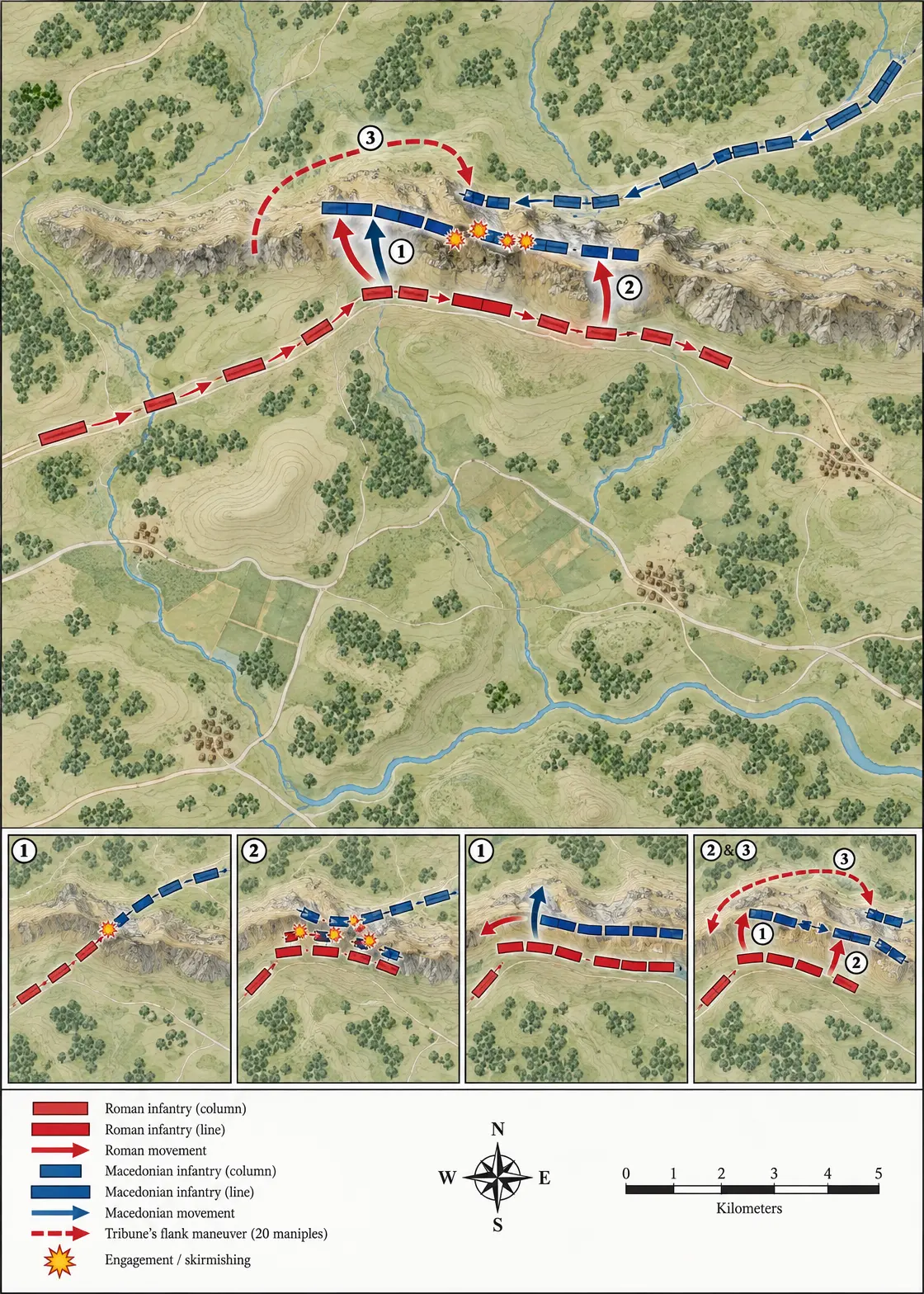
The second phase of the engagement, however, transformed the operational situation. While Philip's right phalanx was successfully engaging the Roman left, Philip's left phalanx was still arriving on the ridge in marching column and had not yet completed deployment when the Roman right wing — under Flamininus's personal command, with Aetolian cavalry on the wing flank — attacked. The Macedonian left, caught in the disorder of half-completed deployment with units still arriving from the column behind, could not form into the cohesive phalanx formation on which Macedonian tactical doctrine depended. The Roman heavy infantry, attacking units that had not yet attained their proper sarissa-frontage formation, broke the Macedonian left within approximately half an hour of the engagement. The Macedonian left wing was driven back along the ridge in disorder; the Roman right wing pursued.
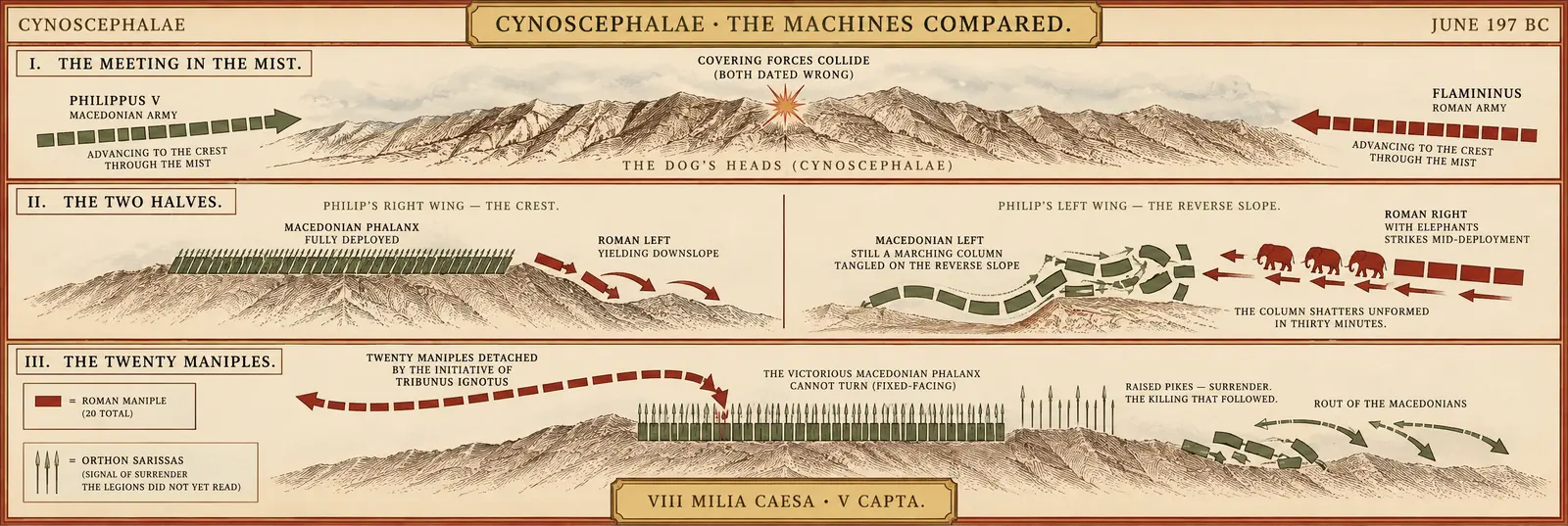
The decisive operational moment of the engagement, however, was the action of an unnamed Roman military tribune (probably the young Marcus Aemilius Lepidus, who would later become consul and triumvir; the identification is not certain) who recognized that the Roman tactical advantage on the right could be converted into a decisive flanking attack against Philip's successful right phalanx if a substantial portion of the victorious Roman right could be redirected across the rear of the Roman line to attack the unprotected rear of the Macedonian right. The tribune, on his own initiative and without specific orders from Flamininus (who was personally engaged on the right wing and not in a position to direct the broader operational situation), detached approximately twenty maniples from the pursuing Roman right wing, marched them across the rear of the Roman center, and brought them around to attack the Macedonian right phalanx from behind.
The Macedonian phalanx's structural inability to redress its formation to face attack from two directions was, in this moment, decisively demonstrated. Philip's right phalanx, engaged frontally with the Roman left and now attacked simultaneously from the rear by the flanking tribune's maniples, could not maintain its sarissa-equipped formation in both directions; the rear ranks turned to face the unexpected attack, the front ranks were thereby weakened, and the entire phalanx collapsed within approximately the next hour. The collapse of Philip's right phalanx — which had been winning its portion of the engagement at the moment the rear attack arrived — converted the developing tactical victory into a strategic catastrophe. The remnant Macedonian forces fled eastward; Philip himself escaped with a small body of cavalry to Larissa and from there back to Macedonia proper.
The casualties at Cynoscephalae are given by Polybius (18.27) as approximately 8,000 Macedonian dead and 5,000 captured, against Roman losses of approximately 700. The numerical figures, though high for a Hellenistic battle, were not exceptional by the standards of the Hannibalic War; what made the engagement strategically decisive was the demonstration that the Macedonian phalanx — the principal tactical instrument of the Hellenistic military tradition for the previous century and a half — was systematically vulnerable to the Roman manipular legion under conditions where the phalanx could not maintain its prepared frontage. The strategic consequence was that Macedonian military supremacy in the Hellenistic world, which had been a basic assumption of strategic-political calculation since the time of Alexander, was no longer reliable; any Hellenistic monarchy that attempted to engage Rome with conventional phalanx doctrine would now have to expect the same kind of operational outcome that Philip had experienced at Cynoscephalae. The implications would shape the subsequent course of the Hellenistic wars.
The Peace and the Declaration of the Isthmus196 BC
The peace negotiations that followed Cynoscephalae were conducted by Flamininus across the winter of 197/196 BC at a series of conferences with Philip and with the Greek allied delegations. The Roman terms, as eventually formulated, required Philip to evacuate all Greek territory outside Macedonia proper, surrender his fleet to Roman supervision, pay an indemnity of 1,000 talents, surrender hostages including his younger son Demetrius (who would later be returned to Macedonia and would play a complex role in the events leading to the Third Macedonian War), and accept Roman supervision of his foreign policy on terms comparable to those imposed on Carthage after Zama. The terms were, by Hellenistic standards, harsh; they reduced Macedonia from the principal Greek power to a constrained kingdom on the northern Greek frontier, with no Mediterranean strategic capacity and no foreign policy autonomy.
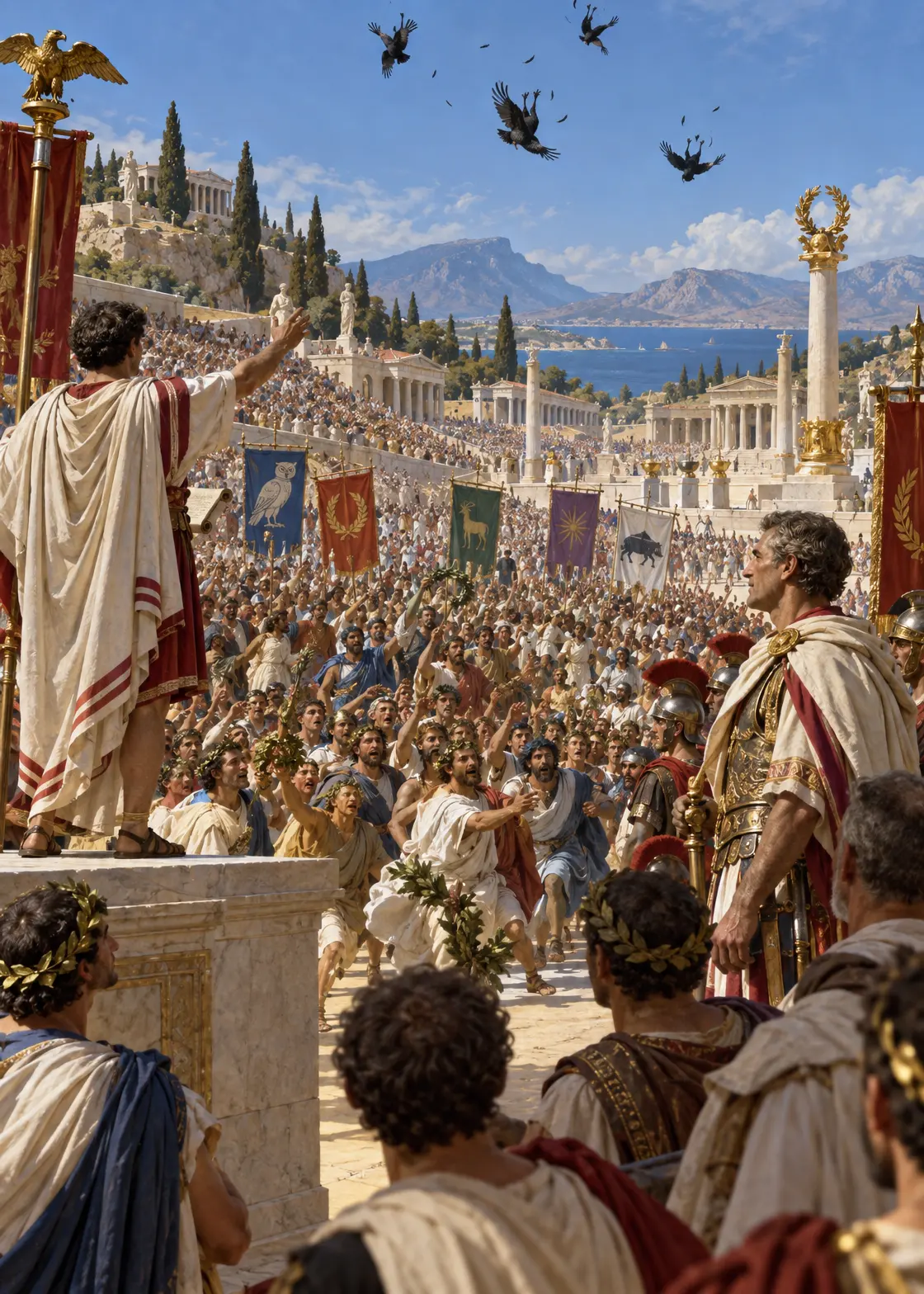
The political climax of Flamininus's command was the declaration that he delivered at the Isthmian Games at Corinth in the spring of 196 BC. The Isthmian Games were the most politically significant of the four major Panhellenic athletic and religious festivals, held biennially at the Isthmus of Corinth and attracting representatives and spectators from all the major Greek political communities. Flamininus, choosing the festival as the venue for the formal Roman announcement of the post-war political settlement, had a herald proclaim before the assembled Greek world that "the Roman Senate and Titus Quinctius the Roman commander, having conquered King Philip and the Macedonians, declare free, ungarrisoned, exempt from tribute, and subject to their own ancestral laws, the Corinthians, Phocians, Locrians, Euboeans, Phthian Achaeans, Magnesians, Thessalians, and Perrhaebians." The declaration, preserved by Polybius (18.46) and by Livy (33.32) with substantial documentary care, was the formal political announcement that the Greek cities liberated from Macedonian control were to be returned to their ancestral self-governance rather than incorporated into a Roman provincial system.
The Greek response to the declaration is preserved by Polybius as the most enthusiastic public reception of any Roman political announcement of the period. The assembled Greek spectators, on hearing the herald's announcement, reportedly broke into such loud applause that the herald could not be heard at his next phrases; ravens flying overhead, by the picturesque detail Polybius preserves, fell to the ground from the shock of the sustained noise (Polybius regards the detail as unreliable but preserves it as an indication of the magnitude of the response). The crowds rushed to Flamininus's position, attempted to lift him bodily, and acclaimed him as the personal liberator of Greece. The political-cultural significance of the moment was substantial: the Roman political class had announced, in the most public possible setting and to the most politically significant Greek audience, that the strategic intention of the eastern wars was not the subjection of the Greek world to Roman provincial administration but the restoration of Greek political autonomy under Roman strategic supervision.
The historical assessment of the Declaration of the Isthmus has been the subject of considerable scholarly debate. The conventional view (Mommsen, Holleaux, Errington) has regarded the Declaration as a genuine expression of Roman strategic policy: the Roman political class, at the moment of its first major eastward expansion, intended a Mediterranean supervisory system in which Greek political autonomy would be preserved under Roman strategic supervision, rather than a provincial system in which Greek territory would be directly administered by Roman magistrates. The minority view (Badian, Eckstein) has regarded the Declaration as a tactical-rhetorical device designed to consolidate Greek political support against Macedon without substantive commitment to the long-term institutional implications: the actual Roman political class, on this reading, was less concerned with Greek political autonomy than with the elimination of Macedonian competitive power, and would gradually allow the supervisory system to evolve toward direct provincial administration as the immediate post-war political logic permitted. The historical evidence, on balance, suggests that both interpretations capture genuine elements of the situation. Flamininus and the Hellenistic-cultural faction at Rome that he represented appear to have been genuinely committed to a long-term supervisory system; the senatorial conservative faction (whose principal voice was the rising Cato the Elder) was less committed to the supervisory model and more inclined to accept provincial direct-administration as the strategically appropriate framework. The institutional outcome across the following decades would reflect the gradual ascendancy of the senatorial conservative position over the Flamininan supervisory one, as the practical complexities of Greek political management led the Roman state, often reluctantly, toward direct administrative intervention.
The Roman withdrawal from Greece was conducted across 195 and 194 BC with substantial care. Flamininus retained his command for three additional years after the Cynoscephalae victory, supervised the implementation of the peace terms, conducted a subsidiary war against the Spartan tyrant Nabis in 195 BC (which produced the defeat of Spartan independence and the integration of Sparta into the Achaean League), and finally evacuated his Roman legions from Greece in 194 BC. The political settlement appeared, at the moment of evacuation, to have established a durable Mediterranean configuration: Macedonia constrained but not eliminated; the Greek cities free under Roman supervision; the Achaean and Aetolian Leagues stable as the principal Greek confederations; Pergamum and Rhodes consolidated as Roman strategic partners in the Aegean; the political-cultural integration between Roman and Greek elites proceeding, at least in the Flamininan vision, on terms that would produce a durable Greco-Roman Mediterranean civilization. The reality, as the subsequent decades would demonstrate, was less stable than the immediate post-war configuration suggested. The strategic appetites of Antiochus III in the Seleucid east, and the internal political dynamics of the Greek confederations themselves, would shortly produce the further wars that the present chapter has prepared.
The Crossroads · Spring 196 BC · The Isthmus of Corinth
The Declaration at the Isthmus
You are Titus Quinctius Flamininus, Roman commander in Greece, preparing to announce the post-war settlement before the assembled delegations of the Greek world at the Isthmian Games.
Following the defeat of Philip V at Cynoscephalae, the Macedonian king has accepted Roman peace terms: surrendering his fleet, providing hostages including his younger son Demetrius, paying an indemnity of one thousand talents, and withdrawing all garrisons from Greek cities outside Macedonia proper. Envoys and spectators from across the Hellenistic world—including Athens, Rhodes, Pergamum, and the Achaean and Aetolian Leagues—have assembled at the Isthmus of Corinth to learn how Rome will dispose of the evacuated territories. At Rome, senatorial conservatives led by Cato the Elder argue that Italian security demands direct provincial administration and permanent garrisons in strategic fortresses to secure the frontier against Philip and Antiochus III. Meanwhile, allies like the Aetolians under Phaeneas demand the annexation of liberated cities as the spoils of war. As the festival herald waits, you must choose what political order Rome will establish in Greece.
What political settlement will you proclaim before the assembled Greek world at Corinth?
Weigh each course: open it to hear your own inner voice. Then decide. Nothing is scored.
- Your inner voiceThe course taken
Our confederates bore the campaign's heavy burdens and demand their reward. Phaeneas and the Aetolians claim the Thessalian cities by right of war, while Rhodes and Attalus expect Aegean coastal domains. Partitioning Macedonia's former holdings among them would build strong client states to check Philip without keeping Roman soldiers abroad. Yet handing independent Greek populations to local leagues will only ignite fresh border wars, alienate our other allies, and dishonor our pledge of liberation.
- Your inner voiceThe course taken
Senatorial conservatives around Cato the Elder urge that we place permanent garrisons in Greece's strongpoints and govern the cities directly. If we evacuate our legions, what will deter Philip from rearming, or stop Antiochus III from crossing from the east into the vacuum? Yet ruling these proud states as tributary subjects will turn ancient allies into bitter enemies, embroiling our legions in perpetual unrest and burdening Rome with foreign administrative entanglements we can scarcely sustain.
- Your inner voiceThe course taken
We must proclaim that the Greeks are free, ungarrisoned, exempt from tribute, and ruled by their ancestral laws. Disclaiming imperial tribute and withdrawing every Roman soldier to Italy will win the enduring goodwill of the Hellenistic world, proving our war was fought for justice rather than dominion. It leaves peace resting upon our prestige alone, risking that local quarrels or eastern kings will one day draw us back, but it establishes our moral supremacy without permanent occupation.
What was done
Flamininus chose to proclaim the freedom of the Greeks. At the Isthmian Games at Corinth in the spring of 196 BC, a herald announced before the assembled crowds that the Senate and Titus Quinctius declared the Corinthians, Phocians, Locrians, Euboeans, Phthian Achaeans, Magnesians, Thessalians, and Perrhaebians free, ungarrisoned, exempt from tribute, and governed by ancestral laws (AGrade A). The spectators erupted in unprecedented jubilation, drowning out the herald and acclaiming Flamininus as Greece's liberator (AGrade A). Over the following two years, Flamininus supervised the peace terms, waged a subsidiary campaign against the Spartan tyrant Nabis in 195 BC to secure Sparta's entry into the Achaean League, and fully evacuated all Roman legions to Italy in 194 BC (BGrade B). Yet the supervisory peace proved fragile. The unsatisfied ambitions of the Aetolian League and Antiochus III, alongside growing pressure from senatorial conservatives like Cato the Elder, soon triggered fresh eastern conflicts that drew Rome inexorably toward direct imperial administration.
The evidence Polybius 18.1–46 (AGrade A, preserving the Cynoscephalae narrative and the text of the Isthmian Declaration with substantial documentary care); Polybius 16 and 17 (BGrade B, fragmentary); Livy 31.5–33.32 (BGrade B, continuous Latin narrative drawing heavily on Polybius); Plutarch Flamininus 1–12 (BGrade B, emphasizing the personal and political dimensions of Flamininus's command); Appian Macedonica 7–9 (CGrade C, fragmentary); Cassius Dio fragments via Zonaras 9.15–17 (CGrade C); Justin 30 (DGrade D, late epitome).
If you choose to walk through itAt every scale
- Yourself
How does a commander balance personal admiration for a foreign culture against the suspicions and strategic habits of his home political class?
- Those beside you
To what extent should an aristocratic faction risk its standing in Rome to implement an overseas policy that denies spoils and commands to fellow senators?
- Rome
Can an expanding republic maintain regional security through distant supervisory influence, or does military intervention inevitably pull it toward formal provincial annexation?
- The wider world
Does proclaiming the autonomy of smaller states establish lasting stability, or does removing a regional hegemon merely invite local feuds and foreign interventions?
- Our own time
Under what conditions should modern powers withdraw their military forces immediately after a successful intervention rather than remain as occupying administrators?
Following major interstate conflicts or coalition interventions, triumphant powers often face the dilemma between imposing formal military occupational administrations and restoring immediate sovereign autonomy under an external security umbrella. After the Second World War, the United States chose to restore self-governing political autonomy to Western European states while offering distant strategic protection through an alliance framework, deliberately avoiding direct imperial governance while maintaining overall supervisory hegemony against potential eastern rivals.
Where the comparison fails. Unlike ancient Rome, modern Western powers operated within formal multilateral treaties, permanent diplomatic corps, and shared ideological commitments, whereas Flamininus relied on personal prestige, vague declarations of ancestral freedom, and ad hoc military withdrawals without permanent treaty institutions.
What does the chapter tell us?
Why did the Roman popular assembly initially reject the Senate's proposal to declare war on Philip V in 200 BC?
The Hannibalic War had inflicted severe demographic and economic damage across Italy across seventeen continuous years. Roman citizens were exhausted by protracted conflict and resisted committing to another distant overseas expedition until consul Publius Sulpicius Galba re-framed the war around Italian security and post-war material plunder.
Livy 31.5–8 and Polybius 16.27–34 (BGrade B)
What diplomatic intelligence most alarmed the Roman Senate regarding the balance of power in the eastern Mediterranean prior to the war?
The Senate received reports of the so-called Pact of the Kings, an agreement between Philip V and Antiochus III to partition the dependent territories of Egypt's infant king Ptolemy V. Roman senators feared this coordination would forge a consolidated Hellenistic bloc capable of directly challenging Roman regional influence.
Polybius 16.27–34 (BGrade B)
At the battle of Cynoscephalae in 197 BC, what decisive tactical maneuver broke the Macedonian right phalanx?
While Philip's right phalanx was pushing back the Roman left, an unnamed military tribune recognized the phalanx's inability to redress its formation to face multiple directions. Operating without Flamininus's orders, he detached twenty maniples from the pursuing right wing and attacked Philip's phalanx from behind, causing it to collapse.
Polybius 18.27 (AGrade A)
How do modern historians differ regarding the political purpose of Flamininus's Declaration of the Isthmus?
Conventional historians view the proclamation as a sincere attempt by Flamininus and Hellenized Romans to establish an informal supervisory hegemony that respected Greek self-government. A minority view argues it was merely a short-term rhetorical strategy to dismantle Macedonian hegemony, masking an eventual drift toward direct provincial administration.
the chapter's narrative (AGrade A for the Isthmian Declaration text; modern commentary cited in the Editor's Note)
What condition was imposed upon King Philip V under the peace terms following his defeat at Cynoscephalae?
The Roman terms reduced Macedonia to a constrained border kingdom. Philip had to evacuate all Greek holdings outside Macedonia, surrender his navy, pay a 1,000-talent indemnity, deliver hostages including his younger son Demetrius, and submit Macedonian foreign policy to Roman supervision, stripping him of any Mediterranean strategic capacity.
Polybius 18.1–46 (AGrade A)