Book IV · The Wars of Mediterranean Hegemony
Chapter 4
The Spanish Wars: Lusitanians, Celtiberians, Viriathus, and Numantia
The Strategic Problem of Iberia
The Iberian peninsula had been formally organized as Roman territory in 197 BC, when the Senate created the two Spanish provinces (Hispania Citerior on the northeastern Mediterranean coast and Hispania Ulterior on the southern and western interior) under the administration of two annually-elected praetors. The decision to provincialize Spain reflected the strategic-military realities that the post-Zama settlement had established: the Iberian territories that had been won from Carthage by Scipio Africanus's campaigns of 210 through 206 BC could not be politically integrated under conventional alliance or supervisory frameworks of the kind that the eastern wars would shortly experiment with, because the Iberian populations lacked the institutional-political traditions (Greek city-state autonomy, Hellenistic monarchical organization) that the supervisory framework required. Direct provincial administration was therefore the institutional solution that the senatorial decision-making process arrived at in 197 BC — making Spain the second and third provinces of the Roman state (after Sicily, organized as a province since the close of the First Punic War in 241 BC, and the smaller Sardinia-Corsica province organized in 238).
The institutional commitment of provincialization, however, did not produce political stability. The Iberian peninsula in 197 BC was a complex political-military mosaic of distinct populations — Iberians proper on the Mediterranean coast, Celtiberians in the central plateau, Lusitanians in the western interior, Vaccaei in the upper Duero valley, Vettones, Carpetani, Turdetani, and numerous smaller tribal groupings — each with its own political-cultural traditions, its own historical relations with the Carthaginian and Roman powers, and its own attitudes toward the new Roman provincial system. The Carthaginian provincial system that had preceded the Roman one had been, in operational terms, a network of fortified positions and tributary relationships with the principal tribal confederations; the Roman provincial system attempted, with somewhat greater institutional formality, the same basic configuration. The political-military stability of the system depended on the continued acquiescence of the major tribal populations in the tributary-administrative requirements that the provincial system imposed, and on the continued operational competence of the provincial administrators (the praetors and their staffs) in managing the relationship with the tribal populations.
The pattern of Spanish provincial administration across the period 197 through 154 BC was, accordingly, one of recurrent low-level military operations punctuated by occasional major revolts. The praetors of the Spanish provinces conducted, in most years, military operations of various scales against particular tribal populations who had refused tributary payment, attacked Roman commercial-administrative positions, or otherwise resisted the provincial system. The operations were generally successful in restoring the immediate tributary requirements but did not produce permanent political-military pacification; the tribal populations recognized the conditional and provisional character of their submission to the provincial system and were prepared, when local political-military conditions permitted, to resume the resistance. The institutional logic of the Spanish provincial system was, in effect, that of permanent low-grade military engagement against the various tribal populations of the peninsula — a strategic configuration substantially different from the Mediterranean supervisory hegemony that the eastern wars were producing, and one that imposed substantial institutional costs on the Roman state in terms of military commitment, fiscal expense, and provincial-administrative personnel.
The Lusitanian and Celtiberian Wars (154–151 BC) and the Viriathic Resistance147–139 BC
The major Spanish war that occupied the central portion of the second century BC began in 154 BC with the simultaneous outbreak of two related revolts: the Lusitanian revolt in the western peninsula (modern Portugal and western Spain), led initially by the chieftain Punicus and subsequently by Caesarus, and the Celtiberian revolt in the central peninsula, led by the chieftains of the great fortified city of Numantia in the upper Duero valley. The two revolts were coordinated to some degree by tribal political-military intercommunication that the Roman provincial intelligence did not adequately monitor, and produced across the years 154 through 151 BC a series of operational reverses for the Roman provincial commanders that the political class at Rome regarded with substantial concern.
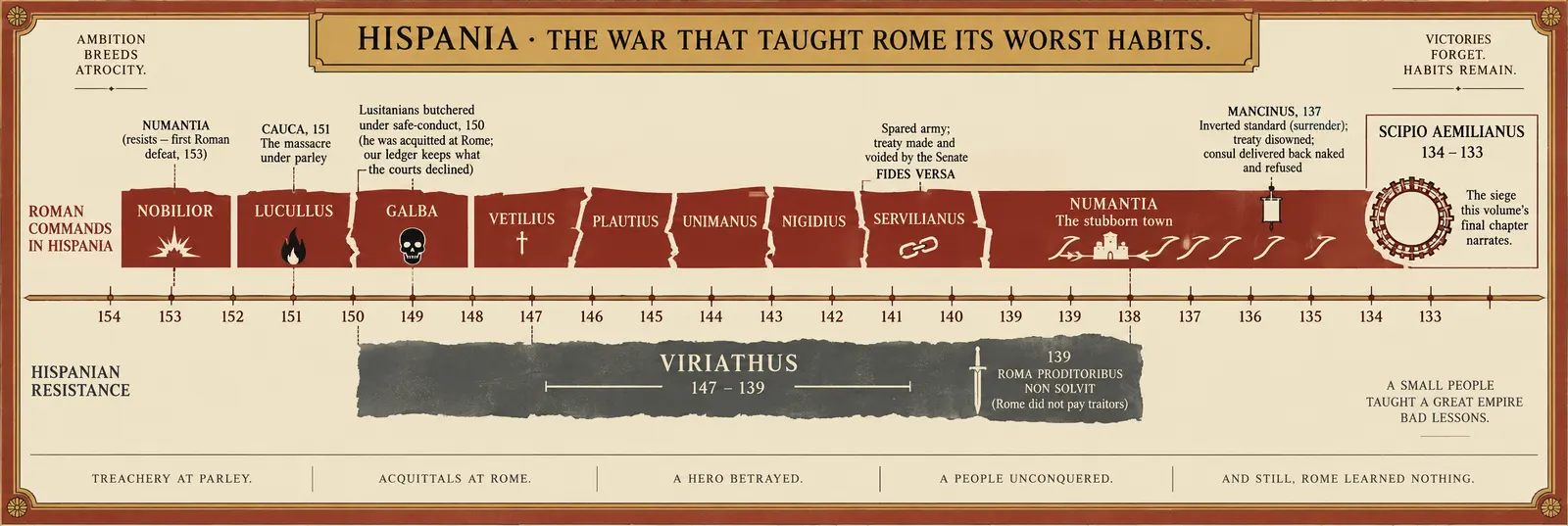
The principal Roman commanders of the early war (the consul Quintus Fulvius Nobilior in 153 BC, the consul Marcus Claudius Marcellus in 152, the consul Lucius Licinius Lucullus in 151, and various subordinate figures) conducted operations whose operational competence varied substantially. Nobilior's campaign of 153 BC produced a significant Roman defeat near Numantia and led to the development among the Roman political class of a strong reluctance to serve in the Spanish provinces — a reluctance that, by 151 BC, had reached the point at which the senatorial selection of provincial commanders was being conducted with substantial difficulty as candidates declined to accept the assignments. The political crisis was resolved by the public volunteering of Scipio Aemilianus (then a young senatorial figure of approximately thirty, with substantial military reputation from his service under his adoptive father at Pydna in 168 BC and from subsequent operations) for service as a military tribune in the Spanish theater — a public-spirited act that the contemporary Roman political tradition recognized as exceptional and that materially assisted the senatorial leadership in completing the provincial appointments. Lucullus's campaign of 151 BC subsequently produced a more successful series of operations, including the reduction of several Celtiberian positions, but it was conducted with the kind of operational severity (the famous massacre of the surrendered population of Cauca, conducted by Lucullus's troops against the explicit terms of the surrender agreement that had been concluded) that produced lasting political-cultural consequences for the Roman provincial position in the peninsula.
The death of the Lusitanian chieftain Caesarus and the assassination of several Lusitanian leaders by the praetor Servius Sulpicius Galba in 150 BC — under circumstances of treachery that the Roman political tradition itself recognized as exceptionally dishonorable, with Galba conducting a fake surrender ceremony at which several thousand Lusitanians were either massacred or sold into slavery contrary to the surrender terms — produced the strategic-political conditions that led to the principal Spanish-resistance figure of the period: Viriathus.
Viriathus was a Lusitanian shepherd-turned-warrior whose biography, as preserved by Appian (Hispanica 60–75) and by Diodorus (33), combines authentic elements of Iberian tribal-resistance leadership with the dramatic-literary elaboration that the figure would attract in subsequent literary tradition. He had been one of the survivors of the Galban massacre of 150 BC, escaped from the killing by speed or by political-personal connection, and had spent the subsequent two years recruiting Lusitanian and Celtiberian warriors for a war of resistance against the Roman provincial system. His military-operational approach was the systematic application of guerrilla tactics adapted to the Iberian geographic-strategic environment: rapid mobility across the broken country of the central and western peninsula, refusal of set-piece engagement with Roman heavy infantry, systematic ambush of Roman supply convoys and isolated detachments, exploitation of intelligence advantages provided by the local population, and the political-rhetorical framing of the resistance as the vindication of Iberian honor against the bad-faith Roman provincial conduct that the Galban massacre had exemplified.
Viriathus's military career across the years 147 through 139 BC was, by any conventional measure, the most successful tribal-resistance career of any individual figure in any Roman provincial war of the second century BC. He defeated, in successive engagements across the period, the praetors Gaius Vetilius (147 BC, ambush near Tribola — Vetilius killed), Gaius Plautius (146 BC, an extended series of small engagements that destroyed Plautius's military reputation), Claudius Unimanus (146 BC, defeated), Gaius Nigidius (146 BC, defeated), the proconsul Quintus Fabius Maximus Aemilianus (145–144 BC, defeated in initial engagements but stabilizing the Roman position by the end of the period), and the consul Quintus Fabius Maximus Servilianus (141 BC, defeated and compelled to negotiate a peace treaty that the Roman Senate subsequently repudiated). The political-strategic consequence was the development across the Spanish provinces of a substantial anti-Roman political-military coalition that included not merely Viriathus's Lusitanian core but also Celtiberian, Vaccaei, and various smaller tribal contingents, with the strategic objective of expelling the Roman provincial system from the peninsula.
The Roman response to Viriathus's continued operational success was the assignment of the consul Quintus Servilius Caepio to the Spanish command in 139 BC, with explicit senatorial authorization to bring the war to conclusion by whatever means proved necessary. Caepio's solution was, as the sources unanimously record, the political-personal procurement of Viriathus's assassination through the bribery of three of Viriathus's senior subordinates (named Audax, Ditalco, and Minurus by the sources). The assassins entered Viriathus's tent at night while he was asleep, killed him in his bed, and presented themselves to Caepio for the agreed payment; Caepio, in a remark preserved by Appian (Hispanica 74) that the Roman tradition would record as the moral nadir of the entire Spanish campaign, refused payment on the principle that "Rome does not pay traitors" — leaving the assassins unrewarded and unprotected, with the political-strategic consequence that the assassination did not produce the kind of Lusitanian political reconciliation that the Roman intention might have anticipated but instead intensified the lasting bitterness of the Iberian-Roman political relationship. Viriathus's funeral, conducted by his surviving followers with the kind of dignity that the Iberian-Lusitanian cultural tradition permitted, included the proverbial three days of mourning and a substantial human-sacrificial component that the Roman sources record with the cultural-anthropological interest characteristic of the Hellenistic-period ethnographic tradition. The Lusitanian resistance, deprived of its principal leadership, was substantially suppressed across the subsequent two years; the strategic-political consequences would extend beyond the immediate military settlement, however, into the long subsequent development of Iberian-Roman political relations across the following two generations.
The Numantine War143–133 BC
The Celtiberian portion of the Spanish wars — known to the Roman tradition as the Numantine War from the name of the principal Celtiberian city that constituted the strategic center of the resistance — was conducted in parallel with the Lusitanian war and continued for several years after Viriathus's assassination. Numantia was a fortified city of approximately 8,000 inhabitants located on a high plateau in the upper Duero valley (the modern Soria region of north-central Spain), with defensive works developed across two generations of Celtiberian political-military consolidation and with a strategic position that controlled the principal trans-peninsular communications of the central peninsula. The Celtiberian political-military leadership at Numantia had been involved in the Spanish wars from the original revolt of 154 BC but had operated with increasing strategic-political autonomy as the principal Celtiberian center across the subsequent decade and a half.
The Roman operational record against Numantia across the years 143 through 133 BC was, by Roman standards, an extended catalogue of strategic-political humiliation. The successive Roman commanders sent to reduce the city — Quintus Caecilius Metellus Macedonicus in 143 BC (who had distinguished himself in the suppression of the Macedonian revolt of 149 and was a senatorial figure of substantial reputation), Quintus Pompeius in 141, Marcus Popilius Laenas in 139, Gaius Hostilius Mancinus in 137, Marcus Aemilius Lepidus in 136, Lucius Furius Philus in 136, and Quintus Calpurnius Piso in 135 — produced no decisive operational results. The Numantine defense, conducted by a small population with limited military resources but with substantial geographic-tactical advantages and with the kind of operational determination that the Roman political tradition would record with both anger and unwilling respect, proved beyond the operational capacity of conventional consular-command engagement.
The most politically consequential episode of the early Numantine War was the surrender of Mancinus's army in 137 BC. The consul had advanced against Numantia with approximately 20,000 men, conducted operations of conspicuous incompetence across several months, and eventually found his army surrounded in a defensive position from which no escape was possible. The negotiated surrender that followed was conducted by Mancinus's quaestor, the young Tiberius Sempronius Gracchus (son of the consul of 177 BC who had served as proconsul in Spain in the 170s BC and had developed political-personal connections with the Celtiberian leadership during that earlier service). Tiberius Gracchus's personal-cultural connections with the Celtiberian leadership permitted him to negotiate surrender terms that preserved the Roman army from destruction — terms that the Celtiberian leadership accepted on the basis of Tiberius's personal credibility rather than on the basis of any institutional Roman guarantee. The Roman army was permitted to withdraw under arms in exchange for the surrender of substantial equipment and supplies and the implicit acknowledgment that the Numantine position would be permitted to remain undisturbed. The senatorial reception of the Mancinian treaty at Rome, however, was hostile: the senatorial conservative faction (now under the leadership of figures like Scipio Aemilianus and Cato's son Cato Licinianus, with Cato himself having died in 149) refused to ratify the treaty on the grounds that no Roman official below consular rank could properly conclude binding agreements with foreign powers, and proposed that Mancinus himself be surrendered to the Numantines in nullification of the treaty's terms. Mancinus was accordingly delivered bound to the gates of Numantia in 136 BC by an embassy formally headed by the consul of that year; the Numantines, recognizing the political-symbolic content of the proceeding, refused to accept the surrender and returned Mancinus to the Roman embassy untouched (he would subsequently resume his political career, with the unusual cognomen Numantinus attaching to him from the episode, though with a damaged senatorial reputation). The political-constitutional crisis surrounding the Mancinian treaty, however, intensified the broader Roman political-cultural strain that the Spanish wars had been producing, with the senatorial conservative faction's institutional rigidity colliding with the practical-operational realities of conditions on the ground in the Iberian theater.
The Senate's decision to assign Scipio Aemilianus to the Numantine command for 134 BC was the institutional response to the accumulated operational failures of the previous decade. The Senate's selection required substantial constitutional manipulation, since Scipio had previously held the consulship in 147 BC (for the African command that would shortly be treated in Chapter 5) and was technically barred from a second consulship by the lex Villia annalis of 180 BC. The senatorial faction associated with Scipio's personal-political alliance system arranged the suspension of the relevant statute and the granting of a second consulship to Scipio specifically for the Spanish command — a constitutional adjustment that paralleled the earlier irregularities by which Scipio Africanus had received his extraordinary commands and that further intensified the institutional pattern of personal-strategic command exceeding the conventional Republican framework.
Scipio Aemilianus's preparations for the Numantine campaign were conducted with the systematic operational discipline that had characterized his earlier service. The Roman army in Spain was reorganized: the troops were retrained, the discipline was restored to standards that the previous commanders had allowed to deteriorate, the camp followers and luxury goods were systematically removed, the supply system was reorganized. The army that conducted the engagement was approximately 30,000 men, supplemented by various Spanish allied contingents (Numidian cavalry under King Jugurtha — the future enemy of Marius in the Jugurthine War, then a young prince serving with Scipio's army as a political-military auxiliary), and was operationally substantially superior to the forces the previous commanders had brought against Numantia.
Scipio's strategic conception for the campaign was the systematic reduction of Numantia by siege rather than by direct assault. He recognized — from the operational record of the previous decade — that direct assault on the Numantine fortifications was beyond Roman operational capacity, but that the city's small population and limited supply base made it vulnerable to systematic starvation if the siege could be conducted with sufficient operational discipline. Scipio accordingly constructed across the spring and summer of 134 BC a comprehensive system of circumvallation around the city: a continuous defensive wall extending approximately nine kilometers around the entire perimeter of the Numantine plateau, with seven major forts at intervals along the wall, with controlled access points monitored by Roman detachments, and with the Duero river itself blocked by a system of beams and stakes to prevent Numantine communications with the broader region. The circumvallation system — which is one of the best-archaeologically-documented Roman siege works of the entire Republican period, with the archaeological investigations of Adolf Schulten in the early twentieth century providing substantial material evidence — was the most systematic application of Hellenistic siege engineering to a Roman provincial campaign and would serve as the operational template for the much more famous Roman circumvallation at Alesia in 52 BC under Caesar.
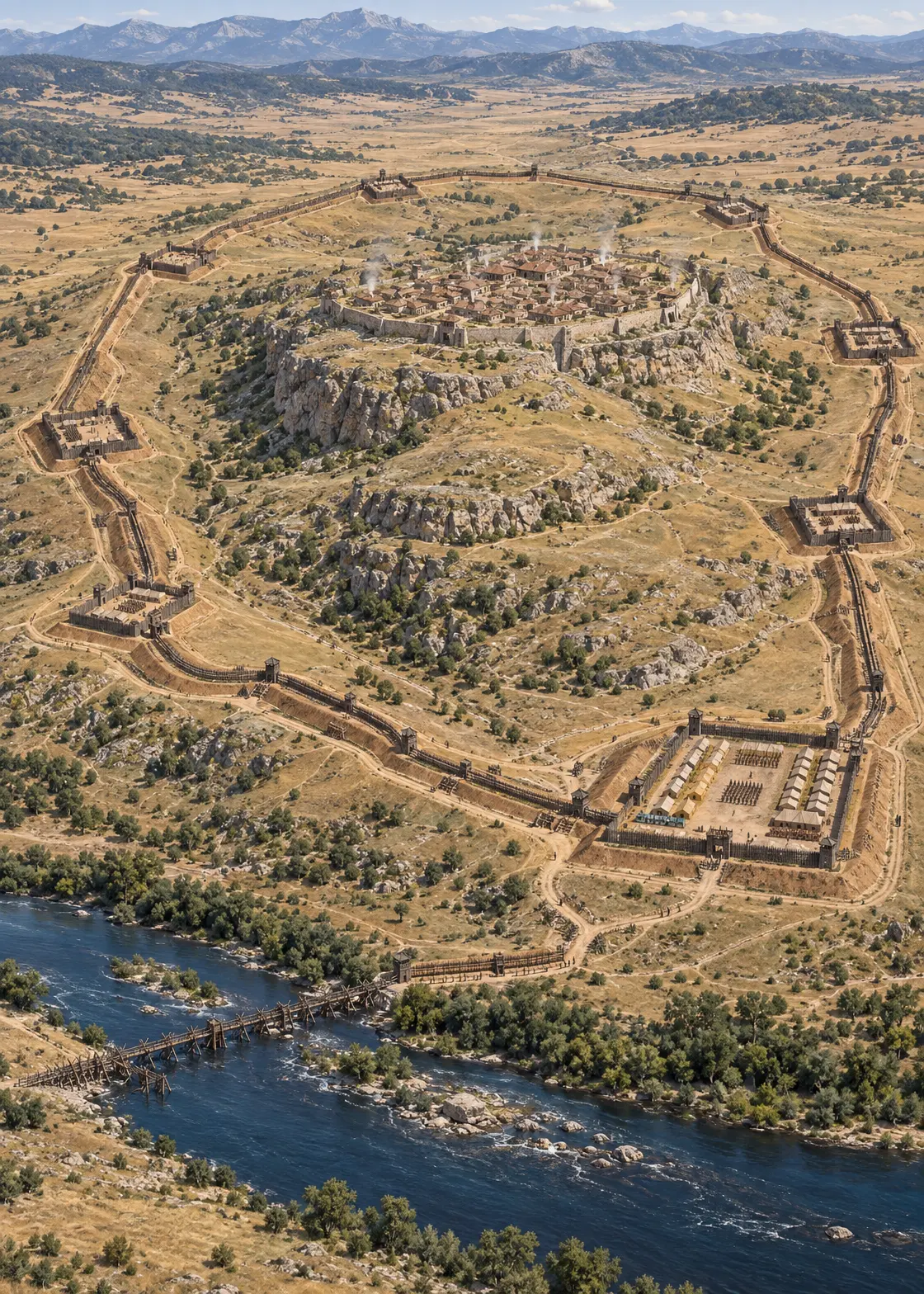
The siege was conducted across approximately fifteen months, from the spring of 134 BC through the summer of 133. The Numantine defense was conducted with what the Roman sources unanimously regarded as exceptional determination: the city's small population maintained the defense without significant attempt at surrender across the entire period; the strategic-political situation deteriorated only as the food supply was systematically exhausted; the cultural-historical traditions that the Roman sources preserve include accounts of cannibalism in the city's final months (a tradition that may be exaggerated but reflects the operational reality of the extreme starvation conditions), of mass-suicide rather than surrender among substantial portions of the population, and of the systematic destruction of the city's material culture by its remaining inhabitants in the days immediately preceding the final surrender. The city's fall in summer 133 BC produced approximately 4,000 surviving captives (out of the original 8,000 population), all of whom were sold into slavery; the city itself was systematically destroyed; the agricultural-territorial hinterland was distributed to Roman and allied veterans.
Scipio Aemilianus's triumph upon his return to Rome in 132 BC was the second major triumph of his personal political career (the first having been the Carthage triumph of 146 BC, which would shortly be treated in Chapter 5). His personal cognomen — Numantinus, added to Africanus — was the formal recognition that his political-strategic career had been the most successful of any individual Roman general of the second century BC; the cognomen accumulation, with the implicit personal-political distinction that it represented, was also one of the cumulative institutional features by which the late Republican strain between individual political prestige and senatorial constitutional framework would become progressively visible.
The strategic-political consequences of the Numantine War were less consequential, in terms of immediate political settlement, than those of the eastern wars. The Iberian peninsula across the post-Numantine period entered a long phase of low-grade tribal resistance that would extend, in various forms, across the next century — through the Sertorian War of the 70s BC, through the Caesarian campaigns of the 40s, and into the Augustan-period Cantabrian Wars. The peninsula would not be fully pacified until the early imperial period. The institutional consequence of the Spanish wars, however, was the development of a Roman military-administrative system substantially different from the Mediterranean-supervisory model of the eastern wars: the Spanish system was based on direct provincial administration, on continuous military commitment, and on the systematic incorporation of peripheral populations into the Roman political-economic system by extended low-grade engagement rather than by major political settlement. The Spanish provincial system would, across the long term of imperial development, become the institutional template that would be exported to Gaul, to Britain, to the Danubian frontier, and to other peripheral regions where the supervisory model was inapplicable; the Spanish wars were, in this institutional sense, the laboratory in which the Roman provincial system that would dominate the imperial period was systematically developed.
The Crossroads · 136 BC · The Senate, Rome
The Mancinian Capitulation
You are a Roman senator sitting in the Senate in 136 BC, weighing the capitulation at Numantia.
In 137 BC, the consul Gaius Hostilius Mancinus led twenty thousand men into an encirclement near Numantia, facing annihilation. His quaestor, Tiberius Sempronius Gracchus, used personal connections established by his father in the 170s BC to negotiate a surrender. The Celtiberians let the Roman army withdraw under arms in exchange for its baggage and an implicit guarantee that Numantia would remain undisturbed. Now the treaty has reached Rome. The senatorial conservative faction, led by Scipio Aemilianus and Cato Licinianus, refuses to sanction terms struck by an inferior officer that leave Iberian resistance unconquered.
How should the Senate resolve the dishonor of the Mancinian treaty and determine the fate of the commander who signed it?
Weigh each course: open it to hear your own inner voice. Then decide. Nothing is scored.
- Your inner voiceThe course taken
Twenty thousand citizens march home alive because young Tiberius Gracchus pledged his family's honor. If we tear up this agreement, what Iberian tribe will ever trust a Roman oath again? The terms are bitter, and Numantia remains untouched, but our legions were thoroughly trapped and helpless. We cannot sacrifice the sacred faith of Rome and twenty thousand lives merely to soothe the bruised pride of the nobility. Ratifying the peace preserves both our blood and our word.
- Your inner voiceThe course taken
Scipio Aemilianus and Cato Licinianus are right: no quaestor or defeated consul possesses the constitutional authority to bind the Senate and people of Rome to shameful terms. We cannot allow Numantia to dictate peace to our empire. By surrendering Mancinus himself, bound and stripped at their gates, we place the entire guilt of the broken pact upon his head alone. Rome's honor remains untarnished, the gods are satisfied, and our legions may renew the war unhindered.
- Your inner voiceThe course taken
We cannot let a barbarian hill town dictate terms to the Roman Republic, yet throwing our consul to the enemy is a hollow spectacle. Let us declare the treaty void, refuse to acknowledge its guarantees, and send fresh legions under a capable general to wipe out Numantia. If Mancinus conducted operations with conspicuous incompetence, strip his command and try him before the people, but let Roman arms, not the ritual surrender of our own magistrate, settle this defeat.
What was done
The Senate rejected the agreement, adopting the position of the conservative faction led by Scipio Aemilianus and Cato Licinianus that no official below consular rank could conclude binding treaties with foreign powers. To nullify the treaty's religious and legal force, an embassy headed by the consul of 136 BC delivered Mancinus bound to the gates of Numantia. Recognizing the symbolic maneuver, the Numantines refused to accept him and returned the former consul untouched. Mancinus subsequently resumed his public career, taking the cognomen Numantinus, though his senatorial standing was permanently compromised. The controversy exposed severe friction between senatorial institutional rigidity and operational necessities in Spain, leaving a bitter political legacy in Rome that alienated Tiberius Sempronius Gracchus and deepened factional discord (BGrade B).
The evidence Appian's Hispanica (BGrade B) provides the continuous narrative of the Spanish campaigns and the Numantine War. Plutarch's Life of Tiberius Gracchus (BGrade B) preserves the political details of the 137 BC negotiations and the senatorial repudiation of the Mancinian treaty. Summary accounts survive in the Livian Periochae 55–56 (CGrade C) and Cassius Dio (CGrade C). The archaeological excavations directed by Adolf Schulten at Numantia (AGrade A) document the strategic position of the Celtiberian city.
If you choose to walk through itAt every scale
- Yourself
How does a senator balance personal conscience and the sworn word that spared citizen lives against the collective duty to uphold Rome's martial reputation?
- Those beside you
How should the family and allies of a young magistrate respond when senior statesmen sacrifice his personal credibility to repudiate an embarrassing capitulation?
- Rome
How can a republican constitution function effectively when field commanders must choose between strict legal authorization and saving entire consular armies from destruction?
- The wider world
What confidence can provincial peoples place in diplomatic agreements when an imperial power's domestic law allows it to disown pacts negotiated by its own representatives?
- Our own time
Under what conditions can modern democratic governments repudiate commitments made by their authorized envoys without forfeiting international trust?
Modern constitutional states periodically confront crises where diplomatic envoys or field commanders negotiate controversial armistices, hostage releases, or local ceasefires under acute operational duress. When domestic legislatures subsequently repudiate these compacts as unauthorized or unconstitutional, the state attempts to reassert sovereign prerogatives while attempting to insulate the broader nation from charges of bad faith, frequently focusing legal censure onto the negotiators themselves.
Where the comparison fails. Modern repudiations rely on codified multilateral rules of diplomatic authority and ratification treaties, whereas the Roman Senate used archaic religious extradition to absolve the republic of divine perjury.
What does the chapter tell us?
Why did the Roman Senate establish direct provincial administration in Hispania in 197 BC rather than using the supervisory alliance model employed in the Greek East?
The chapter explains that Iberian populations lacked the institutional-political traditions of Hellenistic monarchs or autonomous city-states required by Rome's supervisory model, compelling the Senate to establish direct provincial governance through two annual praetors.
the chapter's narrative
What action by the praetor Servius Sulpicius Galba in 150 BC catalyzed Viriathus's eight-year war of resistance?
Galba concluded a treacherous surrender agreement in 150 BC, after which he massacred or enslaved several thousand Lusitanians. Viriathus survived this betrayal and used the vindication of Iberian honor against Roman bad faith as a primary rallying cause.
Appian Hispanica 60–75 (BGrade B)
On what constitutional grounds did the conservative faction in the Roman Senate repudiate the Mancinian treaty of 137 BC?
The senatorial conservative faction, led by Scipio Aemilianus and Cato Licinianus, argued that no Roman magistrate below consular rank possessed the authority to conclude binding international agreements, rejecting Tiberius Gracchus's pact despite its preservation of the legions.
Plutarch Tiberius Gracchus 5–7 (BGrade B)
What constitutional obstacle did the Senate overcome to appoint Scipio Aemilianus to the Numantine command for 134 BC?
Scipio had held the consulship in 147 BC for the African command and was legally disqualified from a second consulship by the lex Villia annalis. His political allies engineered the suspension of the statute to grant him the command.
the chapter's narrative
How does the historical evidence for Scipio Aemilianus's circumvallation around Numantia compare with narrative accounts of the siege?
The chapter notes that the archaeological record for the siege works is AGrade A material evidence, with Adolf Schulten's twentieth-century excavations substantiating the nine-kilometer perimeter wall, seven forts, and river obstacles described in Appian's narrative.
Appian Hispanica (BGrade B) and Schulten's archaeological record (AGrade A)