Book V · The Crisis of the Republic
Chapter 2
The Jugurthine War and the Rise of Marius
The Numidian Succession
The war that carried Gaius Marius to the consulship and the Roman army to its professional transformation began, like the Third Punic War before it, in the dynastic politics of the Numidian kingdom that Masinissa had built and Rome had guaranteed. Micipsa, Masinissa's son and successor, died in 118 BC leaving the kingdom jointly to his two sons, Adherbal and Hiempsal, and to his nephew Jugurtha — the illegitimate grandson of Masinissa whom Micipsa had adopted late and reluctantly, precisely because the young man's capacities made him dangerous to exclude. Those capacities were genuine and Roman-certified: Jugurtha had commanded the Numidian contingent under Scipio Aemilianus at Numantia in 134–133, where he had distinguished himself in the fighting and, more consequentially, had received an education in the purchasability of the Roman aristocracy from the ambitious young nobles of Scipio's staff — several of whom, Sallust reports, privately assured him that a bold man could buy at Rome whatever a king might need. Scipio himself, with characteristic penetration, had warned him formally against exactly this course. The warning was remembered; the private assurances were acted upon.
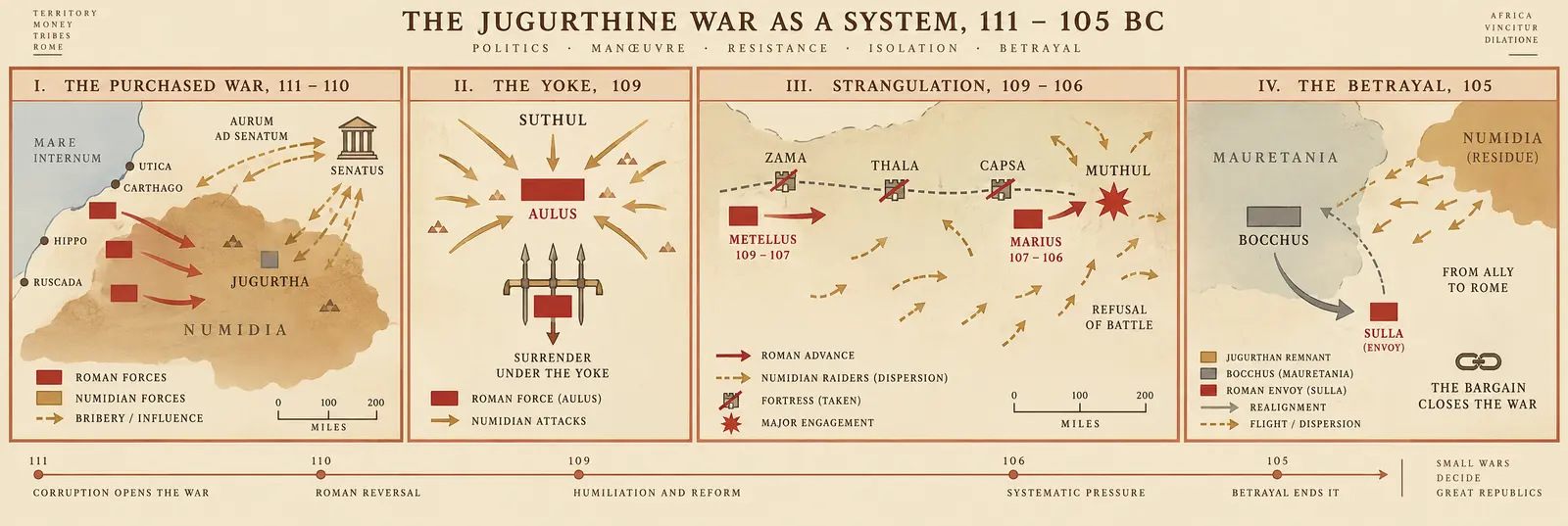
The joint kingship dissolved in the manner such arrangements do. Hiempsal, the more assertive of the legitimate heirs, was murdered by Jugurtha's agents within the year — surprised in a house at Thirmida and his head brought to his cousin. Adherbal, defeated in the open war that followed, fled to Rome and laid the cause before the Senate; Jugurtha's envoys arrived with heavier purses; and the senatorial commission of 116, headed by the same Lucius Opimius who had killed Gaius Gracchus, partitioned Numidia in a settlement that assigned the western — and, as events proved, militarily stronger — portion to the usurper. When Jugurtha resumed the war regardless and penned Adherbal in his capital of Cirta, two successive Roman embassies were received with courtesies and dismissed with nothing; and in 112, when Cirta capitulated on terms, Jugurtha executed Adherbal under torture and put to the sword the town's defenders indiscriminately — including a substantial community of resident Italian merchants who had manned the walls. The massacre of the Italians made the war. The Senate might still have temporized — substantial portions of it, in Sallust's unsparing account, having been retained in Jugurtha's interest — but the equestrian order whose kinsmen and correspondents had died at Cirta could not be faced down, and the tribune Gaius Memmius made the scandal of senatorial venality the theme of a sustained popular agitation. Rome declared war in 111 BC.
The war's opening years compounded the scandal. The consul Lucius Calpurnius Bestia campaigned briefly and then sold Jugurtha a peace of derisory mildness for what everyone understood to be a personal consideration; the tribunes forced the treaty's repudiation and summoned Jugurtha to Rome itself under safe-conduct to give evidence on the corruption — an extraordinary scene, the African king lodged in the city naming the senators he had purchased, until a tribune's veto (itself purchased) silenced the inquiry, and Jugurtha, having meanwhile procured the murder in Rome of a rival Numidian pretender, was expelled from Italy. His verdict on departure became the most quoted sentence of the war, and Sallust set it at the head of the whole moral architecture of his monograph: urbem venalem et mature perituram, si emptorem invenerit — "a city for sale, and doomed to perish quickly, if it finds a buyer." The campaign of 110 under Spurius Postumius Albinus achieved nothing; and in January 109 the consul's brother Aulus, left in command through the winter, was lured into a night assault on the treasury-town of Suthul, ambushed in the retreat, and compelled to surrender his surrounded army — which was sent under the yoke, the archaic humiliation Rome had not suffered since the Caudine Forks, and bound by a treaty of evacuation that the Senate, once again, repudiated as unauthorized. At Rome the Mamilian commission, established by tribunician law over senatorial resistance, tried and exiled the venal commanders and negotiators of the preceding decade, Bestia and Opimius among them: the killer of Gaius Gracchus died an exile at Dyrrachium, hated, as Cicero later noted, by the very order he had bloodied his hands to defend.
Metellus and Marius
The commander who restored the war was Quintus Caecilius Metellus, consul for 109 — a noble of the great house that would collect more triumphal cognomina than any other in the late Republic, personally incorruptible, operationally methodical, and (the trait on which the sequel turned) serenely certain that high command belonged to his class. He rebuilt the demoralized African army with a winter of disciplinary reconstruction that Sallust describes in admiring detail — the camp-followers expelled, the soldiers reloaded with their own equipment, the marching standards restored — and took it into Numidia in 108 in a campaign of deliberate territorial strangulation, refusing Jugurtha's proffered negotiations while quietly purchasing his envoys. At the river Muthul, Jugurtha achieved operational surprise, catching the Roman column descending from the hills into the valley with a concealed force posted along its flank; the engagement that followed was the hardest-fought Roman battle in Africa since Zama — the column fragmented into knots of men fighting in dust so thick that units could not see one another, the day saved by the discipline of the reconstructed legions and by the aggressive local leadership of the senior legate, who rallied a detachment, took the Numidian line in reverse, and converted a threatened disaster into a costly victory. That legate was Gaius Marius; and the Muthul, together with the grinding sieges and razzias of the following year — Zama Regia assaulted without success, the treasury-fortress of Capsa in the deep desert later stormed and destroyed — made him, in the army's estimation and his own, the real engine of the war.
Marius was at this point in his middle fifties, a novus homo from Arpinum in the Volscian hills — the first man of his family to enter the Senate, risen through equestrian military service (he had been commended at Numantia by Scipio Aemilianus himself, in an anecdote the tradition polished until it became prophecy), tribune, praetor, marriage into the patrician but faded house of the Julii Caesares — his wife's nephew, born a decade before the Muthul, would be Gaius Julius Caesar. When Marius sought leave from Metellus to return to Rome and stand for the consulship of 107, the proconsul's reply — that Marius should not hurry, that it would be time enough for him to stand alongside Metellus's own son, then a boy of twenty — was the aristocratic insolence around which the novus homo built his campaign. Released at last, contemptuously late, Marius reached Rome with the army's letters and the equestrian traders' testimony proclaiming him the man who would end the war, and was elected consul for 107 in a landslide that the popular assembly then compounded with a second unprecedented step: overriding the Senate's routine assignment of provinces, it voted the African command directly to Marius by plebiscite. The Metellan establishment answered with the honors of its own — a triumph for Metellus and the cognomen Numidicus — but the constitutional fact stood: for the second time in a generation the assembly had taken a fundamental senatorial prerogative into its own hands, and this time the beneficiary was a general.
What Marius did next is the institutional hinge of the entire volume. Authorized to raise supplementary forces and finding the propertied recruitment classes depleted and unwilling, he enrolled volunteers from the capite censi — the "head count," the propertyless citizens below the census minimum, whom the Servian constitution had never armed because men without property were held to have no stake worth defending. Sallust presents the step as expedience seasoned with demagogy, and at the time it was scarcely remarked as revolutionary; the census minimum had already been lowered repeatedly across the second century, and emergency enrollments of the poor had ancient precedent. But the volunteers of 107 were not an emergency measure to be disbanded at the crisis's end; they were the first cohorts of a new kind of army — men for whom the legion was not an interruption of livelihood but the livelihood itself, whose service had no natural terminus, and whose hopes of a farm at discharge rested not on any institution of the state, which provided none, but on the personal capacity of their commander to wring land laws out of the political system. The client army was born in the recruiting of 107; every civil war of the following seventy-six years was implicit in it. Marius completed the transformation in the field across the following years with the reorganizational package that tradition, simplifying, calls the Marian reforms: the cohort of six hundred confirmed as the standard tactical unit in place of the maniple, the legion's ten cohorts giving a flexibility of articulation the manipular checkerboard had lacked; the soldier's kit consolidated onto his own back — the muli Mariani, "Marius's mules," the army's own name for itself — cutting the baggage train that had made Roman columns slow and vulnerable; equipment standardized and state-supplied, as it had to be once the recruits owned nothing; the pilum's shank redesigned to bend on impact; and above all the eagle — the aquila, made the sole standard of the legion, the cult-object of the new professional loyalty. The reader should hold in mind that "reform" here names a process, spread over years and shared with other commanders, more than a legislative act; but the tradition is right about its author in the sense that matters, for it was Marius's army, recruited on Marius's terms, that first demonstrated what the new instrument could do — and whom it would obey.
The Capture of Jugurtha107–105 BC
The African war itself ended not in a decisive field engagement — Jugurtha, after the Muthul, never again offered one — but in the slow strangulation of the king's resources and the final treachery of his last ally. Marius campaigned across 107 and 106 with the new army in the deep interior, storming Capsa and the desert fortresses, wintering where Numidian armies had always assumed Romans could not, and progressively driving Jugurtha westward into dependence on his father-in-law Bocchus, king of Mauretania, whose enormous and untested kingdom stretched to the Atlantic. Twice the combined kings attacked the Roman army on the march near Cirta in late 106, in sprawling engagements of ambush and counterattack from which the legions extricated themselves with heavy Numidian slaughter; and Bocchus, weighing the account, opened the secret correspondence with the Roman command that occupied the war's final year. The Roman negotiator was the quaestor of 107, retained since as legate: Lucius Cornelius Sulla, a patrician of ruined family and dazzling gifts, whose descent into Bocchus's camp — where the king was simultaneously entertaining Jugurtha's envoys and weighing, Sallust makes clear, which guest to betray to the other — is one of the great sustained nerve-pieces of ancient narrative. The Moorish council was held; the dice fell Roman; and at a parley staged for the purpose in 105, Jugurtha was seized by his father-in-law's men, his companions cut down around him, and the king delivered in chains to Sulla, who conveyed him to Marius. Sulla commemorated the scene on his personal seal-ring — Bocchus delivering, Sulla receiving, the kneeling king between — and wore it for the rest of his life: a small object over which, Plutarch records, the enmity of the two greatest soldiers of the age first crystallized, Marius holding the war to be his and the capture a subordinate's errand, Sulla wearing the errand on his hand.
Marius triumphed on the first of January 104 — the day he entered his second consulship, to which the next chapter turns — with Jugurtha led before the chariot in the royal ornaments he had worn at Cirta. The king was then stripped, his earrings torn away with the flesh, and lowered into the Tullianum, the ancient carcer beneath the Capitol; the tradition preserves his last words as he went down naked into the cold — "Hercules, how cold your bath is, Romans" — and he died there of starvation on the sixth day. Numidia was not annexed: the western portion went to Bocchus as the wage of treachery, the remainder to a compliant grandson of Masinissa, and Rome withdrew, having fought the whole war, as she had fought it under the Scipiones, to demonstrate that no African client might defy her — and having acquired in the process, almost inadvertently, the general, the army, and the grievances out of which the Republic's destruction would be assembled.
The Crossroads · 107 BC · Rome
The Consul's Levy
You are Gaius Marius, newly elected consul for 107 BC, a novus homo from Arpinum granted the African command against Jugurtha by plebiscite of the popular assembly.
Elected consul in a landslide after breaking with the proconsul Quintus Caecilius Metellus, you have secured the African command directly through the popular assembly, overriding the Senate's traditional prerogative. The assembly has authorized you to raise supplementary forces for the war against Jugurtha. However, the propertied recruitment classes prescribed by the Servian constitution are depleted by continuous warfare and unwilling to serve. Metellus's noble allies watch closely, expecting your African campaign to falter before it begins if you cannot produce the necessary troops.
How will you raise the supplementary troops required for the Numidian campaign?
Weigh each course: open it to hear your own inner voice. Then decide. Nothing is scored.
- Your inner voiceThe course taken
I can break with aristocratic routine and call for volunteers from the capite censi, the propertyless citizens counted only by their heads. The census minimum has been lowered repeatedly across the second century, and emergency enrollments of the poor have ancient precedent. These men are eager for service and plunder. If I arm them, I gain a devoted force ready to follow me into the deep desert, bypassing the reluctant landowners entirely.
- Your inner voiceThe course taken
I could enforce the ancient levy against the propertied recruitment classes, adhering strictly to the Servian constitution. The ancestral order insists that only citizens with property possess a stake worth defending in the Republic. Yet those propertied classes are depleted and unwilling after years of war, and dragging reluctant men into another African campaign risks political resistance in Rome and sullen disaffection in the field before we even confront Jugurtha.
- Your inner voiceThe course taken
I could forgo raising controversial supplementary forces at Rome and rely entirely on the army Metellus has already reconstructed in Africa. Those legions proved their discipline at the river Muthul and know the desert terrain. Yet those veterans have endured grinding sieges at Zama Regia and Capsa and remain loyal to the Metellan establishment. Venturing into the deep interior without fresh reinforcements invites disaster if Jugurtha draws us into another ambush.
What was done
Marius enrolled volunteers from the capite censi — propertyless citizens below the census minimum — an expedient that tradition treated as demagogy and scarcely revolutionary at the time, though it created the client army (BGrade B). Over the following campaigns he reorganized the legions into six-hundred-man cohorts, had soldiers carry their own kit as Marius's mules, supplied standardized state equipment, redesigned the pilum, and elevated the eagle (aquila) as the sole legionary standard. In Numidia, Marius campaigned across the interior, storming Capsa and beating back combined assaults by Jugurtha and King Bocchus near Cirta. In 105 BC Bocchus betrayed Jugurtha into Roman hands through Marius's quaestor Lucius Cornelius Sulla. Marius celebrated his triumph on January 1, 104 BC, while Jugurtha starved in the Tullianum, leaving Rome with a new professional army whose loyalty belonged to its commander.
The evidence The primary narrative comes from Sallust's Bellum Iugurthinum (BGrade B), which depicts the enrollment of the capite censi as an expedient seasoned with demagogy, supplemented by Plutarch's Marius (BGrade B). The chapter's Editor's Note assigns BGrade B to the recruitment of 107 BC while noting that its systematic 'reform' package is partly a construction of later tradition. The exact legal-administrative mechanism—whether a formal suspension of the census minimum or an ad hoc volunteer enrollment—remains unrecoverable from the surviving texts.
If you choose to walk through itAt every scale
- Yourself
Does rising from outside the ancient nobility require you to break ancestral conventions, or does resorting to demagogy reveal the very personal ambition your aristocratic enemies despise?
- Those beside you
How will the veterans and equestrian supporters who backed your election react if your recruits prove undisciplined or fail to win the rapid victory you promised them?
- Rome
When the propertied classes refuse military service, does arming citizens who own no property protect the commonwealth or undermine the constitutional foundation that ties arms to civic stake?
- The wider world
How does the sight of Rome enrolling its destitute poor to finish an African campaign alter the perception of Roman power and reliability among allied kingdoms and hostile princes?
- Our own time
When public institutions struggle to find citizens willing to bear collective burdens, what are the perils of relying on those with the fewest economic alternatives?
In modern republics transitioning from universal conscription to an all-volunteer military force, service often shifts from a shared civic obligation across all social classes into a career path drawn disproportionately from economically marginalized populations. When enlistment becomes primarily a pathway to wages, education, and livelihood for those lacking other prospects, the armed forces develop a distinct professional identity detached from the broader civilian population they defend.
Where the comparison fails. Modern professional militaries swear an institutional oath to a constitutional framework, receive state-funded pensions guaranteed by law, and remain subordinate to civilian oversight. In contrast, Marius's recruits possessed no legal pension rights from the Roman state, forcing veterans to look exclusively to the political clout and personal patronage of their commanding general for land grants.
What does the chapter tell us?
Why did Rome officially declare war on Jugurtha in 111 BC after years of senatorial hesitation?
Although the Senate had previously temporized despite Jugurtha's violence, the indiscriminate slaughter of Italian merchants defending Cirta could not be ignored by the equestrian order, prompting the tribune Gaius Memmius to lead a sustained agitation over senatorial venality that forced a declaration of war.
Sallust Bellum Iugurthinum (BGrade B)
What humiliation did the Roman army suffer under Aulus Postumius Albinus at Suthul in early 109 BC?
After being lured into a failed night assault at the treasury-town of Suthul, Aulus's surrounded army was forced to pass under the yoke—an archaic disgrace unseen since the Caudine Forks—and agreed to evacuate Numidia under terms the Senate promptly repudiated.
the chapter's narrative
How did Gaius Marius obtain the African command for 107 BC?
After winning the consulship of 107 BC in a landslide as a novus homo, Marius received the command when the popular assembly took matters into its own hands, overriding the Senate's routine assignment of provinces by passing a direct plebiscite in his favor.
Sallust Bellum Iugurthinum (BGrade B)
What made Marius's recruitment of the capite censi a fateful turning point for the late Republic?
Because the Roman state offered no institutional pensions or land grants, soldiers recruited from the propertyless capite censi relied entirely on their general's political power to secure land laws upon discharge, creating personal client armies whose loyalties fueled decades of civil war.
Sallust Bellum Iugurthinum (BGrade B)
How was the war against Jugurtha brought to a final conclusion in 105 BC?
The war ended through diplomatic treachery rather than a pitched battle: Marius's quaestor Lucius Cornelius Sulla negotiated with King Bocchus of Mauretania, who seized his son-in-law Jugurtha at a parley and handed him over to Sulla.
Plutarch Marius and Sulla (BGrade B, AGrade A substrate via Sulla's Memoirs)