The Capstone · Across the eight volumes
Mind map · C-M01
Destroyed by nothing except the cost of being defended
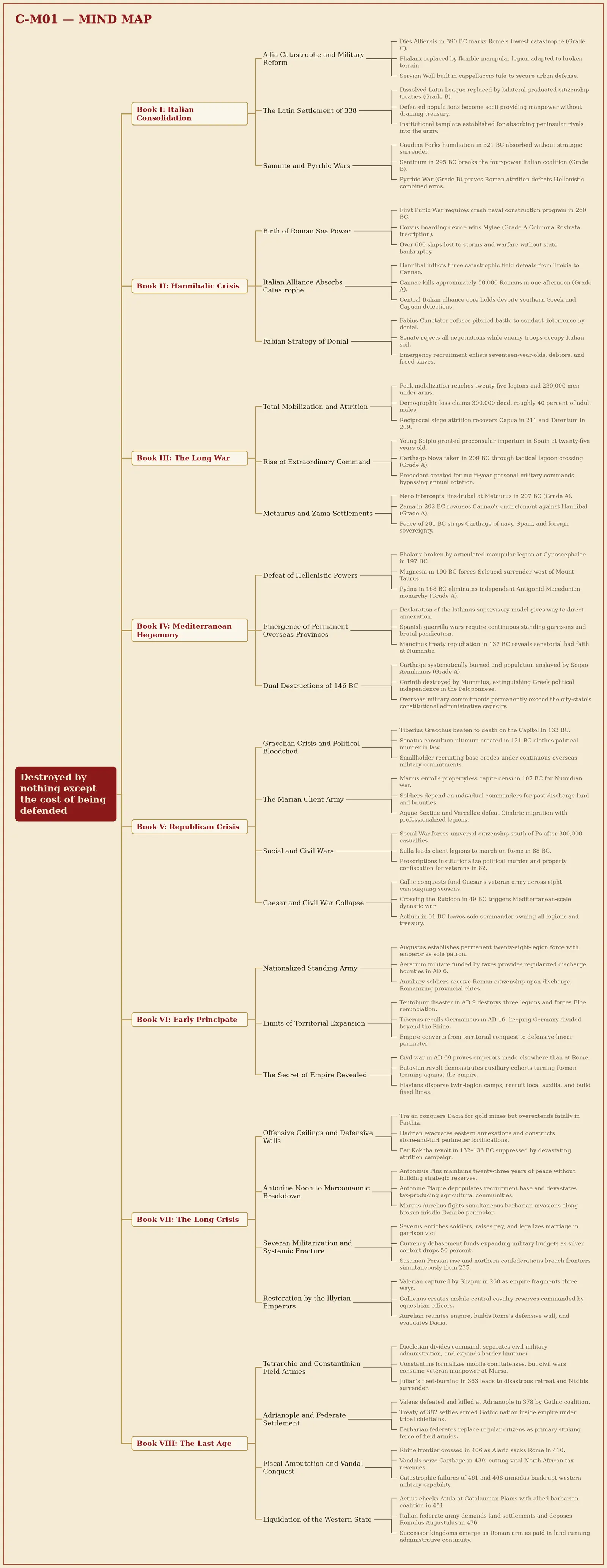
- Book I: Italian Consolidation
- Allia Catastrophe and Military Reform
- Dies Alliensis in 390 BC marks Rome's lowest catastrophe (CGrade C).
- Phalanx replaced by flexible manipular legion adapted to broken terrain.
- Servian Wall built in cappellaccio tufa to secure urban defense.
- The Latin Settlement of 338
- Dissolved Latin League replaced by bilateral graduated citizenship treaties (BGrade B).
- Defeated populations become socii providing manpower without draining treasury.
- Institutional template established for absorbing peninsular rivals into the army.
- Samnite and Pyrrhic Wars
- Caudine Forks humiliation in 321 BC absorbed without strategic surrender.
- Sentinum in 295 BC breaks the four-power Italian coalition (BGrade B).
- Pyrrhic War (BGrade B) proves Roman attrition defeats Hellenistic combined arms.
- Allia Catastrophe and Military Reform
- Book II: Hannibalic Crisis
- Birth of Roman Sea Power
- First Punic War requires crash naval construction program in 260 BC.
- Corvus boarding device wins Mylae (AGrade A Columna Rostrata inscription).
- Over 600 ships lost to storms and warfare without state bankruptcy.
- Italian Alliance Absorbs Catastrophe
- Hannibal inflicts three catastrophic field defeats from Trebia to Cannae.
- Cannae kills approximately 50,000 Romans in one afternoon (AGrade A).
- Central Italian alliance core holds despite southern Greek and Capuan defections.
- Fabian Strategy of Denial
- Fabius Cunctator refuses pitched battle to conduct deterrence by denial.
- Senate rejects all negotiations while enemy troops occupy Italian soil.
- Emergency recruitment enlists seventeen-year-olds, debtors, and freed slaves.
- Birth of Roman Sea Power
- Book III: The Long War
- Total Mobilization and Attrition
- Peak mobilization reaches twenty-five legions and 230,000 men under arms.
- Demographic loss claims 300,000 dead, roughly 40 percent of adult males.
- Reciprocal siege attrition recovers Capua in 211 and Tarentum in 209.
- Rise of Extraordinary Command
- Young Scipio granted proconsular imperium in Spain at twenty-five years old.
- Carthago Nova taken in 209 BC through tactical lagoon crossing (AGrade A).
- Precedent created for multi-year personal military commands bypassing annual rotation.
- Metaurus and Zama Settlements
- Nero intercepts Hasdrubal at Metaurus in 207 BC (AGrade A).
- Zama in 202 BC reverses Cannae's encirclement against Hannibal (AGrade A).
- Peace of 201 BC strips Carthage of navy, Spain, and foreign sovereignty.
- Total Mobilization and Attrition
- Book IV: Mediterranean Hegemony
- Defeat of Hellenistic Powers
- Phalanx broken by articulated manipular legion at Cynoscephalae in 197 BC.
- Magnesia in 190 BC forces Seleucid surrender west of Mount Taurus.
- Pydna in 168 BC eliminates independent Antigonid Macedonian monarchy (AGrade A).
- Emergence of Permanent Overseas Provinces
- Declaration of the Isthmus supervisory model gives way to direct annexation.
- Spanish guerrilla wars require continuous standing garrisons and brutal pacification.
- Mancinus treaty repudiation in 137 BC reveals senatorial bad faith at Numantia.
- Dual Destructions of 146 BC
- Carthage systematically burned and population enslaved by Scipio Aemilianus (AGrade A).
- Corinth destroyed by Mummius, extinguishing Greek political independence in the Peloponnese.
- Overseas military commitments permanently exceed the city-state's constitutional administrative capacity.
- Defeat of Hellenistic Powers
- Book V: Republican Crisis
- Gracchan Crisis and Political Bloodshed
- Tiberius Gracchus beaten to death on the Capitol in 133 BC.
- Senatus consultum ultimum created in 121 BC clothes political murder in law.
- Smallholder recruiting base erodes under continuous overseas military commitments.
- The Marian Client Army
- Marius enrolls propertyless capite censi in 107 BC for Numidian war.
- Soldiers depend on individual commanders for post-discharge land and bounties.
- Aquae Sextiae and Vercellae defeat Cimbric migration with professionalized legions.
- Social and Civil Wars
- Social War forces universal citizenship south of Po after 300,000 casualties.
- Sulla leads client legions to march on Rome in 88 BC.
- Proscriptions institutionalize political murder and property confiscation for veterans in 82.
- Caesar and Civil War Collapse
- Gallic conquests fund Caesar's veteran army across eight campaigning seasons.
- Crossing the Rubicon in 49 BC triggers Mediterranean-scale dynastic war.
- Actium in 31 BC leaves sole commander owning all legions and treasury.
- Gracchan Crisis and Political Bloodshed
- Book VI: Early Principate
- Nationalized Standing Army
- Augustus establishes permanent twenty-eight-legion force with emperor as sole patron.
- Aerarium militare funded by taxes provides regularized discharge bounties in AD 6.
- Auxiliary soldiers receive Roman citizenship upon discharge, Romanizing provincial elites.
- Limits of Territorial Expansion
- Teutoburg disaster in AD 9 destroys three legions and forces Elbe renunciation.
- Tiberius recalls Germanicus in AD 16, keeping Germany divided beyond the Rhine.
- Empire converts from territorial conquest to defensive linear perimeter.
- The Secret of Empire Revealed
- Civil war in AD 69 proves emperors made elsewhere than at Rome.
- Batavian revolt demonstrates auxiliary cohorts turning Roman training against the empire.
- Flavians disperse twin-legion camps, recruit local auxilia, and build fixed limes.
- Nationalized Standing Army
- Book VII: The Long Crisis
- Offensive Ceilings and Defensive Walls
- Trajan conquers Dacia for gold mines but overextends fatally in Parthia.
- Hadrian evacuates eastern annexations and constructs stone-and-turf perimeter fortifications.
- Bar Kokhba revolt in 132–136 BC suppressed by devastating attrition campaign.
- Antonine Noon to Marcomannic Breakdown
- Antoninus Pius maintains twenty-three years of peace without building strategic reserves.
- Antonine Plague depopulates recruitment base and devastates tax-producing agricultural communities.
- Marcus Aurelius fights simultaneous barbarian invasions along broken middle Danube perimeter.
- Severan Militarization and Systemic Fracture
- Severus enriches soldiers, raises pay, and legalizes marriage in garrison vici.
- Currency debasement funds expanding military budgets as silver content drops 50 percent.
- Sasanian Persian rise and northern confederations breach frontiers simultaneously from 235.
- Restoration by the Illyrian Emperors
- Valerian captured by Shapur in 260 as empire fragments three ways.
- Gallienus creates mobile central cavalry reserves commanded by equestrian officers.
- Aurelian reunites empire, builds Rome's defensive wall, and evacuates Dacia.
- Offensive Ceilings and Defensive Walls
- Book VIII: The Last Age
- Tetrarchic and Constantinian Field Armies
- Diocletian divides command, separates civil-military administration, and expands border limitanei.
- Constantine formalizes mobile comitatenses, but civil wars consume veteran manpower at Mursa.
- Julian's fleet-burning in 363 leads to disastrous retreat and Nisibis surrender.
- Adrianople and Federate Settlement
- Valens defeated and killed at Adrianople in 378 by Gothic coalition.
- Treaty of 382 settles armed Gothic nation inside empire under tribal chieftains.
- Barbarian federates replace regular citizens as primary striking force of field armies.
- Fiscal Amputation and Vandal Conquest
- Rhine frontier crossed in 406 as Alaric sacks Rome in 410.
- Vandals seize Carthage in 439, cutting vital North African tax revenues.
- Catastrophic failures of 461 and 468 armadas bankrupt western military capability.
- Liquidation of the Western State
- Aetius checks Attila at Catalaunian Plains with allied barbarian coalition in 451.
- Italian federate army demands land settlements and deposes Romulus Augustulus in 476.
- Successor kingdoms emerge as Roman armies paid in land running administrative continuity.
- Tetrarchic and Constantinian Field Armies
C-M01 · generated by the Imperium factory studio (gemini-3.8-flash) from all eight volumes under the House Preamble.