Book II · The Mediterranean Wars
Infographic · II-G03
THE FLEET-LOSS SEISMOGRAPH: Roman Naval Attrition and Replacement (264–241 BC)
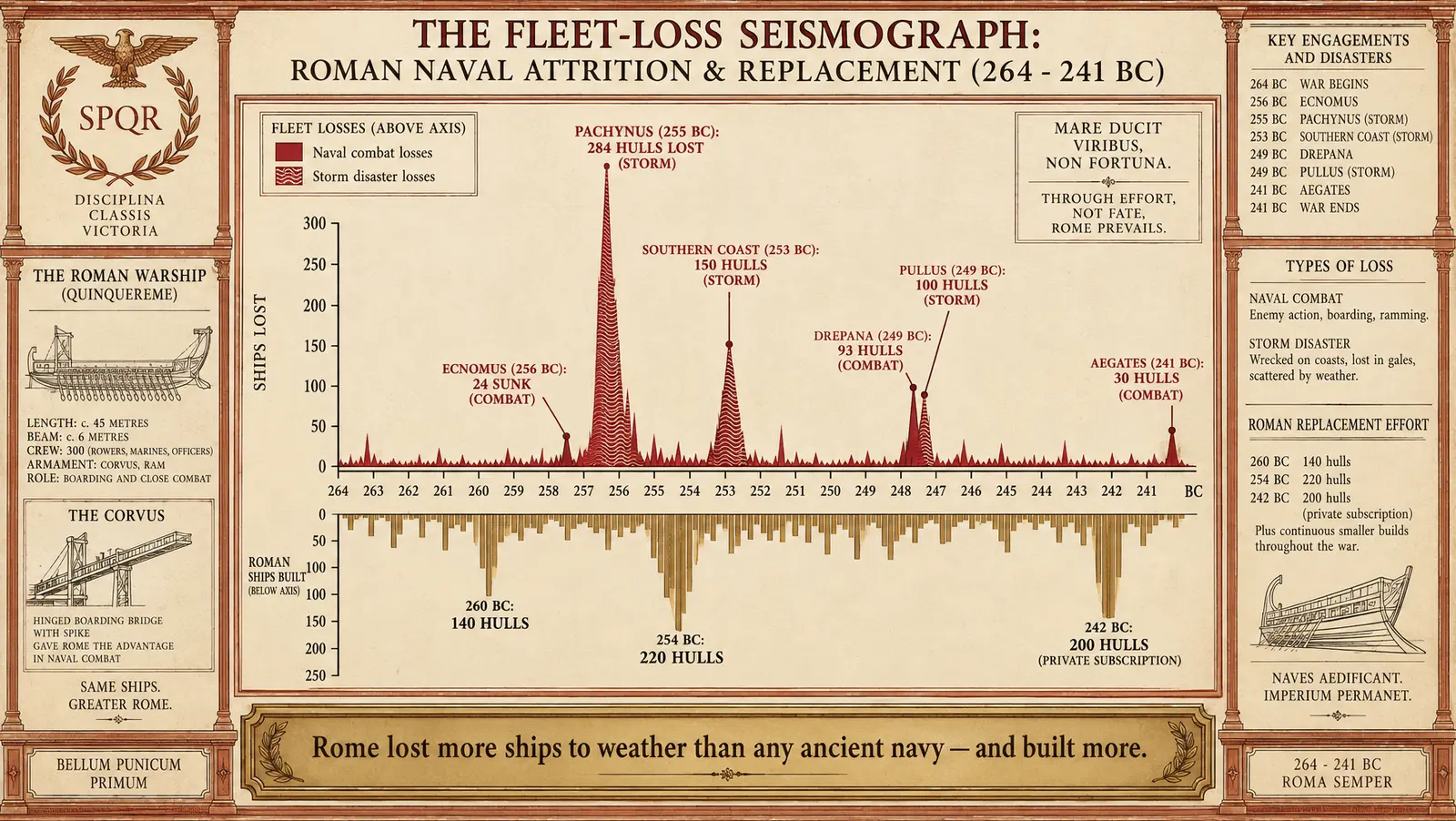
Rome lost more ships to weather than any ancient navy — and built more.
Design Brief: The Fleet-Loss Seismograph (Infographic II-G03)
1. Purpose & Analytical Thesis
This infographic visualizes the extraordinary material paradox of the First Punic War: the Roman Republic lost more warships to maritime weather and catastrophic navigation than to Carthaginian naval action, yet sustained an unprecedented pace of shipbuilding. The graphic is organized as a timeline seismograph (264–241 BC) mapping sudden hull-loss spikes, separating combat losses from storm catastrophes, set against parallel registers detailing crash construction programs and private civic financing.
2. Structural Layout & Technical Panels
Frame & Header
- Border: Terracotta (
#A85638) double rule with corner rosettes. - Ground: Warm antique cream parchment (
#F4EBD5). - Top Cartouche: Gold (
#B89954) and crimson banner with title:THE FLEET-LOSS SEISMOGRAPH · ROMAN NAVAL ATTRITION & REPLACEMENT (264–241 BC). - Subtitle:
An Accounting of Republican Hulls Broken by Storm and Ram Across Twenty-Three Years of War.
Panel I: The Seismograph Timeline (Main Upper Register)
- Axis: Horizontal timeline spanning 264 BC to 241 BC, graduated by annual campaigning seasons.
- Waveform/Spikes: Upward vertical seismographic jagged peaks indicating Roman warship hulls lost per engagement or catastrophe.
- Color Code:
- Storm Catastrophes: Deep slate-crimson (
#6B1724) with wave-hachure texture. - Hostile Action / Naval Combat: Roman crimson (
#8B1A1A) with solid fills.
- Storm Catastrophes: Deep slate-crimson (
- Color Code:
- The Four Major Loss Spikes:
- 256 BC · Ecnomus: Combat loss —
XXIV NAVES(24 hulls sunk). Attestation: BGrade B (Polybius). - 255 BC · Cape Pachynus: Storm catastrophe —
CCLXXXIV NAVES(284 hulls of 300 lost off Camarina/Pachynus; >100,000 dead). Attestation: BGrade B (Polybius 1.37). - 253 BC · Lucanian / Southern Coast: Storm catastrophe —
c. CL NAVES(~150 hulls broken returning from Panormus raid). Attestation: BGrade B (Polybius 1.39). - 249 BC · Drepana: Combat loss —
XCIII NAVES(93 hulls lost of 123 engaged; Adherbal). Attestation: BGrade B (Polybius 1.51). - 249 BC · South Coast of Sicily (Pullus): Storm catastrophe —
c. C NAVES(~100 hulls wrecked). Attestation: BGrade B (Polybius 1.54). - 241 BC · Aegates Islands: Combat loss —
c. XXX NAVES(~30 hulls sunk). Attestation: AGrade A/B (Polybius, confirmed by Egadi bronze warship rams).
- 256 BC · Ecnomus: Combat loss —
Panel II: The Construction Counter-Register (Inverted Lower Register)
- Downward bar glyphs descending from the zero-baseline showing Roman shipbuilding crash programs:
- 261/260 BC: Initial naval program —
CXL NAVES(120 quinqueremes, 20 triremes; 60-day assembly tradition). Attestation: BGrade B. - 255/254 BC: Immediate replacement program —
CCXX NAVES(220 quinqueremes built after Pachynus). Attestation: BGrade B. - 250 BC: Navy stabilized at
c. CC NAVES(200 quinqueremes). Corvus formally discontinued. Attestation: BGrade B. - 243/242 BC: Catulus's emergency subscription fleet —
CC NAVES(200 quinqueremes built via private senatorial and citizen contribution, repaid from post-war indemnity). Attestation: BGrade B.
- 261/260 BC: Initial naval program —
Panel III: The Technical Diagnostic & Arithmetic Ledger (Flanking Panels)
- Left Box: "The Architectural Vulnerability (The Corvus Trap)":
- Technical schema showing bow load distribution: Gangway height 24 ft (7.2 m), weight concentrated at the prow, raising the center of gravity and causing capsize in cross-seas.
- Label:
The weapon that conquered Mylae destroyed the fleet at Pachynus. Discontinued post-250 BC.
- Right Box: "The Tradition's Arithmetic":
Total Attested Losses to Weather: c. DXXXIV+ Hulls (c. 534+)Total Attested Losses to Hostile Arms: c. CXLVII Hulls (c. 147)Ratio of Storm to Combat Destruction: 3.6 : 1Demographic Toll: >150,000 rowers and marines drowned in 255–253 BC alone.
3. Verbatim Text Elements
- Title:
THE FLEET-LOSS SEISMOGRAPH - Subtitle:
Hulls Lost to Storm vs Combat, 264–241 BC - Axis labels:
264 BC,260 BC (MYLAE),256 BC (ECNOMUS),255 BC (PACHYNUS),253 BC (SECOND STORM),250 BC (PANORMUS),249 BC (DREPANA & PULLUS),242 BC (SUBSCRIPTION FLEET),241 BC (AEGATES) - Spike annotations:
PACHYNUS: 284 LOST (STORM),LUCANIAN COAST: 150 LOST (STORM),DREPANA: 93 LOST (ENEMY),PULLUS: 100 LOST (STORM),ECNOMUS: 24 LOST (ENEMY),AEGATES: 30 LOST (ENEMY) - Program annotations:
CRASH PROGRAM 260 BC: 140 HULLS,REBUILD 254 BC: 220 HULLS,SUBSCRIPTION FLEET 242 BC: 200 HULLS - Bottom Epigram:
"Rome lost more ships to weather than any ancient navy — and built more."
4. Palette Guide
- Background Ground: Cream parchment (
#F4EBD5) - Frame & Borders: Terracotta (
#A85638) - Banners & Highlights: Roman Gold (
#B89954) - Combat Losses: Roman Crimson (
#8B1A1A) - Storm Catastrophes: Deep Slate-Crimson / Iron Storm (
#6B1724/#4A4A4A) - Shipbuilding Inverted Bars: Muted Bronze / Ochre (
#B5824A) - Typography: Crisp, dark iron-gall ink (
#2B261F), serif capitals.
Image prompt (16:9)
A pristine 19th-century staff-history technical timeline and statistical chart titled "THE FLEET-LOSS SEISMOGRAPH: ROMAN NAVAL ATTRITION & REPLACEMENT (264–241 BC)", printed on warm cream antique paper (#F4EBD5) within a crisp terracotta (#A85638) architectural border. Running horizontally through the center of the frame is a timeline axis marked from 264 BC to 241 BC. Above the axis, a seismographic jagged graph displays towering vertical loss spikes: slate-crimson (#6B1724) wave-hatched peaks for storm disasters and solid crimson (#8B1A1A) peaks for naval combat. Prominent labeled peaks include: 'ECNOMUS (256 BC): 24 SUNK (COMBAT)', the massive towering spike of 'PACHYNUS (255 BC): 284 HULLS LOST (STORM)', 'SOUTHERN COAST (253 BC): 150 HULLS (STORM)', 'DREPANA (249 BC): 93 HULLS (COMBAT)', 'PULLUS (249 BC): 100 HULLS (STORM)', and 'AEGATES (241 BC): 30 HULLS (COMBAT)'. Below the central axis, an inverted bar register in Punic-ochre (#B5824A) and bronze displays Roman naval construction: '260 BC: 140 HULLS', '254 BC: 220 HULLS', and '242 BC: 200 HULLS (PRIVATE SUBSCRIPTION)'. Flanking side data panels display clean technical text and small warship hull schematics with the corvus device labeled. A prominent gold (#B89954) bottom cartouche displays the text: 'Rome lost more ships to weather than any ancient navy — and built more.' Highly detailed, razor-sharp serif typography, immaculate historical cartographic aesthetic, no modern graphical elements, no pictorial figures.
II-G03 · generated by the Imperium factory studio (gemini-3.8-flash) from Book II under the House Preamble.