Book II · The Mediterranean Wars
Mind map · II-M01
Two Systems at War: Rome Versus Carthage
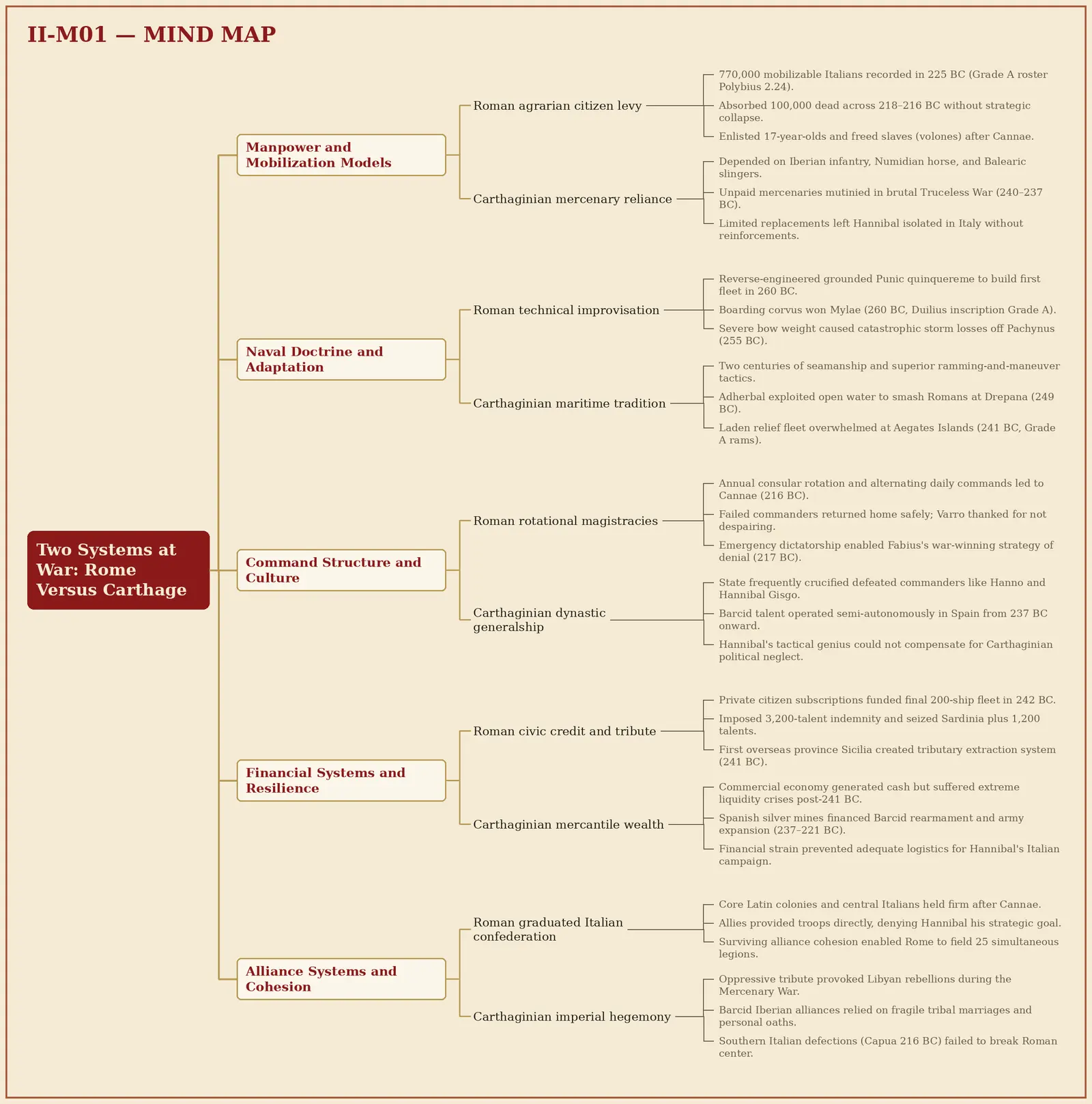
- Manpower and Mobilization Models
- Roman agrarian citizen levy
- 770,000 mobilizable Italians recorded in 225 BC (AGrade A roster Polybius 2.24).
- Absorbed 100,000 dead across 218–216 BC without strategic collapse.
- Enlisted 17-year-olds and freed slaves (volones) after Cannae.
- Carthaginian mercenary reliance
- Depended on Iberian infantry, Numidian horse, and Balearic slingers.
- Unpaid mercenaries mutinied in brutal Truceless War (240–237 BC).
- Limited replacements left Hannibal isolated in Italy without reinforcements.
- Roman agrarian citizen levy
- Naval Doctrine and Adaptation
- Roman technical improvisation
- Reverse-engineered grounded Punic quinquereme to build first fleet in 260 BC.
- Boarding corvus won Mylae (260 BC, Duilius inscription AGrade A).
- Severe bow weight caused catastrophic storm losses off Pachynus (255 BC).
- Carthaginian maritime tradition
- Two centuries of seamanship and superior ramming-and-maneuver tactics.
- Adherbal exploited open water to smash Romans at Drepana (249 BC).
- Laden relief fleet overwhelmed at Aegates Islands (241 BC, AGrade A rams).
- Roman technical improvisation
- Command Structure and Culture
- Roman rotational magistracies
- Annual consular rotation and alternating daily commands led to Cannae (216 BC).
- Failed commanders returned home safely; Varro thanked for not despairing.
- Emergency dictatorship enabled Fabius's war-winning strategy of denial (217 BC).
- Carthaginian dynastic generalship
- State frequently crucified defeated commanders like Hanno and Hannibal Gisgo.
- Barcid talent operated semi-autonomously in Spain from 237 BC onward.
- Hannibal's tactical genius could not compensate for Carthaginian political neglect.
- Roman rotational magistracies
- Financial Systems and Resilience
- Roman civic credit and tribute
- Private citizen subscriptions funded final 200-ship fleet in 242 BC.
- Imposed 3,200-talent indemnity and seized Sardinia plus 1,200 talents.
- First overseas province Sicilia created tributary extraction system (241 BC).
- Carthaginian mercantile wealth
- Commercial economy generated cash but suffered extreme liquidity crises post-241 BC.
- Spanish silver mines financed Barcid rearmament and army expansion (237–221 BC).
- Financial strain prevented adequate logistics for Hannibal's Italian campaign.
- Roman civic credit and tribute
- Alliance Systems and Cohesion
- Roman graduated Italian confederation
- Core Latin colonies and central Italians held firm after Cannae.
- Allies provided troops directly, denying Hannibal his strategic goal.
- Surviving alliance cohesion enabled Rome to field 25 simultaneous legions.
- Carthaginian imperial hegemony
- Oppressive tribute provoked Libyan rebellions during the Mercenary War.
- Barcid Iberian alliances relied on fragile tribal marriages and personal oaths.
- Southern Italian defections (Capua 216 BC) failed to break Roman center.
- Roman graduated Italian confederation
II-M01 · generated by the Imperium factory studio (gemini-3.8-flash) from Book II under the House Preamble.