Book II · The Mediterranean Wars
Mind map · II-M03
Why Rome Kept Rowing (264–241 BC)
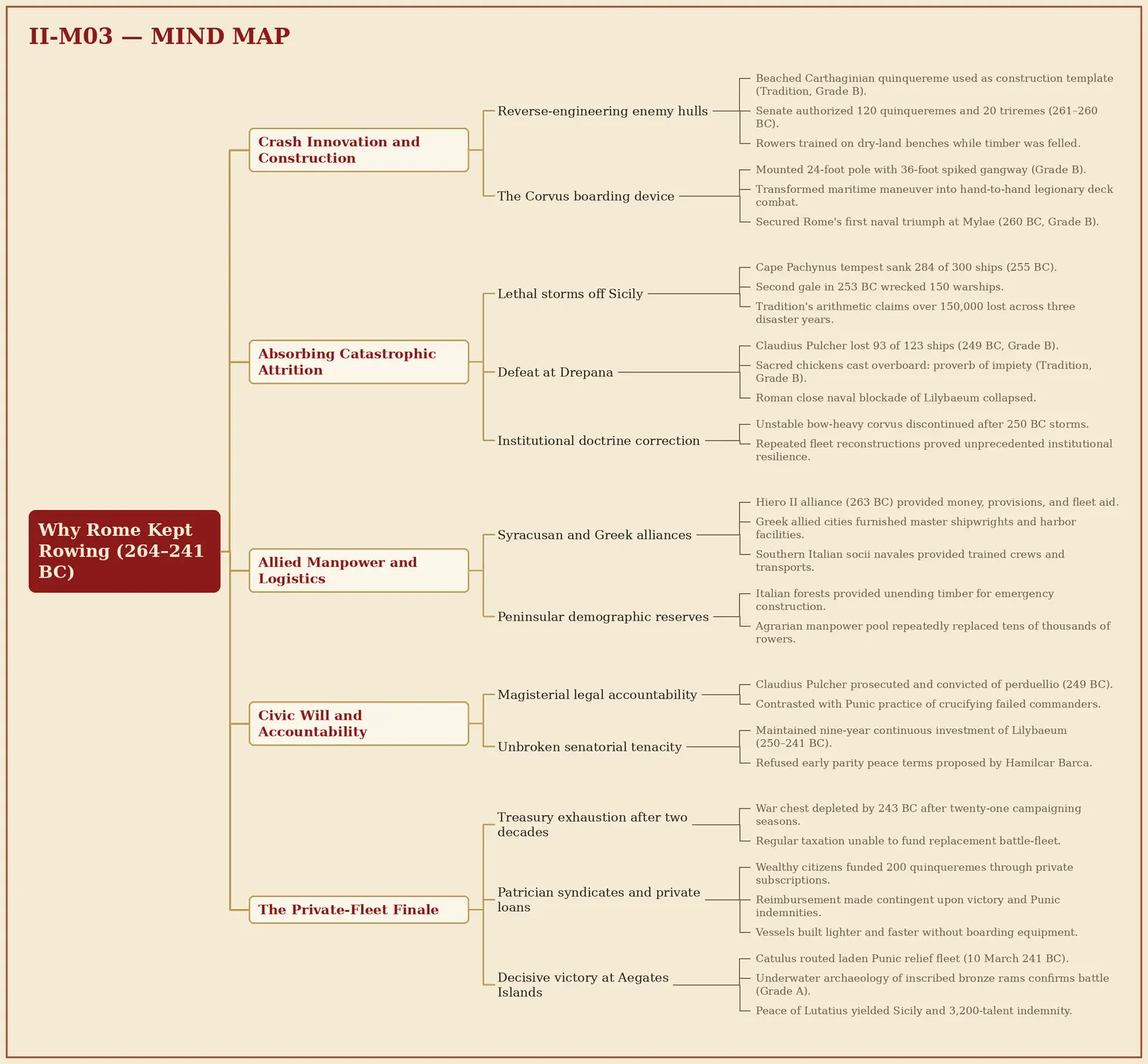
- Crash Innovation and Construction
- Reverse-engineering enemy hulls
- Beached Carthaginian quinquereme used as construction template (Tradition, BGrade B).
- Senate authorized 120 quinqueremes and 20 triremes (261–260 BC).
- Rowers trained on dry-land benches while timber was felled.
- The Corvus boarding device
- Mounted 24-foot pole with 36-foot spiked gangway (BGrade B).
- Transformed maritime maneuver into hand-to-hand legionary deck combat.
- Secured Rome's first naval triumph at Mylae (260 BC, BGrade B).
- Reverse-engineering enemy hulls
- Absorbing Catastrophic Attrition
- Lethal storms off Sicily
- Cape Pachynus tempest sank 284 of 300 ships (255 BC).
- Second gale in 253 BC wrecked 150 warships.
- Tradition's arithmetic claims over 150,000 lost across three disaster years.
- Defeat at Drepana
- Claudius Pulcher lost 93 of 123 ships (249 BC, BGrade B).
- Sacred chickens cast overboard: proverb of impiety (Tradition, BGrade B).
- Roman close naval blockade of Lilybaeum collapsed.
- Institutional doctrine correction
- Unstable bow-heavy corvus discontinued after 250 BC storms.
- Repeated fleet reconstructions proved unprecedented institutional resilience.
- Lethal storms off Sicily
- Allied Manpower and Logistics
- Syracusan and Greek alliances
- Hiero II alliance (263 BC) provided money, provisions, and fleet aid.
- Greek allied cities furnished master shipwrights and harbor facilities.
- Southern Italian socii navales provided trained crews and transports.
- Peninsular demographic reserves
- Italian forests provided unending timber for emergency construction.
- Agrarian manpower pool repeatedly replaced tens of thousands of rowers.
- Syracusan and Greek alliances
- Civic Will and Accountability
- Magisterial legal accountability
- Claudius Pulcher prosecuted and convicted of perduellio (249 BC).
- Contrasted with Punic practice of crucifying failed commanders.
- Unbroken senatorial tenacity
- Maintained nine-year continuous investment of Lilybaeum (250–241 BC).
- Refused early parity peace terms proposed by Hamilcar Barca.
- Magisterial legal accountability
- The Private-Fleet Finale
- Treasury exhaustion after two decades
- War chest depleted by 243 BC after twenty-one campaigning seasons.
- Regular taxation unable to fund replacement battle-fleet.
- Patrician syndicates and private loans
- Wealthy citizens funded 200 quinqueremes through private subscriptions.
- Reimbursement made contingent upon victory and Punic indemnities.
- Vessels built lighter and faster without boarding equipment.
- Decisive victory at Aegates Islands
- Catulus routed laden Punic relief fleet (10 March 241 BC).
- Underwater archaeology of inscribed bronze rams confirms battle (AGrade A).
- Peace of Lutatius yielded Sicily and 3,200-talent indemnity.
- Treasury exhaustion after two decades
II-M03 · generated by the Imperium factory studio (gemini-3.8-flash) from Book II under the House Preamble.