Book VII · The High Empire and the Long Crisis
Infographic · VII-G02
READ BY THE ENEMY: The Sasanian Record at Naqsh-e Rustam
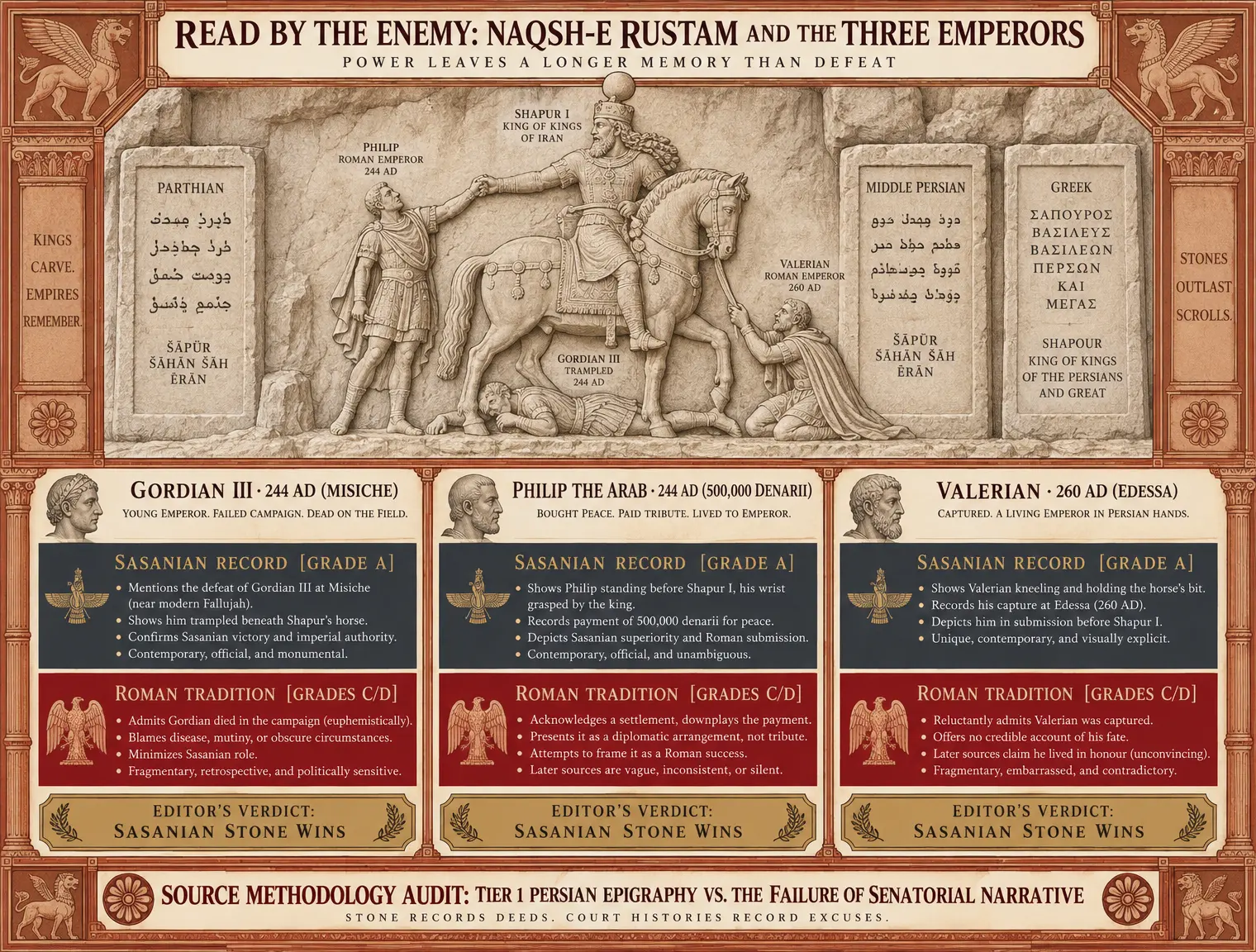
Infographic VII-G02: The Res Gestae Divi Saporis at Naqsh-e Rustam, arbitrating the disasters of Gordian III, Philip the Arab, and Valerian against the evasions of Roman historiography.
Design Brief: Infographic VII-G02 — "READ BY THE ENEMY"
1. Strategic Purpose
To confront the evidentiary nadir of Book VII by juxtaposing Rome's fragmented, evasive literary tradition with its premier external epigraphic witness: the trilingual rock inscription (Res Gestae Divi Saporis) and monumental relief of Shapur I at Naqsh-e Rustam. The infographic audits three cataclysmic mid-third-century imperial crises (Gordian III, Philip the Arab, Valerian) across two opposing perspectives, grading each claim and presenting the Editor's verdict on why stone from Fars out-attests Rome's lost histories.
2. Layout & Architecture
The plate is structured as a classical tripartite administrative audit enclosed in a decorative terracotta border (#A85638) on a warm cream ground (#F4EBD5), split into three functional bands:
-
Top Register (The Monument & The Medium):
- Visual Diagram: Schematic elevation of the Naqsh-e Rustam rock relief (Shapur mounted in profile; Gordian III trampled beneath hooves; Philip the Arab standing grasping the king's wrist; Valerian kneeling in supplication at the horse's bit).
- Epigraphic Banner: The trilingual administrative apparatus: Middle Persian (Pahlavi script), Parthian, and Greek panels. Keyed as Tier 1 contemporary official epigraphy.
-
Middle Register (Three Comparative Panels — Case Audits):
- Three vertical comparative columns, each divided horizontally into:
- The Sasanian Record (Iron-grey
#3E424Bwith Punic Ochre#B5824Aaccents; Persian official testimony, AGrade A). - The Roman Counter-Tradition (Roman Crimson
#8B1A1A; literary epitomes, Kaisergeschichte, and later Christian polemic, Grades C–D). - Editor's Verdict (Gold
#B89954cartouche; evidentiary arbitration and source ranking).
- The Sasanian Record (Iron-grey
- Three vertical comparative columns, each divided horizontally into:
-
Bottom Register (Methodological Ledger & Synthesis):
- Material corroboration timeline (coinage debasement, Dura-Europos burn-layer, Bishapur engineering works) demonstrating that external monument and physical archaeology systematically validate the Persian account over Roman senatorial silence.
3. Verbatim Text & Data Inventory
- Primary Title:
"READ BY THE ENEMY: NAQSH-E RUSTAM AND THE THREE EMPERORS" - Subtitle:
"The Res Gestae Divi Saporis vs. Roman Historiography (244–260 AD)" - Epigraphic Header:
"TRILINGUAL ROCK INSCRIPTION: PARTHIAN · MIDDLE PERSIAN · GREEK · C. 262 AD"
Column 1: GORDIAN III (244 AD) — Misiche vs. Zaitha
- Event Tag:
"BATTLE OF MISICHE / CIRCESIUM" - Sasanian Claim
[AGrade A]:"Gordian Caesar marched against Iran; at Misiche in Babylonia a great frontal battle was joined; Gordian Caesar was slain, and the Roman army destroyed." - Roman Tradition
[CGrade C]:"Philip the Arab orchestrated supply failure and mutiny at Zaitha near Circesium; Gordian was murdered by his own troops, who raised a cenotaph to him." - Corroborating Material:
"Misiche refounded as Peroz-Shapur ('Victorious Shapur'). No Roman battlefield cenotaph survives." - Editor's Verdict:
"SASANIAN STONE WINS. Contemporary official inscription stands uncontested by any surviving Roman witness. Roman mutiny narrative is a standard senatorial face-saving trope for battlefield catastrophe."
Column 2: PHILIP THE ARAB (244 AD) — Tribute vs. Honorable Peace
- Event Tag:
"THE TREATY OF 244 AD" - Sasanian Claim
[AGrade A]:"Philip Caesar came to terms of submission, paying 500,000 denarii ransom for the lives of his surviving army, becoming tributary to the King of Kings." - Roman Tradition
[BGrade B/C]:"An honorable peace negotiated out of military necessity to secure the frontier and allow the emperor's return to Rome; celebrated as PAX FUNDATA CUM PERSIS." - Corroborating Material:
"500,000 denarii tribute represented in Shapur's treasury records; Roman commemorative issue PAX FUNDATA CUM PERSIS struck in silver-debased coin." - Editor's Verdict:
"SASANIAN STONE WINS. The Roman mint's own protestation ('Peace Established with the Persians') is AGrade A material proof that peace was purchased retail with an enormous indemnity."
Column 3: VALERIAN (260 AD) — The Capture at Edessa
- Event Tag:
"THE DISASTER AT EDESSA" - Sasanian Claim
[AGrade A]:"In battle beyond Edessa and Carrhae, Valerian Caesar was taken alive by our hand, together with his praetorian prefect, senators, and 70,000 soldiers. Captives deported to Fars to build the King's dams and cities." - Roman/Christian Tradition
[Grades C/D]:"Valerian lured into ambush under false flag of parley after pestilence crippled his army (Zosimus); later Christian tradition records Valerian used as Shapur's royal mounting-block, then flayed, cured, and dyed with vermilion (Lactantius)." - Corroborating Material:
"Bishapur rock reliefs; Band-e Kaisar ('Caesar's Dam') masonry built by deported Roman legionary engineers; Naqsh-e Rustam relief showing kneeling emperor." - Editor's Verdict:
"SASANIAN STONE WINS ON CAPTURE; CHRISTIAN TRADITION DISMISSED AS POLEMIC. The physical capture of an emperor, his staff, and army is AGrade A fact. Lactantius's mounting-block and flayed skin are DGrade D theological vengeance narratives without contemporary witness."
Bottom Synthesis Bar
- Legend/Rule: `"SOURCE METHODOLOGY AUDIT · BOOK VII"
- Text:
"The best witnesses to the lowest ebb of the Roman world are a Persian king's cliff, an abandoned garrison's paperwork at Dura-Europos, and the depth at which frightened provincial citizens buried their coin hoards. A governing class that lost command of its armies ceased writing their history."
4. Palette & Styling
- Background: Antique parchment cream (
#F4EBD5). - Border/Frames: Terracotta rule (
#A85638). - Roman Data: Deep imperial crimson (
#8B1A1A). - Sasanian Data: Iron-grey (
#3E424B) with Punic/Near-Eastern ochre (#B5824A). - Titling & Verdict Cartouches: Imperial gold (
#B89954) with dark sepia serif typography.
Image prompt (4:3)
A high-resolution, archival historical-atlas infographic titled 'READ BY THE ENEMY: NAQSH-E RUSTAM AND THE THREE EMPERORS' on a smooth light-cream parchment background (#F4EBD5) enclosed in an intricate terracotta architectural frame (#A85638). Upper register features a clean, archaeological line-art elevation of the Sasanian rock relief at Naqsh-e Rustam: King Shapur I mounted in profile on a massive charger, extending his hand to grasp the wrist of the standing Roman emperor Philip, while Gordian III lies trampled beneath the horse hooves and Valerian kneels in submission with outstretched hands at the bit; flanked by crisp stone tablets labeled 'PARTHIAN', 'MIDDLE PERSIAN', and 'GREEK'. Below the relief, three distinct vertical comparative audit columns rendered in an antique serif editorial layout: Column 1 labeled 'GORDIAN III · 244 AD (MISICHE)', Column 2 labeled 'PHILIP THE ARAB · 244 AD (500,000 DENARII)', Column 3 labeled 'VALERIAN · 260 AD (EDESSA)'. Each column contains two contrasting horizontal blocks: the upper block in dark slate-grey (#3E424B) with ochre (#B5824A) accents labeled 'SASANIAN RECORD [GRADE A]', the lower block in deep Roman crimson (#8B1A1A) with cream lettering labeled 'ROMAN TRADITION [GRADES C/D]'. Each column terminates in a sharp gold cartouche (#B89954) inscribed with 'EDITOR'S VERDICT: SASANIAN STONE WINS'. At the bottom, a full-width footer banner framed in terracotta rule labeled 'SOURCE METHODOLOGY AUDIT: TIER 1 PERSIAN EPIGRAPHY VS. THE FAILURE OF SENATORIAL NARRATIVE'. Every label rendered in immaculate, legible classical serif lettering, clean graphic cartography, no modern charts, strictly academic historical compendium aesthetic.
VII-G02 · generated by the Imperium factory studio (gemini-3.8-flash) from Book VII under the House Preamble.