Book II · The Mediterranean Wars
Chapter 2
The First Punic War: Africa, Sicily, and the Long Resolution
Regulus in Africa256–255 BC
The Roman army that disembarked at Aspis in the late summer of 256 BC was, by every standard a Roman expeditionary force had previously been measured against, both the most ambitious and the most isolated. Two consular armies and their attached allied contingents — perhaps thirty-five to forty thousand fighting men, plus cavalry and supporting personnel — had been put ashore on a coast where no Roman force had ever previously stood, with no local allies to offer logistical support, with the nearest friendly base across a hundred miles of sea, and with the certainty that any extended campaign would draw down their numbers by attrition that could only be replaced from Italy. The strategic decision facing the consuls in the autumn of 256 was whether to attempt a decisive campaign before the season closed or to consolidate a coastal position for winter and await reinforcement and instructions from Rome.
The Senate, in a decision that has been judged variously by ancient and modern military historians, recalled Lucius Manlius Vulso with the bulk of the fleet, leaving the other consul Marcus Atilius Regulus in Africa with about fifteen thousand foot, five hundred cavalry, and forty ships. The reasoning was probably financial: the maintenance of a fleet of three hundred warships across the winter was beyond the Roman naval-administrative capacity at this stage of the war, and the political pressure to economize was significant. The military consequence was severe: Regulus was now committed to conducting an offensive campaign in unfamiliar country with a force that was small by Carthaginian standards (the Carthaginian field army that would shortly oppose him was approximately thirty thousand strong) and that had no realistic prospect of significant reinforcement before the following summer.
Regulus, however, proved equal to the challenge in the short term. The Carthaginian field forces of 256 were demoralized by the loss at Ecnomus and by the political crisis in the city itself (which was struggling with mercenary contract problems and with the question of whether the Barcid faction or the Hanno-led party should direct the war). Regulus advanced inland from Aspis, taking the small city of Adys (the modern Uthina, somewhat southwest of modern Tunis), and engaged the Carthaginian field army at the Battle of Adys in late 256 BC. The Carthaginians had taken up position on a hill — a deployment that nullified their cavalry and elephant superiority by forcing battle on terrain unsuited to either — and Regulus, recognizing the Punic error, attacked the position with his heavy infantry frontally and a second column in flank. The Carthaginian line broke; the field army was driven from the position with substantial losses; Carthage itself was now exposed to direct Roman attack.
Regulus pressed his advantage with vigor. He advanced to Tunis (then a separate fortified town, not yet absorbed into the metropolitan area of Carthage), occupying it as a winter base and as the assembly point for an attack on Carthage proper in the spring. He also conducted negotiations with the Numidian tribal kings of the African interior, several of whom recognized that the strategic balance had shifted and sought accommodation with the new power. From the Roman position at Tunis, Carthage lay only ten miles away. The strategic moment was the most precarious for Carthage in the entire war.
The Carthaginian response to this crisis was the diplomatic mission that introduced Xanthippus the Spartan to the war. Xanthippus was a mercenary officer of Greek background and Spartan citizenship, with considerable experience in Hellenistic-style combined-arms warfare, who had come to Carthage seeking employment in the manner that Greek military adventurers had been seeking employment in the Hellenistic east since the time of Xenophon. He was hired, given command of the reorganized Carthaginian field army, and tasked with the destruction of Regulus's expeditionary force. Xanthippus's appointment was a Carthaginian institutional admission of the kind that would have been unthinkable in the Roman system: a foreign mercenary placed in supreme field command of the state's armies because no native general was thought capable of the task. The decision was made over the resentment of the Carthaginian officer corps, but it would prove, in the short term, brilliantly successful.
The Battle of the Bagradas (Tunis)255 BC
Xanthippus reorganized the Carthaginian field army through the winter of 256/255 BC. He drilled the infantry — including the heavy phalanx-style Carthaginian heavy infantry, the Iberian mercenary swordsmen, and the various other contingents — in coherent tactical doctrine on the Hellenistic combined-arms model. He concentrated and exercised the cavalry, both the Numidian light horse and the heavier Punic and Greek mercenary cavalry. He took particular care with the elephant corps — perhaps a hundred animals, the largest force the Carthaginians had yet deployed in this war — training the mahouts and the supporting infantry to use the elephants in coordinated action with the phalanx and the cavalry. By the spring of 255, the Carthaginian army that took the field against Regulus was a transformed instrument from the demoralized force that had been defeated at Adys.
The engagement was fought on the plain of the Bagradas river (the modern Medjerda), in flat country southwest of Tunis — exactly the kind of terrain on which the Carthaginian elephants and cavalry could operate to maximum effect. Regulus, perhaps assuming that the previous winter's victories had broken Carthaginian morale and that the new field army would be no more formidable than the one he had beaten at Adys, accepted battle on Xanthippus's chosen ground. The Roman force was approximately fifteen thousand foot, five hundred cavalry, drawn up in the standard triplex acies. The Carthaginian force was approximately twelve thousand foot, four thousand cavalry, and one hundred elephants, deployed in a Hellenistic-style line with the elephants in front of the center, the phalanx behind, and the cavalry on both wings.
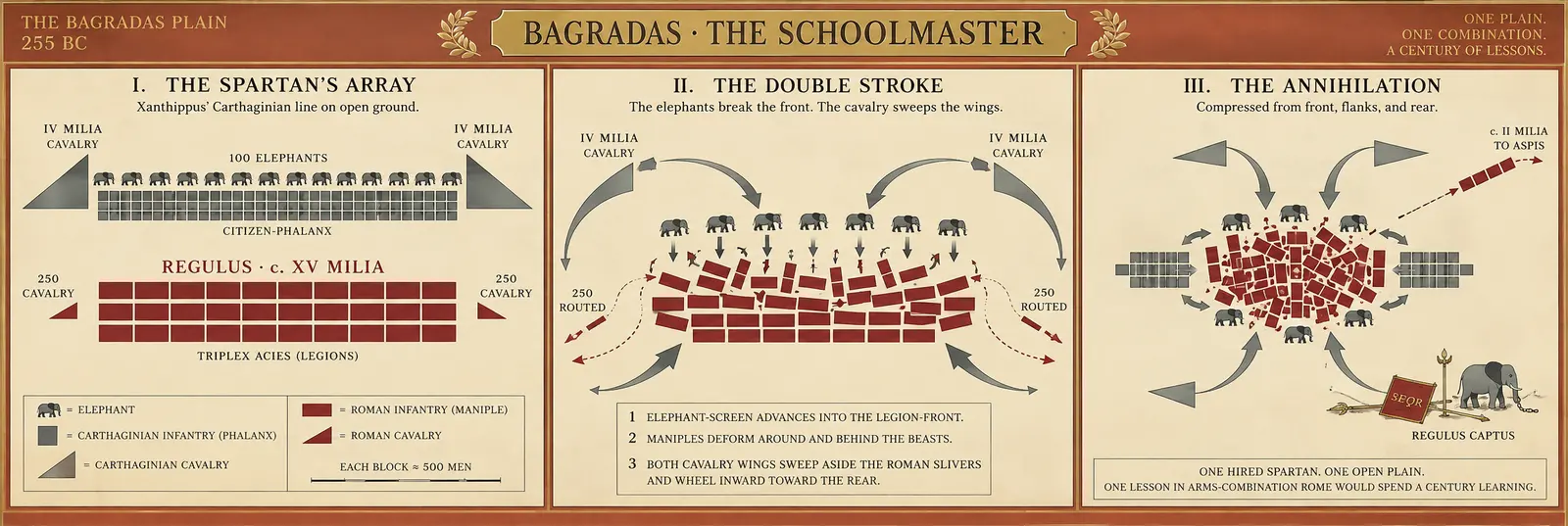
The engagement was, in tactical terms, a Hellenistic textbook. The elephants advanced in line at a measured pace toward the Roman center; the Roman cavalry, finding itself outnumbered by sixteen to one on each wing, was driven from the field within the first quarter-hour of the engagement; the Carthaginian cavalry then swept around behind the Roman line; the elephants struck the Roman center and broke it; the phalanx advanced into the disrupted Roman line; the Carthaginian cavalry attacked the Roman rear. The Roman army, surrounded and pressed from all sides, was destroyed in detail. Polybius's casualty figures (12,000 Romans killed of the 15,500 engaged, with 2,000 captured and only 500 escaping to Aspis) are probably approximately accurate: only a small fraction of the expeditionary force survived. Regulus himself was among the prisoners.
The capture of Regulus is the source of one of the most famous and most problematic episodes of the Roman literary tradition. According to the later Roman accounts — beginning with Cicero in De Officiis, and reaching their full elaboration in the imperial writers and in Horace's odes — Regulus was sent to Rome by the Carthaginians, on his parole and under oath to return, to negotiate either a prisoner exchange or a peace settlement. He used the opportunity, on arrival in Rome, to advise the Senate against any settlement on Carthaginian terms; then, having broken the negotiating mission by his own counsel against it, he returned to Carthage in accordance with his oath, where he was tortured to death — variously: kept awake until he died, placed in a barrel studded with spikes, or both. The story made Regulus a moral exemplar of the entire later Roman ethical tradition, the model of an oath-keeper who chose certain death rather than break faith with a hated enemy.
The historicity of the Regulus martyrdom is, however, doubtful in detail. Polybius, our best source for the war and writing only a hundred years after the events, does not mention the embassy to Rome or the torture. The story first appears in this developed form in Roman writers of the second and first centuries BC, by which point the literary embellishment of Punic War heroes was well advanced. It is probable that Regulus was indeed captured at the Bagradas and probable that he died in Carthaginian captivity at some point thereafter, but the embassy and the torture are likely to be later inventions or elaborations of more modest underlying facts. What is firmly historical is the destruction of Regulus's army and the collapse of the Roman strategic position in Africa.
The Catastrophe of the Return Fleet255 BC
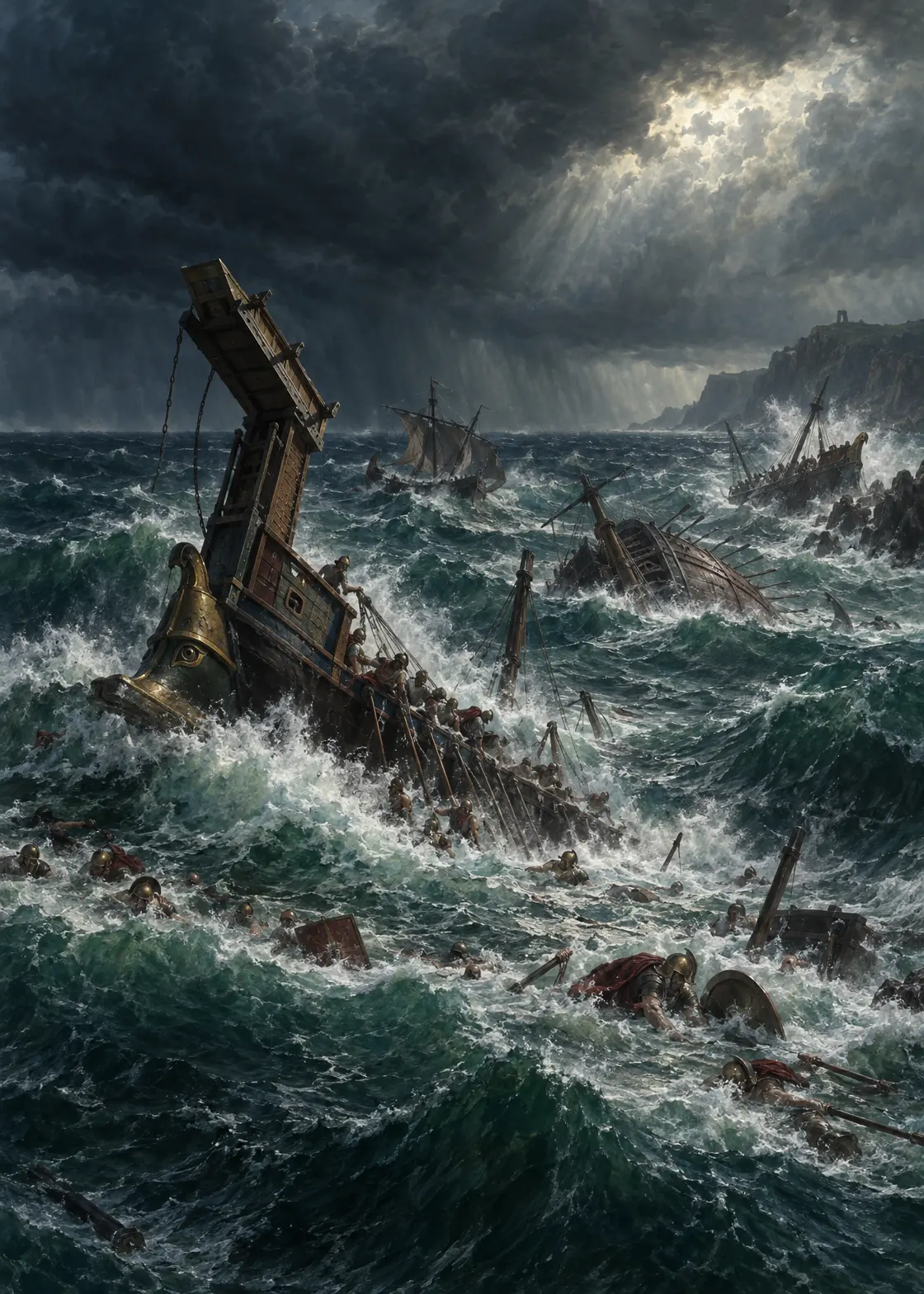
A relief expedition was dispatched from Rome in the summer of 255 BC to evacuate the survivors of Regulus's army from Aspis. The fleet of three hundred ships under the consuls Marcus Aemilius Paullus and Servius Fulvius Paetinus reached Africa, fought and won an additional naval engagement against a Carthaginian fleet off the African coast (the Battle of Cape Hermaeum, in which approximately a hundred Carthaginian ships were captured), and embarked the surviving Roman forces from Aspis. The return crossing, however, ended in the worst naval disaster of the entire war and one of the worst in ancient history. The fleet was caught by a summer storm off the southern coast of Sicily, between Camarina and Cape Pachynus; the corvi, which had given the Roman fleet its tactical advantage in combat, were a navigational liability in heavy weather, raising the center of gravity of the bow and compromising the ships' stability in cross-seas. Two hundred and eighty-four of the three hundred ships were lost, with their crews. The death toll has been estimated at over one hundred thousand men — sailors, marines, the survivors of the African campaign whom the fleet had been sent to rescue. Comparable losses are difficult to find in the entire ancient record; the disaster was on a scale that would not be matched until the catastrophe of Cannae thirty-nine years later, and Cannae itself would kill fewer Romans than the Cape Pachynus storm.
The Roman state, faced with what was effectively the destruction of its naval establishment within a single afternoon, undertook the construction of a replacement fleet across the following two years. The institutional capacity to do so was itself a remarkable achievement. A second fleet of 220 ships was launched by 254, and a third storm in 253 (off the southern Italian coast, returning from a Sicilian raid) destroyed approximately 150 of those, with another tens of thousands of dead. The cumulative naval losses of the years 255 to 253 — from storms and from Cape Hermaeum — exceeded six hundred ships and well over a hundred and fifty thousand men. The Roman response, even more remarkably, was again to rebuild. By 250 BC the Roman fleet was back at strength of approximately two hundred ships. But the lesson of the storms had been learned: subsequent fleets would be deployed with greater caution, the corvus would be discontinued (the technical evidence for its use after about 250 BC is absent), and the naval war would shift toward operations conducted closer to friendly coasts.
The Long Sicilian War254–250 BC
With the African theater closed and the Roman fleet diminished, the war reverted in the years from 254 to 250 BC to the Sicilian land theater that had occupied it before 256. Roman armies operated against the Carthaginian epikrateia with the principal objective of reducing the fortified positions one by one. Panormus (modern Palermo), the most important Carthaginian-held city on the northern coast, was taken by the consul Aulus Atilius Calatinus in 254 by a combined land-and-sea operation; the Roman fleet, even in its reduced state, was strong enough to prevent Carthaginian relief by sea, and the city's walls were stormed after a relatively brief siege. The fall of Panormus secured the entire northern coast of Sicily for Roman operations.
The Carthaginian response was a major land offensive in 250 BC under the general Hasdrubal son of Hanno (one of several Hasdrubals of the war; this one was the Carthaginian field commander in Sicily for several years and should not be confused with the later Hasdrubal Barca). Hasdrubal advanced from Lilybaeum eastward toward Panormus with a substantial army including about one hundred and forty elephants — the largest elephant force in any Carthaginian field operation in the entire war. The Roman commander at Panormus, the proconsul Lucius Caecilius Metellus, recognized that the engagement would be decided by his handling of the elephants and made careful preparation.
The Battle of Panormus250 BC
Metellus's tactical conception was a model of how a manipular Roman army should engage a Hellenistic combined-arms force in conditions where the defender had time and ground of his own choosing. He stationed his main force inside the fortifications of Panormus and the trench-and-rampart system that the Romans had constructed in the year following the city's capture. He stationed his light troops — velites and the Roman skirmishers, equipped with javelins — in advanced positions beyond the trenches with orders to engage the Carthaginian elephants directly and then to withdraw to the trenches drawing the elephants after them. He concealed in the trenches and behind the city walls bodies of soldiers equipped with extra javelins and with fire-pots, ready to attack the elephants when they were brought into the trench area. The Carthaginian commander, eager to engage the apparently fearful Roman force and unaware of the trap, advanced his elephants ahead of the main line and pushed the Roman skirmishers backward.
The elephants reached the Roman trench line in good order. The Roman troops then opened on them from all directions: javelins from the trenches in front, javelins and fire-pots from the city walls above, infantry assault on the elephants' flanks once they were committed to the trench area. The elephants, panicked by the wounds and the fire and unable to maneuver in the constricted ground, broke ranks and turned back into the Carthaginian main line. The Carthaginian infantry, advancing in support of what they had supposed would be a successful elephant attack, met instead a stampeding herd of their own elephants charging back through them. The Carthaginian line broke; the Romans sallied from the city in a general counter-attack; Hasdrubal's army was destroyed as a fighting force.
The Roman victory at Panormus was decisive in the elephant-warfare dimension of the conflict. Metellus captured approximately one hundred and twenty elephants — most of the surviving Carthaginian elephant corps — and had them shipped to Rome for his triumph (a logistical undertaking that itself attests to the scale of the Roman operation). The elephants were displayed in the triumph and were subsequently dispatched to various Italian cities for public exhibition before being slaughtered. The Carthaginian capacity to deploy elephants in this war was effectively ended; Lilybaeum and Drepana, the remaining major Carthaginian positions on Sicily, would have to be defended without elephants for the rest of the war.
Metellus's triumph was a moment of national celebration and was commemorated on his family's coinage for several generations afterward — the elephant became a heraldic emblem of the gens Caecilia, appearing on republican coinage as the family symbol. The Roman strategic position in Sicily, after Panormus, was as strong as it had been at any point since the war's opening. Only Lilybaeum and Drepana remained.
The Siege of Lilybaeum250–241 BC
Lilybaeum (modern Marsala, on the western tip of Sicily) was the principal Carthaginian fortified base on the island. Its position on a promontory with the sea on three sides and the land approach defended by the strongest fortification system in Sicily made it a position of unusual defensive strength. The harbor was protected by reefs and shoals navigable only with local pilots; the land approaches were covered by walls and a deep ditch system; the garrison was perhaps ten thousand strong, well-supplied, and commanded by a Carthaginian officer named Himilco who would prove one of the more competent defensive commanders of the war.
The Roman siege of Lilybaeum, undertaken in 250 BC by the consuls Gaius Atilius Regulus (no relation to the African Regulus) and Lucius Manlius Vulso, was the longest continuous Roman military operation of the war. It would continue, with varying intensity, from 250 BC until the war's end in 241 BC — nine full years of investment. The Roman siege engines were on the largest scale yet constructed in Roman warfare: belfries and rams against the walls, ballistae and onagers as artillery, lines of circumvallation and counter-circumvallation. The Carthaginians answered with mining and counter-mining, sorties against the siege works, and a successful blockade-running operation that managed to bring supplies and reinforcements into the harbor on multiple occasions during the siege's first years.
The most famous of the Carthaginian blockade-runners was a captain named Hannibal the Rhodian (so called from his island origin), whose seamanship was such that he could navigate the reefs of Lilybaeum harbor at speeds the Roman blockaders could not match. Hannibal the Rhodian made multiple successful runs into the besieged harbor in 249 BC, bringing intelligence, supplies, and reinforcements. He was eventually captured when his ship was disabled by an unusually positioned Roman vessel, and his captured quinquereme was used by the Romans as a template to build vessels of comparable speed for the blockade. The episode is a useful reminder that the technical contest of the war was not entirely one-sided in Roman favor; in particular dimensions, Carthaginian seamanship remained superior, and Roman gains were often achieved by reverse-engineering rather than independent innovation.
The siege of Lilybaeum did not, ultimately, succeed by storm. The Carthaginian position was strong enough that even nine years of investment could not reduce it by direct assault. The siege's strategic function was different: it tied down a substantial Carthaginian fleet and field force in the defense of the position, consumed Carthaginian resources, and eventually contributed to the cumulative strategic exhaustion that brought Carthage to the negotiating table. Lilybaeum would surrender, in 241 BC, not because the besiegers had broken in but because the war as a whole had been decided elsewhere — at sea, off the Aegates Islands.
The Disaster at Drepana249 BC
Adjacent to Lilybaeum, slightly to the north on the western coast of Sicily, was the Carthaginian fortified port of Drepana (modern Trapani). The Roman strategic objective in 249 BC was to take Drepana by surprise naval attack, opening the way for the closer investment of Lilybaeum and for the elimination of the Carthaginian naval base nearest the Sicilian war zone. The Roman consul for the year, Publius Claudius Pulcher (son of Appius Claudius Caecus, who had given the famous speech against Pyrrhus's terms thirty years before), conducted the operation.
The Drepana attack was, by any reasonable measure, a Roman military catastrophe of the first order. It is the source of two famous episodes in the Roman religious tradition. The first concerned the sacred chickens: by the established Roman practice, no major military undertaking could be begun unless the sacred chickens — kept aboard a vessel for this very purpose — ate the grain offered to them in the formal auspicium. On the morning of the planned naval assault, the chickens refused to eat. The augurs reported the omen to Claudius Pulcher, who is said to have responded with a phrase that became proverbial for impious arrogance: "If they will not eat, let them drink." He had the chickens thrown overboard, and proceeded with the attack. The second episode concerned his sister Claudia, who on a subsequent occasion, finding her carriage delayed in Roman street traffic, was reputed to have wished aloud that her brother were still alive to lose another fleet so that the city would be less crowded. The Claudii of this generation acquired in Roman memory a reputation for sacrilegious arrogance that hung over the family for several subsequent generations.
The historical engagement, as best it can be reconstructed from Polybius, was a tactical catastrophe of straightforward kind. The Roman fleet of about 123 ships approached Drepana in the early dawn, intending to surprise the Carthaginian fleet of about 120 ships in the harbor. The surprise failed — the Carthaginian admiral Adherbal had been warned by Carthaginian observers on the coast — and the Carthaginians put out to sea before the Romans could close the harbor entrance. The Carthaginian fleet, now formed for battle outside the harbor, was in the position of seamanship superiority that the Carthaginians had always preferred: open water, room to maneuver, against a Roman fleet that had been constrained into a poor approach formation by the geography of the harbor and that no longer carried the corvus (which had been discontinued after the storm losses of 255). Adherbal engaged with his ships in line abreast, pressing the Roman fleet backward toward the rocks of the coast; the Romans, unable to maneuver and unable to break off, were either driven onto the rocks or boarded and captured. Of the 123 Roman ships engaged, 93 were lost (about 76 percent); the Roman crews lost numbered probably 20,000 to 25,000. The catastrophe of Cape Pachynus six years earlier had been a natural disaster; Drepana was a Roman defeat by Carthaginian arms, the most serious of the entire war.
Claudius Pulcher escaped with about thirty ships and returned to Rome to face investigation. He was charged with perduellio (high treason against the state), prosecuted, and convicted; he is reported to have died shortly afterward, perhaps by suicide, perhaps from natural causes. The political reaction in Rome to the Drepana disaster was severe: there was widespread popular anger at the cost in lives, and the families of those lost in the action constituted a substantial political bloc against the senatorial leadership that had supported the operation. The strategic impact was equally serious: the Roman naval blockade of Lilybaeum was effectively broken (the surviving Roman fleet was inadequate to maintain the close blockade after Drepana), and a second Roman fleet under Lucius Junius Pullus, sent to relieve the situation, was caught in another summer storm off the southern Sicilian coast in late 249 and lost approximately a hundred ships. The Roman naval establishment, twice almost destroyed by storms and once by enemy action, was now reduced to its lowest point since the war's opening years.
The years from 249 to 244 BC are sometimes called the "exhaustion years" of the First Punic War. Neither side had the strategic resources to mount a major offensive. The siege of Lilybaeum continued, but at reduced intensity. Carthaginian raiding parties operated against the Italian coast at points distant from Rome's main fleet bases. The land war in Sicily continued in the form of small-scale engagements, hill-fort sieges, and skirmishes, with no significant change in the territorial situation. The principal Carthaginian field commander on Sicily through this period was Hamilcar Barca — the founder of the Barcid line, father of the future Hannibal, brother-in-law of the future Hasdrubal — who took up his command in 247 BC and would conduct the Carthaginian war effort until the peace of 241.
Hamilcar Barca on Mount Eryx247–241 BC
Hamilcar Barca's command on Sicily is the moment at which the Barcid family enters Roman military history. He had taken his command in 247 BC under conditions of considerable strategic difficulty: the Carthaginian state was financially strained, the Carthaginian government was politically divided, the field forces on Sicily were demoralized by years of attrition, and the strategic situation offered no clear path to victory. Hamilcar's response was characteristic of the Barcid temperament that the next century of Mediterranean warfare would come to know: he established a defensible position on the mountain of Eircte (modern Monte Pellegrino, on the northern coast just east of Panormus), and from this base conducted a war of raids, ambushes, and limited engagement that tied down disproportionate Roman forces while preserving the Carthaginian field army intact.
The Eircte position was, in essence, a fortified guerrilla base in the heart of Roman-controlled Sicily. From it Hamilcar raided the Italian coast (Cumae, Catana, the gulf of Naples), engaged Roman field forces only on terms favorable to himself, and prevented Roman consolidation of the central Sicilian interior. In 244 BC he shifted his base to the more strategically advantageous position of Mount Eryx (modern Erice, near Drepana), commanding both the road south to Lilybaeum and the line of communication between Drepana and the Carthaginian fleet anchorages further east. The Mount Eryx position was held by Hamilcar against multiple Roman attempts to dislodge him for the remaining years of the war. He never lost a major engagement during his command; he never abandoned a fortified position to which he had committed himself; he successfully maintained Carthaginian field capacity through what would otherwise have been the period of greatest Carthaginian weakness. He was, in Polybius's later judgment, the only Carthaginian commander of the entire war whose strategic understanding matched the situation he faced.
But Hamilcar's tactical brilliance could not, by itself, win a war whose strategic resources favored Rome. The Roman naval establishment, slowly rebuilt across the years of exhaustion, was approaching by 242 the strength necessary to attempt a final naval engagement that would break the Carthaginian capacity to supply the Sicilian theater. The decision in Rome to attempt this engagement was the one that would, eventually, end the war.
The Battle of the Aegates Islands10 March 241 BC
The Roman naval program of 243–242 BC was undertaken outside the regular state expenditure system. The treasury, exhausted by the war's cumulative cost, could not fund a new fleet on the scale required. The Senate therefore authorized a private subscription: wealthy citizens contributed funds for the construction of warships, with repayment to be made from war indemnities after victory (a remarkable instance of the political and financial confidence of the senatorial class in the outcome of a war that had been fought for over twenty years and that had brought multiple catastrophic losses). Two hundred quinqueremes were constructed in this manner. The new ships were built on a design improvement over the previous Roman quinqueremes — lighter, faster, with the corvus abandoned and a return to the Hellenistic ramming-and-boarding doctrine for which the Carthaginians themselves had been famous. The Roman crews trained intensively through the winter of 242/241 in seamanship that would not have been characteristic of earlier Roman fleets.
The consul Gaius Lutatius Catulus took command of the new fleet in the spring of 242 BC and proceeded directly to the western Sicilian coast, establishing a close blockade of Lilybaeum and Drepana for the first time in years. The Carthaginian government, recognizing that the situation required a major naval response, hastily prepared a fleet of about 250 ships to relieve the besieged positions. The Carthaginian fleet was, by all accounts, hastily prepared: the crews were inadequately trained, the ships were heavily laden with supplies and reinforcements for Lilybaeum (intended to be off-loaded before the engagement), and the command — under Hanno (yet another Hanno) — was not of the first quality.
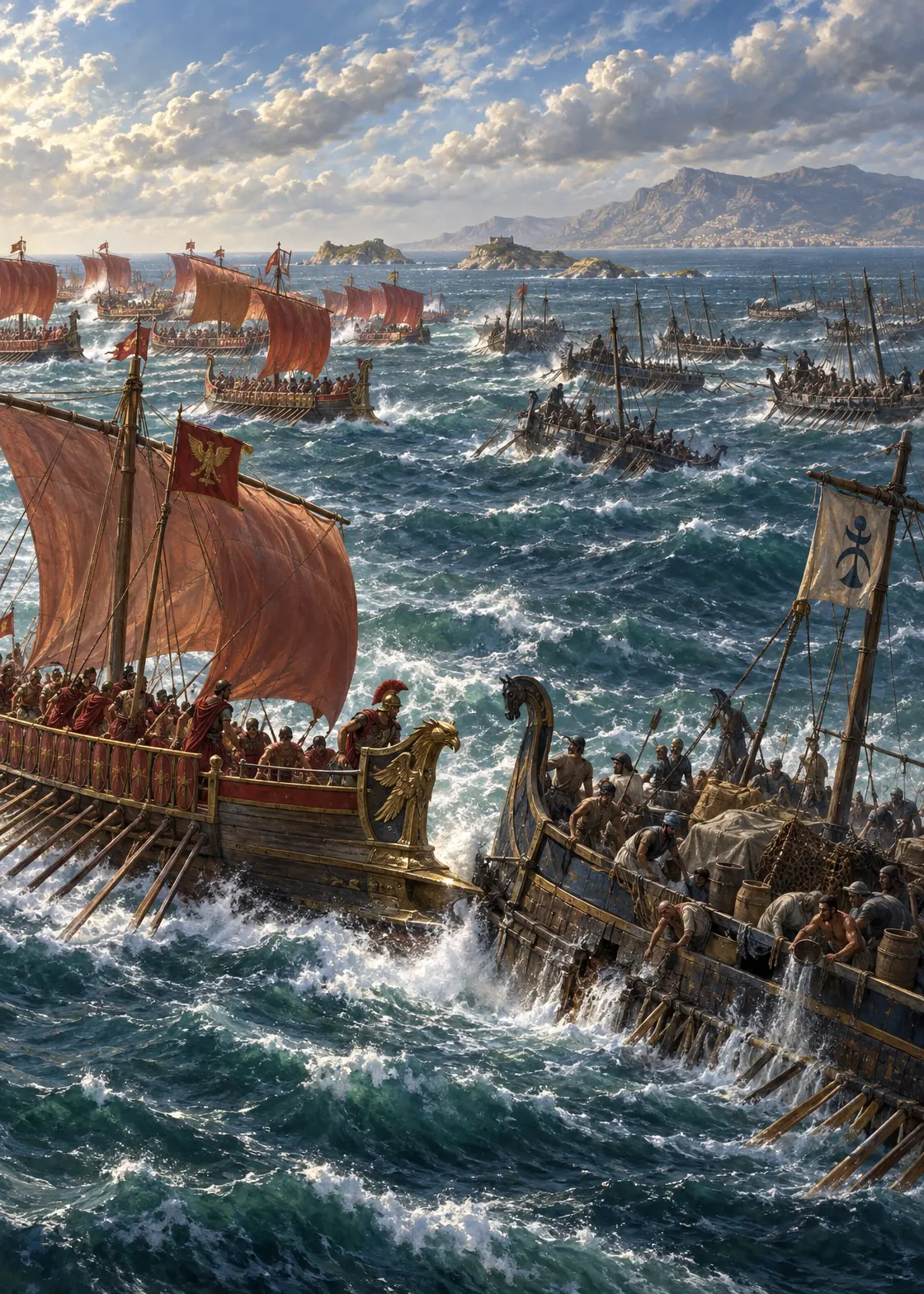
The two fleets met on 10 March 241 BC off the Aegates Islands (modern Egadi), the small archipelago about ten miles west of the Sicilian coast and the principal Carthaginian naval approach route. The Romans had positioned themselves to intercept the Carthaginian relief fleet before it could deliver its supplies and reinforcements; they had a powerful westerly wind behind them and the advantage of fresh crews and lightly-laden ships. The Carthaginians, with the wind against them and their ships laden, were in a tactical position they had not chosen and could not improve. Catulus engaged at long range with light skirmishing and then closed for the decisive ramming engagement. The Carthaginian fleet, unable to maneuver in the wind and unable to deploy its crews to the close-quarters fighting that might have favored them, was systematically broken. Fifty Carthaginian ships were sunk; seventy were captured; the surviving vessels fled westward back toward Africa. Roman losses were about thirty ships sunk. The engagement was decided within a few hours.
The Peace of Lutatius241 BC
The Carthaginian government, on receiving news of the Aegates defeat, recognized that the war could not be continued. The relief fleet had been the last major naval effort the city could undertake; without it, the Sicilian positions could not be supplied; without the Sicilian positions, the war was lost. The Senate of Carthage authorized Hamilcar Barca, the Sicilian field commander, to negotiate peace terms with Catulus. Hamilcar's first proposal — that the Carthaginian army withdraw from Sicily with honors of war, that no indemnity be paid, and that the war be ended on terms of essential parity — was rejected by Catulus, whose strategic position now permitted him to demand much more. The terms eventually agreed in March or April 241 BC, the Peace of Lutatius, were ratified by the Roman popular assembly later that year after some modification. They included:
— Carthaginian withdrawal from all of Sicily and from the islands between Sicily and Italy (the Aeolian and Aegates groups);
— Carthaginian payment of an indemnity of 3,200 talents over ten years (approximately 83 metric tons of silver, a substantial fraction of the entire Carthaginian state's annual revenue);
— Carthaginian agreement not to attack Syracuse or the other Roman allies in Sicily;
— Roman prisoners to be returned without ransom; Carthaginian prisoners to be ransomed at standard rates;
— Mutual non-engagement of allied populations in war.
The terms left Carthage with her territorial possessions in Africa, in Sardinia and Corsica, and in coastal Iberia (the Carthaginian presence in Spain was still relatively limited but would shortly be greatly expanded under Barcid leadership). They removed her from Sicily, ended her position as the western Mediterranean's first-rank naval power, and saddled her with an indemnity that would significantly constrain her economic capacity for at least a decade. Roman territorial gains in Sicily would be organized, over the following years, into the first Roman province — Sicilia — under regular provincial administration rather than the alliance system that had previously governed Italian incorporation. The institutional innovation involved was substantial: Sicily was not an ally but a tributary territory administered by a Roman magistrate (the praetor Siciliensis), with the populations paying taxes to the Roman state rather than providing military contingents. This provincia arrangement would, in the century to come, be extended to the rest of the Mediterranean territories Rome would acquire. The First Punic War thus produced not only the geographical expansion of Roman power but the constitutional innovation that would allow further expansion to be administratively absorbed.
The First Punic War had lasted twenty-three years, longer than any previous Mediterranean war on this scale. It had cost both sides enormous losses in men, ships, and treasure. It had taught the Romans how to build and use a navy. It had introduced the institutional structures — the provincial administration, the regular financial indemnity — that would shape the Mediterranean of the next two centuries. And it had produced, in Hamilcar Barca's frustrated tactical brilliance and in his Sicilian command's bitter conclusion, the personal and family animus that would, in the next generation, produce his son Hannibal's invasion of Italy.
The Crossroads · Autumn 256 BC · Rome
The Division at Aspis
You are a Roman senator called to deliberate on the dispatches from Africa sent by the consuls Lucius Manlius Vulso and Marcus Atilius Regulus.
The consuls Lucius Manlius Vulso and Marcus Atilius Regulus have put ashore at Aspis with two consular armies and allied contingents, numbering thirty-five to forty thousand fighting men and three hundred warships. It is the most ambitious expedition Rome has ever launched, but also the most isolated. No Roman force has ever stood on African soil; no local allies exist to provide supplies, and the nearest friendly base lies across a hundred miles of open sea. The consuls ask whether to attempt a decisive campaign before the season closes or to fortify a coastal position for winter and await reinforcement. Meanwhile, sustaining three hundred warships and forty thousand men through the winter overtaxes the naval-administrative capacity of the Republic, creating intense political pressure to economize.
What instructions should the Senate send to the consuls in Africa for the coming winter?
Weigh each course: open it to hear your own inner voice. Then decide. Nothing is scored.
- Your inner voiceThe course taken
Africa is a trap. We have no allies among the Numidian tribes, our supply line stretches across a hundred miles of treacherous water, and winter storms will soon sever all contact with Italy. Sparing the treasury the cost of the fleet is not enough; leaving any force isolated on Punic soil invites destruction. Let both consuls embark all thirty-five thousand men and sail home. We have proven we can land in Africa; now we should preserve our legions.
- Your inner voiceThe course taken
Our treasury cannot maintain three hundred warships across the winter sea without ruinous expense. Bringing Vulso and the fleet home lifts that crushing administrative burden. Regulus will hold forty ships, fifteen thousand foot, and five hundred horse—enough to strike inland while Carthaginian forces are demoralized by their loss at Ecnomus and internal factional strife. Yet we expose him to grave danger if Carthage recovers her strength before we can send aid from Italy next summer.
- Your inner voiceThe course taken
To divide our strength before an enemy in his own homeland invites ruin. Carthage can field thirty thousand men; if we reduce our numbers, we surrender our numerical weight. Thirty-five to forty thousand men under both consuls can overawe the Punic field army and march directly on Carthage once spring opens. Yes, provisioning three hundred ships and forty thousand troops across a hundred miles of sea strains our finances to the utmost, but half-measures will cost far more.
- Your inner voiceThe course taken
Our men stand on an unfamiliar shore without local allies. To push inland now risks ambush or starvation before we understand the ground. Let Vulso and Regulus dig in behind strong ramparts at Aspis, keeping their forty thousand men together beside the sea. The fleet can ride at anchor or shelter along the beaches while securing our lifeline to Italy. We risk high maintenance costs through the stormy season, but we preserve the entire army intact.
What was done
The Senate resolved to economize, recalling Lucius Manlius Vulso with the bulk of the fleet and leaving Marcus Atilius Regulus in Africa with fifteen thousand foot, five hundred cavalry, and forty ships. Regulus advanced boldly, defeating the Carthaginian field army at Adys after it deployed on a hill that neutralized its cavalry and elephants. He seized Tunis, only ten miles from Carthage, and negotiated with Numidian tribal kings. But Carthage responded by hiring the Spartan mercenary Xanthippus, who drilled her infantry into a combined-arms phalanx and trained a hundred elephants. In the spring of 255 BC on the plain of the Bagradas, Xanthippus annihilated Regulus's army: twelve thousand Romans fell, two thousand were captured—including Regulus—and only five hundred reached Aspis (Polybius 1.29–34, BGrade B). When a relief fleet of three hundred ships evacuated the survivors, a summer storm off Cape Pachynus sank 284 vessels, drowning over one hundred thousand men.
The evidence Polybius 1.29–63 provides the principal narrative for Regulus's African campaign and the disaster at the Bagradas (BGrade B, Tier 2, drawing on Fabius Pictor and Philinus). Additional accounts and summaries appear in Cassius Dio fragments via Zonaras 8.12–17 (BGrade B), Livy Periochae 17–19 (BGrade B summary), Diodorus 23–24 (CGrade C, fragmentary), Cicero De Officiis 3.99 (BGrade B, regarding Regulus), Frontinus Strategemata (CGrade C), Florus Epitome 1.18 (CGrade C), Eutropius 2.21–28 (CGrade C), Orosius 4.7–11 (CGrade C), and the Fasti Triumphales (AGrade A).
If you choose to walk through itAt every scale
- Yourself
When public pressure demands fiscal restraint, does a leader's duty lie in upholding prudent stewardship of the treasury or in warning against the hidden military perils of an underfunded expedition?
- Those beside you
How should a senator balance the expectations of senatorial peers eager to cut war costs against the lives of the fifteen thousand soldiers left behind on a distant shore?
- Rome
Can the constitutional and logistical machinery of a republic, designed for seasonal campaigns close to home, successfully sustain an ambitious overseas theater without compromising either solvency or military safety?
- The wider world
How do foreign powers and wavering allies—such as the Numidian kingdoms or the Carthaginian factions—alter their allegiance when an invading empire signals a reluctance to commit its full might?
- Our own time
When modern governments undertake foreign interventions under strict budgetary constraints, how should strategic planners weigh financial limits against the operational requirements of success?
In modern expeditionary warfare, governments frequently deploy military forces with strictly limited troop ceilings and constrained budgets to satisfy domestic political demands for economy. Planners assume initial victories will suffice to demoralize opponents, leaving small stabilization contingents to secure political objectives. When adversaries adapt through unexpected doctrine or foreign assistance, lightly manned expeditionary forces find themselves overextended, isolated from immediate reinforcement, and vulnerable to catastrophic defeat.
Where the comparison fails. The comparison fails in scale, communication, and logistical isolation. Modern expeditionary forces maintain continuous satellite communication, aerial resupply, and rapid-reaction extraction capabilities unknown to antiquity, where an ancient naval force faced absolute severance across open water once winter weather and seasonal storms closed Mediterranean sea lanes.
What does the chapter tell us?
Why did the Roman Senate recall Lucius Manlius Vulso and the bulk of the fleet in the autumn of 256 BC?
The chapter explains that the Senate's decision was probably financial, as maintaining a fleet of three hundred warships through the winter exceeded Roman administrative capacity and political pressure to economize was significant.
the chapter's narrative
What key tactical factor allowed Marcus Atilius Regulus to defeat the Carthaginian field army at the Battle of Adys in late 256 BC?
The Carthaginians took up a position on a hill, an error that nullified their cavalry and elephant superiority on ground unsuited to either. Regulus exploited this mistake by attacking the position frontally and in flank with his heavy infantry.
the chapter's narrative
According to the chapter's discussion of historical evidence, what is the status of the tradition regarding Regulus's oath, embassy to Rome, and torture in Carthage?
Polybius, writing a century after the events and using both Roman and Punic traditions, makes no mention of Regulus's embassy or torture. The story first appears in later Roman writers like Cicero and Horace as moral embellishment.
Polybius 1.29–63 (BGrade B) and Cicero De Officiis 3.99 (BGrade B)
What structural vulnerability in Roman warships contributed directly to the catastrophic loss of 284 ships off Cape Pachynus in 255 BC?
While the corvus boarding bridge provided combat superiority in boarding actions, it proved a severe navigational hazard during heavy weather, destabilizing the bow in cross-seas and leading to the loss of 284 ships.
the chapter's narrative
How did the Roman state finance the construction of the replacement fleet of two hundred quinqueremes in 243–242 BC that won the Battle of the Aegates Islands?
With the public treasury exhausted after more than twenty years of warfare, the Senate authorized private citizens to fund warship construction, with reimbursement guaranteed from the indemnities to be extracted from Carthage after victory.
Polybius 1.29–63 (BGrade B)