Book II · The Mediterranean Wars
Infographic · II-G01
THE CORVUS — Architecture, Tactical Inversion, and Abandonment (260–241 BC)
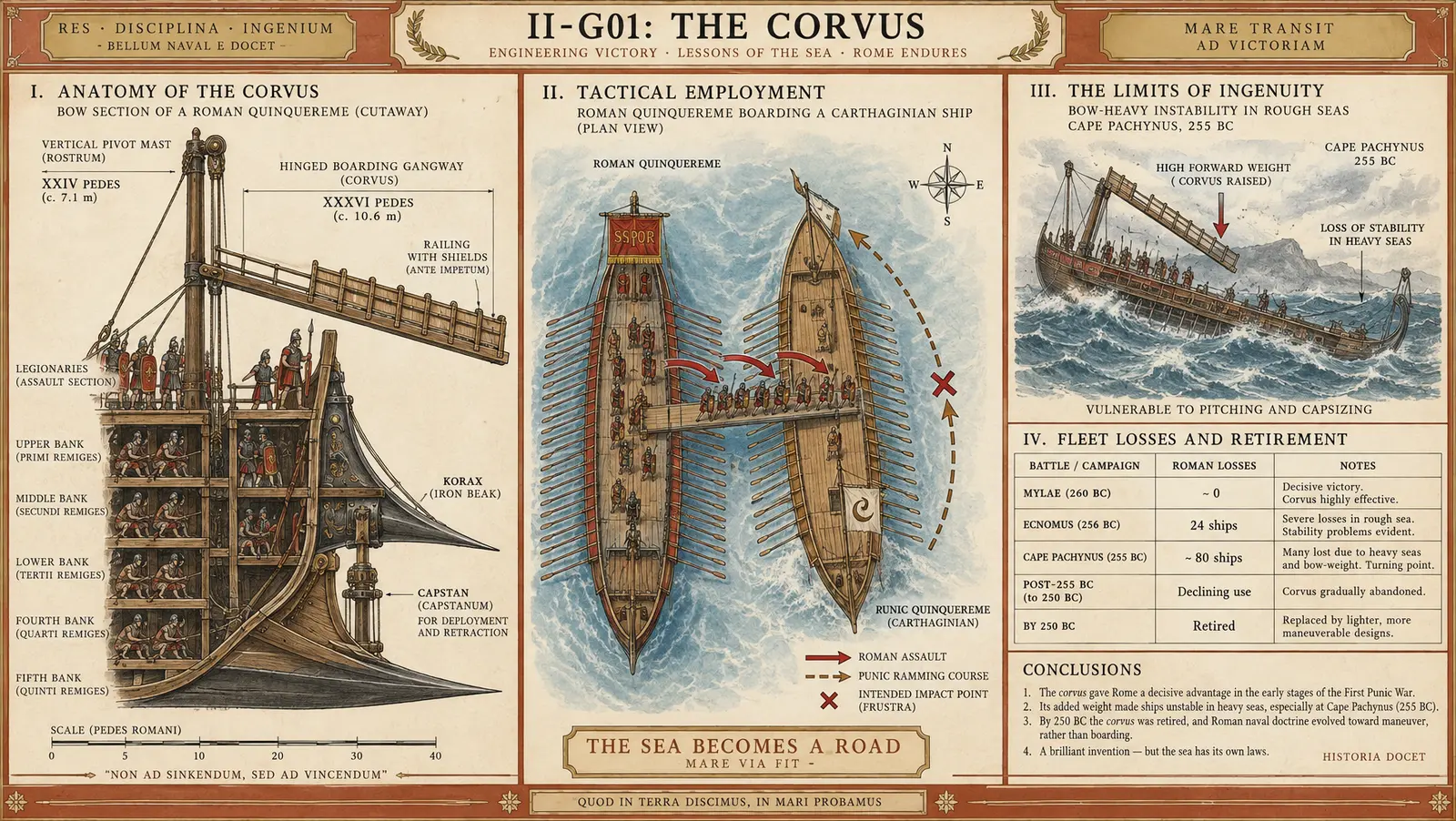
The bridge that made the sea a road — and its quiet retirement as a design confession.
INFOGRAPHIC DESIGN BRIEF: II-G01 — THE CORVUS
1. Purpose & Strategic Thesis
This technical and operational infographic illustrates the Republican Roman navy's defining technological innovation of the First Punic War: the corvus (the "crow"). It documents how an agrarian continental power without maritime doctrine neutralized Carthage's two-century superiority in naval maneuver by converting open-water ramming actions into infantry engagements on floating platforms. Crucially, the graphic charts both the technical anatomy that won Mylae (260 BC) and Ecnomus (256 BC) and the catastrophic hydrodynamic compromise (the top-heavy bow weight) that doomed the fleets off Cape Pachynus (255 BC) and Palinurus (253 BC), forcing the device's quiet retirement by c. 250 BC in favor of Hellenistic seamanship and ramming.
2. Palette & Technical Architecture
- Field / Background: Aged parchment / archival cream (
#F4EBD5) - Roman Identifiers / Boarding Arrows: Roman Crimson (
#8B1A1A) - Carthaginian Identifiers / Punic Hull Vectors: Punic Ochre (
#B5824A) - Vessel Machinery / Hull Section Ironwork / Punic Ranks: Iron-Grey (
#4A4A4A) - Cartouches / Frame Rules / Framing Accents: Terracotta (
#A85638) - Titles / Headers / Inscription Highlights: Antique Gold (
#B89954) - Typography: Classical serif Roman titling (Trajan/Cinzel), clean technical drafting numerals, and crisp explanatory footnotes.
3. Layout Structure (Horizontal Tripartite Composition, 16:9 Aspect Ratio)
TOP BANNER / CARTOUCHE
- Series Header:
IMPERIUM ROMANUM · BOOK II: THE MEDITERRANEAN WARS - Plate Code & Title:
INFOGRAPHIC II-G01 · THE CORVUS (260–241 BC) - Subtitle:
The boarding bridge that made the sea a road — and its quiet retirement as a design confession.
PANEL I (Left, 40% Width): The Engineering Cutaway — Machina Bellica
- Visual: Longitudinal cutaway profile and sectional elevation of the forward third of a Roman Quinquereme (nervis rostrata), c. 260 BC.
- Main pivot mast (stylos): 24 Roman feet (c. 7.2 m) vertical timber mounted behind the stem-post.
- Swiveling gangway (pons): 36 Roman feet (c. 10.8 m) long by 4 feet (c. 1.2 m) wide with waist-high lattice side-rails.
- The Spike (korax / rostrum): Heavy curved iron beak at the under-lip of the outer end, poised to drop and penetrate timber decks.
- Rigging: Pulley block at mast-head with hoisting-rope coiled around a deck-capstan.
- Deck & Oar Banks: Cutaway showing tiered rowing arrangement (zugitai-thranitai-thalamitai, 300 rowers, flagged as conjectural reconstruction) and muster deck holding 30 Roman legionary marines (milites classiarii) in scuta and mail.
- Callout Annotations & Technical Metrics (BGrade B):
PIVOT MAST (STYLOS) · XXIV PEDES (c. 7.2 m)SWIVEL GANGWAY (PONS) · XXXVI PEDES (c. 10.8 m) × IV PEDESIRON BEAK (KORAX) · FORGED SPIKE FOR DECK PENETRATIONSTOWAGE POSITION · VERTICAL LASHING AGAINST THE STEMDROP ANGLE · CCXL° HORIZONTAL ROTATION ARCMARINES EMBARKED · c. XXX LEGIONARIES PER GANGWAY RUNROWING SKELETON · CCC REMIGES (CONJECTURAL TIERING) [GRADE B]
PANEL II (Center, 30% Width): The Tactical Inversion — Maneuver vs. Bridge
- Visual: Comparative bird's-eye schematic showing the tactical confrontation before and after the drop.
- Phase A: Traditional Punic Doctrine: A fast Punic quinquereme executing the diekplous (shearing oar banks) or periplus (ramming the unarmored beam).
- Label:
CARTHAGINIAN SEAMANSHIP · RAM & OUTFLANK (DIEKPLOUS)
- Label:
- Phase B: The Corvus Engagement (Mylae, 260 BC): The Roman quinquereme absorbs or turns toward the flank charge; the corvus rotates across the bow and crashes down through the Carthaginian foredeck.
- Movement Lines: Crimson tactical vectors show files of Roman heavy infantry pouring across the locked bridge into the Punic waist.
- Annotation:
THE SEA BECOMES A ROAD · BOARDING IN CLOSE ORDER - Inset Cartouche: Fragment citation of the Columna Rostrata Duilii [AGrade A]:
"M·CAELIO·C·F·CONSOL... CLASES·POENICAS·PRIMOS·EXPOCNAVEIT·NUMEI..."(CIL VI 1300 / ILS 65: First Roman naval consul to take Punic fleets by storm).
- Phase A: Traditional Punic Doctrine: A fast Punic quinquereme executing the diekplous (shearing oar banks) or periplus (ramming the unarmored beam).
PANEL III (Right, 30% Width): The Hydrodynamic Cost & Quiet Retirement (255–241 BC)
- Visual: The operational casualty balance and hydrodynamic physics diagram.
- The Bow-Weight Vector: Graphic cross-section of quinquereme pitching in heavy swells off Cape Pachynus (255 BC). Vectors show the center of gravity displaced forward by the 1.5-ton corvus assembly, suppressing reserve buoyancy and creating lethal bows-under swamping in cross-seas.
- The Ledger of Operational Consequence:
VICTORIES BY BOARDING (260–256 BC):- Mylae (260 BC): ~50 Punic ships sunk/captured [AGrade A/B]
- Ecnomus (256 BC): ~80 Punic ships sunk/captured [BGrade B]
DISASTERS BY DISPLACEMENT (255–253 BC):- Cape Pachynus (255 BC): 284 of 300 ships lost; >100,000 lost (the tradition's arithmetic) [BGrade B]
- Cape Palinurus (253 BC): c. 150 ships wrecked in coastal storm [BGrade B]
THE SILENT RETIREMENT (c. 250–241 BC):- Total absence of corvus in archaeological and textual records post-250 BC.
- Aegates Islands (241 BC): Fleets built light, fast, stripped of boarding towers. Decisive victory won by pure ramming.
- Direct Material Evidence: Egadi bronze warship rams (rostra) recovered in situ confirm pure Hellenistic ramming design [AGrade A].
4. Footnotes & Source Attribution Block
ATTESTATION DATA: Corvus mechanical specifications via Polybius 1.22 [BGrade B]. Duilius triumph and Forum rostral column via CIL VI 1300 [AGrade A]. Fleet storm loss figures represent the tradition's arithmetic via Polybius 1.37 [BGrade B]. Physical confirmation of post-corvus naval architecture established by Egadi bronze warship rams [AGrade A].
Image prompt (16:9)
An authoritative historical-technical infographic on cream parchment (#F4EBD5) with terracotta framing borders (#A85638) and gold cartouches (#B89954), titled 'II-G01: THE CORVUS'. Formatted in a clean horizontal 16:9 three-panel layout in the style of 19th-century naval architecture plates and staff-college historical diagrams. Left panel: high-detail technical cutaway cross-section of the bow of a Roman quinquereme warship, showing the vertical pivot mast ('XXIV PEDES'), the hinged wooden boarding gangway ('XXXVI PEDES') with railing, and the massive iron beak ('KORAX') suspended over an iron capstan, revealing internal rowing decks and armed legionary silhouettes. Center panel: overhead tactical schematic showing a Carthaginian quinquereme in Punic ochre (#B5824A) attempting a ramming pass, intersected by the Roman gangway dropped across its deck with crimson assault arrows (#8B1A1A) and label 'THE SEA BECOMES A ROAD'. Right panel: naval architectural diagram illustrating bow-heavy instability in rough sea waves off 'CAPE PACHYNUS 255 BC', accompanied by a ledger table detailing fleet losses and the weapon's retirement by 250 BC. Crisp classical serif typography, precise scale rules, Latin technical annotations, perfectly rendered diagrammatic linework, no modern graphical anomalies.
II-G01 · generated by the Imperium factory studio (gemini-3.8-flash) from Book II under the House Preamble.