Book II · The Mediterranean Wars
Infographic · II-G02
CANNAE IN FOUR FRAMES: The Geometry of Annihilation (2 August 216 BC)
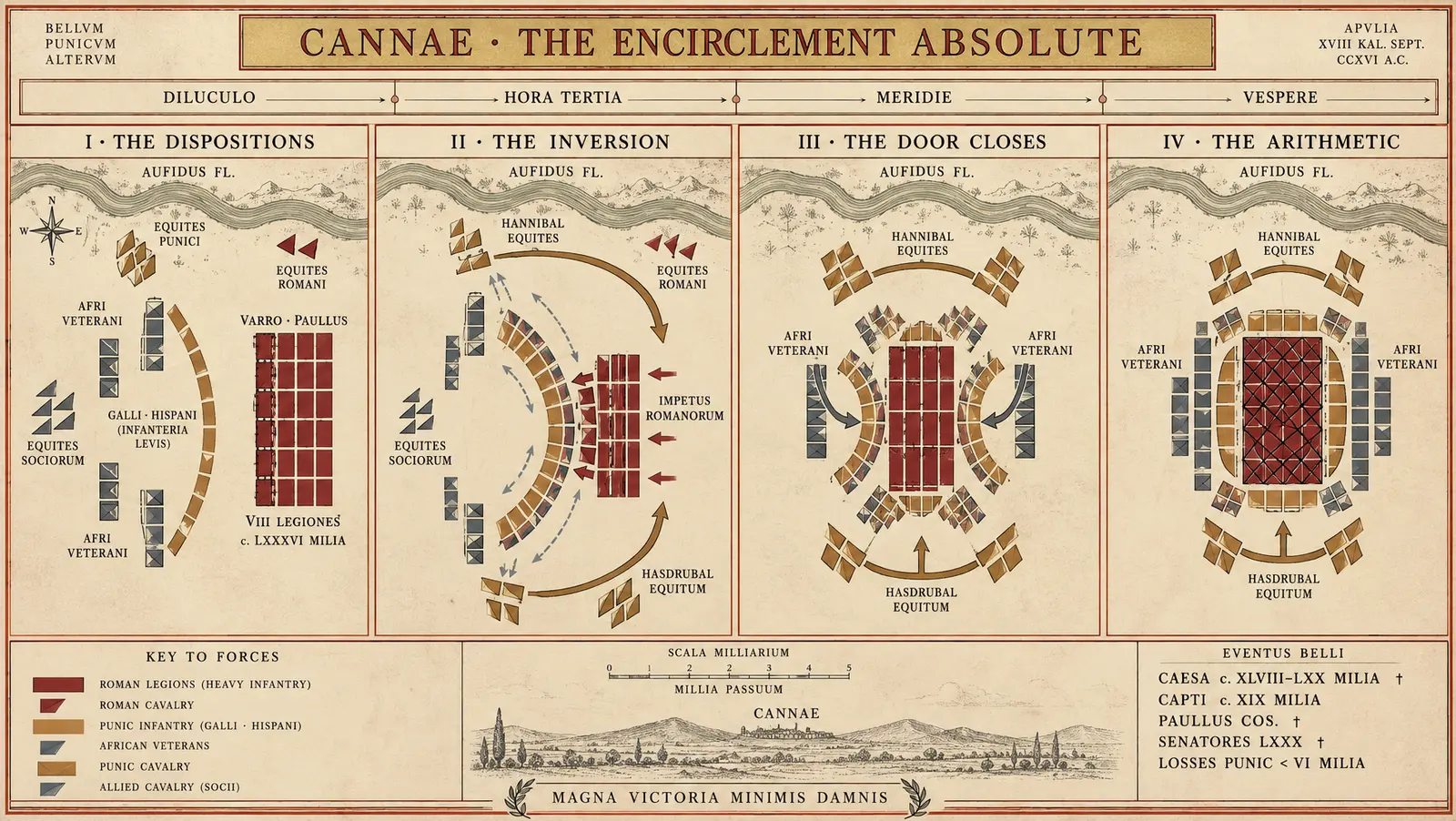
Cannae, 2 August 216 BC: the geometry of total encirclement that staff colleges still teach.
Strategic & Tactical Purpose
This infographic (Asset II-G02) illustrates the operational masterpiece of the ancient Mediterranean: the encirclement and destruction of the Roman consular army on the plain of the Aufidus at Cannae. Based upon the tactical analysis of Polybius (3.107–118, AGrade A) and Livy (22.45–52, BGrade B), the four-panel sequence tracks how Hannibal converted Roman kinetic mass into tactical self-entombment.
Layout & Architecture
- Format: Horizontal four-panel sequence across a 16:9 panoramic field, reading left to right from dawn to dusk.
- Timeline Header Bar: Running above the panels, divided into four phases:
DILUCULO(Dawn) ·HORA TERTIA(Mid-Morning) ·MERIDIE(Noon) ·VESPERE(Evening). - Border & Framing: Exterior double ruled border in Terracotta (
#A85638). Main titling set in Gold (#B89954) Roman capitals inside an upper header cartouche:CANNAE · THE ENCIRCLEMENT ABSOLUTE. - Ground Color: Pale parchment cream (
#F4EBD5) across all panels. - Terrain Landmark: The River Aufidus depicted along the upper edge of each panel as a winding sepia-wash band (
#8A7356).
Panel-by-Panel Specification
Panel I: "THE DISPOSITIONS" (Diluculo / Dawn)
- Spatial Logic: Initial order of battle.
- Roman Force (
#8B1A1ACrimson):- Roman center: Abnormally deep, dense rectangle representing 8 legions plus allied contingents (
VARRO · PAULLUS · VIII LEGIONES ET SOCII · c. LXXXVI MILIA[AGrade A]). Individual maniples rendered as tightly compressed squares to denote maximum forward kinetic weight. - Right wing: Roman citizen cavalry (
EQUITES ROMANI · c. II MILIA) pinned between the infantry and the Aufidus. - Left wing: Allied Italian cavalry (
EQUITES SOCIORUM · c. IIII MILIA) on the open plain.
- Roman center: Abnormally deep, dense rectangle representing 8 legions plus allied contingents (
- Carthaginian Force (
#B5824AOchre A6572Iron-Grey):- Center: Advanced convex crescent (bowed towards the Romans) composed of Gallic and Iberian infantry (
GALLI ET IBERI · c. XXX MILIA), thin at the center, thicker at the flanks. - Flanks: Elite African heavy infantry (
AFRI VETERANI · c. X MILIA), equipped in captured Roman gear, deployed in deep column formation stepped back en échelon behind the crescent's shoulders. - Left wing: Hasdrubal’s heavy Celtic/Iberian cavalry (
HASDRUBAL · c. VI MILIA) massed on the Aufidus bank. - Right wing: Maharbal’s Numidian light cavalry (
MAHARBAL · c. IIII MILIA) facing the allied horse.
- Center: Advanced convex crescent (bowed towards the Romans) composed of Gallic and Iberian infantry (
- Panel Annotation:
THE CONVEX CRESCENT · THE DOOR OFFERED
Panel II: "THE INVERSION" (Hora Tertia / Mid-Morning)
- Spatial Logic: The trap springs through calculated elasticity.
- Actions:
- Roman infantry drives forward by main force; Hannibal’s Gallic-Iberian center yields under controlled withdrawal, absorbing the shock without routing.
- The crescent inverts from convex to flat, then bows inward into a deep concave crescent (
THE LINE THAT BENDS IS THE DOOR THAT OPENS INWARD). - Roman maniples converge instinctively toward the retreating center, wedging themselves into the funnel and compressing their own ranks.
- Hasdrubal’s heavy cavalry on the Aufidus smashes through the Roman citizen horse, drives them from the riverbank, and executes a wide sweep across the rear of the entire Roman infantry mass.
- Panel Annotation:
INVERSION TO CONCAVE · HASDRUBAL CIRCLES
Panel III: "THE DOOR CLOSES" (Meridie / Midday)
- Spatial Logic: Bilateral envelopment and rear interdiction.
- Actions:
- The two columns of African veterans (
AFRI VETERANI), completely unengaged and fresh, wheel 90 degrees inward like closing gates onto both exposed Roman flanks. - Hasdrubal’s cavalry strikes the rear of the allied cavalry on the left wing, routes them, and turns inward to slam into the rear of the packed Roman infantry mass.
- The Roman army is fully enclosed in a shrinking quadrilateral pocket. Maniple spacing collapses; interior legionaries cannot raise shields or draw weapons.
- The two columns of African veterans (
- Panel Annotation:
AFRI WHEEL 90° · HASDRUBAL SEALS THE REAR
Panel IV: "THE ARITHMETIC" (Vespere / Evening)
- Spatial Logic: Annihilation and statistical autopsy.
- Visual: The Roman mass reduced to a cross-hatched crimson pocket under mechanical compression. Outward escape arrows: none. Dispersed flight of surviving cavalry (Varro) toward Venusia.
- Subscript Ledger (Strict adherence to attestation grades and ancient arithmetic):
CAESA: c. XLVIII–LXX MILIA ✝(Polybius: 70,000 [AGrade A narrative]; Livy: 48,200 [45,500 foot, 2,700 horse, BGrade B]; Modern consensus: 45,000–55,000 [BGrade B]).CAPTI: c. X–XIX MILIA[BGrade B]L. AEMILIUS PAULLUS COS. †[AGrade A]CN. SERVILIUS GEMINUS PROCOS. †[AGrade A]M. MINUCIUS RUFUS MAG. EQ. †[AGrade A]SENATORES ET MAGISTRATUS LXXX †[AGrade A]TRIBUNI MILITUM XXIX †[AGrade A]CARTHAGINIAN LOSSES: < VI MILIA(c. 4,000 Gauls, 1,500 Iberians/Africans, 200 cavalry) [AGrade A/B].
- Bottom Summary Cartouche:
THE ENCIRCLEMENT ABSOLUTE: THE MOST PERFECT TACTICAL ANNIHILATION IN THE WESTERN RECORD, EXECUTED BY THE SMALLER ARMY, IN OPEN FIELD, IN DAYLIGHT.
Image prompt (16:9)
A technical four-panel military tactical sequence diagram illustrating the Battle of Cannae, 216 BC, horizontal panoramic 16:9 layout in the rigorous visual tradition of 19th-century German General Staff battle atlases and Hans Delbrück. Entire diagram on an aged cream parchment ground (#F4EBD5) bordered by an outer double rule in terracotta red (#A85638). Across the very top, a prominent gold (#B89954) cartouche lettered in clean classical Latin serif capitals: 'CANNAE · THE ENCIRCLEMENT ABSOLUTE'. Below the title runs an etched timeline strip split into four segments: 'DILUCULO', 'HORA TERTIA', 'MERIDIE', 'VESPERE'. Below, four distinct sequential operational panels arranged side-by-side, each framed by fine terracotta rules. A continuous winding sepia-wash band (#8A7356) labeled 'AUFIDUS FL.' runs across the top bank of each panel. Panel 1 ('THE DISPOSITIONS'): on the right, Roman army shown as an exceptionally deep, compressed crimson (#8B1A1A) rectangular formation of block maniples labeled 'VARRO · PAULLUS · VIII LEGIONES · c. LXXXVI MILIA', with small cavalry wedges labeled 'EQUITES ROMANI' on the river and 'EQUITES SOCIORUM' on the open left; opposite, Hannibal’s array in Punic ochre (#B5824A) and iron-grey allies (#5A6572), featuring a pronounced convex arc of Gallic-Iberian infantry bowed forward toward the Romans, flanked by two stepped-back vertical columns labeled 'AFRI VETERANI', with heavy cavalry blocks on the wings. Panel 2 ('THE INVERSION'): the crimson mass drives forward into the center; the ochre-grey center yields in a controlled backward bend, reversing into a deep concave crescent; a bold curved cavalry arrow curves from the river, completely encircling the Roman rear toward the opposite wing labeled 'HASDRUBAL EQUITUM'. Panel 3 ('THE DOOR CLOSES'): the two untouched African veteran columns execute precise inward 90-degree wheel arrows into the Roman flanks, while the returned ochre cavalry seals the rear, trapping the compressed crimson block in a complete four-sided vise. Panel 4 ('THE ARITHMETIC'): the surrounded crimson pocket is heavily cross-hatched with black kill-hatching and zero escape routes, beneath which is an engraved Roman casualty ledger with text: 'CAESA c. XLVIII–LXX MILIA ✝', 'CAPTI c. XIX MILIA', 'PAULLUS COS. †', 'SENATORES LXXX †', 'LOSSES PUNIC < VI MILIA'. Sharp vector-like clarity, clean serif typography, crisp tactical symbols, staff-college cartography, entirely devoid of pictorial human figures.
II-G02 · generated by the Imperium factory studio (gemini-3.8-flash) from Book II under the House Preamble.